
GRAND STRATEGY ANALYSIS | SEPTEMBER 22, 2026
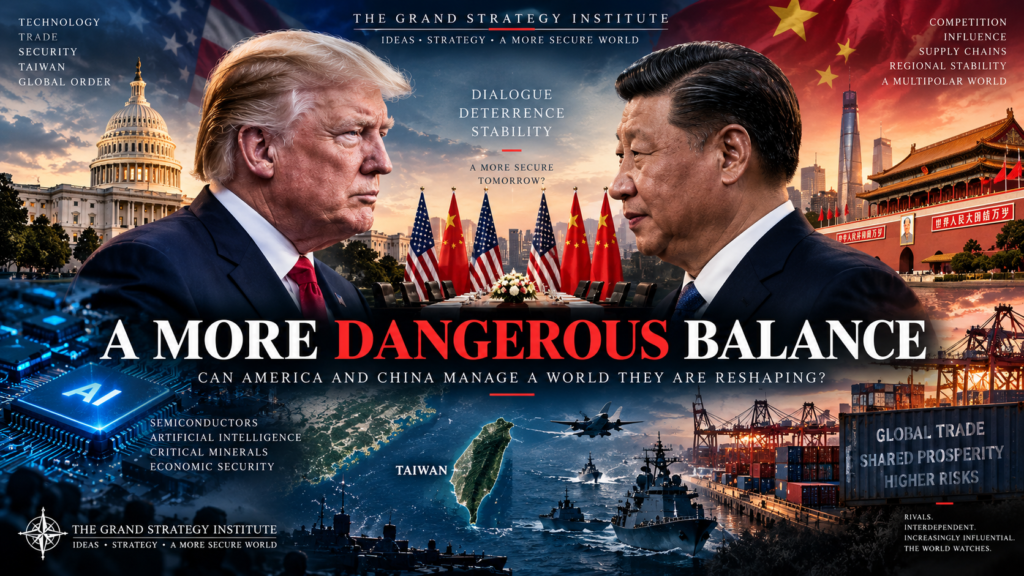
As Donald Trump and Xi Jinping prepare for talks in Washington, the United States and China are confronting a strategic dilemma. Their economies remain deeply interconnected, yet competition over artificial intelligence, critical minerals, military power and Taiwan is increasingly shaping their relationship. The central question is no longer simply which country will lead the international system, but whether the two powers can manage their differences without destabilising the institutions, markets and security arrangements on which much of the world depends.
By The Grand Strategy Institute | Research Division
Introduction: A relationship that cannot be reduced to rivalry
The anticipated meeting between US President Donald Trump and Chinese President Xi Jinping in Washington comes at a time when economic interdependence and strategic competition are developing simultaneously.
Both governments have reasons to maintain diplomatic communication. American companies remain connected to Chinese manufacturing networks, while Chinese businesses continue to depend on international markets and technologies developed in the United States and its partner countries.
At the same time, Washington and Beijing are pursuing policies intended to reduce their exposure to each other’s strategic capabilities.
American restrictions on advanced semiconductor technology, Chinese controls over critical mineral exports, disagreements concerning Taiwan and competing approaches to international economic governance illustrate the increasingly complex nature of their relationship.
The preparations for the Washington meeting therefore raise a fundamental question: can two economically interconnected powers establish a stable framework for competition when each regards certain capabilities controlled by the other as potential national security vulnerabilities?
The answer depends on more than the relationship between Trump and Xi.
It involves the institutions responsible for implementing agreements, the economic interests of both countries, the security concerns of their regional partners and the willingness of both governments to maintain communication during periods of confrontation.
The Washington talks provide an opportunity to examine these issues, but their outcome cannot be established before the negotiations take place.
1. From economic interdependence to strategic competition
For decades, economic relations between the United States and China were shaped by the expansion of international trade, investment and industrial production.
American companies developed extensive manufacturing and supply chain relationships with China, while Chinese economic growth benefited from access to international markets, foreign investment and technological cooperation.
This relationship created substantial economic opportunities for both countries.
It also generated dependencies that have become increasingly important in national security debates.
The United States remains concerned about its reliance on Chinese production and processing capacity in strategically important industries. China, meanwhile, has sought to reduce its dependence on American technologies, particularly advanced semiconductors and computing infrastructure.
The resulting policy responses have contributed to a gradual reorganisation of international economic relationships.
Washington has introduced restrictions affecting selected Chinese technology companies and advanced computing products. Beijing has responded to American trade and technology measures while investing in domestic industrial capabilities.
These developments do not amount to a complete separation of the two economies.
Instead, they demonstrate a more selective approach to economic interdependence, in which governments seek to preserve commercial relationships while limiting dependencies they consider strategically sensitive.
For third countries, the consequences extend beyond bilateral trade.
Manufacturers, technology companies and governments must increasingly consider how American and Chinese restrictions affect investment decisions, access to essential materials and the security of international supply chains.
2. Artificial intelligence and the competition for technological leadership
Artificial intelligence has become an important dimension of the relationship between Washington and Beijing.
Both governments regard advanced computing capabilities as relevant to economic productivity, scientific research, national security and military technology.
The competition involves several interconnected resources: semiconductor manufacturing, computing infrastructure, specialised technical expertise, electricity generation and access to the data and systems required to develop advanced AI applications.
American policy has focused partly on restricting China’s access to certain advanced semiconductors and related technologies.
China has responded by investing in domestic computing capabilities, semiconductor development and artificial intelligence research.
These policies reflect different national security and industrial priorities, but they also demonstrate the difficulty of separating civilian technological development from potential military applications.
Advanced AI systems can support commercial services, medical research and industrial automation. Related technologies can also contribute to intelligence analysis, cybersecurity and military decision support.
Consequently, export controls intended to protect national security may also affect civilian companies, research institutions and international technological cooperation.
The dispute over AI distillation
The source material for this assessment describes a further disagreement concerning the use of AI distillation.
Distillation involves training one artificial intelligence model using outputs generated by another system, potentially allowing the resulting model to reproduce some of the original system’s capabilities.
American authorities have raised concerns about the use of this technique by Chinese developers in relation to American AI models.
Beijing has challenged the suggestion that distillation is inherently improper, pointing to its wider use within the technology industry.
The relevant distinction is between the technique itself and the circumstances in which it is employed.
Whether a particular use violates intellectual property rights, contractual restrictions or other legal obligations depends on the specific conduct and applicable rules.
The broader strategic issue is that competition over artificial intelligence increasingly extends beyond physical technology to the methods through which advanced capabilities are developed and transferred.
3. AI safety and the possibility of limited cooperation
Despite their technological competition, the United States and China have a shared interest in reducing the risk of serious incidents involving advanced artificial intelligence.
The source material reports that US Treasury Secretary Scott Bessent discussed a proposed notification mechanism for AI incidents with Chinese Vice Premier He Lifeng.
Under the proposal, the two governments would establish a communication channel for incidents with potential national security implications.
Such a mechanism could address a practical problem.
As AI systems become more widely integrated into critical infrastructure, cybersecurity and military applications, an unexpected technical incident could generate uncertainty about its origin, consequences or intentionality.
Communication between governments could help distinguish technical failures from deliberate hostile activity.
However, the proposal should not be confused with an agreement on the wider governance of artificial intelligence.
Washington and Beijing continue to have different positions concerning technology restrictions, industrial policy and international regulatory arrangements.
A notification mechanism would represent a narrower form of cooperation focused on managing particular risks.
As of the reporting contained in the source material, no final agreement on the proposed mechanism had been announced.
Its significance will depend on whether the governments establish clear procedures, define the incidents covered and implement the arrangement through their relevant institutions.
4. Critical minerals and the strategic importance of industrial supply chains
Competition between the United States and China is not limited to advanced digital technologies.
It also involves the physical materials required to manufacture modern industrial and military equipment.
China occupies an important position in the global processing and supply of several critical minerals used in electric vehicles, electronics, renewable energy technologies and defence systems.
This industrial capacity gives Beijing an important role in international manufacturing networks.
During the trade confrontation described in the source material, China introduced export restrictions affecting certain critical minerals.
For American manufacturers, such restrictions highlight the potential consequences of depending heavily on a limited number of suppliers for strategically important inputs.
Washington has consequently pursued measures intended to diversify supply chains and expand alternative sources of production and processing.
However, developing new industrial capacity involves substantial financial, technological and logistical requirements.
Mining operations must be established, processing facilities constructed, specialised workers trained and commercial relationships developed.
The existence of mineral deposits outside China does not automatically translate into an immediately available alternative supply chain.
The wider international consequences
Other countries face similar challenges.
European manufacturers, Japanese technology companies, Indian industrial producers and businesses across the Global South participate in supply chains affected by American and Chinese economic policies.
Restrictions imposed by either government can therefore have consequences for companies that are not directly involved in their bilateral disputes.
This illustrates an important characteristic of contemporary strategic competition.
Economic influence increasingly depends not only on the volume of goods a country produces, but also on its position within the networks through which essential materials, technologies and industrial components are supplied.
For governments seeking greater economic resilience, diversification must be balanced against the costs of duplicating production capacity and reducing the efficiency of existing commercial relationships.
5. Trade policy and the limits of economic confrontation
Trade remains a major source of disagreement between Washington and Beijing.
The source material describes a relationship in which both governments have continued to introduce targeted restrictions following an earlier period of substantial tariff escalation.
American measures have affected selected Chinese technology products and companies, while Beijing has maintained restrictions concerning particular goods and commercial relationships.
The United States has also pursued trade measures linked to allegations of forced labour in China’s Xinjiang region.
Chinese authorities reject those allegations and have criticised the corresponding American restrictions.
These disputes involve questions of national security, industrial competition, human rights and the application of international trade rules.
They also create practical difficulties for companies operating across both markets.
Businesses must assess changing import duties, export restrictions, compliance obligations and the possibility that products or technologies may become subject to additional controls.
For consumers, the economic consequences depend on the particular goods affected, the availability of alternative suppliers and the extent to which companies pass additional costs through to prices.
The strategic significance of trade restrictions therefore cannot be assessed solely by examining their immediate political objectives.
Their effects on domestic production, investment, consumer costs and international supply chains must also be considered.
A trade agreement may reduce particular sources of friction without resolving the wider disagreements concerning technological leadership and national security.
6. Taiwan and the security architecture of the Indo-Pacific
Taiwan remains one of the most sensitive issues in relations between the United States and China.
Beijing regards Taiwan as part of its territory and maintains that unification is a central national objective.
Taiwan operates under its own democratically elected government, maintains its own armed forces and exercises effective control over the territory it administers.
The United States does not maintain formal diplomatic relations with Taiwan but continues to provide defence equipment within the framework of American domestic law.
These positions create a longstanding disagreement over the relationship between Chinese sovereignty claims, Taiwan’s security and American military assistance.
The source material reports that a major American weapons package for Taiwan was paused following Trump’s visit to Beijing in May.
The precise implications of that decision depend on subsequent announcements and the implementation of American arms sales policy.
The importance of the 1982 agreements
The legal and diplomatic framework surrounding Taiwan cannot be understood through a single bilateral statement.
The August 17, 1982, communiqué between Washington and Beijing addressed American arms sales to Taiwan.
In the accompanying American policy framework, President Ronald Reagan made the willingness to reduce arms sales conditional on China’s continued commitment to resolving differences with Taiwan peacefully.
The United States also maintains its Six Assurances concerning Taiwan.
These include the position that Washington has not agreed to establish a date for ending arms sales or to consult Beijing in advance about such sales.
American domestic legislation, particularly the Taiwan Relations Act, forms another important part of this framework.
The interaction between these documents helps explain why Taiwan remains a recurring subject of disagreement between Washington and Beijing.
China opposes American arms sales to Taiwan, while the United States maintains a longstanding legal and policy framework governing its unofficial relationship with the island.
Taiwan’s government, meanwhile, has its own security priorities and an interest in maintaining its ability to defend the territory under its administration.
Military competition and the risks of miscalculation
The security environment surrounding Taiwan also involves the wider military balance in the Indo-Pacific.
China has expanded its military capabilities and increased its activities around Taiwan in recent years.
The United States maintains security relationships with regional partners, including Japan, South Korea, Australia and the Philippines.
These arrangements differ in their legal obligations, operational scope and relationship to a potential crisis involving Taiwan.
The central strategic concern is the possibility that military activity, political signalling or an unexpected incident could generate a confrontation that neither government initially intended.
Direct communication between Washington and Beijing can contribute to crisis management, but it does not eliminate the underlying disagreements.
Nor can an agreement between the two presidents alone resolve the security interests of Taiwan or the wider concerns of regional governments.
7. Iran and the global consequences of American and Chinese competition
The conflict involving Iran introduces another dimension into relations between Washington and Beijing.
The United States has pursued measures intended to restrict Tehran’s economic resources and influence its regional activities.
China maintains significant economic relationships with Iran, including energy trade.
These different approaches reflect broader disagreements over sanctions, energy security and the use of economic pressure in international diplomacy.
For Washington, restrictions on Iranian economic activity form part of its policy toward Tehran.
For Beijing, access to energy supplies and the preservation of international commercial relationships are important economic considerations.
The source material describes American concerns about China’s continuing trade with Iran and the possible implications of alternative international payment arrangements.
However, the existence of economic relationships between China and Iran does not, by itself, establish that Beijing controls Iranian decisions or that Chinese policy determines the course of the conflict.
Those are separate questions requiring specific evidence.
Energy security connects the Middle East to the Indo-Pacific
The international consequences of conflict in the Middle East extend beyond the countries directly involved.
Disruptions affecting maritime transport, energy production or financial transactions can influence global commodity prices and industrial supply chains.
China’s energy requirements connect its economic interests to the stability of international shipping routes.
The United States must also consider the relationship between its military commitments in different regions.
Resources allocated to one theatre may affect planning, deployment schedules and the availability of particular military capabilities elsewhere.
Nevertheless, such tradeoffs cannot be quantified without information about actual force deployments, operational requirements and available reserves.
The broader strategic issue is that developments in the Middle East can complicate the management of American and Chinese competition in other regions.
8. The Global South and the changing distribution of economic influence
The relationship between the United States and China has consequences for countries that do not wish to organise their foreign policies exclusively around either power.
India, Brazil, Indonesia, South Africa and other developing economies maintain different combinations of commercial, diplomatic and security relationships with Washington and Beijing.
Their national priorities are not identical.
Some seek access to advanced technology and investment. Others place particular emphasis on energy security, industrial development, infrastructure or the preservation of diplomatic flexibility.
American and Chinese competition can create additional opportunities for investment and commercial partnerships.
It can also expose countries to conflicting trade restrictions, technological standards and diplomatic expectations.
Multilateral institutions and competing priorities
China has sought to expand its participation in international economic arrangements involving developing countries.
The United States continues to maintain extensive relationships through established international institutions, bilateral agreements and regional partnerships.
The consequences of these initiatives depend on their practical implementation.
Trade agreements, development financing, infrastructure investment and technology cooperation can be assessed through measurable outcomes, including project completion, debt obligations, market access and the distribution of economic benefits.
Participation in an international grouping does not necessarily imply alignment with every foreign policy position adopted by its members.
The Global South is not a single political or strategic actor.
Its governments have different economic structures, security interests and diplomatic relationships.
Understanding their responses to American and Chinese competition therefore requires examining individual national policies rather than treating developing countries as a unified geopolitical bloc.
9. What the Washington summit can establish
The anticipated meeting between Trump and Xi offers an opportunity for both governments to clarify their positions on several interconnected issues.
Trade restrictions, technological competition, critical minerals, artificial intelligence and regional security are all subjects on which decisions taken by one government can directly affect the interests of the other.
Diplomatic engagement may help establish clearer expectations concerning future policy.
However, the significance of any agreement will depend on its content and implementation.
A public commitment to maintain stable relations is different from a detailed arrangement establishing specific obligations.
Similarly, an announcement concerning trade restrictions does not necessarily resolve disagreements about semiconductor technology, Taiwan or international security.
Several questions will therefore be important when assessing the results of the Washington meeting.
Will the two governments announce specific changes to existing trade or technology restrictions?
Will the proposed AI incident notification mechanism receive a formal institutional framework?
Will Washington clarify the status of pending military equipment transfers to Taiwan?
Will any understandings concerning critical minerals include verifiable implementation measures?
Will the governments establish additional communication procedures for managing regional security incidents?
These questions provide a basis for evaluating the substance of the meeting without assuming that diplomatic engagement will necessarily produce agreement.
10. Strategic assessment: Competition, interdependence and the future international order
The relationship between the United States and China illustrates a central feature of contemporary international politics.
Major powers can remain economically interconnected while regarding each other’s technological, military and industrial capabilities as potential strategic vulnerabilities.
The resulting competition is not confined to a single region or policy area.
It connects semiconductor production to national security, critical mineral supplies to industrial policy, Taiwan to regional military planning and Middle Eastern energy markets to global economic stability.
For the United States, these developments raise questions about the relationship between national security objectives, economic competitiveness and international partnerships.
For China, they involve the pursuit of technological development, economic resilience and its stated territorial and security priorities.
For other countries, the consequences include the need to manage economic dependencies and maintain their own diplomatic and security interests amid competition between the two powers.
The Washington meeting will not, by itself, determine the future structure of the international system.
It can, however, provide evidence of how the American and Chinese governments intend to manage their relationship.
The distinction between political declarations and implemented agreements will be particularly important.
A sustained reduction in tensions would require more than a temporary understanding between two leaders. It would involve institutions capable of maintaining communication, implementing commitments and addressing disputes as they arise.
Conversely, continued restrictions and military competition would not necessarily mean that all forms of diplomatic or economic cooperation had ended.
The relationship can contain elements of cooperation and confrontation simultaneously.
Conclusion: The challenge of managing great power competition
The United States and China are entering the Washington talks with substantial disagreements over technology, trade and regional security.
Their relationship nevertheless remains important to the functioning of international markets, industrial supply chains and diplomatic institutions.
Neither government can make decisions concerning advanced technology, critical minerals or major security issues without affecting other countries.
The implications extend to Europe, the Indo-Pacific, the Middle East and the developing world.
The central question is therefore not simply whether Washington and Beijing can reach an agreement during a single diplomatic visit.
It is whether they can establish arrangements that allow their governments to pursue different national interests while reducing the risk that economic disputes, technological competition or military incidents develop into broader confrontations.
The results of the Washington meeting will provide evidence about the policies both governments intend to pursue.
Their longer-term significance will depend on what is agreed, what is implemented and how both countries respond when their interests diverge again.
For the international community, understanding those developments requires distinguishing diplomatic commitments from practical outcomes and recognising that the future of American and Chinese relations will be shaped by decisions extending well beyond Washington and Beijing.
The Grand Strategy Institute
Continue Exploring Strategic Analysis
Return to The Grand Strategy Institute for strategic assessments, long-form analysis and research examining geopolitics, military affairs, international security, emerging technologies and the changing international order.
← Back to The Grand Strategy Institute