
Inside the tiny silicon processor that powers artificial intelligence, photography, gaming and billions of calculations every second.
By Open Chronicle Explained
Every time you unlock your smartphone, take a photograph, open an application or send a message, an extraordinary sequence of electronic operations takes place inside a component smaller than a postage stamp.
Billions of microscopic transistors switch between electrical states. Instructions are retrieved from memory, calculations are performed, images are processed and information moves between specialised computing units.
Most of this happens so quickly that the user never notices.
The technology responsible is commonly called a processor or microchip.
But a modern smartphone processor is much more than a miniature version of the central processing unit found in a traditional computer.
It is an entire computing system integrated into a tiny piece of silicon.
The latest developments in Qualcomm’s Snapdragon family illustrate how sophisticated these systems have become. Modern mobile platforms combine general computing, graphics processing, artificial intelligence, photography and wireless communications within a tightly integrated architecture.
But what actually happens inside a chip?
How can billions of transistors work together to perform complex calculations?
Why do modern smartphones need several different types of processors?
And what makes one chip faster or more efficient than another?
To answer these questions, we need to begin with the smallest building blocks of modern computing.
1. What Exactly Is a Microchip?
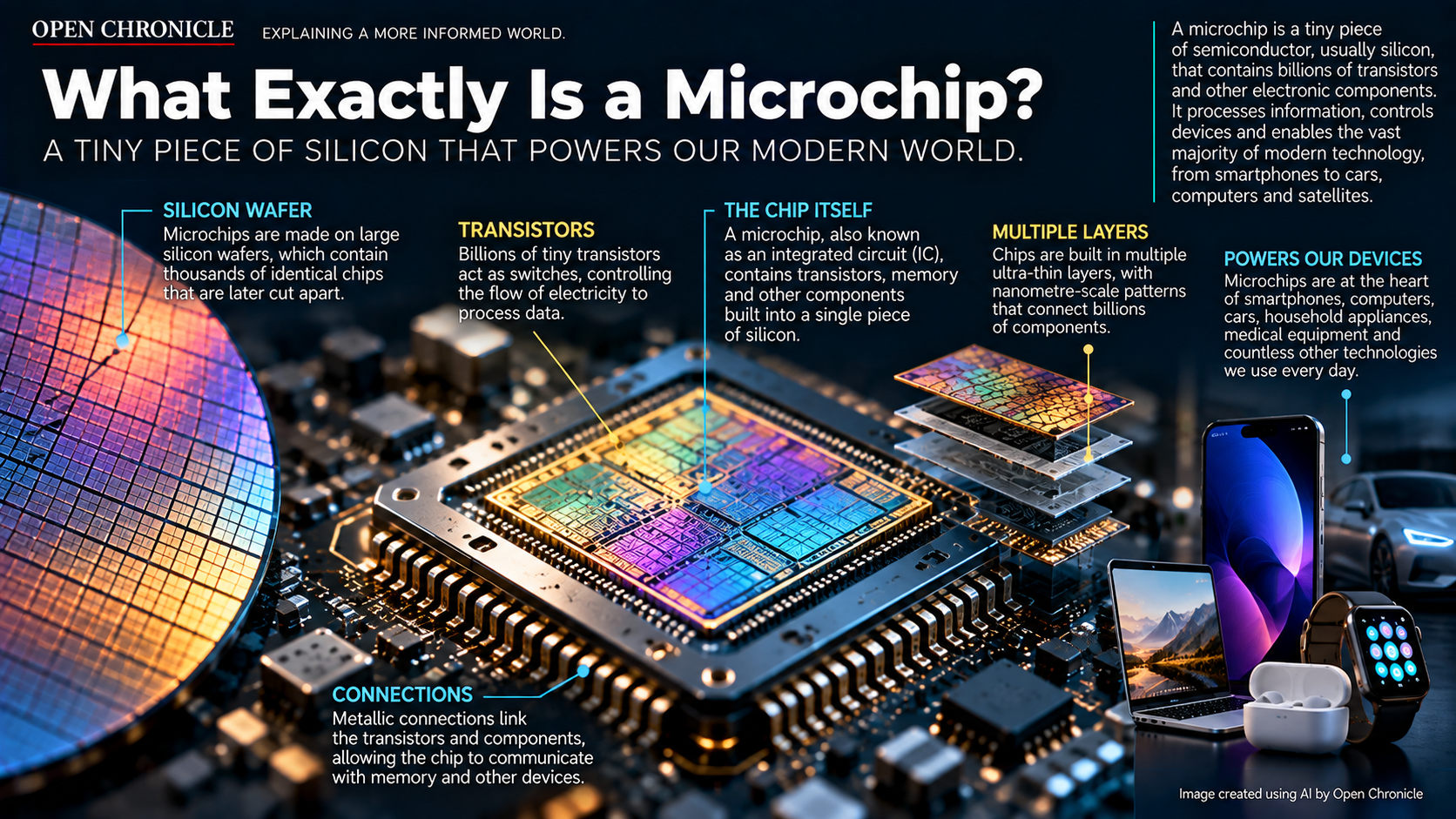
A microchip is a miniature electronic circuit manufactured on a piece of semiconductor material, usually silicon.
Silicon is particularly useful because its electrical properties can be carefully controlled during manufacturing.
By introducing specific impurities into the material and constructing extremely small electronic structures, engineers can create devices that control the movement of electrical current.
These devices are known as transistors.
Modern integrated circuits contain enormous numbers of transistors connected through microscopic pathways.
Together, they form circuits capable of performing calculations, storing information, processing signals and controlling other electronic components.
The remarkable achievement of semiconductor technology is not simply that individual transistors are small.
It is that billions of them can be manufactured and interconnected with extraordinary precision.
A modern chip is therefore not a single electronic component performing one operation.
It is a complex network of specialised circuits working together.
2. The Transistor: The Microscopic Switch Behind Computing
To understand how a chip works, imagine an ordinary light switch.
When the switch is open, electricity cannot flow through the circuit.
When it is closed, electricity can flow.
A transistor can perform a similar function electronically, although its behaviour is more sophisticated than that of a mechanical switch.
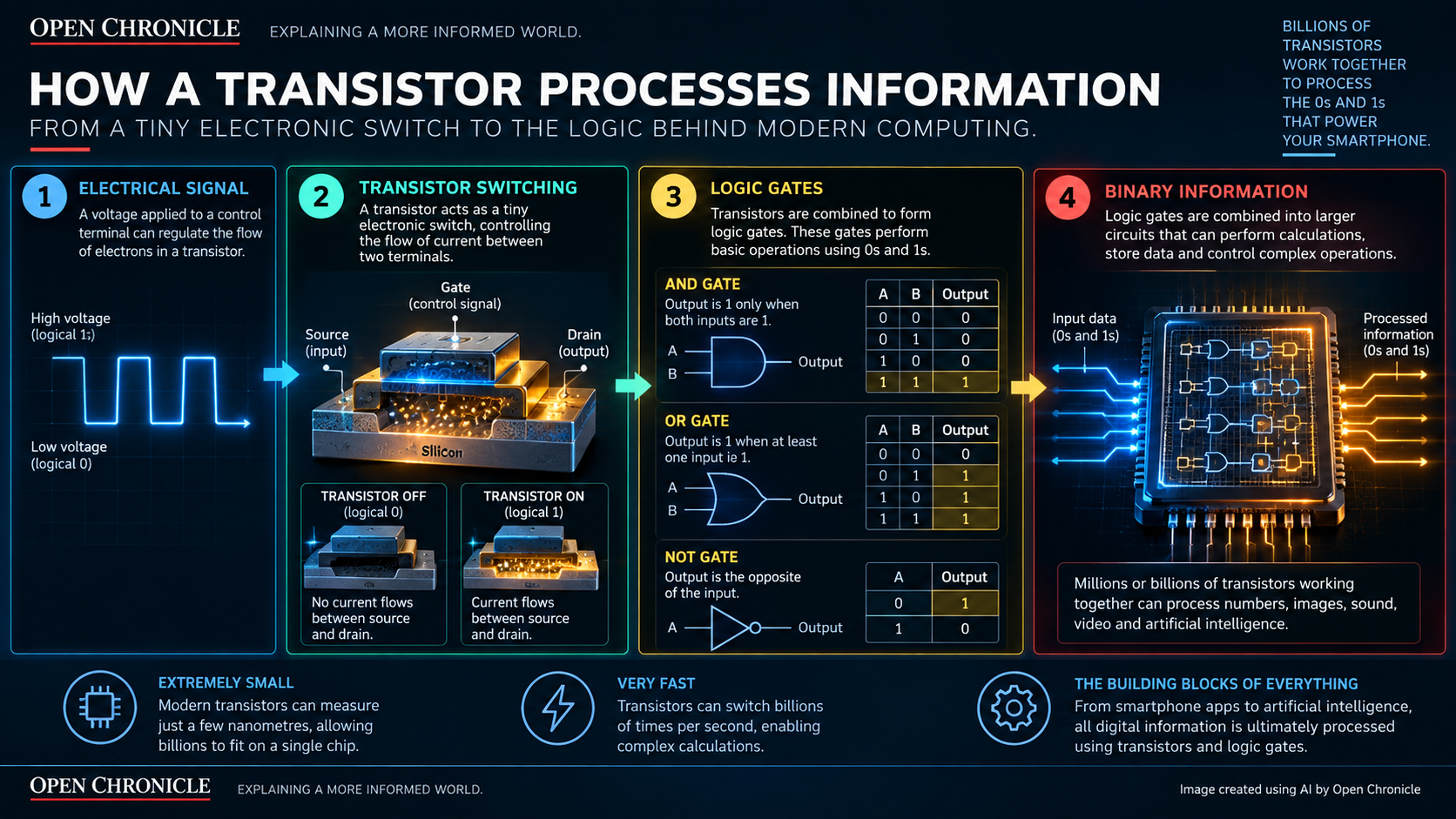
In a common type of modern transistor, an electrical signal applied to a control terminal called the gate influences whether current can flow between two other terminals.
This allows one electrical signal to control another.
In digital circuits, engineers design transistors to operate between voltage ranges representing two logical states.
These states are conventionally called:
0 and 1.
A zero does not necessarily mean that absolutely no electricity exists, nor does a one mean that electricity is simply present everywhere.
They represent defined electrical conditions that a digital circuit interprets as logical values.
By combining transistors into carefully designed arrangements, engineers create logic gates.
These gates perform basic logical operations such as AND, OR and NOT.
For example, an AND gate produces a logical one only when both of its inputs are one.
A NOT gate reverses the logical state of its input.
These operations may appear elementary, but they form the foundation of digital computing.
Complex arrangements of logic gates can perform arithmetic, compare numbers, select information and control the movement of data.
A smartphone does not understand a photograph, a message or a video in the way a human does.
At the electronic level, it manipulates patterns of binary information using circuits built from transistors.
3. How Can Zeros and Ones Become Photographs, Music and Applications?
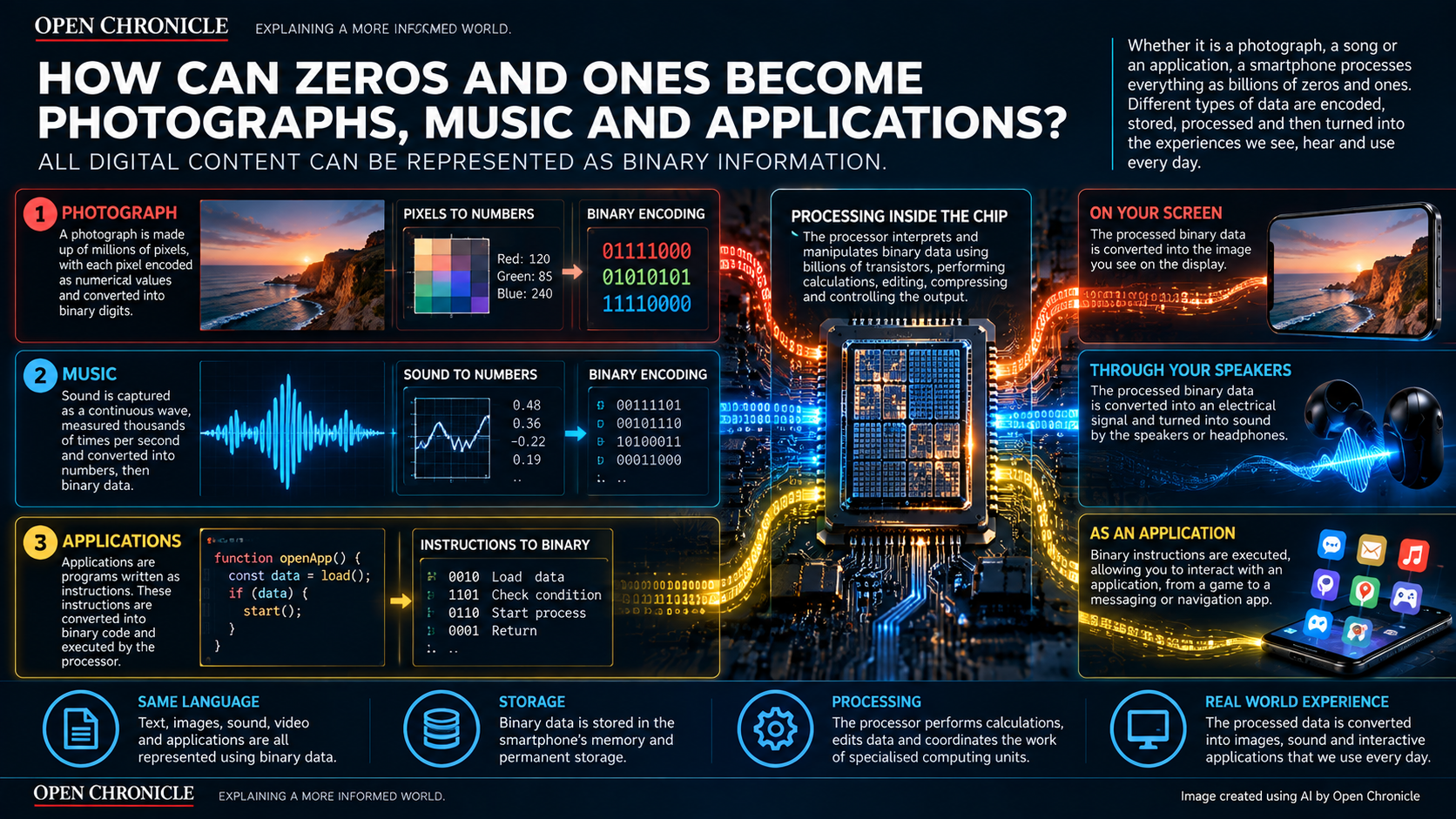
Consider a photograph stored on your smartphone.
To a person, it is an image containing colours, shapes, people and objects.
To a computer, the photograph is represented by digital information.
The colour and brightness of individual pixels can be encoded as numerical values.
Those numbers are stored as sequences of binary digits, commonly called bits.
Eight bits form a byte.
A byte can represent 256 different combinations of zeros and ones.
By combining many bytes, a computer can represent much larger numbers, images, audio recordings, video files and software instructions.
The same principle applies to music.
An audio recording can be represented as a sequence of numerical samples describing changes in a sound waveform.
When you play a song, the smartphone processes that digital information and sends it to audio hardware that converts it into an electrical signal suitable for driving speakers or headphones.
The chip is not literally hearing music or seeing photographs.
It is processing numerical representations of sound and images.
The meaning of that information comes from the software and the rules used to interpret it.
This is one of the most important ideas in computing.
The same underlying electronic technology can process text, images, sound, video and artificial intelligence because all of them can be represented and manipulated as digital information.
4. What Happens When You Open an Application?
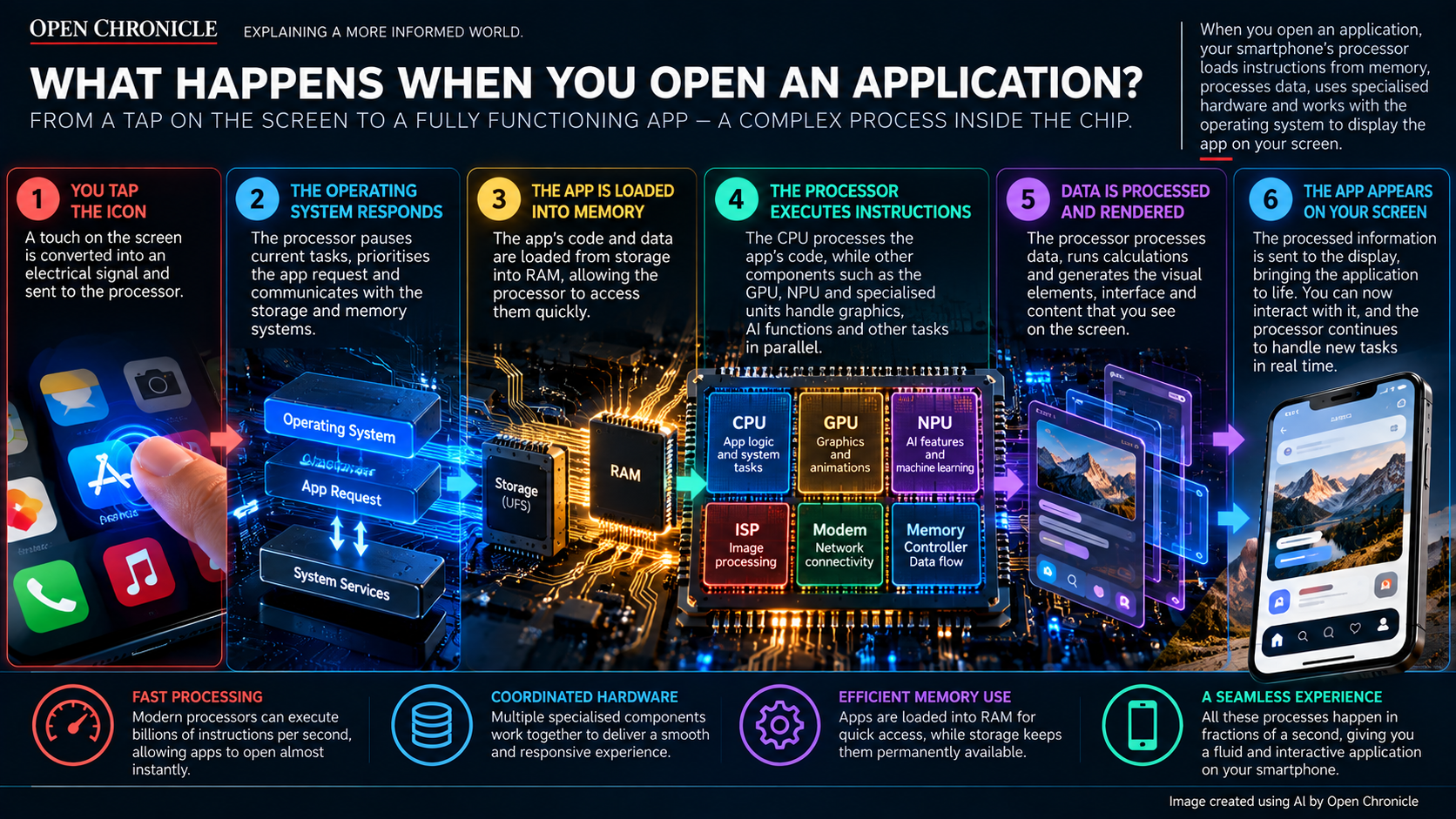
Imagine tapping the camera icon on your smartphone.
The touchscreen detects the interaction and communicates the event to the device’s operating system.
The operating system determines which application should respond.
The processor then executes the instructions required to open the camera application.
But how does a processor execute an instruction?
A simplified description of the process involves three fundamental stages.
First, the processor retrieves an instruction from memory.
Second, it interprets the instruction to determine what operation is required.
Third, the appropriate circuitry performs that operation.
This process is commonly described as the instruction cycle.
Modern processors use much more sophisticated techniques, including pipelines, parallel execution and specialised execution units.
Nevertheless, the fundamental idea remains the same.
A processor repeatedly executes instructions that tell it what operations to perform.
Opening the camera may involve allocating memory, preparing the display, communicating with the camera hardware and activating image processing components.
All of these operations must be coordinated.
The processor acts as a central part of that coordination, while other specialised circuits perform their respective tasks.
5. Why Does a Smartphone Need More Than One Processor?
A traditional explanation of computing often describes the CPU as the brain of the computer.
That analogy is useful, but it is incomplete when applied to modern smartphones.
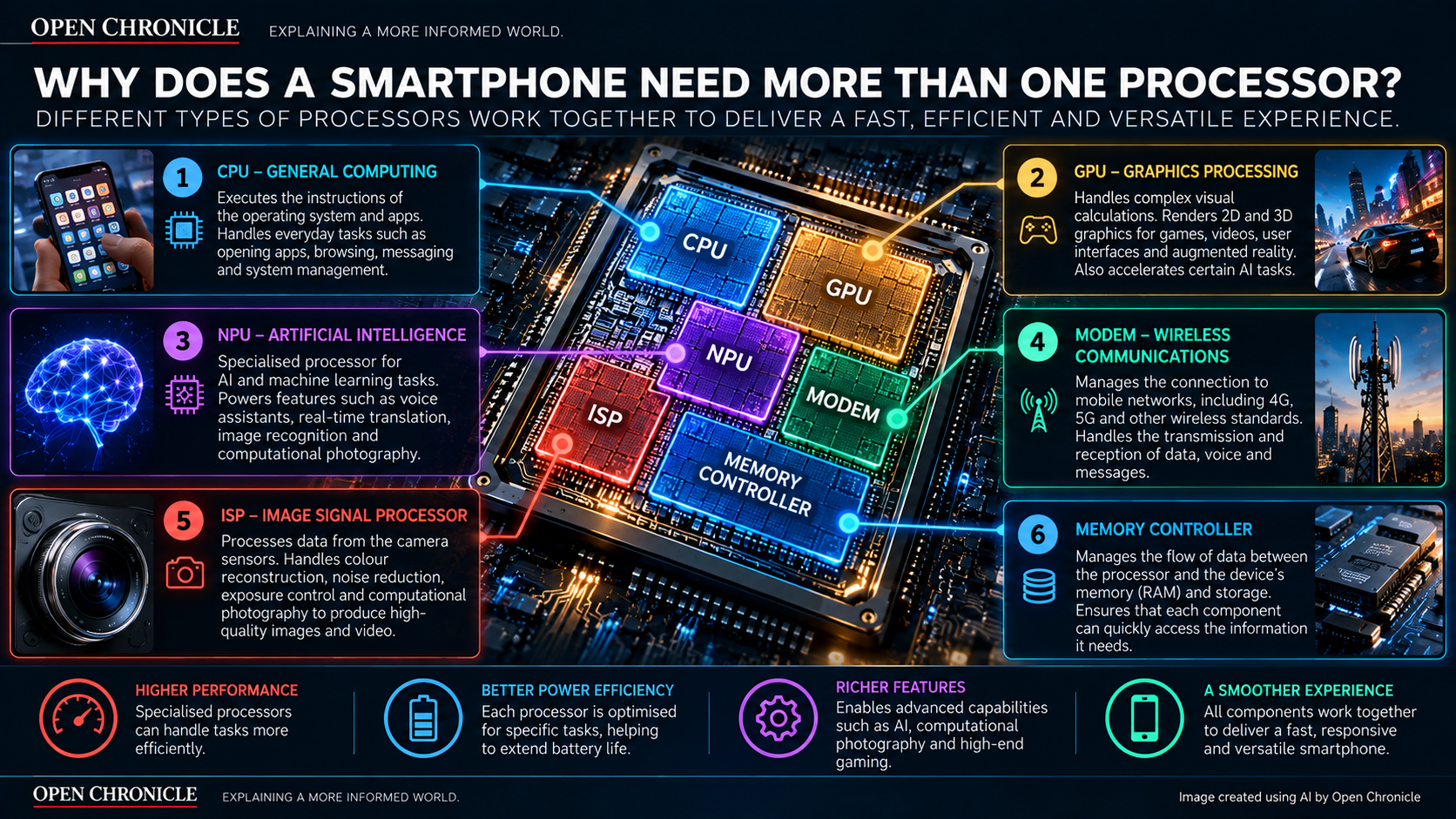
A contemporary smartphone processor contains several specialised computing systems.
Qualcomm describes Snapdragon as a System on a Chip, or SoC, because it integrates multiple processing functions within a single chip. These can include a CPU, GPU, NPU and modem, depending on the particular design.
Each component is designed to handle particular types of work.
CPU: The General Purpose Processor
The Central Processing Unit executes the instructions required by the operating system and applications.
It performs calculations, makes logical decisions and coordinates many of the smartphone’s activities.
When you open an application, browse the internet or edit a document, the CPU performs a substantial part of the required processing.
Modern smartphone CPUs contain multiple processing cores.
Each core can execute its own stream of instructions, allowing suitable tasks to run concurrently.
However, having more cores does not automatically make every application faster.
Software must be capable of using the available processing resources effectively.
GPU: The Graphics Processor
The Graphics Processing Unit specialises in performing large numbers of calculations associated with graphics and other parallel workloads.
When you play a three dimensional game, the GPU helps transform the game’s virtual objects into the images displayed on the screen.
It processes information relating to geometry, textures, lighting and other visual effects.
GPUs are designed to perform many similar calculations in parallel.
This makes them particularly useful for graphics rendering and certain scientific and artificial intelligence workloads.
NPU: The Artificial Intelligence Processor
The Neural Processing Unit is designed to accelerate calculations commonly used in machine learning.
Many artificial intelligence models require large numbers of mathematical operations involving arrays of numerical values.
An NPU contains specialised hardware intended to perform suitable operations efficiently.
This can allow a smartphone to execute supported AI workloads locally rather than sending every request to a remote server.
Qualcomm’s Snapdragon platforms use specialised Hexagon NPU hardware to accelerate supported artificial intelligence applications.
ISP: The Image Signal Processor
The Image Signal Processor handles important stages of digital image processing.
It transforms information received from the camera sensor into images suitable for display, further processing or storage.
Its tasks can include colour reconstruction, noise reduction, exposure processing and other image adjustments.
Modern smartphone photography also uses software algorithms and, in some cases, artificial intelligence to improve the final result.
Modem: The Communications Processor
The cellular modem handles essential aspects of communication with mobile networks.
It processes information transmitted and received through supported cellular radio systems.
This allows the smartphone to connect to mobile data networks and participate in cellular communications.
Other connectivity functions, such as WiFi and Bluetooth, may use additional integrated or separate hardware.
The exact arrangement depends on the smartphone’s design.
Inside a modern smartphone chip
A simplified functional overview. The actual arrangement varies between chip designs.
CPU
General computing and application instructions
GPU
Graphics and parallel calculations
NPU
Specialised artificial intelligence processing
ISP
Camera image processing
Modem
Cellular network communications
Memory controller
Access to the smartphone’s working memory
These components do not operate as completely independent computers.
They communicate through internal connections, exchange information and share access to system resources.
The objective is to perform different types of work using hardware suited to each task.
6. What Happens Inside the Chip When You Take a Photograph?
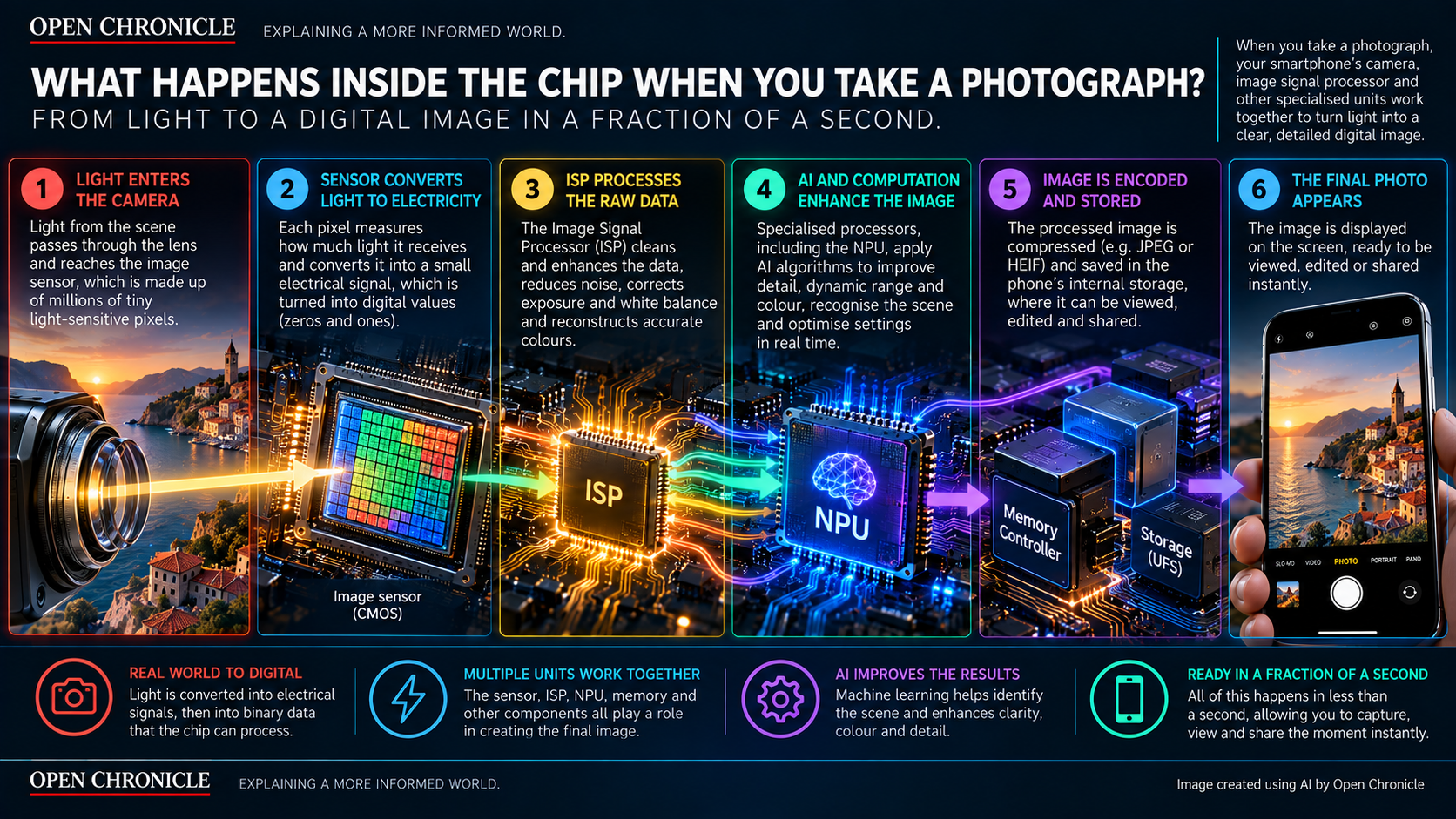
Taking a photograph is an excellent example of how several smartphone components work together.
Imagine pointing your camera at a sunset.
Light enters the camera lens and reaches the image sensor.
The sensor contains millions of light sensitive elements that convert incoming light into electrical signals.
These signals are measured and converted into digital information.
At this stage, the information does not necessarily resemble the finished photograph displayed on your screen.
It must first be processed.
The image signal processor can reconstruct colour information, adjust exposure, reduce noise and perform other corrections.
Depending on the smartphone and camera mode, the device may capture several images with different exposure settings.
Software can combine information from those images to preserve details in bright and dark areas.
Artificial intelligence may also contribute to selected operations, such as recognising visual features or improving particular aspects of image processing.
The CPU coordinates software activity, the ISP performs specialised image processing and other computing units may assist with additional calculations.
Finally, the processed image can be compressed and saved in the smartphone’s storage.
All of this can happen in a fraction of a second.
The result is a photograph that appears almost immediately after you press the shutter button.
Modern Snapdragon platforms incorporate dedicated image processing hardware and support computational photography features that combine image processing with artificial intelligence.
The quality of the final photograph, however, depends on much more than the processor alone.
The camera sensor, lens, software algorithms and decisions made by the smartphone manufacturer all contribute to the result.
7. How Does a Chip Run Artificial Intelligence?

Artificial intelligence applications often rely on mathematical models trained to recognise patterns or generate outputs.
A model may contain millions or billions of numerical parameters.
When the model receives an input, such as a photograph or a spoken instruction, it performs mathematical operations using those parameters.
These operations may involve matrix multiplication and other calculations that can be accelerated by specialised computing hardware.
A smartphone can distribute supported AI workloads between the CPU, GPU and NPU, depending on the software and hardware architecture.
The NPU is particularly useful when the workload matches the types of mathematical operations it is designed to accelerate.
For example, an AI model running locally might help transcribe speech, recognise objects in photographs or perform supported language processing tasks.
But the presence of an NPU does not mean that every AI application runs entirely on the smartphone.
Some applications continue to depend on cloud computing.
Others divide their processing between the device and remote servers.
The choice depends on the model’s size, memory requirements, computational demands, software support and the capabilities of the device.
Local AI processing can reduce the need to transmit certain data to remote services and may improve responsiveness for suitable tasks.
However, privacy and performance still depend on how an individual application is designed.
8. How Does the Chip Communicate With Memory?
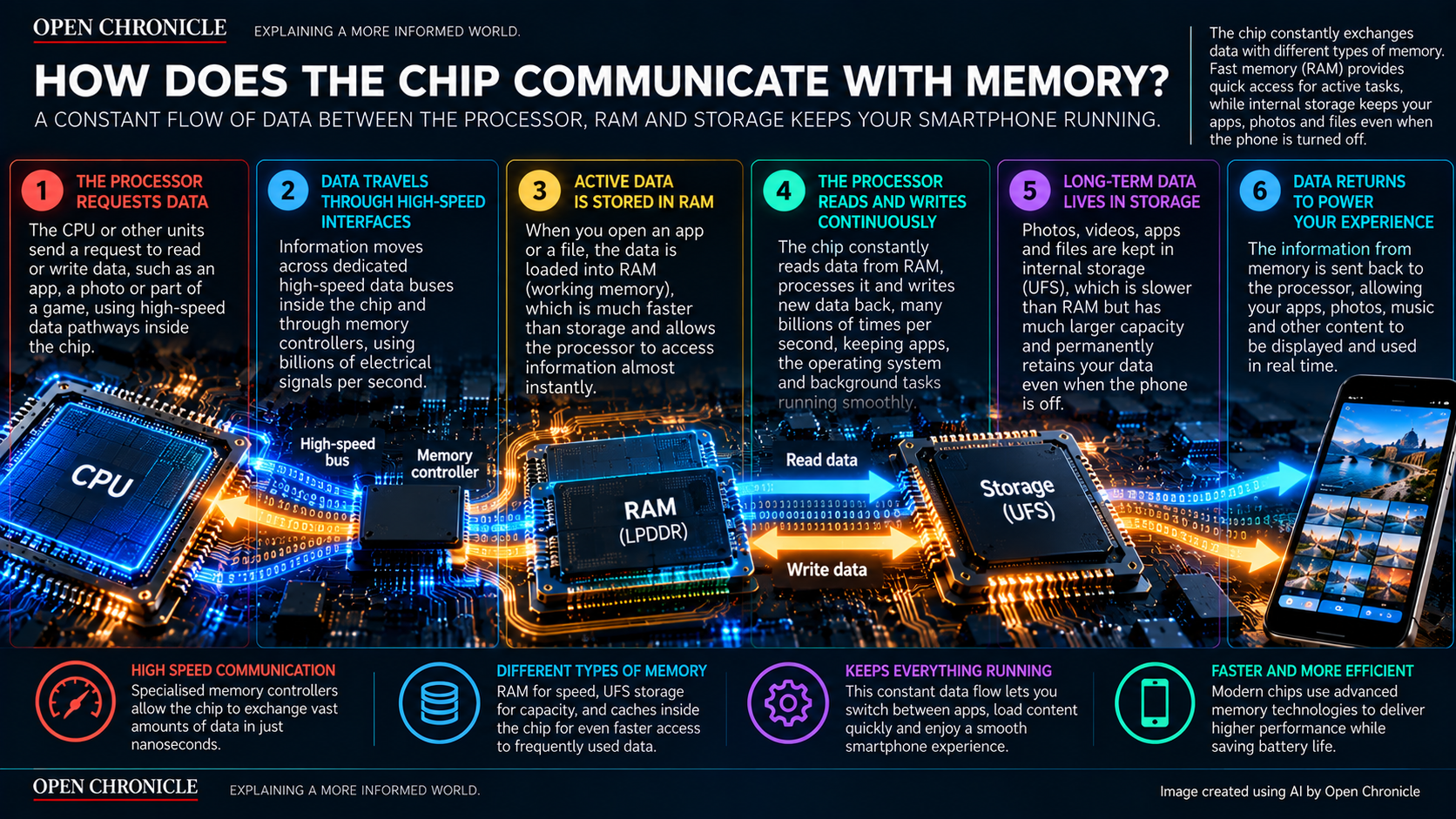
A processor cannot perform useful calculations without access to information.
It needs instructions, application data, images and other material.
That information must be stored somewhere.
Modern smartphones use several different types of memory and storage.
The CPU contains small, extremely fast memory structures called registers.
It also uses cache memory to keep frequently needed information close to its processing units.
The smartphone’s RAM provides working memory for applications and the operating system.
Permanent storage retains applications, photographs and other files when the device is switched off.
These different forms of memory have different characteristics.
Registers and cache are extremely fast but limited in capacity.
RAM provides a larger working area, while permanent storage offers much greater capacity but generally takes longer to access.
When you open an application, relevant instructions and data are made available in working memory.
The processor retrieves the information it needs and performs the required operations.
If the necessary information is already in a nearby cache, the processor may access it more quickly than if it must retrieve it from external RAM.
This is one reason why processor performance depends on memory architecture as well as raw computing speed.
A powerful CPU can spend valuable time waiting for information if the memory system cannot supply data quickly enough.
9. Why Are Some Smartphone Chips Faster Than Others?
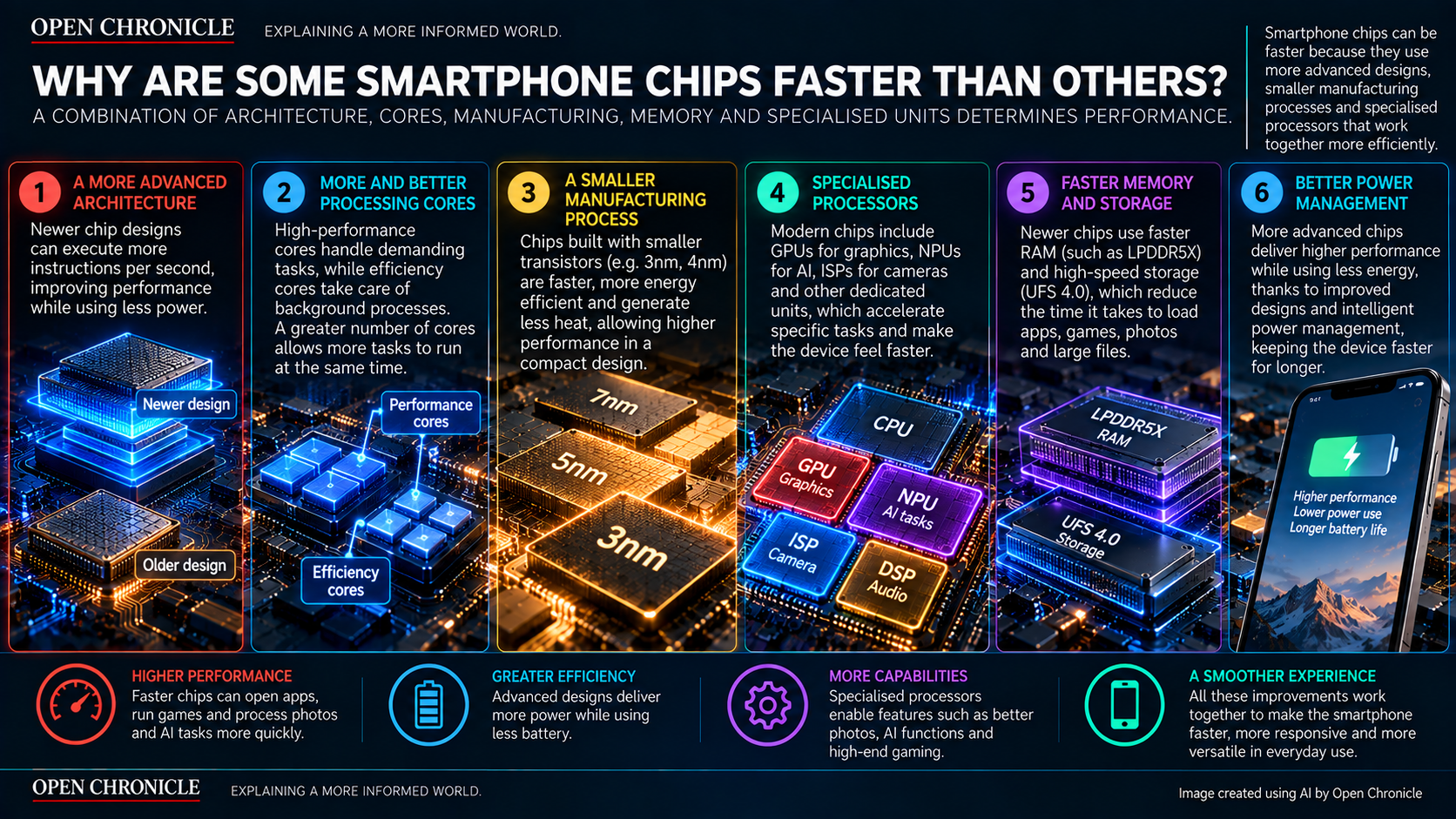
When a new smartphone processor is announced, manufacturers often emphasise clock speed, core count and performance improvements.
These specifications matter, but none provides a complete description of performance.
Clock speed indicates how many clock cycles a processor performs per second.
A processor operating at 3 GHz has a clock frequency of three billion cycles per second.
However, a clock cycle is not equivalent to one completed application instruction or one useful calculation.
Different processor architectures can perform different amounts of work during each cycle.
A chip with a lower clock speed may therefore outperform another chip with a higher frequency in certain workloads.
The number and design of processing cores also matter.
A processor may contain cores optimised for demanding workloads alongside cores designed to operate more efficiently during lighter tasks.
This allows the smartphone to select suitable computing resources according to what the user is doing.
Other important factors include cache capacity, memory bandwidth, GPU architecture, NPU capabilities, software optimisation and the manufacturing process.
The performance experienced by the user depends on how these elements work together.
A smartphone that opens applications quickly may not necessarily provide the highest gaming performance.
A chip that performs well in a short benchmark may not maintain the same speed during a prolonged workload.
This brings us to one of the most important limitations of mobile computing.
Heat.
10. Why Does a Powerful Chip Become Hot?
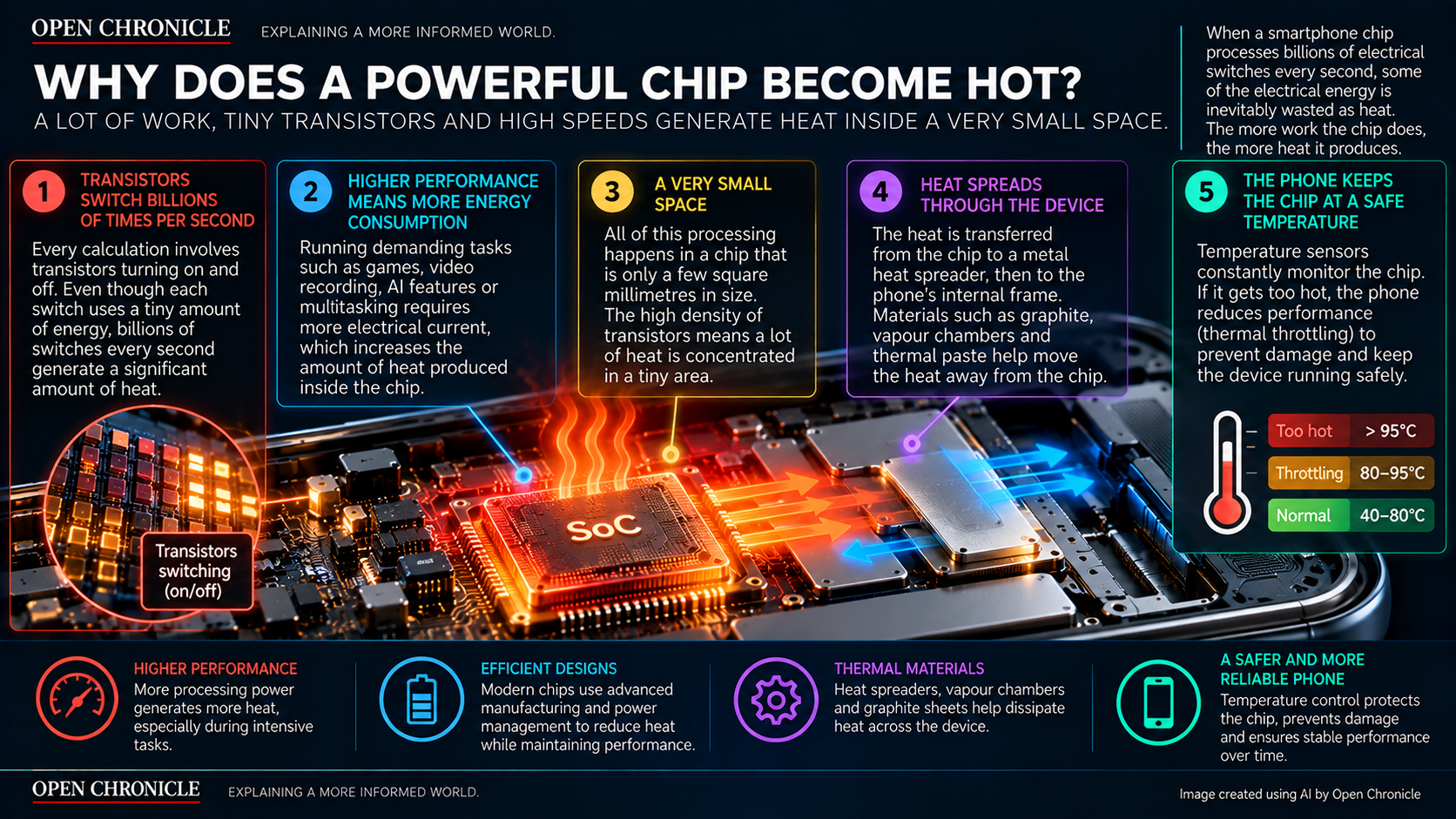
Every time transistors switch states, electrical energy is consumed.
Energy is also lost through other electrical processes, including leakage currents.
Much of the electrical energy consumed by a processor ultimately becomes heat.
When the smartphone performs demanding tasks, more parts of the chip may become active and power consumption can increase.
A smartphone has limited space for cooling equipment.
Unlike a large desktop computer, it generally cannot accommodate a substantial cooling fan and heatsink assembly.
Instead, manufacturers use combinations of thermal materials, heat spreaders, vapour chambers and other passive cooling solutions.
These systems transfer heat away from the processor and distribute it through the device.
But they have physical limits.
If the chip becomes too hot, the smartphone may reduce its operating frequency or power consumption.
This process is commonly known as thermal throttling.
It helps prevent the processor from exceeding its permitted operating temperature.
A chip may therefore achieve extremely high performance for a short period but operate at a lower speed during a demanding task that continues for several minutes.
This is why sustained performance matters.
The most useful smartphone processor is not necessarily the one capable of reaching the highest instantaneous clock speed.
It is one that can deliver the required performance while remaining within the device’s power and thermal limits.
11. How Are Billions of Transistors Manufactured?
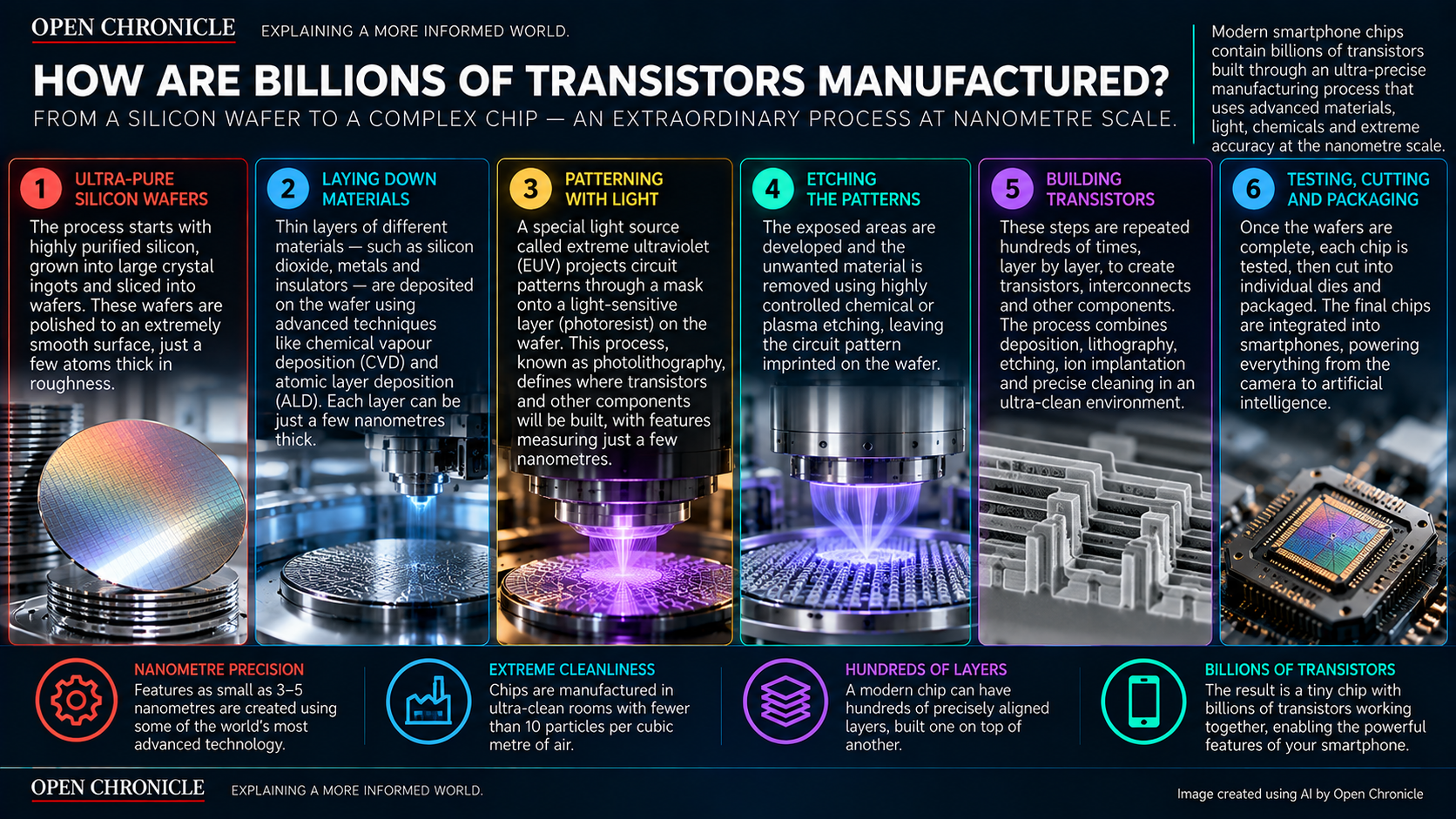
Designing a chip is only part of the challenge.
The next step is manufacturing its microscopic circuits.
Modern semiconductor manufacturing begins with highly purified silicon.
The material is processed into thin circular discs called wafers.
These wafers provide the foundation on which integrated circuits are constructed.
Manufacturing involves repeated processes that create and modify extremely small structures.
One of the most important techniques is photolithography.
During lithography, light is used to transfer a circuit pattern onto a light sensitive material applied to the wafer.
The patterned material helps define where subsequent manufacturing operations will take place.
Other processes add materials, remove selected regions or alter the electrical properties of the silicon.
These operations are repeated to construct transistors and the layers of microscopic connections that link them together.
Modern chips contain many precisely aligned layers.
ASML, a major manufacturer of semiconductor lithography equipment, explains that advanced chips can contain up to 100 layers and require alignment accuracy measured in nanometres.
The manufacturing environment must also be extraordinarily clean.
A particle of dust that would be almost invisible to a human observer can damage microscopic circuit structures.
This is why semiconductor factories use highly controlled cleanrooms and sophisticated automated equipment.
Once the manufacturing process is complete, individual chips are separated from the wafer, tested and packaged.
The package protects the silicon and provides electrical connections to the surrounding electronic system.
A smartphone processor is therefore the product of both highly advanced circuit design and an exceptionally precise industrial manufacturing process.
12. What Do 3 nm and 2 nm Actually Mean?
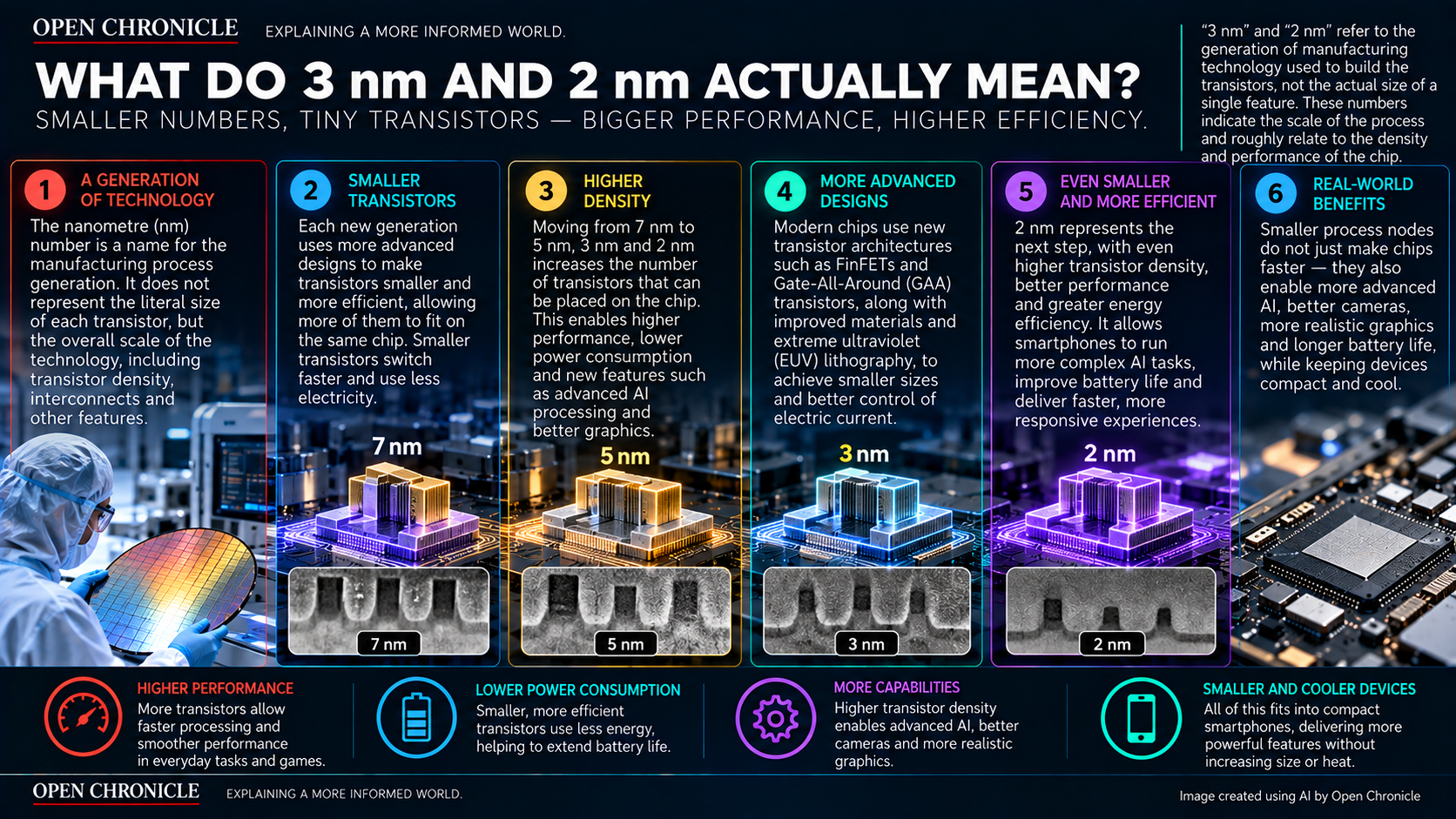
Semiconductor manufacturers frequently describe advanced manufacturing technologies using terms such as 3 nanometres and 2 nanometres.
A nanometre is one billionth of a metre.
These numbers are associated with generations of semiconductor manufacturing technology, commonly called process nodes.
Historically, process node names were more directly related to particular physical dimensions of transistor structures.
In modern semiconductor manufacturing, however, a node name should not be interpreted as the literal measurement of every transistor or circuit feature.
A chip manufactured using a process marketed as 2 nm does not contain transistors in which every component measures exactly two nanometres.
The designation identifies a particular generation of manufacturing technology.
Newer process generations may enable improvements in transistor density, power efficiency or performance.
However, the actual benefits depend on the technology and the chip’s design.
A newer manufacturing process does not automatically guarantee that every processor manufactured using it will outperform every processor produced on an older process.
Architecture, power consumption, memory, cooling and software remain important.
The manufacturing process provides engineers with technological possibilities.
The final processor design determines how those possibilities are used.
13. Why Do Companies Produce Different Versions of the Same Chip?
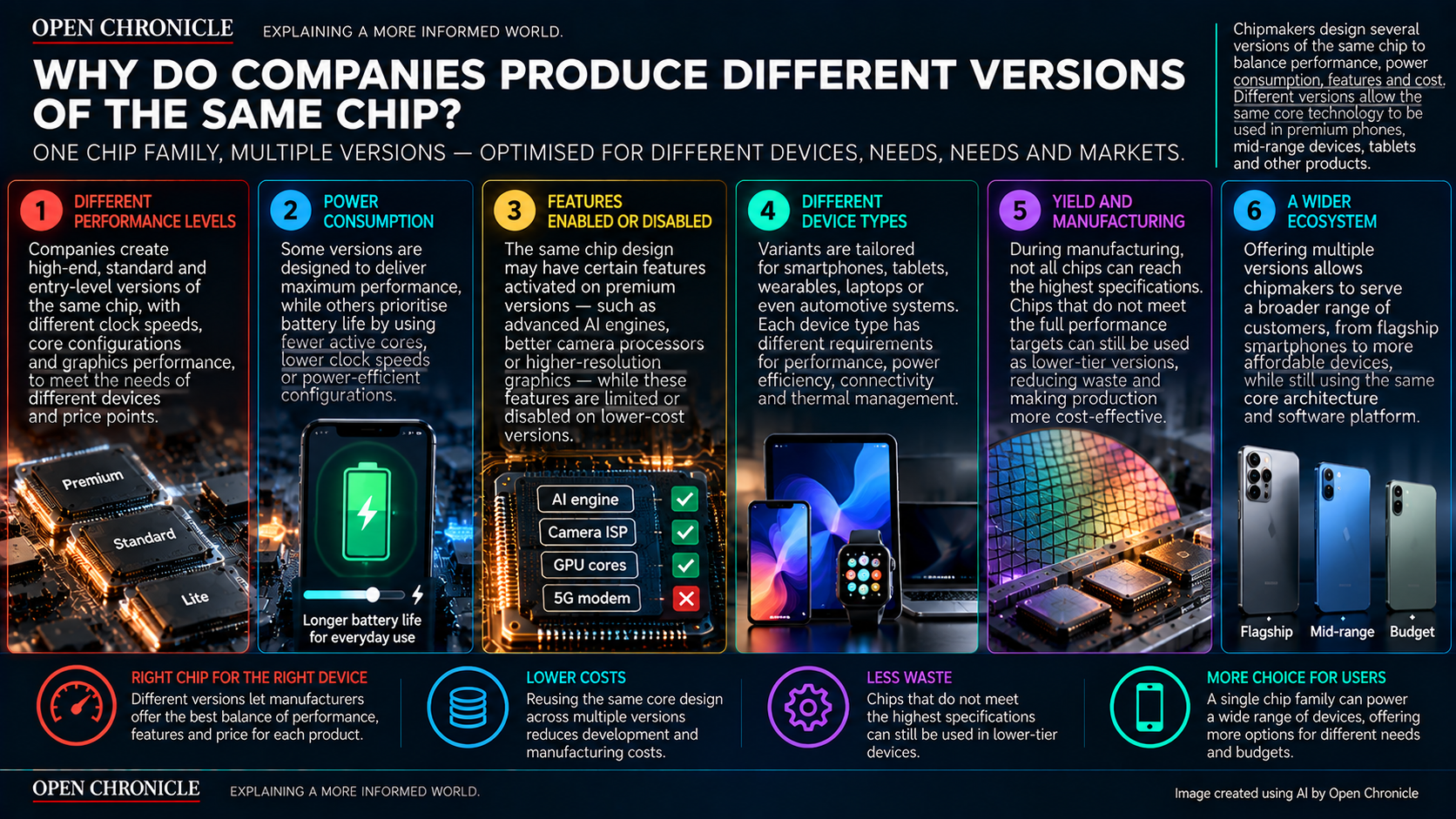
A semiconductor company may develop several processors based on a related architecture.
These versions can share important design elements while differing in their operating characteristics.
One version may use higher clock frequencies.
Another may contain a different GPU configuration or support different memory capabilities.
Some models may be designed for maximum performance, while others place greater emphasis on power efficiency or cost.
There is also a manufacturing consideration.
Not every chip produced on a silicon wafer has exactly the same electrical characteristics.
After manufacturing, chips undergo testing to determine whether they meet particular specifications.
Manufacturers can classify suitable chips according to characteristics such as supported operating frequency, power consumption and functional capabilities.
This process is commonly known as binning.
It can allow closely related chip designs to be sold in different performance categories.
However, two products with different names are not necessarily the same physical design operating at different frequencies.
They may also contain architectural or hardware differences.
Understanding the distinction requires examining the specifications of the actual products.
14. What Do Qualcomm’s Snapdragon Processors Tell Us About the Future of Smartphones?
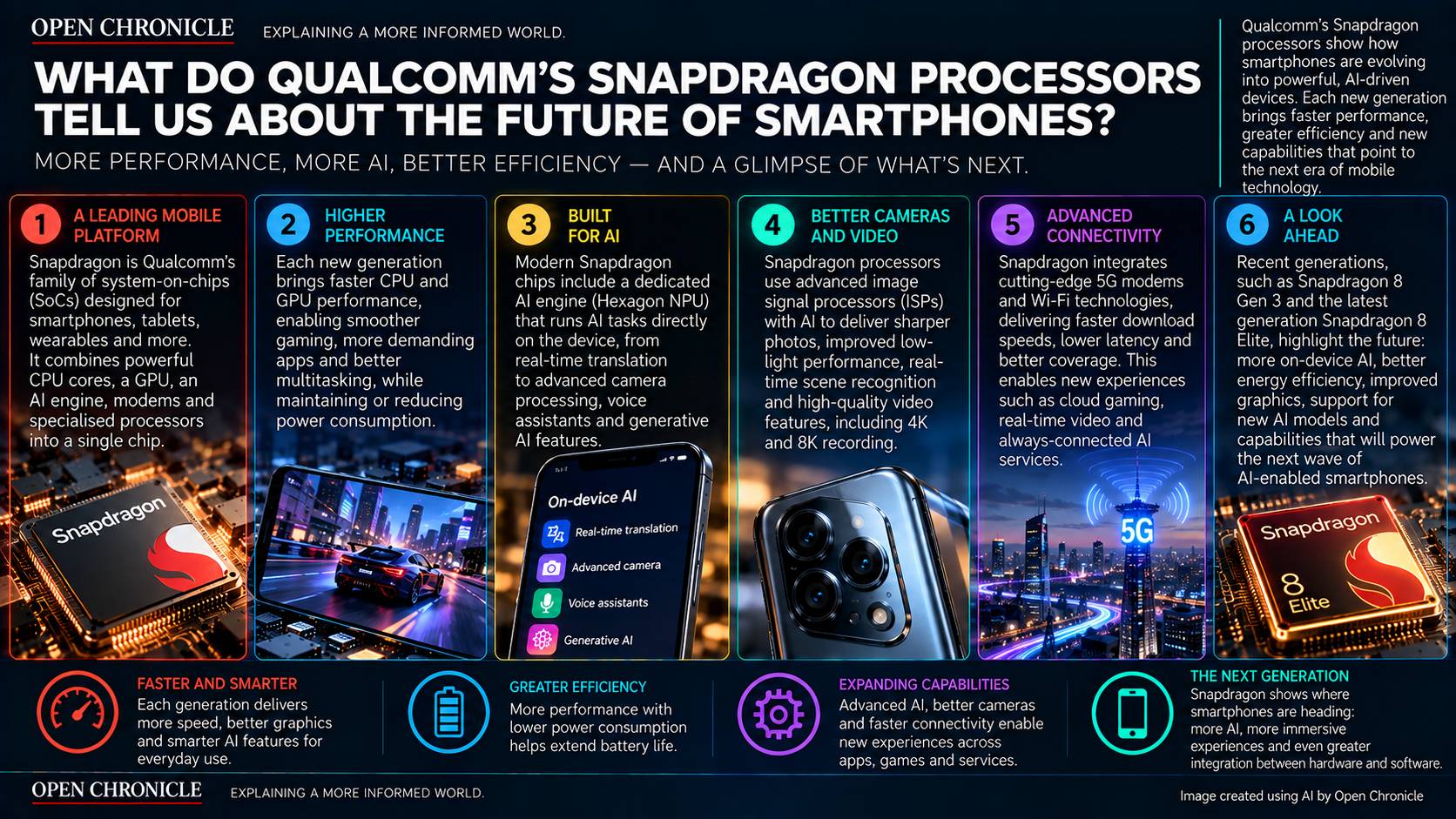
Qualcomm’s Snapdragon family provides a useful example of how mobile computing has evolved.
A smartphone processor is no longer defined solely by the speed of its CPU.
Modern platforms combine multiple processing engines intended to support different workloads efficiently.
Qualcomm’s published Snapdragon documentation describes architectures incorporating Oryon CPU technology, Adreno graphics processing, Hexagon AI acceleration, Spectra image processing and cellular connectivity capabilities.
These components reflect the increasingly diverse tasks performed by modern smartphones.
A user may be recording high resolution video while running background applications, maintaining a cellular connection and using computational photography.
A gaming application may require intensive graphics processing, memory access and continuous coordination with the CPU.
An artificial intelligence application may depend on specialised mathematical acceleration.
The challenge is not simply to make every component faster.
It is to make the entire system work efficiently within the smartphone’s limited power and thermal budget.
The Snapdragon 8 Elite Gen 6 developments discussed in Open Chronicle’s September 2026 report provide the context for this broader technological explanation.
The reported distinction between standard and Extreme versions raises questions about performance, power consumption, graphics capabilities and the relationship between chip architecture and smartphone design.
However, specific claims about unreleased devices, including a possible Samsung Galaxy S27 Ultra configuration, should be distinguished from confirmed product specifications.
The technical principles described in this article apply to modern smartphone processors generally and do not depend on unverified specifications for a particular future model.
15. Why Does the Chip Matter More Than Ever?
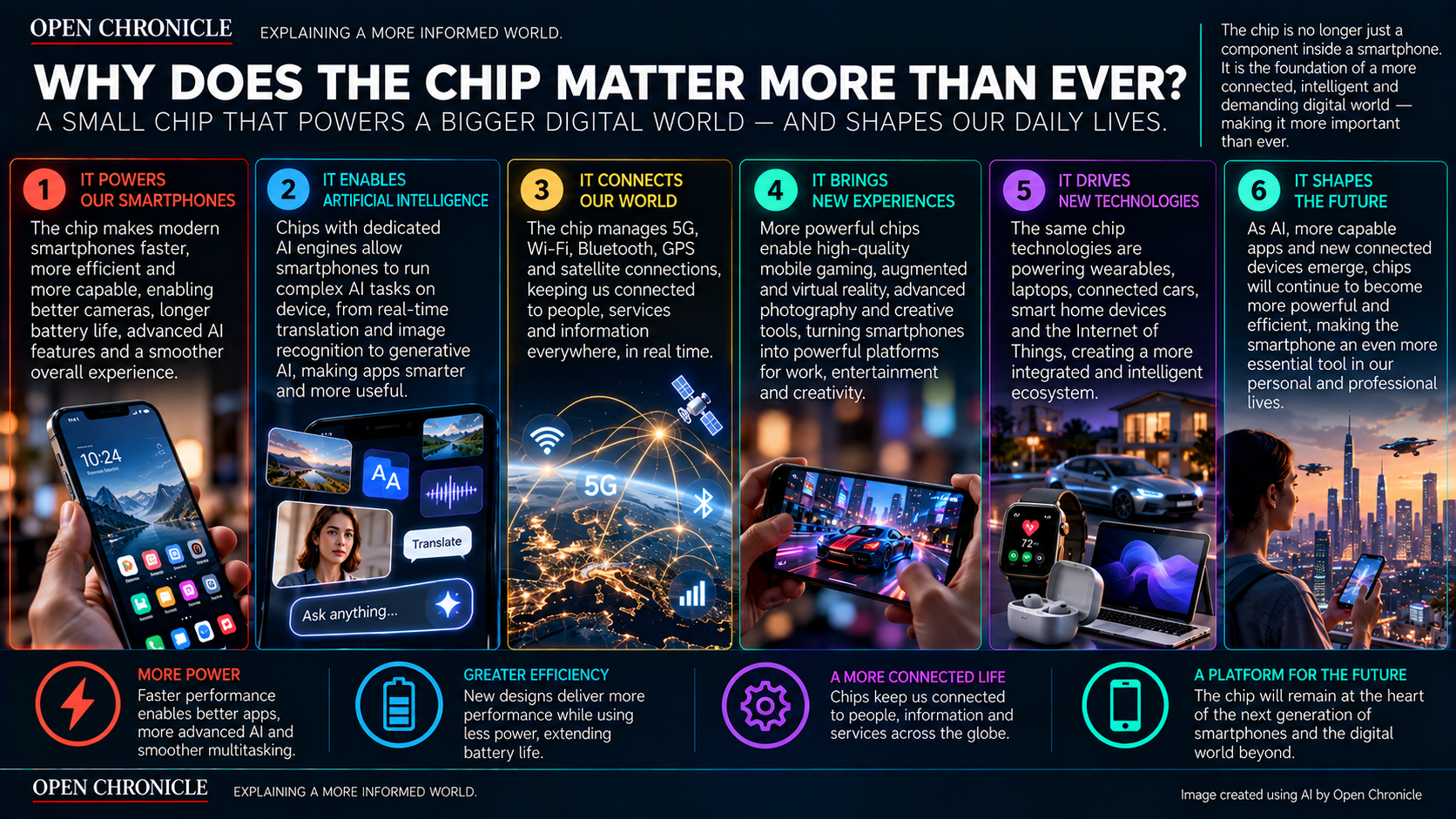
The modern smartphone has become a camera, communications device, navigation system, gaming platform, digital wallet and personal computer.
Each function creates different computing requirements.
Photography requires rapid image processing.
Gaming requires graphics performance.
Artificial intelligence requires substantial mathematical computation.
Communications depend on sophisticated signal processing.
Everyday applications need responsive general computing.
All of these functions must operate within a device powered by a relatively small battery.
The chip sits at the centre of that challenge.
Its architecture influences how quickly applications respond, how efficiently information is processed, how much energy the device consumes and how effectively the smartphone can support new software capabilities.
Yet the processor does not determine the entire experience on its own.
A smartphone’s performance also depends on its memory, storage, display, battery, cameras, cooling system and software.
The most sophisticated chip cannot compensate for every limitation elsewhere in the device.
The modern smartphone is therefore an integrated technological system.
The processor is one of its most important components, but its capabilities become useful only when the surrounding hardware and software can take advantage of them.
What? How? Why?
What is a smartphone chip?
A smartphone chip is an integrated electronic circuit containing large numbers of transistors and specialised computing components. Modern smartphone processors often use a System on a Chip architecture that combines several processing functions.
How does a chip process information?
Transistors form electronic circuits that manipulate binary information. Complex combinations of these circuits execute instructions, perform calculations and control the movement of data.
Why does a smartphone need a CPU, GPU and NPU?
Different computing tasks benefit from different hardware architectures. The CPU performs general computing, the GPU accelerates graphics and suitable parallel workloads, and the NPU accelerates supported artificial intelligence calculations.
How can a chip contain billions of transistors?
Semiconductor manufacturing uses highly precise processes to construct microscopic electronic structures and connections across multiple layers of silicon based integrated circuits.
Does a smaller manufacturing node always mean a faster chip?
No. Advanced manufacturing technologies can enable improvements in performance, efficiency and transistor density, but the actual results depend on the processor’s architecture and design.
Why do smartphone processors become hot?
Transistors consume electrical energy during operation, and much of that energy ultimately becomes heat. Sustained demanding workloads can require the smartphone to reduce processor power or frequency to remain within safe operating temperatures.
What makes one Snapdragon processor different from another?
Differences may include CPU and GPU architecture, operating frequencies, AI processing capabilities, memory support, manufacturing technology and power management. The precise distinctions depend on the specifications of the individual products.
Does a more powerful processor automatically make a smartphone better?
No. The overall experience also depends on software optimisation, memory, storage, cooling, battery capacity and other hardware components.
The Tiny Machine Behind Modern Life
A smartphone chip is one of the most remarkable examples of modern engineering.
Within a tiny piece of silicon, billions of transistors form circuits capable of performing an extraordinary range of operations.
Those circuits transform electrical signals into calculations.
Calculations become instructions.
Instructions become applications.
And applications allow people to communicate, navigate, create images, access information and interact with artificial intelligence.
What appears to the user as a simple touch on a screen is the result of an immense number of coordinated electronic operations.
The continuing development of processors such as Qualcomm’s Snapdragon family demonstrates how mobile computing is evolving beyond the traditional idea of a faster CPU.
The future of smartphone processing increasingly depends on the integration of specialised computing engines, efficient memory systems, advanced manufacturing and sophisticated power management.
But the fundamental principle remains unchanged.
Billions of microscopic electronic switches, working together, transform electrical signals into the digital experiences that define modern life.
Related Reporting
Qualcomm Unveils Two Snapdragon 8 Elite Gen 6 Chips, With Extreme Version Tipped for Samsung Galaxy S27 Ultra
Read the Open Chronicle report examining Qualcomm’s latest Snapdragon developments and the reported specifications of its next generation of flagship smartphone processors.
Read the Open Chronicle report
OPEN CHRONICLE EXPLAINED
Sources and Further Reading
Official documentation and technical resources for understanding smartphone processors, semiconductor architecture and microchip manufacturing.
01 · Processor architecture
Qualcomm
What is Snapdragon FAQ | Qualcomm
An introduction to Snapdragon processors and the integration of CPU, GPU, NPU and communications hardware.
Official Qualcomm documentation
02 · Mobile computing
Qualcomm
Mobile Processors 101 | Smarter Smartphones with an All-in-One Processor | Qualcomm
An explanation of the components of a mobile processor and how they work together to support smartphone applications.
03 · Semiconductor manufacturing
ASML
How microchips are made | ASML
An overview of semiconductor manufacturing, silicon wafers, microscopic circuit structures and the industrial processes used to produce modern chips.
04 · Lithography
ASML
Lithography principles | Technology | ASML
A technical introduction to photolithography and the use of light to transfer microscopic circuit patterns onto silicon wafers.
Editorial note:
This article explains established semiconductor principles and general smartphone processor architecture. Product specifications and future device configurations should be evaluated separately using the relevant manufacturers’ official documentation.
Open Chronicle Explained
What? How? Why?
Understanding the systems behind the headlines.
Understanding the systems behind the headlines.
Explore Open Chronicle Explained →