
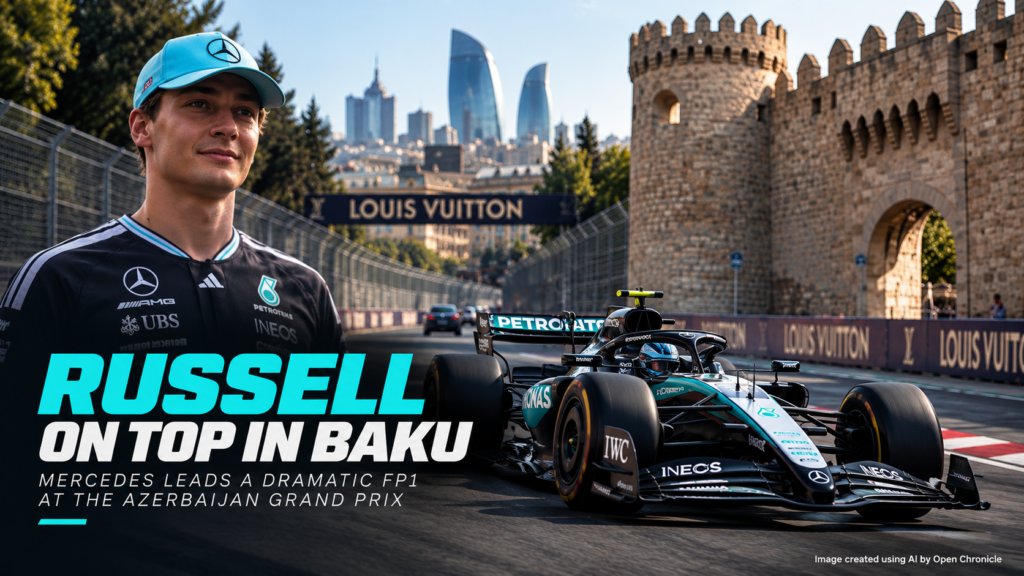
FORMULA 1 | AZERBAIJAN GRAND PRIX 2026 | FREE PRACTICE 1
By Open Chronicle Sports
George Russell leads a closely contested opening session in Azerbaijan, with Max Verstappen and Ferrari within striking distance. Gabriel Bortoleto recovers from technical difficulties and an extensive aerodynamic testing programme to finish tenth for Audi.
George Russell made a strong start to the Azerbaijan Grand Prix weekend by setting the fastest time in the opening free practice session at the Baku City Circuit on Thursday, September 24.
The Mercedes driver recorded a lap of 1:45.687, finishing just 0.100 seconds ahead of Max Verstappen in a session characterised by mechanical problems, interruptions and the challenges of finding grip on the demanding street circuit.
Ferrari also demonstrated competitive pace, with Charles Leclerc finishing third, only 0.104 seconds behind Russell, and Lewis Hamilton taking fourth.
Championship leader Kimi Antonelli completed the top five despite suffering a hydraulic problem that brought his session to an early end.
For Audi, Gabriel Bortoleto delivered an encouraging result after a complicated opening hour. The Brazilian spent much of the session evaluating aerodynamic developments, encountered a gearbox issue and had his first timed lap disrupted by a Virtual Safety Car.
Nevertheless, a late improvement to 1:46.688 secured tenth place, putting him immediately ahead of teammate Nico Hülkenberg.
A demanding opening session on the streets of Baku
The first practice session began with teams facing a particularly compressed preparation schedule.
With qualifying scheduled for Friday, the opening hour represented an important opportunity to gather information about car balance, tyre behaviour and the circuit’s evolving grip levels.
Baku’s combination of long straights, heavy braking zones and narrow sections between concrete barriers presented its familiar engineering challenges.
The track surface offered limited grip during the opening minutes, while resurfaced sections and changing wind conditions complicated the drivers’ attempts to establish consistent braking points.
Pirelli selected the three softest compounds in its range for the weekend, with the C3 designated as the hard tyre, the C4 as the medium and the C5 as the soft.
Most drivers began their programmes on the hard compound, although McLaren and Franco Colapinto were among those initially running on mediums.
The different tyre choices and testing programmes meant that early lap times provided only a partial indication of the competitive order.
Audi prioritises aerodynamic development
Bortoleto was among the first drivers to leave the pit lane, but Audi’s initial programme was focused on gathering technical information rather than setting a competitive lap time.
His car carried aerodynamic measurement equipment designed to collect information about airflow around the vehicle and assess the performance of the updates introduced for Baku.
After completing an installation lap, the Brazilian returned to the garage, where the team continued its evaluation and fitted a different front wing.
Bortoleto subsequently returned to the circuit without the measuring equipment, although he did not immediately begin a representative performance run.
The approach reflected the importance of understanding the aerodynamic characteristics required at Baku, where teams must balance straight-line efficiency against the downforce needed for the circuit’s slower corners.
Arvid Lindblad’s Racing Bulls was also equipped with aerodynamic measurement devices during the session.
While Audi continued its development work, the leading teams began establishing their initial performance benchmarks.
Verstappen briefly headed the classification with a 1:49.202 before Leclerc, Antonelli, Norris, Russell and Lawson began improving as the track developed.
Antonelli’s session ends with a hydraulic failure
Antonelli quickly established himself among the fastest drivers.
The Mercedes driver recorded a 1:46.265 to take the lead during the opening part of the session, continuing the competitive form he had demonstrated at the previous round in Madrid.
However, his programme ended prematurely shortly after the first 20 minutes.
The Italian stopped his Mercedes between Turns 6 and 7 and reported a hydraulic problem over the radio.
He was unable to return to the circuit.
The timing was particularly unfortunate because Antonelli had just fitted soft tyres and was preparing to begin a qualifying simulation.
His retirement triggered a Virtual Safety Car period, interrupting several drivers’ programmes.
Bortoleto was among those affected. The Audi driver finally completed his first timed lap, but the VSC restrictions resulted in an unrepresentative 2:35.072.
For Mercedes, the incident also reduced the amount of track data available from its championship-leading driver ahead of Friday’s qualifying session.
Although Antonelli remained fifth in the final classification, the team faced additional work to investigate the hydraulic failure and prepare his car for the remainder of the weekend.
Russell, Verstappen and Ferrari separated by fractions
Once normal running resumed, the battle at the front intensified.
Verstappen moved into the lead with a 1:45.787, demonstrating the Red Bull’s speed around the streets of Baku.
Russell subsequently improved to 1:45.687, establishing the benchmark that would remain unbeaten for the rest of the session.
The Mercedes driver was not entirely comfortable throughout the hour, however. He overshot one of the circuit’s heavy braking zones and had to recover without making contact with the barriers.
Verstappen also experienced an off-track moment as the drivers explored the limits of grip.
Ferrari remained firmly involved in the battle for the leading positions.
Leclerc recorded a 1:45.791, placing him just four thousandths of a second behind Verstappen and 0.104 seconds away from Russell.
Hamilton followed with a 1:45.824.
The narrow margins suggested that Mercedes, Red Bull and Ferrari all possessed competitive single-lap pace.
However, differences in tyre preparation, fuel loads and individual run plans prevented the opening session from establishing a definitive competitive hierarchy.
McLaren’s Oscar Piastri finished sixth, while Lando Norris ended the session in fourteenth, leaving the team with further work to complete before qualifying.
Bortoleto recovers from gearbox trouble
As the session progressed, Bortoleto finally began recording more representative lap times.
His first significant improvement was a 1:48.833, which moved him into seventeenth position.
However, Audi subsequently identified an issue affecting one of the gears in his gearbox.
The team worked to resolve the problem, allowing the Brazilian to return to the circuit on soft tyres.
With the aerodynamic evaluation largely completed and the mechanical issue addressed, Bortoleto could concentrate on extracting performance from the car.
He improved to 1:47.151, moving into the midfield and demonstrating that there was considerably more pace available than his earlier position had suggested.
Hülkenberg had already established a competitive benchmark in the other Audi, although the different programmes made a direct comparison between the teammates difficult during much of the session.
Bortoleto’s opportunity to complete a final representative lap would arrive in the closing minutes.
Mechanical problems and interruptions disrupt the field
The opening practice session was also difficult for several other drivers.
Carlos Sainz experienced a braking problem on his Williams, with flames appearing around the rear brakes before he returned to the pits.
Oscar Piastri reported brake vibrations in his McLaren, while Isack Hadjar complained that his Red Bull was pulling to one side.
Hadjar’s return to the cockpit after missing the Dutch, Italian and Spanish Grands Prix because of a wrist injury was further complicated by an engine problem.
The French driver completed limited running and finished twentieth.
The closing stages brought further disruption.
Lindblad crashed, prompting another interruption just as several drivers were preparing their final attempts.
Hülkenberg also stopped on the circuit, while Esteban Ocon encountered difficulties near the pit exit.
The sequence of incidents reduced the time available for uninterrupted running and left several teams with incomplete practice programmes.
Despite the disruptions, the circuit reopened for a final opportunity to improve.
A late lap puts Bortoleto into the top ten
Bortoleto took full advantage of the final minutes.
Having spent much of the session outside the leading positions, the Brazilian produced a 1:46.688 after the chequered flag had been displayed.
The lap initially moved him from sixteenth to eighth.
Subsequent improvements from Piastri and Lindblad pushed him back two places, but he retained tenth position in the final classification.
The result represented a substantial recovery after a session that had included aerodynamic testing, changes to the front wing, a gearbox problem and a disrupted first timed lap.
Bortoleto also finished ahead of Hülkenberg, who recorded a 1:46.871 to take eleventh.
The Brazilian’s final lap was 0.183 seconds faster than his teammate’s best effort.
Although the result provided an encouraging indication of Audi’s potential, the team still needed to establish whether its updated aerodynamic package could deliver consistent performance over longer runs.
The narrow margins in the midfield also meant that small improvements in braking stability, tyre preparation or car balance could make a significant difference during qualifying.
What FP1 revealed ahead of qualifying
Russell’s performance gave Mercedes the fastest time of the opening session, but the closely grouped leading drivers suggested that the fight for pole position remained open.
Verstappen and both Ferrari drivers finished within 0.137 seconds of the Mercedes benchmark.
Antonelli’s hydraulic failure introduced an additional concern for Mercedes, particularly given the limited preparation time available before qualifying.
McLaren faced a different challenge. Piastri’s sixth place demonstrated competitive potential, but Norris’s fourteenth position left questions about how much performance the team could recover during the remaining practice session.
For Audi, the immediate priority was to consolidate the progress shown by Bortoleto and Hülkenberg while completing the evaluation of its aerodynamic developments.
The opening hour also reinforced the importance of reliability at Baku.
With concrete barriers close to the racing line and several heavy braking zones, mechanical problems or small driving errors can quickly compromise a driver’s preparation.
The second free practice session, scheduled for later on Thursday, would provide another opportunity to evaluate race pace, tyre degradation and the effectiveness of the teams’ revised setups.
Azerbaijan Grand Prix 2026: FP1 results
Baku City Circuit | Thursday, September 24, 2026
| Pos. | Driver | Team | Best lap |
|---|---|---|---|
| 1 | George Russell | Mercedes | 1:45.687 |
| 2 | Max Verstappen | Red Bull | 1:45.787 |
| 3 | Charles Leclerc | Ferrari | 1:45.791 |
| 4 | Lewis Hamilton | Ferrari | 1:45.824 |
| 5 | Kimi Antonelli | Mercedes | 1:46.265 |
| 6 | Oscar Piastri | McLaren | 1:46.398 |
| 7 | Liam Lawson | Racing Bulls | 1:46.440 |
| 8 | Arvid Lindblad | Racing Bulls | 1:46.601 |
| 9 | Esteban Ocon | Haas | 1:46.624 |
| 10 | Gabriel Bortoleto | Audi | 1:46.688 |
| 11 | Nico Hülkenberg | Audi | 1:46.871 |
| 12 | Carlos Sainz | Williams | 1:46.893 |
| 13 | Alexander Albon | Williams | 1:46.939 |
| 14 | Lando Norris | McLaren | 1:46.981 |
| 15 | Oliver Bearman | Haas | 1:46.994 |
| 16 | Pierre Gasly | Alpine | 1:47.043 |
| 17 | Sergio Pérez | Cadillac | 1:47.253 |
| 18 | Franco Colapinto | Alpine | 1:47.523 |
| 19 | Fernando Alonso | Aston Martin | 1:47.835 |
| 20 | Isack Hadjar | Red Bull | 1:47.873 |
| 21 | Lance Stroll | Aston Martin | 1:48.547 |
| 22 | Valtteri Bottas | Cadillac | 1:49.315 |
Editorial note: This report is based on the supplied FP1 session account and classification. The results have not been independently verified against the official FIA timing documents.