
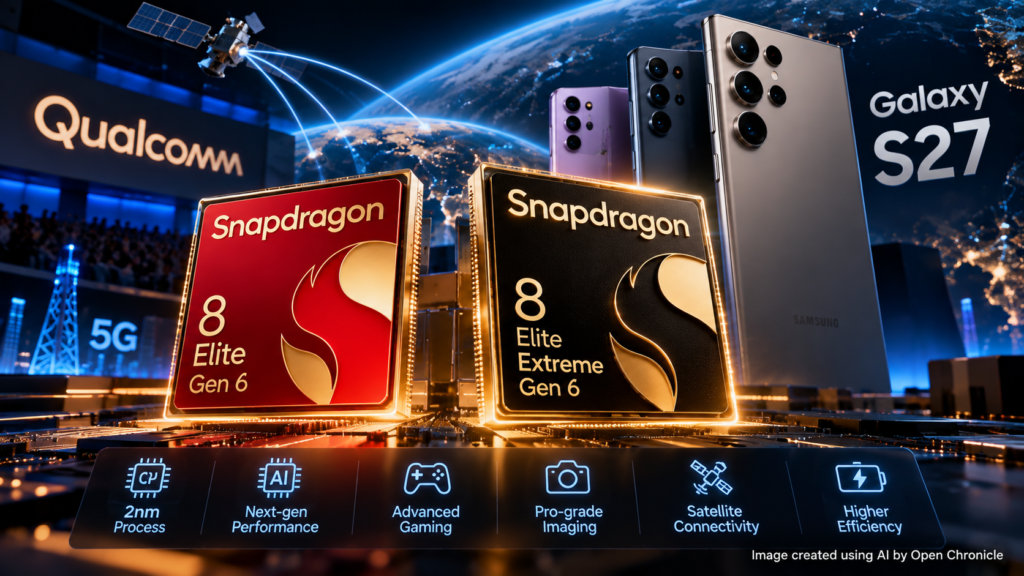
Qualcomm has introduced two flagship smartphone processors built on advanced 2nm technology, promising improvements in performance, artificial intelligence, gaming, photography and satellite connectivity. The Snapdragon 8 Elite Extreme Gen 6 could power Samsung’s next generation of premium Galaxy smartphones.
By Open Chronicle with agencies
September 24, 2026
Qualcomm has unveiled two new flagship mobile processors at Snapdragon Summit 2026, introducing the Snapdragon 8 Elite Gen 6 and the more powerful Snapdragon 8 Elite Extreme Gen 6.
The announcement marks a change in the company’s flagship processor strategy, with two distinct versions designed to meet the requirements of premium Android smartphones.
Both processors are manufactured using TSMC’s advanced N2P 2nm process and incorporate Qualcomm’s custom Oryon CPU architecture, upgraded Adreno graphics, enhanced artificial intelligence capabilities and a new generation of mobile connectivity technologies.
The Extreme version introduces additional graphics processing capabilities, expanded AI performance and advanced professional video recording features.
Samsung’s forthcoming Galaxy S27 series is among the smartphone lineups expected to adopt Qualcomm’s new processors, although the company has not officially confirmed the chipset configurations of its next generation of flagship devices.
Two flagship processors built on 2nm technology
The Snapdragon 8 Elite Gen 6 and Snapdragon 8 Elite Extreme Gen 6 represent Qualcomm’s first flagship mobile processors manufactured using a 2nm semiconductor process.
Both chips use TSMC’s N2P manufacturing technology, which is designed to deliver improvements in transistor density, processing performance and energy efficiency.
The processors will compete with other next generation mobile platforms, including Apple’s A20 Pro, MediaTek’s Dimensity 9600 series and Samsung’s forthcoming Exynos 2700.
Qualcomm has equipped both chips with an eight core CPU based on its custom Oryon architecture.
The configuration includes two Prime cores operating at frequencies of up to 5GHz and six Performance cores capable of reaching up to 4GHz.
Both processors also incorporate 16MB of Oryon FlexCache memory.
Despite sharing the same basic CPU configuration, the two chips differ in their graphics processing capabilities, artificial intelligence performance and advanced multimedia features.
Snapdragon 8 Elite Gen 6: Improved performance and efficiency
The standard Snapdragon 8 Elite Gen 6, identified by the model number SM8950, is designed to deliver flagship performance across a wide range of premium Android smartphones.
Qualcomm claims that its CPU provides a 10% performance improvement compared with the previous generation Snapdragon 8 Elite Gen 5.
The company also reports a 37% improvement in CPU power efficiency.
These improvements are intended to support demanding applications while reducing energy consumption, potentially allowing smartphone manufacturers to improve battery life without compromising processing performance.
The processor incorporates the Adreno 845 GPU, which supports hardware accelerated real time ray tracing and advanced graphics rendering technologies.
According to Qualcomm, the new GPU delivers 35% higher graphics performance and 40% better power efficiency than its predecessor.
The graphics architecture supports high frame rate gaming, HDR rendering and technologies including Lumen Global Illumination, Nanite Virtualized Geometry and Game Quick Touch 3.0.
These capabilities are intended to improve lighting, geometric detail and responsiveness in demanding mobile games.
High resolution displays and advanced gaming support
The Snapdragon 8 Elite Gen 6 supports several high resolution display configurations.
Smartphone manufacturers can use the processor to drive QHD+ displays at refresh rates of up to 240Hz or 4K+ displays at up to 120Hz.
The chip also supports 8K display output at refresh rates of up to 30Hz.
Supported display technologies include Dolby Vision, HDR10, HDR10+, HDR Vivid, 10 bit colour depth and the Rec. 2020 colour gamut.
These capabilities provide manufacturers with greater flexibility when developing premium smartphones with high resolution displays and advanced visual features.
However, the availability of individual display capabilities will depend on the specifications of each smartphone.
Artificial intelligence becomes a central feature
Qualcomm has redesigned its Hexagon neural processing unit to improve the performance of artificial intelligence applications running directly on smartphones.
The Snapdragon 8 Elite Gen 6 introduces a new Element Accelerator, which the company says delivers a 14% improvement in AI processing performance and a 20% increase in performance per watt.
The processor supports AI workloads with context windows of up to 32,000 tokens.
It also supports agentic AI workflows, allowing compatible artificial intelligence systems to perform more complex tasks involving multiple operations.
These capabilities could support more advanced digital assistants, on device language models and applications that process information without continuously relying on cloud servers.
The chip also includes an upgraded Qualcomm Sensing Hub with two micro NPUs and two always sensing image signal processors.
This architecture supports continuous voice recognition, audio and video intelligence, activity monitoring and sensor assisted navigation.
The processor supports up to 24GB of LPDDR5x or LPDDR6 memory, alongside UFS 5.0 storage.
Camera technology supports sensors up to 320 megapixels
Qualcomm has introduced a new Spectra image signal processor designed to support advanced smartphone photography.
The Snapdragon 8 Elite Gen 6 features a triple 20 bit AI powered ISP capable of processing information from high resolution camera sensors.
The processor supports camera sensors with resolutions of up to 320 megapixels.
It can also capture images at resolutions of up to 108 megapixels with zero shutter lag or process information from three 64 megapixel camera sensors simultaneously.
These capabilities provide smartphone manufacturers with greater flexibility when developing multi camera systems.
For video recording, the standard chip supports 4K capture at up to 120 frames per second and 8K recording at up to 30 frames per second with HDR.
It also supports 4K slow motion recording at 120 frames per second.
The actual camera and video capabilities available to consumers will depend on the camera hardware, software and thermal design of each smartphone.
Snapdragon 8 Elite Extreme Gen 6: A more powerful flagship processor
The Snapdragon 8 Elite Extreme Gen 6 introduces additional performance and multimedia capabilities for smartphones designed to occupy the highest segment of the premium market.
Although it shares the same basic CPU architecture as the standard version, Qualcomm claims the Extreme processor delivers a 13% improvement in CPU performance compared with the previous generation.
CPU power efficiency is also reported to improve by 37%.
The most significant differences are found in the graphics processor, artificial intelligence architecture and professional video recording capabilities.
The Extreme version incorporates the Adreno 850 GPU, which includes 18MB of dedicated high bandwidth memory and specialised AI Matrix Cores.
According to Qualcomm, this graphics processor delivers a 44% performance improvement and 40% better power efficiency compared with the previous generation.
The additional graphics capabilities are designed to support demanding mobile games, advanced rendering and AI accelerated visual processing.
Adreno Neural Fusion introduces AI powered gaming enhancements
The Snapdragon 8 Elite Extreme Gen 6 introduces Adreno Neural Fusion, a technology that uses artificial intelligence to enhance graphics rendering.
The system supports advanced image upscaling and frame generation, allowing compatible games to improve visual quality and perceived smoothness.
The processor also introduces MegaLights, a real time lighting technology designed to support large numbers of dynamic light sources in gaming environments.
Combined with Nanite technology, which automatically adjusts geometric detail, these capabilities are intended to improve the visual complexity of mobile games.
The Extreme processor supports the same maximum display configurations as the standard version, including QHD+ at 240Hz, 4K+ at 120Hz and 8K at 30Hz.
The availability of these technologies in individual games will depend on developer support and smartphone hardware configurations.
Extreme version brings more powerful on device AI
Artificial intelligence is another area where Qualcomm has introduced significant differences between its two flagship processors.
The Snapdragon 8 Elite Extreme Gen 6 incorporates an upgraded Hexagon NPU with 50% more shared memory than the standard processor.
Qualcomm claims that the Extreme version delivers 35% higher AI processing performance and a 33% improvement in performance per watt.
The processor supports context windows of up to 32,000 tokens and can run compatible Mixture of Experts AI models containing more than 30 billion parameters locally.
Mixture of Experts models use specialised components to process different parts of an AI workload, potentially allowing more efficient use of computing resources.
Running compatible AI models directly on a smartphone can reduce dependence on remote servers for certain tasks, although performance and memory requirements vary between models.
Both Snapdragon processors support up to 24GB of LPDDR5x or LPDDR6 memory and UFS 5.0 storage.
Professional video recording receives a major upgrade
The Snapdragon 8 Elite Extreme Gen 6 offers additional video recording capabilities compared with the standard processor.
While both chips support camera sensors with resolutions of up to 320 megapixels, the Extreme version can record 8K video at up to 60 frames per second.
It also supports 4K super slow motion recording at up to 240 frames per second.
Another addition is support for Samsung’s Advanced Professional Video format, known as APV.
The format is designed to support high quality video capture and professional editing workflows.
The Extreme processor also introduces hardware level decoding for the Versatile Video Coding standard, known as VVC or H.266.
Qualcomm claims that the technology can improve video playback power efficiency by up to 55%.
These features could be particularly relevant to smartphone manufacturers seeking to expand professional photography and filmmaking capabilities.
Snapdragon X105 introduces advanced 5G and satellite connectivity
Both Snapdragon 8 Elite Gen 6 processors incorporate Qualcomm’s X105 5G modem.
The modem supports millimetre wave and sub 6GHz 5G networks in standalone and non standalone configurations.
Qualcomm reports theoretical peak download speeds of up to 14.8Gbps and upload speeds of up to 4.2Gbps.
Actual connection speeds will depend on network availability, operator infrastructure, spectrum allocation and local conditions.
The company describes the X105 as the world’s first 3GPP Release 19 ready 5G modem.
The processor also supports NB NTN and NR NTN technologies, enabling compatible devices to communicate directly with satellite networks.
These capabilities can support messaging, voice communication, data transmission and video calls in areas where conventional mobile networks are unavailable.
However, the availability of satellite services will depend on compatible satellite networks, operator agreements, regional regulations and smartphone hardware.
Additional connectivity features include Wi-Fi 8, Bluetooth 6.0, Thread 1.4, ultra wideband, NFC and USB 3.2 Gen 1.
The processors also support multiple global navigation satellite systems, including GPS, Galileo, GLONASS, BeiDou, NavIC and QZSS.
Qualcomm’s Snapdragon Sound platform provides support for Bluetooth LE Audio, spatial audio with dynamic head tracking and lossless wireless audio playback at resolutions of up to 24 bit and 96kHz.
Snapdragon 8 Elite Gen 6 vs Snapdragon 8 Elite Extreme Gen 6
Key specifications
Comparison based on Qualcomm’s reported specifications and performance claims.
|
Feature |
Elite Gen 6 |
Extreme Gen 6 |
|
Manufacturing |
TSMC 2nm N2P | TSMC 2nm N2P |
|
CPU |
8 core Oryon, up to 5GHz | 8 core Oryon, up to 5GHz |
|
CPU performance gain |
+10% | +13% |
|
GPU |
Adreno 845 | Adreno 850 |
|
GPU performance gain |
+35% | +44% |
|
Dedicated GPU memory |
Not specified | 18MB HBM |
|
AI performance gain |
+14% | +35% |
|
Maximum camera sensor |
320MP | 320MP |
|
Maximum 8K video |
30fps | 60fps |
|
4K slow motion |
120fps | 240fps |
|
Memory |
Up to 24GB | Up to 24GB |
|
5G modem |
Snapdragon X105 | Snapdragon X105 |
|
Satellite connectivity |
Supported | Supported |
Performance improvements are manufacturer claims relative to the previous generation. They do not represent independent benchmark results.
Samsung Galaxy S27 series could adopt the new Snapdragon processors
Qualcomm’s announcement has renewed attention on Samsung’s forthcoming Galaxy S27 smartphone lineup.
According to industry reports, the Galaxy S27 Pro and Galaxy S27 Ultra could use the Snapdragon 8 Elite Extreme Gen 6 globally.
The standard Galaxy S27 and Galaxy S27+ could adopt a Snapdragon processor in China and North America, while other markets may receive devices powered by Samsung’s own Exynos processor.
Samsung has previously used different processors across its Galaxy S series depending on the model and region.
However, the company has not officially confirmed the processor configurations of the Galaxy S27 series.
The reported allocation of Qualcomm’s new processors therefore remains subject to change.
If Samsung adopts the Extreme version for its most advanced Galaxy devices, the additional GPU, AI and video processing capabilities could support improvements in gaming, photography and on device artificial intelligence.
The final capabilities of the Galaxy S27 series will depend on Samsung’s hardware design, software optimisation and the specific processor configurations selected for each market.
A new generation of flagship Android smartphones
The introduction of two Snapdragon 8 Elite Gen 6 processors gives smartphone manufacturers additional options when developing their next generation of premium devices.
The standard processor combines advanced CPU and GPU performance with enhanced artificial intelligence, imaging and connectivity capabilities.
The Extreme version expands these features with additional graphics processing resources, more powerful AI acceleration and professional video recording technologies.
Both processors also introduce support for newer memory, storage, wireless networking and satellite communication standards.
Qualcomm’s reported performance and efficiency improvements will require independent testing once commercial smartphones become available.
For Samsung and other Android manufacturers, the new Snapdragon platform provides a foundation for developing devices with increasingly sophisticated gaming, photography and artificial intelligence capabilities.
The forthcoming Galaxy S27 series could become one of the first major smartphone lineups to demonstrate how Qualcomm’s two chip strategy translates into everyday performance and user experience.