
THE GRAND STRATEGY INSTITUTE | OPINION & STRATEGIC ANALYSIS
The war in Ukraine, Russia’s confrontation with NATO and the uncertainties surrounding American security commitments raise a question that Europe can no longer avoid: is the continent preparing to prevent a wider war, or building another defensive system around the assumptions of a previous era?
By The Grand Strategy Institute | Research Division
25 September 2026
Introduction: The uncomfortable lesson of 1940
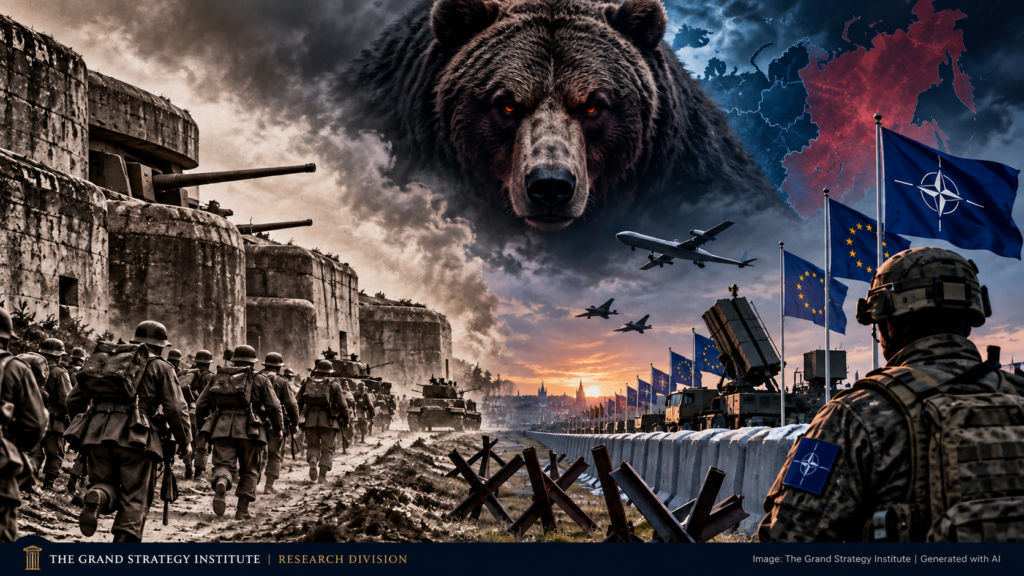
In May 1940, France possessed one of the most sophisticated defensive systems ever constructed. The Maginot Line represented an enormous investment in military engineering, strategic planning and national security.
Its fortifications were designed to protect France against another German invasion, following the devastation of the First World War.
The system was formidable. Underground installations, reinforced concrete, artillery positions and interconnected defensive structures provided protection against a direct assault.
Yet the German invasion exposed a fundamental problem.
France had invested heavily in defending against a particular form of warfare, while Germany developed an operational plan that exploited vulnerabilities elsewhere.
German forces advanced through Belgium and the Ardennes, bypassing the principal fortifications of the Maginot Line. Their breakthrough at Sedan and subsequent advance towards the English Channel disrupted the Allied defensive system.
The Maginot Line was not simply destroyed in a frontal assault. Much of it remained intact even as the wider French military position collapsed.
The failure was therefore not merely technological or architectural. It was also a failure of strategic adaptation.
The French defensive system could perform many of the tasks for which it had been designed. It could not, however, compensate for weaknesses in the wider operational strategy.
More than eight decades later, Europe faces a very different adversary, a different military environment and a fundamentally different international order.
Nevertheless, the historical parallel raises an uncomfortable question.
Could Europe once again be investing in defensive measures that are individually necessary but collectively insufficient to address the full nature of the threat it faces?
This question is particularly relevant as Russia continues its war against Ukraine, European governments expand sanctions and military surveillance, and NATO attempts to adapt its defensive posture to an increasingly unstable security environment.
The analogy with 1940 does not mean that a Russian invasion of NATO territory is inevitable or that contemporary European defences are destined to fail.
It does, however, provide a useful framework for examining the relationship between military preparation, political assumptions and the changing character of warfare.
1. Ukraine: The war that transformed European security
Russia’s full-scale invasion of Ukraine in February 2022 fundamentally altered Europe’s security environment.
The invasion demonstrated that large-scale conventional warfare, territorial conquest, artillery-intensive combat and prolonged military mobilisation had not disappeared from the European continent.
It also challenged assumptions about the relationship between economic interdependence and military conflict.
Before the invasion, European governments maintained extensive economic relationships with Russia, particularly in the energy sector.
Economic cooperation was widely regarded as one element of the broader framework through which relations with Moscow could be managed.
Russia’s decision to invade Ukraine demonstrated that economic relationships alone could not prevent the use of military force.
The war has subsequently become a prolonged confrontation involving conventional military operations, drone warfare, missile strikes, electronic warfare, attacks on energy infrastructure and the mobilisation of industrial resources.
For European governments, the conflict has produced consequences extending well beyond Ukraine’s borders.
Military assistance to Kyiv, the expansion of defence expenditure, the protection of critical infrastructure and the reinforcement of NATO’s eastern flank have become central elements of European security policy.
The Alliance itself has formally identified Russia as a long-term threat to Euro-Atlantic security. Its July 2026 Ankara Summit Declaration reaffirmed collective defence commitments and announced additional defence procurement and industrial production measures.
Yet a fundamental distinction remains.
Ukraine is fighting an active war against Russia. NATO is attempting to prevent that war from expanding into a direct confrontation between Russia and the Alliance.
These are related but different strategic objectives.
The challenge for Europe is to support Ukraine’s defence while ensuring that its own military capabilities, industrial resources and political institutions are prepared for a wider range of security contingencies.
The continuation of the war does not establish that Russia has decided to attack NATO. It does, however, demonstrate the importance of preparing for threats that cannot be addressed through diplomatic declarations or economic pressure alone.
2. Russia and NATO: A confrontation beyond the battlefield
The confrontation between Russia and NATO extends beyond the territory of Ukraine.
It involves competing security objectives, military deployments, nuclear deterrence, intelligence activities, cyber operations and political disputes over Europe’s security architecture.
Russian officials have repeatedly opposed NATO’s military expansion and the Alliance’s support for Ukraine.
NATO, meanwhile, maintains that its collective defence arrangements and support for Ukraine are necessary responses to Russia’s military actions and the threat they pose to European security.
The resulting confrontation creates several distinct security challenges.
The first concerns conventional military capabilities and the possibility of an armed incident involving Russian and NATO forces.
The second concerns activities below the threshold of conventional war, including cyberattacks, sabotage, interference with communications and operations against critical infrastructure.
The third concerns the use of military threats and political messaging to influence the decisions of European governments.
These challenges require different responses.
An air defence system may intercept a missile or drone, but it cannot prevent a cyberattack against an electricity network.
Economic sanctions may restrict access to financial resources or advanced technology, but they cannot independently protect an airport, telecommunications network or military installation.
Military surveillance may identify suspicious activity, but identifying a threat is not equivalent to possessing the means to prevent or defeat it.
This is the central problem with treating European security as a collection of separate defensive measures.
A strategy must connect intelligence, military readiness, economic resilience, political decision-making and the capacity to respond to unexpected developments.
NATO has already undertaken significant adaptations, including new regional defence plans, the reinforcement of its eastern flank, the development of rapid reaction capabilities and increased attention to cyber defence and critical infrastructure.
The question is therefore not whether Europe is responding.
It is whether the pace and integration of those responses are sufficient for the security environment in which they may eventually be required.
3. The new Maginot Line: Sanctions, surveillance and the limits of defensive thinking
The historical comparison with the Maginot Line should not be interpreted as an argument that sanctions, surveillance or defensive fortifications are inherently ineffective.
The original Maginot Line was a substantial military obstacle. Its central weakness was that it could not compensate for vulnerabilities elsewhere in the French defensive system.
A similar distinction is necessary when examining contemporary European security.
Economic sanctions are designed to impose costs on Russia, restrict access to certain technologies and financial resources, and reduce the resources available for activities targeted by those measures.
The European Union has progressively expanded its sanctions in response to Russia’s invasion of Ukraine, territorial annexations and hybrid activities.
These measures have a role in the broader European response.
However, sanctions are instruments of economic and political pressure. They are not physical barriers against military aggression.
Their effectiveness depends on implementation, international cooperation, the availability of alternative markets and Russia’s capacity to adapt.
Most importantly, the existence of sanctions does not automatically prevent a government from continuing military operations when its leadership is prepared to absorb substantial economic costs.
The war in Ukraine has continued despite successive rounds of international sanctions.
That fact does not establish that sanctions have produced no effect. It demonstrates that economic pressure alone has not brought the conflict to an end.
The same distinction applies to surveillance.
Monitoring Russian military activity, protecting European airspace and strengthening intelligence cooperation are essential components of early warning and deterrence.
But surveillance is only one stage in the process of responding to a threat.
The decisive question is what happens after a threat has been identified.
Can military forces respond rapidly?
Are the necessary aircraft, missiles, drones and ammunition available?
Can civilian infrastructure continue operating during a prolonged emergency?
Can European governments coordinate decisions when an incident affects several countries simultaneously?
And can NATO maintain a coherent response when its members face different political, economic and military pressures?
The Maginot Line analogy becomes relevant when defensive instruments are mistaken for a complete strategy.
A modern European security system cannot depend exclusively on detecting threats, announcing sanctions or promising future military investment.
It must also possess the operational capacity to respond when deterrence fails.
4. The danger of preparing for the previous war
One of the defining characteristics of the war in Ukraine has been the rapid evolution of military technology and operational methods.
Uncrewed aerial systems have become central to reconnaissance, targeting, attacks against military equipment and operations against infrastructure.
Electronic warfare, communications systems, air defence and counter-drone capabilities have consequently acquired greater importance.
These developments create a challenge for European defence planning.
Major military procurement programmes often require years to move from political approval to operational deployment.
The technologies and tactics observed on the battlefield can change substantially during that period.
In September 2026, Latvian President Edgars Rinkēvičs warned that European and NATO preparations were struggling to keep pace with developments in drone and aerial warfare in Ukraine. His concerns included gaps in air defence and the availability of interceptor missiles.
The problem is not simply the amount of money allocated to defence.
It is the relationship between expenditure, production capacity, technological adaptation and operational readiness.
An expensive military platform does not necessarily provide an effective response to every emerging threat.
Likewise, possessing sophisticated air defence systems does not eliminate the need for affordable counter-drone capabilities, electronic warfare equipment, protected communications and adequate ammunition reserves.
Europe must also consider the vulnerability of civilian infrastructure.
Electricity networks, ports, telecommunications systems, railways, airports and undersea cables support both civilian life and military operations.
A disruption affecting these systems could complicate the movement of military reinforcements or the continuity of essential services without requiring a conventional invasion.
The strategic lesson of 1940 is therefore broader than the need to avoid constructing static fortifications.
It is the danger of organising national defence around assumptions that technological and operational developments have already begun to undermine.
5. The United States: Europe’s strategic uncertainty
The United States remains a central component of NATO’s military capabilities and collective defence arrangements.
American forces, intelligence systems, strategic transport, nuclear deterrence and military technology contribute substantially to the Alliance’s ability to defend European territory.
Nevertheless, the relationship between Washington and its European allies has become an increasingly important source of strategic debate.
The Trump administration has pressed European governments to assume a greater share of defence expenditure and responsibility for their own security.
In September 2026, the Pentagon was reviewing American military deployments in Europe, including possible adjustments to troop levels and the distribution of responsibilities between the United States and its allies.
This review does not establish that Washington has abandoned NATO or that the United States intends to support Russian military objectives.
Indeed, the United States has continued to undertake actions directed against Russia.
On 18 September 2026, President Donald Trump signed legislation expanding sanctions against Russia, including measures targeting its energy and defence sectors.
On 22 September, Lithuania announced a new rotation of American troops to its territory, confirming the continuation of a US military presence in that NATO member state.
These developments demonstrate why the relationship between Washington, Moscow and Europe cannot be reduced to a simple description of American alignment with Russia.
Nevertheless, the question of European dependence remains.
A military alliance can retain its formal commitments while its members disagree over priorities, expenditure, diplomatic approaches and the distribution of military resources.
For European governments, uncertainty surrounding the availability or timing of American support creates a practical defence planning challenge.
The European members of NATO must determine which capabilities they can sustain independently, which require continued American cooperation and how quickly they could respond to a crisis affecting their own territory.
This does not require abandoning the transatlantic alliance.
It requires distinguishing between the political commitment to collective defence and the practical military capabilities needed to implement that commitment.
Europe’s security cannot be measured exclusively by the strength of declarations issued in Washington or Brussels.
It must also be measured by the forces, equipment, infrastructure and decision-making systems available when a crisis occurs.
6. A defence strategy that cannot remain on paper
European governments have already committed substantial additional resources to defence.
At the June 2025 NATO summit in The Hague, the Allies agreed to work towards spending 5% of GDP annually on defence and security-related requirements by 2035.
The commitment includes at least 3.5% for core defence requirements and up to 1.5% for other security-related investments, including critical infrastructure, resilience and industrial capacity.
At the July 2026 Ankara summit, NATO reported that European allies and Canada had increased their investment in core defence requirements by more than $139 billion in 2025 and announced more than $50 billion in new procurement commitments.
These decisions represent significant changes in European defence policy.
They also illustrate the difference between allocating resources and possessing operational capabilities.
A financial commitment scheduled for 2035 cannot automatically resolve a military vulnerability identified in 2026.
Military personnel require recruitment and training.
Industrial production requires factories, supply chains, skilled workers and access to essential materials.
Air defence systems require interceptors, maintenance, radar coverage and integration with command networks.
Military reinforcements require roads, railways, ports, fuel supplies and logistical coordination.
Civilian populations require functioning emergency services, communications and public infrastructure.
The central challenge is to transform financial commitments into capabilities that can be deployed and sustained.
The historical parallel with the Maginot Line is particularly relevant here.
France did not lack investment in defence before 1940.
Its failure demonstrated that resources must be allocated within a strategy capable of responding to the adversary’s actual methods of warfare.
The same principle applies to Europe today.
Defence expenditure, however substantial, cannot replace strategic coherence.
7. The possibility of a wider war
A direct military confrontation between Russia and NATO would represent a profound escalation beyond the existing war in Ukraine.
Such a conflict would involve nuclear-armed powers and create risks extending far beyond the European continent.
It is therefore essential to distinguish between a potential threat and an established intention to initiate war.
Russia’s invasion of Ukraine, its military activities and its confrontational relationship with NATO justify serious defence planning.
They do not, by themselves, demonstrate that Moscow has made a decision to invade a NATO member state.
Nor does every hostile statement by a Russian official constitute evidence of an imminent military operation.
Strategic analysis must distinguish political rhetoric, military capability, operational preparation and actual decisions.
A confrontation could also develop through an incident that neither side initially intended to escalate into a wider conflict.
An armed encounter, an attack affecting critical infrastructure, an airspace violation or a misunderstanding during a period of heightened military activity could create pressure for rapid political and military decisions.
The existence of NATO’s collective defence commitments makes such scenarios particularly consequential.
Article 5 establishes the principle that an armed attack against one member is considered an attack against all, while allowing each ally to determine the action it considers necessary in response.
This framework is intended to deter aggression by demonstrating that an attack on one ally could produce a collective response.
The credibility of that deterrence depends on both political commitment and military capability.
At the same time, preventing escalation requires reliable communications, disciplined decision-making and the ability to distinguish deliberate aggression from accidents or ambiguous incidents.
The purpose of European defence preparation should therefore be to reduce the likelihood of war, not to treat a wider conflict as unavoidable.
8. What the Maginot Line actually teaches Europe
The collapse of France in 1940 is frequently presented as evidence that defensive fortifications are ineffective.
That interpretation is incomplete.
The principal Maginot fortifications were designed to resist direct assault, and many remained operational even after German forces had advanced deep into France.
The decisive German manoeuvre exploited vulnerabilities outside the strongest sections of the French defensive system.
The failure involved operational planning, military coordination, the speed of the German advance and the inability of the Allied forces to restore a coherent defensive position after the breakthrough.
The relevant lesson for contemporary Europe is not that defensive measures should be abandoned.
It is that no defensive system should be considered sufficient merely because it is technically sophisticated, politically reassuring or financially expensive.
For NATO, the equivalent vulnerability might not be a geographical gap in a line of fortifications.
It could be a weakness in logistics, ammunition production, air defence, cyber resilience, military mobility or political coordination.
It could also involve an excessive dependence on capabilities that European countries cannot independently provide during a prolonged emergency.
These are potential vulnerabilities to examine, not evidence that Russia has identified a particular route or decided to exploit one.
The historical analogy is most useful when it encourages governments to question their assumptions.
It becomes misleading when it is used to suggest that contemporary Europe is simply repeating the events of 1940 or that Russia possesses the same military advantages as Germany did at that time.
Europe today has different military capabilities, a different alliance structure, nuclear deterrence and extensive experience of modern warfare through its support for Ukraine.
The task is to understand how those advantages can be maintained and adapted to changing conditions.
9. The central question: What happens if deterrence fails?
The debate over European security frequently concentrates on defence budgets, sanctions packages, diplomatic negotiations and the declarations issued by NATO leaders.
These are important subjects.
However, they do not fully answer the most difficult strategic question.
What happens if the measures designed to prevent a military confrontation fail?
A credible European defence strategy must be able to address several possible developments simultaneously.
It must consider how to respond to a conventional military attack against NATO territory, how to protect critical infrastructure during hybrid operations and how to maintain essential civilian services during a prolonged emergency.
It must also address the political and military consequences of a crisis in which American support is delayed, limited or directed towards competing priorities.
Such planning should not be confused with an assumption that the United States will abandon Europe.
It is a recognition that national and collective defence require preparation for uncertainty.
The same principle applies to Russia.
European governments cannot base their security exclusively on the assumption that Moscow will always avoid military escalation because the economic or military costs would be too high.
Deterrence depends on influencing an adversary’s calculations, but those calculations are not always visible to outside observers.
The possibility of miscalculation is one reason why credible military capabilities and diplomatic communication must coexist.
Economic sanctions, surveillance, military readiness and diplomacy should therefore be understood as complementary instruments.
None can independently guarantee European security.
Conclusion: The danger is not the wall, but what lies beyond it
The Maginot Line was built to prevent another devastating invasion of France.
Its fortifications reflected the experience of an earlier war and the determination of a country to protect its territory.
The tragedy of 1940 was not that France had constructed defences.
It was that the wider defensive system could not respond effectively when the German offensive developed outside the principal fortified positions.
Europe’s present security challenge is fundamentally different, but the underlying strategic question remains relevant.
The continent has expanded sanctions against Russia, strengthened military surveillance, reinforced NATO’s eastern flank and committed substantial additional resources to defence.
These measures are real, and it would be inaccurate to describe Europe as doing nothing.
Yet their existence does not settle the question of whether European governments possess the capabilities and political coordination necessary to respond to every plausible form of military escalation.
The war in Ukraine has demonstrated the importance of industrial production, technological adaptation, military logistics and the capacity to sustain operations over time.
It has also shown that economic pressure does not automatically bring an armed conflict to an end.
The uncertainty surrounding future American military commitments adds another dimension to European defence planning, even as the United States continues to participate in NATO and maintain forces on European territory.
The historical lesson is therefore not that Europe should abandon sanctions, surveillance or diplomacy.
It is that these instruments must form part of a broader strategy capable of responding to threats that do not conform to existing expectations.
A defensive system is only as credible as its capacity to function when its assumptions are challenged.
The question Europe must confront is not simply whether it has built a sufficiently strong barrier against Russia.
It is whether its political institutions, military forces, industrial resources and civilian infrastructure can continue to function if a confrontation develops in ways that its current defensive arrangements were not designed to address.
The danger of a new Maginot Line is not that Europe is preparing to defend itself. It is the possibility of confusing the measures already taken with a complete answer to the threats that remain.
Sources and Further Reading
The following sources document the current NATO defence posture, European security commitments and developments in American policy. The comparison with the Maginot Line and the conclusions drawn from it are editorial analysis.
The Ankara Summit Declaration
Official declaration adopted by NATO leaders in July 2026, covering collective defence, Russia and allied defence investments.
NATO | Official Source
Deterrence and Defence
NATO’s explanation of its regional defence plans, military readiness, air defence, logistics and adaptation to emerging threats.
NATO | Official Source
Timeline: EU Sanctions Against Russia
Official chronology of European Union sanctions imposed in response to Russia’s invasion of Ukraine and other activities.
Council of the European Union
Top NATO Commander Joins Briefing on Review of US Defence Engagement in Europe
Reuters reporting, 18 September 2026, on the review of American military deployments and defence responsibilities in Europe.
Reuters | International News
Latvia’s President Warns That Europe Is Not Up to Date With Drone and Aerial Warfare in Ukraine
Reporting on European concerns about adapting air defence and military preparations to technological developments in Ukraine.
The Guardian | International Reporting
This article is an opinion and strategic analysis based on documented developments and historical comparison. It does not assert that a Russian attack on NATO has been decided or is inevitable. The Maginot Line analogy is used to examine the relationship between defensive investment, strategic assumptions and military adaptation, rather than to predict the outcome of a future conflict.
The Grand Strategy Institute
Continue Exploring Strategic Analysis
Return to The Grand Strategy Institute for strategic assessments, long-form analysis and research examining geopolitics, military affairs, international security, emerging technologies and the changing international order.
← Back to The Grand Strategy Institute