
Azerbaijan Grand Prix 2026 | Free Practice 3
The Red Bull driver delivered a decisive late lap to end Mercedes’ run at the top of the timesheets, while Lewis Hamilton put Ferrari within striking distance. Gabriel Bortoleto finished 13th for Audi, ahead of teammate Nico Hülkenberg.
By Open Chronicle Sports
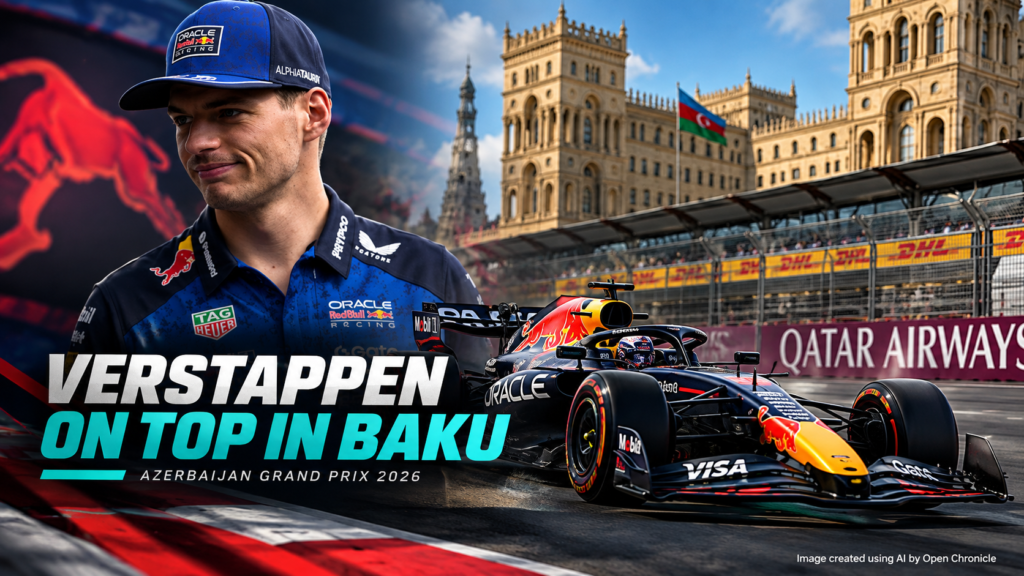
Max Verstappen topped the third and final practice session for the 2026 Azerbaijan Grand Prix on Friday, September 25, setting a time of 1:43.922 around the demanding streets of Baku.
The Red Bull driver produced his fastest lap in the closing minutes on used soft tyres, beating George Russell by just 0.099 seconds and ending the Mercedes driver’s run of consecutive practice session victories.
Lewis Hamilton finished third for Ferrari, only 0.111 seconds behind Verstappen and 0.012 seconds behind Russell. Championship leader Kimi Antonelli took fourth, with Charles Leclerc completing the top five.
The result left three different teams occupying the leading positions ahead of qualifying, with Mercedes, Red Bull and Ferrari separated by exceptionally small margins.
For Audi, Gabriel Bortoleto finished 13th with a time of 1:45.854, ahead of teammate Nico Hülkenberg, who placed 15th with 1:45.998. The Brazilian briefly entered the top ten during the closing stages but lost positions as other drivers completed their final qualifying simulations.
The session also featured several excursions into the escape roads and an accident involving Lance Stroll, highlighting the narrow margins available to drivers on Baku’s street circuit.
A Quiet Start on the Streets of Baku
The final practice session began with relatively little activity as teams waited for track conditions to improve.
Russell entered Friday as the benchmark after leading both Thursday sessions, but the final hour of practice offered his rivals another opportunity to refine their cars before qualifying.
The circuit presented familiar challenges. Overnight dirt had reduced grip, while the wind continued to affect car stability on the long straights and under heavy braking.
Pierre Gasly was the first driver to establish a representative time, initially recording 1:50.582 before improving to 1:48.295.
As more cars joined the session, lap times began to fall rapidly.
Hamilton briefly moved into the lead with 1:46.168, only for Leclerc to respond with 1:45.564. Verstappen and the Mercedes drivers subsequently joined the fight at the front.
Bortoleto, meanwhile, began another important session for Audi.
The German manufacturer had spent much of Thursday evaluating its aerodynamic updates, comparing different configurations between its two drivers. Friday’s final practice provided an opportunity to translate that development work into competitive single lap performance.
The Brazilian initially recorded 1:48.643 before improving to 1:47.304, briefly moving into the top ten.
However, the rapidly changing timesheets meant that his position was far from secure.
Mercedes and Ferrari Exchange Fastest Laps
As the session developed, the leading teams began to reveal more of their performance.
Verstappen moved ahead with a 1:45.329, but Hamilton responded with 1:45.093.
Antonelli then demonstrated the strength of the Mercedes on medium tyres, setting a 1:45.046 to move ahead of the Ferrari by 0.047 seconds.
Russell soon joined the battle, improving from 1:45.377 to 1:44.715.
Leclerc remained competitive with a 1:44.877, while McLaren began to find additional pace with Oscar Piastri and Lando Norris.
The sequence suggested that Mercedes remained competitive, but the advantage it had enjoyed during Thursday’s practice sessions was becoming increasingly difficult to maintain.
With several teams following different tyre programmes, however, the timesheets could not yet provide a definitive picture of their relative performance.
Mistakes Highlight Baku’s Narrow Margins
The increasing pace was accompanied by several driving errors.
Verstappen missed his braking point at Turn 15, entering the escape road before manoeuvring his Red Bull back onto the circuit.
Antonelli experienced a similar excursion, while Hamilton and Leclerc both ran beyond the braking point at Turn 3.
Alexander Albon also went off at Turn 4.
The most significant incident involved Lance Stroll, who struck the inside wall at Turn 1 and damaged the suspension of his Aston Martin.
The Canadian managed to stop in an escape area but was unable to continue.
The incident underlined the particular demands of Baku, where long straights lead into heavy braking zones and even relatively small mistakes can result in contact with the barriers.
With just over 20 minutes remaining, several teams called their drivers back to the garages to prepare for their final qualifying simulations.
Mercedes fitted soft tyres to both Russell’s and Antonelli’s cars, while Audi also prepared Bortoleto for his final performance runs.
Before the decisive attempts began, a tree branch was discovered in the third sector. It was quickly removed, allowing the session to continue without a prolonged interruption.
Russell Raises the Benchmark
Mercedes immediately found additional performance after switching to soft tyres.
Antonelli recorded 1:44.797, moving into second place, but Russell responded with an impressive 1:44.177.
The British driver was now 0.620 seconds ahead of his teammate and appeared to be moving towards another practice session victory.
Verstappen had other plans.
The Red Bull driver improved to 1:44.162, beating Russell by just 0.015 seconds and moving to the top of the classification.
With the leading drivers separated by such small margins, the final minutes promised an increasingly competitive conclusion.
Russell also experienced a moment of concern when he ran wide and stopped just short of the barriers. He avoided contact and was able to continue.
Leclerc suffered another excursion, this time at Turn 7, where he needed to select reverse gear before returning to the circuit.
The repeated mistakes demonstrated how difficult it was to extract maximum performance from the cars without exceeding the available grip.
Bortoleto Finds Time but Misses the Top Ten
Audi’s final practice programme produced an encouraging improvement for Bortoleto, although the Brazilian remained outside the leading group.
His first representative lap during the closing phase was a 1:46.293, temporarily placing him tenth.
Hülkenberg then improved to 1:45.998, opening a gap of almost three tenths over his teammate.
Bortoleto responded with less than six minutes remaining.
The Brazilian completed a lap in 1:45.854, improving by more than four tenths compared with his previous best and moving from 17th to ninth on the provisional timesheets.
He was also 0.144 seconds faster than Hülkenberg.
However, the improvement was not enough to secure a top ten finish.
As Bearman, Gasly, Colapinto and Sainz completed their final attempts, Bortoleto gradually slipped down the order.
He ultimately finished 13th, with Hülkenberg in 15th.
The result provided Audi with additional information about its updated aerodynamic package but also highlighted the work remaining before qualifying.
Bortoleto had shown that the car could improve significantly during the session, yet both Audi drivers finished outside the top ten.
Verstappen Delivers the Decisive Lap
The final change at the top came with just over two minutes remaining.
Despite running on soft tyres that had already completed previous laps, Verstappen produced a 1:43.922 to take the lead.
It was the first lap of the session below 1:44 and established a new benchmark for his rivals.
Russell responded with a 1:44.021, but the Mercedes driver remained 0.099 seconds behind.
Hamilton also improved in the closing minutes, recording 1:44.033 and finishing just 0.012 seconds behind Russell.
Antonelli ended the session fourth with 1:44.273, while Leclerc took fifth with 1:44.544.
Gasly secured sixth for Alpine, ahead of Piastri, who improved to 1:44.746 on his final lap.
Norris finished eighth, followed by Isack Hadjar and Franco Colapinto.
Verstappen had ended Mercedes’ sequence of practice session victories and placed Red Bull at the front at the final opportunity before qualifying.
What FP3 Revealed Ahead of Qualifying
The final practice session produced a different picture from Thursday, when Mercedes had established itself as the early benchmark.
Russell remained competitive throughout Friday’s session and finished within a tenth of Verstappen, but Red Bull’s late improvement demonstrated that the battle for pole position was not confined to Mercedes.
Hamilton’s third place also provided an encouraging indication for Ferrari. The seven time world champion finished just 0.111 seconds from the fastest time, while Leclerc remained within the top five.
Antonelli’s fourth place left both Mercedes drivers among the leading contenders, although the championship leader finished 0.351 seconds behind Verstappen.
McLaren, meanwhile, had a more difficult final practice session. Piastri finished seventh and Norris eighth, leaving the team with a larger gap to close before qualifying.
For Audi, the main challenge was converting its development work into stronger single lap performance. Bortoleto’s late improvement demonstrated progress, but the team finished with both cars outside the top ten.
The narrow margins at the front also reinforced the importance of a clean qualifying lap.
Baku’s long straights, heavy braking zones and unforgiving barriers leave little room for error, and the repeated excursions during FP3 showed how easily a promising lap could be compromised.
With Verstappen, Russell and Hamilton separated by just 0.111 seconds, the final practice session ended without establishing a clear advantage for any one of the three leading teams.
The Final Word
Verstappen’s late lap transformed the final practice classification and ended Mercedes’ run at the top of the timesheets in Baku.
Russell remained within a tenth of the Red Bull driver, while Hamilton demonstrated that Ferrari could also compete at the front.
For Audi, Bortoleto’s improvement provided a positive conclusion to a session in which the team continued to search for performance from its updated car.
The focus now turns to qualifying, where the leading teams will attempt to convert their practice pace into a competitive starting position on one of Formula 1’s most demanding street circuits.