
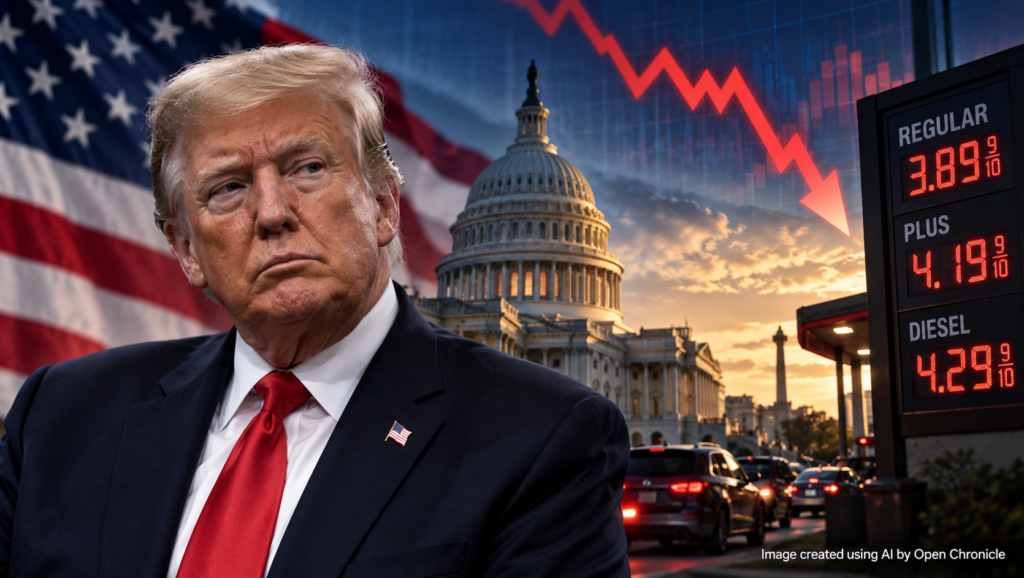
A Reuters/Ipsos poll shows declining support for the U.S. president amid rising living costs and the economic consequences of the war with Iran, with dissatisfaction spreading among Republican voters ahead of November’s midterm elections.
By Open Chronicle with agencies | September 25, 2026
WASHINGTON – A new Reuters/Ipsos poll has found that U.S. President Donald Trump’s approval rating has fallen to 32%, its lowest level of his political career, as growing concerns over the cost of living and the economic consequences of the war with Iran weigh on public confidence in his administration.
The survey, conducted over four days and concluding on Sunday, September 20, also revealed a decline in support among Republican voters, traditionally the president’s most reliable political base.
According to the poll, 73% of Republicans approved of Trump’s overall performance in office, compared with 82% in a Reuters/Ipsos survey conducted one week earlier.
His overall approval rating stood at 35% in the previous survey.
The findings suggest that economic concerns are becoming an increasingly important source of dissatisfaction, including among voters who continue to support the president on other issues.
Republican voters express growing frustration over living costs
The latest survey found that only 17% of American adults approved of Trump’s handling of the cost of living, highlighting the economic pressures facing households across the United States.
Among Republican respondents, dissatisfaction with the president’s management of living costs exceeded approval for the first time.
The poll found that 51% of Republicans disapproved of his handling of the issue, compared with 44% who approved.
The figures indicate that support for Trump’s broader presidency does not necessarily translate into confidence in his economic policies.
Trump returned to the White House in January 2025 promising to bring inflation under control and end American involvement in overseas wars.
A Reuters/Ipsos survey conducted shortly after his inauguration recorded an overall approval rating of 47%.
The latest results represent a decline of 15 percentage points from that initial measurement.
The cost of living has also emerged as a central concern for voters ahead of the November 3 congressional midterm elections, when Republicans will seek to retain their narrow majorities in Congress.
War with Iran adds pressure to household budgets
The economic consequences of the war with Iran have become an important factor in the public debate over the administration’s performance.
Since the conflict began in February, gasoline and diesel prices have risen sharply, adding to transportation costs and placing additional pressure on American households and businesses.
Higher fuel prices can also affect the wider economy by increasing the cost of transporting goods, agricultural production and other essential services.
The latest polling results indicate that dissatisfaction with Trump’s handling of living costs has increased among Republicans during the conflict.
However, the survey does not establish how much of the decline in his overall approval rating can be attributed specifically to the war, fuel prices or other economic concerns.
The administration faces the challenge of addressing domestic inflation and household expenses while managing the economic and security consequences of the conflict in the Middle East.
Midterm elections bring economic concerns into focus
The November 3 midterm elections will determine control of Congress during the remaining two years of Trump’s current presidential term.
Republicans currently hold narrow majorities in both chambers, making the composition of the next Congress an important factor in the administration’s ability to advance its legislative agenda.
The Reuters/Ipsos findings show that living costs remain a significant concern among American voters.
The decline in approval of Trump’s economic management among Republican respondents is particularly notable because it contrasts with the substantially higher level of support for his overall performance.
The survey, however, measures public attitudes toward the president rather than voting intentions in individual congressional races.
Its findings cannot establish how respondents will vote in November or determine the outcome of the elections.
What the Reuters/Ipsos poll found
Trump’s approval and economic performance
Republican views on living costs
Survey of 1,277 U.S. adults, conducted online over four days ending September 20, 2026.
Reported margin of error: ±3 percentage points for the full sample.
Republican subgroup estimates may have a larger margin of error.
Polling results reflect a changing political environment
The Reuters/Ipsos survey provides a snapshot of American public opinion at a time when economic pressures and international security developments are shaping the national political debate.
Although Trump continues to receive majority approval among Republican respondents for his overall performance, the figures reveal a substantial difference between that support and their assessment of his handling of household expenses.
The results also underline the distinction between presidential approval and attitudes toward individual policies.
As the midterm elections approach, the administration’s economic record, the cost of energy and developments in the war with Iran remain subjects of public debate.
Further polling will be needed to establish whether the decline recorded in the latest survey represents a sustained change in public opinion or a temporary movement associated with current economic and international developments.