
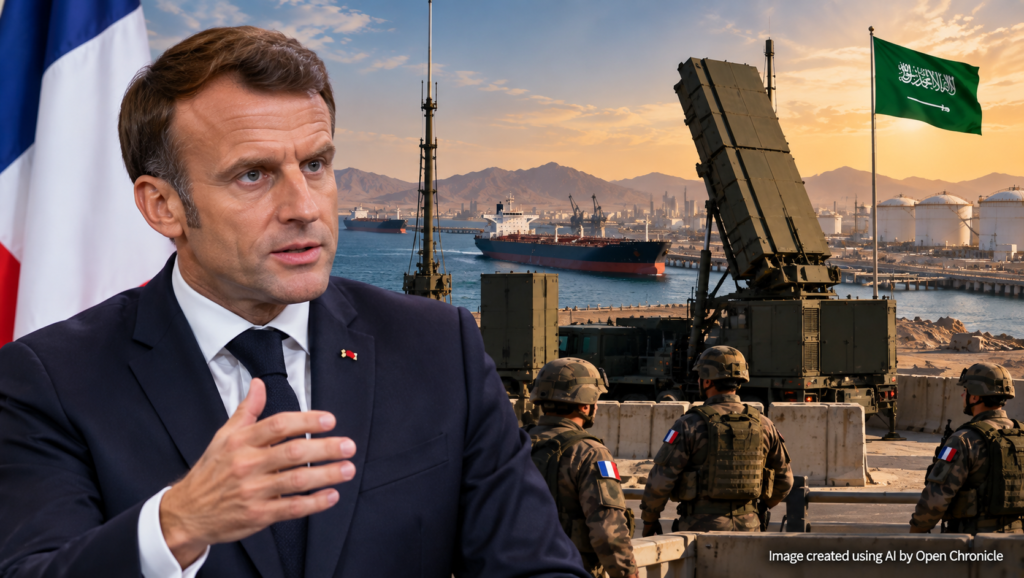
French President Emmanuel Macron has announced plans to send military personnel, radar equipment and defence systems to Saudi Arabia to protect the strategic Red Sea port of Yanbu, as attacks on regional energy infrastructure raise concerns over global oil supplies and European energy security.
By Open Chronicle with agencies | September 25, 2026
France will deploy military personnel and defensive equipment to Saudi Arabia to help protect the port city of Yanbu, a crucial hub for international oil shipments, President Emmanuel Macron announced on Thursday during a televised interview with French broadcasters TF1 and France 2.
The announcement comes amid heightened tensions in the Middle East, where missile attacks by Yemen’s Iran-backed Houthi movement have threatened energy infrastructure and shipping routes.
Yanbu has become particularly important for Saudi Arabia’s oil exports, providing an alternative route to international markets as regional conflict disrupts traditional energy corridors.
Macron said the French deployment would focus on protecting the port and maintaining the security of energy supplies rather than involving France in the wider regional conflict.
“We are going to send military resources, that is to say, soldiers, radar systems and defence systems, to protect this site, not to get us involved in any conflicts, but to protect this site,” the French president told the broadcasters.
The announcement reflects growing European concerns about the security of critical energy infrastructure and the potential economic consequences of further disruption to oil exports from the Middle East.
Yanbu’s strategic importance for global energy supplies
Located on Saudi Arabia’s Red Sea coast, Yanbu serves as an important outlet for the kingdom’s oil exports, particularly when shipping through the Persian Gulf and the Strait of Hormuz faces disruption.
The port is connected to Saudi Arabia’s eastern oil-producing regions through the East-West Pipeline, allowing crude oil to reach the Red Sea without passing through the Strait of Hormuz.
This infrastructure has become increasingly important amid regional military tensions and concerns about the security of maritime energy transport.
Recent missile attacks attributed to Yemen’s Houthi movement have placed additional pressure on the port and contributed to volatility in international crude oil prices.
For France and other European economies, the security of Yanbu is closely linked to the stability of global energy markets.
A prolonged disruption to Saudi oil exports could increase fuel prices, complicate supply arrangements and place further pressure on households and businesses already facing elevated energy costs.
The French deployment is intended to strengthen the protection of the port against potential aerial threats, although Macron did not provide details about the number of personnel involved, the specific defence systems to be deployed or the expected duration of the mission.
Macron seeks to reassure France over winter energy supplies
The French president also addressed growing domestic concerns about energy prices as Europe approaches the winter months.
Macron sought to reassure French households that the country had sufficient oil and natural gas supplies and that the government was actively working to prevent disruptions.
His comments came as higher crude oil prices raised concerns about the cost of transport, heating and industrial production.
Macron also warned about the potential consequences of a United States ban on diesel exports, describing such a measure as catastrophic for both the global economy and the United States itself.
The White House has denied that such a restriction is under consideration.
France remains exposed to international energy market fluctuations despite its substantial domestic nuclear electricity generation capacity.
Oil continues to play a significant role in transport and industry, while natural gas remains important for heating and several industrial activities.
The French government is therefore seeking to maintain reliable energy imports while supporting measures to protect international supply routes.
Macron denies reports of a CIA warning about Russian drone attacks
During the same television interview, Macron addressed reports that United States intelligence agencies had warned European governments about possible Russian drone attacks launched from commercial vessels in the Mediterranean.
Spanish newspaper El Mundo reported that American intelligence had alerted France, Spain and Italy to a potential operation involving Russian drones concealed inside shipping containers.
According to the report, the aircraft could be launched from commercial ships and directed towards sensitive infrastructure, including ports and airports.
Macron rejected the claim that French intelligence services had received such a warning from the CIA.
“I can deny it. The CIA did not inform French services,” he said.
His statement directly contradicted the reported account of an intelligence warning, although it did not rule out the broader possibility of hostile drone activity against European infrastructure.
The French president nevertheless acknowledged that France faces a growing range of security threats linked to Russia.
France strengthens protection against hybrid threats
Macron accused Russia of increasing hostile activities against European countries, including operations targeting critical infrastructure.
He warned that France could face incidents similar to an attempted drone attack at Leipzig airport in Germany in August, which German authorities have attributed to Russia.
Moscow has rejected European allegations of hybrid attacks, describing them as unfounded and politically motivated.
The French president said Russia was seeking to intimidate European governments and weaken their commitment to supporting Ukraine.
Last week, Macron convened leaders of France’s political parties at the Élysée Palace to discuss the security situation and the growing threat posed by drone and cyber operations.
Following those discussions, he instructed the government to prepare additional measures to protect critical national infrastructure.
The proposed measures focus on strengthening defences against unmanned aircraft, improving cybersecurity and ensuring that essential facilities can continue operating during potential attacks.
Airports, ports, energy installations and other strategically important sites are among the types of infrastructure that could require additional protection.
The French government has not yet provided a detailed timetable for implementing the new security measures.
Russian sanctions decision raises questions among European partners
Macron’s remarks on Russian security threats came during a week in which France faced criticism from some European partners over its position on sanctions against Russian businessman Alisher Usmanov.
France supported removing the Russian-Uzbek metals tycoon from European Union sanctions, citing national security concerns.
The decision prompted questions among other EU member states about the consistency of the bloc’s sanctions policy towards Russia.
According to the information reported, Azerbaijan subsequently pardoned a French national who had been imprisoned on espionage charges.
The developments illustrate the diplomatic complexity facing European governments as they attempt to maintain pressure on Moscow while managing other national security and foreign policy priorities.
France faces simultaneous security challenges in Europe and the Middle East
The planned deployment to Yanbu highlights the geographical scope of France’s current security commitments.
In the Middle East, Paris is seeking to protect energy infrastructure and support the continuity of international oil shipments without becoming directly involved in the wider regional conflict.
In Europe, the French government is strengthening preparations against potential drone attacks, cyber operations and other threats to critical infrastructure.
Both priorities have significant implications for the French economy, particularly as rising energy costs place additional pressure on households and businesses.
Macron’s announcements indicate that the government intends to combine military protection of strategic facilities abroad with stronger domestic security measures.
The operational details of the deployment to Saudi Arabia, including its scale, duration and coordination with Saudi authorities, have yet to be announced.
For France, the immediate challenge is to maintain reliable energy supplies while responding to security risks across two increasingly interconnected regions.