
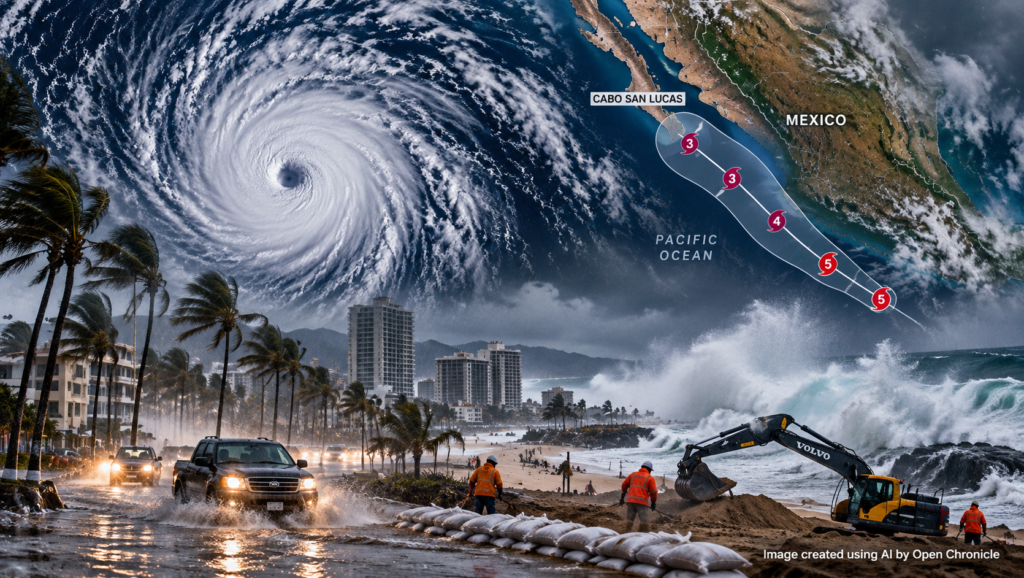
Hurricane Nolo is expected to strengthen into a major hurricane as it passes south of Hawaii, threatening the Big Island with potentially life threatening flooding, destructive surf and strong winds. Meanwhile, Hurricane Polo is intensifying near Mexico, with the Baja California peninsula preparing for another powerful Pacific storm.
By Open Chronicle with agencies | September 26, 2026
HILO, Hawaii, Residents across Hawaii’s Big Island are preparing for another potentially catastrophic storm as Hurricane Nolo approaches the islands, bringing the threat of extreme rainfall, flash flooding, damaging winds and dangerous coastal conditions.
Nolo’s maximum sustained winds increased to 105 mph, or 165 kph, on Friday, with forecasters expecting the system to strengthen into a major hurricane on Saturday.
The storm’s centre was approximately 145 miles, or 235 kilometres, south of Hawaii’s southernmost point.
Although the centre is expected to remain south of the islands, Nolo’s northern edge could bring severe conditions across the Big Island through the weekend.
Forecasters warned that parts of the island could receive as much as 15 inches, or 38 centimetres, of rain, with isolated totals potentially reaching 25 inches, or 64 centimetres.
That represents a reduction from an earlier forecast that suggested some locations could receive as much as 35 inches, or 89 centimetres.
Residents urged to shelter as conditions deteriorate
Michael Brennan, director of the National Hurricane Center, urged Big Island residents to remain in safe locations as the storm approaches.
“People are going to want to kind of shelter in place on the Big Island, be in their safe place, certainly by later today, tonight, well into Saturday,” Brennan said Friday.
He warned people against travelling unnecessarily during the storm because flooding and strong winds could create dangerous conditions.
“Don’t venture out if you don’t have to into the dangerous flooding environment, but also high winds. We can have trees and power lines down.”
Heavy rainfall is also possible elsewhere across Hawaii.
Maui could experience significant rainfall, potentially producing life threatening flooding and mudslides.
Big Island prepares for extreme rainfall
Emergency crews spent Friday preparing vulnerable communities for the expected rainfall.
Workers constructed berms designed to redirect floodwater and removed large debris that could become dangerous once heavy rain intensified.
Humanitarian organisations have also been preparing emergency supplies.
CORE and other nonprofit partners spent the week transporting camp stoves, hygiene products and other essential supplies by air from Oahu to the Big Island.
The equipment is being sent to a community relief hub that has remained active since Hurricane Lala struck in August.
That previous storm has created an additional concern because southeastern areas of the Big Island remain saturated from Lala and subsequent rainfall.
Nolo’s heaviest precipitation is expected to affect some of those same areas.
Already saturated ground increases the potential for flooding, runoff and mudslides.
Trump approves federal emergency declaration
President Donald Trump approved an emergency declaration for Hawaii on Friday.
The declaration authorises the Federal Emergency Management Agency to coordinate federal assistance and provide financial support for emergency protective measures.
Hawaii’s governor has also issued an emergency proclamation.
More than 230 members of the Hawaii National Guard have been activated as authorities prepare for deteriorating conditions.
Schools have been closed in some areas.
Hawaii County officials have urged people living in flood prone communities to consider relocating to emergency shelters or other safer locations before conditions become too dangerous for travel.
Storm surge threatens coastal communities
Flooding from rainfall is not the only concern.
Nolo could generate a storm surge of between one and three feet, approximately 30 to 91 centimetres.
The additional water could combine with large waves to produce dangerous surf and coastal flooding.
Communities along exposed coastlines have been warned to prepare for rapidly changing conditions.
Hawaiian Electric is also repositioning personnel ahead of the storm.
Crews that had been helping restore electricity on Kauai following Hurricane Lowell earlier this month are returning to Oahu, Maui and the Big Island to prepare for potential outages caused by Nolo.
High winds combined with saturated soil could bring down trees and power lines, complicating restoration efforts.
Sandbags distributed in Hilo
Residents and visitors in Hilo spent Friday making final preparations.
Authorities established a sand distribution centre at Francis Wong Stadium, where residents filled bags with sand and gravel to protect homes and property.
Dean Taise decided to collect sandbags after water began entering his driveway from the street.
“They say, prepare for the worst, right? Hope for the best,” he said.
At Hilo International Airport, piles of sandbags were positioned around the terminal as airlines adjusted operations.
Southwest Airlines cancelled flights, while Hawaiian Airlines was still operating from the airport on Friday afternoon.
Passenger Daniela Mendoza was attempting to return home to Oahu following the cancellations.
“I hope I can leave,” she said. “My cats are waiting for me.”
Hurricane Polo threatens Mexico
Hawaii is not the only part of the Pacific facing a major tropical cyclone.
Mexico is preparing for Hurricane Polo as the powerful storm moves toward the Baja California peninsula after bringing severe conditions to the country’s southwestern coastline.
Polo strengthened significantly overnight into Friday morning.
By midday Friday, its estimated sustained winds had reached 175 mph, or 280 kph.
The storm brought heavy rainfall and dangerous coastal conditions to parts of Mexico’s Pacific coast, although no major widespread flooding or damage had initially been reported overnight.
Attention has now shifted toward Baja California, where Polo is expected to curve toward the peninsula and potentially affect the region between Monday and Tuesday.
Local authorities are preparing shelters, while the Mexican government has announced port closures.
Coastal communities prepare for Polo
Residents in vulnerable Mexican communities have been stacking sandbags around beachfront businesses and evacuating homes in exposed coastal areas.
Authorities cleared people from beaches and opened emergency shelters.
Approximately 15,000 security personnel have been deployed across affected coastal regions.
Schools have also been closed.
In Lazaro Cardenas, Michoacan, seawater entered homes and left furniture, wooden debris and other material scattered across streets.
Residents and government workers were clearing debris and removing thick mud left behind by the water.
Restaurant owner Alicia Contreras said waves reaching approximately 15 feet, or 4.5 metres, severely damaged the walls and roof of her business.
She expressed concern about how she would recover financially because the restaurant represents her only source of income.
Polo could affect southwestern United States
Polo’s effects may eventually extend beyond Mexico.
Moisture associated with the hurricane could move into parts of the southwestern United States by Monday.
The Four Corners region could experience scattered flash flooding, with portions of Arizona and New Mexico facing particular risks.
Concern about high tides and hazardous surf has also reached Southern California.
Biologists relocated eggs from two olive ridley sea turtle nests on Southern California beaches to the Aquarium of the Pacific in Long Beach as officials monitored conditions associated with Polo.
El Niño fuels active Pacific storm season
The powerful storms are developing during an El Niño period that is producing major environmental changes around the world.
El Niño can alter atmospheric and oceanic circulation patterns, contributing to drought in some regions and flooding in others.
It traditionally suppresses tropical cyclone activity in the Atlantic while creating conditions more favourable for storms in the Pacific, including increased atmospheric moisture and reduced wind shear.
Nolo and Polo are not the only significant systems currently being monitored.
Hurricane Odalys remains far from land
Hurricane Odalys was at Category Four intensity on Friday.
The storm remained well away from populated areas, approximately 1,537 kilometres west southwest of the southern tip of the Baja California peninsula.
Forecasters continue to monitor the system, although it was not immediately threatening land.
Two additional storms were active in the Atlantic.
Tropical Storm Fay reformed early Thursday in the northern Atlantic and was approximately 1,674 kilometres west southwest of the Azores as of Friday.
Closer to Africa, Tropical Storm Gonzalo strengthened early Friday while approaching the Cabo Verde Islands.
A weekend of dangerous weather across the Pacific
The immediate focus remains on Hawaii, where residents are preparing for Nolo’s closest approach and potentially extreme rainfall.
The Big Island faces a combination of hazards including flash flooding, mudslides, strong winds, dangerous waves, coastal inundation and possible power outages.
The threat is intensified by saturated ground left by previous storms.
Emergency authorities are urging residents to complete preparations before conditions worsen and to avoid unnecessary travel once flooding begins.
At the same time, Mexican authorities are preparing for Hurricane Polo’s expected approach toward Baja California.
With multiple powerful systems active across the Pacific, the final weekend of September is presenting emergency services with a complex and rapidly evolving tropical weather situation.