
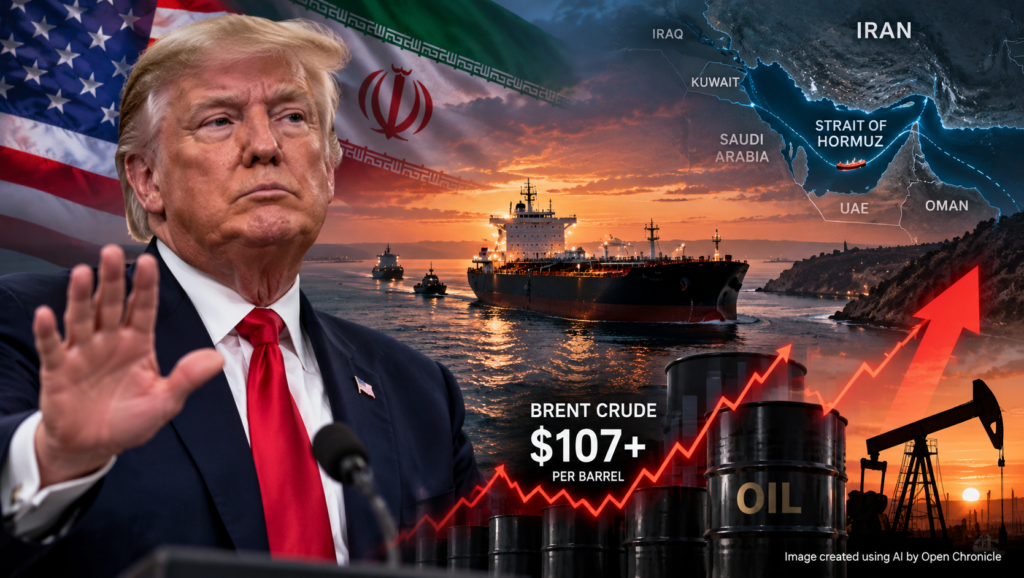
Crude prices jumped sharply at the start of the week after US President Donald Trump rejected an Iranian proposal for a seven day truce that could have reopened the Strait of Hormuz. The renewed uncertainty pushed Brent crude back above $107 a barrel and revived concerns about inflation, interest rates and the stability of global energy supplies.
By Open Chronicle with agencies | September 28, 2026
HONG KONG — Oil prices surged on Monday after US President Donald Trump rejected an Iranian proposal for a seven day truce, reviving fears that disruption to one of the world’s most important energy corridors could continue and intensify pressure on the global economy.
The Iranian proposal, presented during the United Nations General Assembly, envisaged a halt in hostilities and the reopening of the Strait of Hormuz under a broader agreement with Washington.
Trump rejected the terms but indicated that diplomatic contacts were not necessarily over.
“I reject their proposal,” Trump told reporters outside the White House.
In a separate interview, Trump said he expected negotiations to resume, while arguing that Tehran was seeking terms Washington was unwilling to accept.
“They want to make a deal, but it is not the deal that I want to make,” he said. “It is what we would have maybe agreed to a year ago.”
“They overplayed their hand,” Trump added.
Recent reporting has confirmed that Iran has offered to reopen the Strait of Hormuz if the United States eases military pressure and lifts its blockade of Iranian ports.
Oil rebounds above $107
The diplomatic setback quickly affected energy markets.
Oil prices had fallen by more than two percent on Friday as traders reacted to the possibility of an agreement. That optimism reversed as the new trading week began.
Brent crude surged by more than three percent, moving back above $107 a barrel.
The reaction reflects the importance of the Strait of Hormuz to international energy supplies. Disruption around the waterway has already forced markets to reassess the security of oil shipments from the Gulf.
Recent trading has demonstrated the sensitivity of crude prices to developments surrounding Hormuz. Brent had already traded near $107 during the previous week as tight supply conditions competed with hopes for diplomatic progress.
Iran maintains its conditions
Despite Trump’s rejection, the possibility of further negotiations remains open.
Indirect discussions between Washington and Tehran could resume, while Iran continues to insist on its conditions for reopening the Strait.
Those conditions include the release of frozen Iranian assets, sanctions relief involving Iranian oil exports and an end to the US blockade of Iranian ports.
Earlier diplomatic discussions had explored the possibility of a phased arrangement in which Iran would reopen Hormuz while Washington eased its blockade.
The negotiations therefore remain focused not simply on a temporary ceasefire, but on the wider economic and strategic conditions surrounding the conflict.
Two strategic waterways under pressure
The Strait of Hormuz is not the only maritime route causing concern.
Developments in Yemen have increased uncertainty around the Bab al Mandab Strait, another critical passage connecting the Red Sea with the Gulf of Aden.
Houthi forces have expanded their presence along Yemen’s Red Sea coast, increasing concern about the security of international shipping through the region. Recent fighting has centred on territory around the Bab al Mandab corridor.
The combination of instability around Hormuz and the Red Sea has increased pressure on global shipping, energy markets and freight costs.
Inflation concerns return
Higher oil prices quickly revived concerns that energy costs could feed into broader inflation.
Bond yields climbed as investors reassessed the possibility that inflationary pressure could remain elevated for longer than previously expected.
The increase in borrowing costs comes at a sensitive moment for central banks, particularly the US Federal Reserve.
Markets are closely watching whether persistent inflation could encourage policymakers to maintain a more restrictive approach to interest rates.
The Fed’s preferred inflation measure is due this week, followed by important US employment data. Both could influence expectations ahead of the central bank’s next policy meeting at the end of October.
Asian markets come under pressure
Stock markets across Asia responded unevenly to the renewed uncertainty.
Seoul fell 2.7 percent as trading resumed following an extended break, while Tokyo, Shanghai, Manila, Mumbai, Bangkok and Jakarta also moved lower.
Hong Kong, Sydney, Singapore and Wellington recorded gains.
European markets opened more positively, with London, Paris and Frankfurt advancing despite the renewed increase in energy prices.
The contrasting performances reflected the competing forces facing investors: geopolitical uncertainty, higher energy costs, inflation risks and the possibility that diplomacy between Washington and Tehran could eventually resume.
Global bond yields rise
Bond markets are also reflecting growing concern about the inflationary consequences of the energy crisis.
Higher oil prices can affect transportation, manufacturing, food production and consumer prices, making sustained increases particularly important for central banks attempting to control inflation.
The renewed rise in yields suggests investors are reconsidering how quickly monetary policy can return to more accommodative conditions.
Markets still see possibility of diplomacy
Despite the sharp reaction in oil prices, investors have not completely abandoned expectations that Washington and Tehran could eventually return to negotiations.
Trump has previously said that talks between the two countries were continuing and that he believed a settlement could ultimately be reached.
The central question for energy markets is whether diplomatic contacts can produce an arrangement capable of restoring more reliable traffic through the Strait of Hormuz.
Until that happens, geopolitical developments are likely to remain a major influence on oil prices.
For the global economy, the consequences extend far beyond the energy market. A prolonged period of elevated crude prices could reinforce inflation, increase transportation and manufacturing costs, complicate central bank decisions and place additional pressure on households and businesses.
With the Strait of Hormuz at the centre of the confrontation and instability continuing around the Red Sea, the security of the world’s energy supply remains closely tied to the outcome of diplomacy between Washington and Tehran.