
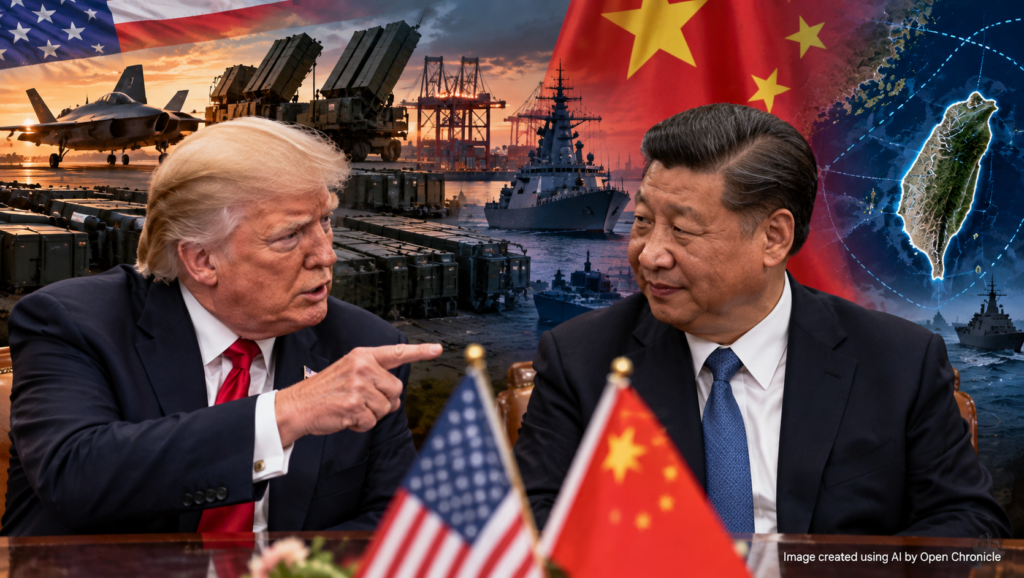
US President Donald Trump asked Chinese President Xi Jinping whether Beijing would be interested in purchasing American weapons during their latest meetings in Washington, according to US Ambassador to China David Perdue. The disclosure came as the ambassador defended continued US arms sales to Taiwan, while the State Department stressed that American law currently prohibits arms sales to China.
By Open Chronicle with agencies | September 28, 2026
WASHINGTON — US President Donald Trump asked Chinese President Xi Jinping whether China would be interested in buying American weapons during Xi’s state visit to Washington, according to the United States ambassador to Beijing.
David Perdue revealed the exchange during an interview on Sunday while discussing Washington’s controversial arms sales to Taiwan.
“President Trump continues to say, hey, we sell arms to other people around the world,” Perdue said.
“He actually asked President Xi, would he like to buy some at one point.”
Perdue did not disclose how the Chinese president responded to the question.
The unusual exchange emerged following three days of high level diplomacy between the leaders of the world’s two largest economies.
Trump and Xi conclude three day summit
Trump hosted Xi at the White House on Thursday for a closely watched summit covering some of the most sensitive issues in relations between Washington and Beijing.
The two leaders met again on Friday for a private tea session and reviewed pictorial and textual archives in Washington before Xi departed for China, concluding his three day state visit.
The meetings came at a critical moment for relations between the two powers, with disagreements over Taiwan, trade and strategic competition continuing alongside efforts to stabilise bilateral relations.
Perdue described Xi’s visit as successful.
Beijing responded cautiously to the disclosure concerning Trump’s question about American weapons.
China says military serves its own security needs
Asked about the remarks on Monday, Chinese Foreign Ministry spokesman Guo Jiakun emphasised Beijing’s stated commitment to international stability.
“China has built its military based on its own needs and is dedicated to safeguarding world peace and stability,” Guo told reporters in Beijing.
The Chinese response did not directly indicate whether Xi had engaged with Trump’s suggestion.
The comments nevertheless came against the background of continued military competition between the United States and China, particularly in the Indo Pacific region.
State Department says there is no plan to sell weapons to China
Following Perdue’s remarks, a US State Department official clarified that Washington does not have a proposal to sell military equipment to Beijing.
The official said US law prohibits arms sales to China and that the administration has “no offer or plan” to provide weapons to the country.
Perdue’s disclosure therefore appears to describe an exchange between the two presidents rather than a formal policy proposal or arms sale initiative.
His remarks were made while defending a very different component of American security policy in East Asia: continued weapons transfers to Taiwan.
Perdue defends US arms sales to Taiwan
Beijing has repeatedly condemned American arms sales to Taiwan, which China considers part of its territory.
Perdue said Washington’s policy towards Taiwan had not changed.
He cited the United States’ one China policy, the Taiwan Relations Act, the three joint US China communiques and the Six Assurances as elements of the framework governing American policy.
“We don’t support independence and we don’t support coercion,” Perdue said.
The ambassador also pointed to the scale of arms transfers authorised under Trump.
According to Perdue, Trump has approved an $11 billion arms package for Taiwan and authorised 50 percent more arms transfers than any US president since 1979.
The arms relationship between Washington and Taipei remains one of the most contentious issues between the United States and China.
Beijing continues to oppose Taiwan weapons sales
China regards Taiwan as part of its territory and has consistently opposed foreign military support for the island.
Beijing argues that US weapons sales interfere in China’s internal affairs and undermine relations between Washington and Beijing.
The United States maintains unofficial relations with Taiwan while continuing to provide the island with defensive capabilities under American law.
Perdue’s comments therefore came in the context of a longstanding disagreement over how Washington’s weapons transfers fit within its broader China policy.
The United States once supplied weapons to China
Although modern US restrictions prohibit arms sales to Beijing, Washington and China previously maintained a limited military supply relationship.
During the 1980s, the two countries developed closer strategic cooperation as both sought to counter the Soviet Union.
During that period, the United States supplied China with military equipment that included AN/TPQ 37 counter artillery radar systems and Mark 46 torpedoes.
The strategic relationship changed substantially after the end of the decade.
US government to government arms sales were subsequently halted, and no new Foreign Military Sales agreements with China were opened after 1990, according to the US Government Accountability Office.
The historical episode illustrates how dramatically the strategic relationship between Washington and Beijing has changed.
An unusual moment in a sensitive relationship
Trump’s reported question to Xi stands out because military technology is now among the most sensitive dimensions of US China competition.
Both countries are investing heavily in advanced military capabilities while competing in areas including artificial intelligence, space, naval power, missiles and advanced manufacturing.
At the same time, the latest Trump Xi meetings have demonstrated that both governments are seeking channels for managing their disagreements.
The state visit produced renewed dialogue between the two leaders at a time when Taiwan remains one of the most serious potential sources of confrontation.
Perdue’s disclosure adds an unexpected detail to those discussions.
Whatever Trump intended by asking Xi whether China wanted to purchase American weapons, the subsequent State Department clarification makes Washington’s formal position clear: there is currently no offer or plan to sell US weapons to Beijing.
Explore International Relations
Discover more reporting and analysis on diplomacy, international security, global governance and the changing balance of power.
Return to International Relations →