
How Robert Peel’s experiment in preventive policing transformed law enforcement in Britain and helped create a model that would influence police forces around the world
By Open Chronicle History Desk
At six o’clock in the evening on September 29, 1829, an unfamiliar sight appeared on the streets of London.
Men dressed in dark blue began walking predetermined beats through the metropolis.
They were not soldiers.
They did not carry muskets or swords.
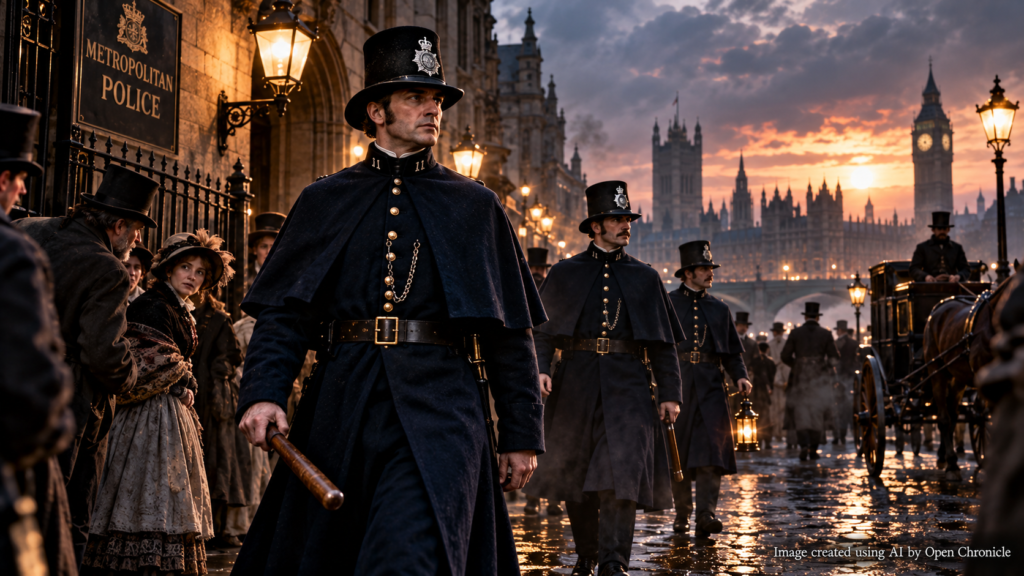
They wore blue coats and black top hats, carried wooden truncheons, and used rattles to summon assistance.
They belonged to a new institution:
the Metropolitan Police.
The British Parliament records that the first group marched out on the evening of September 29 from premises near what would become associated with Scotland Yard. Their appearance was deliberately civilian rather than military, an important distinction in a country where the creation of a centrally organized police force had generated considerable suspicion.
Many Londoners initially mocked them.
Some distrusted them.
Others feared that Britain was creating something resembling the centralized police institutions associated in the public imagination with authoritarian continental governments.
Yet the experiment survived.
Within decades, the uniformed constable walking a neighborhood beat would become one of the most recognizable figures of British public life.
And the institution launched in London in 1829 would influence the development of modern policing far beyond Britain.
1. London Before the Metropolitan Police
London did not suddenly acquire law enforcement in 1829.
For centuries, communities had relied upon a complicated collection of constables, watchmen, magistrates and parish organizations.
There were also specialized institutions.
The Bow Street Runners, associated with the Bow Street magistrates’ office, had developed during the eighteenth century and performed investigative and enforcement functions.
The Thames had its own policing arrangements.
Parishes employed watchmen.
Constables carried out local duties.
But there was no single professional police organization responsible for most of metropolitan London.
The National Archives describes the old system as involving thousands of night watchmen, hundreds of constables, the Bow Street Runners and other overlapping organizations, with fragmented responsibilities and widely varying effectiveness.
For a rapidly expanding metropolis, this arrangement was becoming increasingly difficult to sustain.
2. The Metropolis Explodes
London was changing dramatically.
Industrialization, commerce and population growth were transforming the city.
People arrived from across Britain and beyond.
New neighborhoods expanded beyond the older urban core.
Docks handled enormous quantities of goods.
Markets, factories, workshops, warehouses and crowded residential districts created an increasingly complex city.
With expansion came concerns about crime and public disorder.
The traditional parish system had been designed for a different urban world.
By the early nineteenth century, reformers increasingly argued that London needed a more coordinated approach.
But creating a police force raised another problem.
Many Britons were deeply suspicious of centralized policing.
3. Fear of a Police State
The opposition was not simply resistance to change.
It reflected political history.
Britain prided itself on traditions of civil liberty and limited standing military involvement in everyday public life.
A powerful national police institution could therefore appear threatening.
Critics worried that police might become government spies.
Others feared that uniformed agents could interfere excessively in ordinary life.
The idea of a centrally controlled police force was sometimes associated with continental European governments regarded by British critics as authoritarian.
The challenge was therefore not merely to create an effective police force.
It was to create one that the population could eventually accept as legitimate.
That distinction would shape the institution established in 1829.
4. Robert Peel
The political figure most closely associated with the transformation was Robert Peel.
Peel became Home Secretary in 1822 and made reform of criminal justice and policing an important part of his work.
He believed that an organized police presence could help prevent crime rather than merely respond after offences had occurred.
Parliament notes that an inquiry in 1828 supported the establishment of a police force for London, and Peel subsequently brought forward the legislation that became the Metropolitan Police Act.
His name became so closely associated with the new constables that two famous nicknames emerged:
Peelers
and later
Bobbies.
Both derived from Peel’s surname.
5. The Metropolitan Police Act 1829
The decisive legislative step came in 1829.
The Metropolitan Police Act established a professional, full-time and centrally organized force for much of greater London, operating under the authority of the Home Secretary. Parlamento UK
The objective represented a fundamental shift.
Policing would no longer depend primarily upon a patchwork of loosely coordinated local arrangements.
There would be trained constables.
Defined areas of responsibility.
Supervision.
Rules of conduct.
Regular patrols.
And an administrative structure capable of coordinating policing across much of the metropolis.
The National Archives records an initial establishment including eight superintendents, 20 inspectors, 88 sergeants and 895 constables.
A new profession was emerging.
6. Two Commissioners
The new institution required leadership.
The first Commissioners were:
Charles Rowan
and
Richard Mayne.
They faced a difficult task.
They needed to recruit hundreds of men quickly while establishing discipline, organization and public credibility.
The force had to appear effective without appearing militarized.
That balance influenced almost everything from uniforms to equipment.
The police officer was intended to become a visible presence in the community.
But he was not supposed to resemble an occupying soldier.
7. Why the Uniform Was Blue
Uniform design carried political meaning.
The new constables wore dark blue rather than military red.
This was deliberate.
The distinction helped visually separate the police from the British Army.
Parliamentary accounts describe the first officers wearing blue cloaks and black top hats, precisely to avoid the appearance of soldiers.
Their equipment reinforced the message.
They did not routinely patrol carrying firearms or swords.
Instead, constables carried wooden truncheons.
A wooden rattle could be used to call other officers for assistance.
The message was visual as well as practical:
this was supposed to be a civilian police service.
8. September 29, 1829
Then came the moment when legislation became reality.
At approximately 6 p.m. on Tuesday, September 29, 1829, the first Metropolitan Police officers began their duties.
They walked out onto London streets and started patrolling.
Parliamentary records describe them leaving a building near Scotland Yard and encountering ridicule and hostility from sections of the public. Parlamento do Reino Unido
The experiment had begun.
There were no police cars.
No radios.
No forensic laboratories.
No emergency telephone system.
No computerized databases.
The fundamental technology of the new force was much simpler:
the constable on foot patrol.
9. Walking the Beat
The beat became one of the defining features of nineteenth-century policing.
A constable was assigned a particular area and expected to patrol it repeatedly.
That created something earlier systems often lacked:
continuous visible presence.
The officer could observe unusual activity.
He could intervene in disturbances.
He could respond to cries for help.
He could identify dangerous locations.
He could become familiar with streets, businesses and residents.
The principle was preventive.
A visible officer might discourage an offence before it occurred.
That represented an important conceptual shift in policing.
10. Preventing Crime
The new police were not designed merely to arrest offenders.
Prevention was central to the project.
During parliamentary debate on the legislation, supporters explicitly argued that preventing crime could reduce the need for punishment. Hansard
That idea became deeply associated with the later philosophy of British policing.
Police presence was supposed to reduce opportunities for crime and maintain public order.
The officer walking his beat therefore represented more than enforcement.
He embodied a theory:
effective policing begins before the crime occurs.
11. The Public Was Not Convinced
The Metropolitan Police did not immediately become beloved.
Quite the opposite.
Officers faced ridicule.
They were insulted.
They sometimes encountered physical resistance.
Some Londoners regarded them as intrusive government agents.
Others mocked their uniforms and authority.
The hostility could become deadly.
In 1833, Constable Robert Culley was killed during a political disturbance, an event later remembered as evidence of the intense opposition faced by early officers. Parliamentary discussion of the Met’s history notes how deep public hostility remained during these early years.
Acceptance had to be earned.
12. Discipline Inside the Force
The Metropolitan Police also imposed strict expectations upon its own recruits.
Constables were expected to behave in ways intended to distinguish them from the disorder they were policing.
The National Archives notes that recruits faced restrictions on associating with known criminals, visiting public houses and other conduct considered incompatible with police service.
Discipline could be severe.
Alcohol was a particularly significant problem.
Records from the early force contain numerous dismissals for drunkenness.
Remarkably, National Archives material notes that William Atkinson, warrant number one, was dismissed for drunkenness on September 29, 1829 itself. Arquivo Nacional
The first day of modern London policing therefore already contained one of the institution’s enduring challenges:
how to police the police.
13. The Police and the City
The new force did not initially cover every part of what we now think of as London policing.
The City of London retained its own institutional arrangements.
Other organizations continued to exist alongside the Metropolitan Police.
Over time, however, the Met absorbed or replaced several older policing structures.
National Archives records show that by 1839 many earlier organizations had been incorporated or superseded, while the City of London remained institutionally separate.
The system was evolving rapidly.
14. Scotland Yard
One name would eventually become internationally synonymous with British policing:
Scotland Yard.
The headquarters of the Metropolitan Police became associated with premises accessed from Great Scotland Yard near Whitehall.
Over time, the name ceased to mean merely a location.
“Scotland Yard” became shorthand for the Metropolitan Police itself, particularly its investigative work.
The transformation illustrates how quickly the institution became embedded in British culture.
A location became an organization.
The organization became a symbol.
15. From Patrolmen to Detectives
The original Metropolitan Police emphasized uniformed preventive patrol.
Detective policing developed later.
The Metropolitan Police’s own historical timeline dates the formation of a formal Detective Branch to 1842. Met Police
This added another dimension to professional policing.
Uniformed constables could patrol streets and maintain order.
Detectives could investigate crimes after they occurred.
Over time, increasingly sophisticated methods of criminal investigation would emerge.
Photography.
Fingerprinting.
Forensic science.
Communications technology.
Databases.
But all of that lay in the future.
In 1829, the central innovation remained the organized constable walking the streets.
16. The Expansion of Professional Policing
London’s experiment did not remain isolated.
The principle of organized professional policing spread.
The Rural Constabulary Act of 1839 allowed counties to establish police forces.
The County and Borough Police Act of 1856 later made policing compulsory throughout England and Wales.
The Metropolitan model also attracted international attention.
Police organizations elsewhere adapted elements of British policing to their own legal, political and social circumstances.
There was never a single universal model.
But London in 1829 became one of the central reference points in the history of modern professional policing.
17. The Myth of the “Peelian Principles”
Modern discussions of policing frequently refer to the Peelian Principles.
These usually emphasize concepts such as public cooperation, prevention, restraint and the idea that police legitimacy depends upon public approval.
There is an important historical qualification.
The familiar nine-point list widely circulated today was not written down by Robert Peel himself in that exact form.
The ideas reflect traditions associated with early Metropolitan policing and later interpretations of its philosophy, but the modern formulation should not simply be presented as a document authored personally by Peel.
That distinction matters.
History is often simplified into memorable quotations and lists.
The development of policing was considerably more complicated.
18. Policing by Consent
One concept became particularly influential in later British policing culture:
policing by consent.
The idea is that effective police authority cannot depend solely upon coercion.
It also requires public legitimacy and cooperation.
A police force operating among civilians must persuade much of the population that its authority is lawful and its presence beneficial.
That principle was especially important in 1829 because the Metropolitan Police began amid suspicion that a centralized force might threaten traditional liberties.
The early constable therefore faced a difficult task.
He had to enforce authority while appearing to remain part of civilian society.
19. The Police Officer as a Cultural Figure
Over the nineteenth century, the London policeman became a recognizable cultural character.
The uniformed “Bobby” appeared in:
newspapers,
illustrations,
novels,
political cartoons,
theatre,
and eventually film and television.
The image could be affectionate or critical.
Sometimes the policeman represented order and security.
Sometimes bureaucracy.
Sometimes authority.
Sometimes comic frustration.
But the cultural visibility itself demonstrated how thoroughly the institution had become part of urban life.
20. Crime, Authority and Society
The history of policing cannot be told only as a story of institutional progress.
Police forces exercise state authority.
That authority raises enduring questions.
Who defines disorder?
Which laws are enforced?
How much power should police possess?
How should officers be held accountable?
How should force be regulated?
How can public safety coexist with civil liberties?
Those questions existed in 1829.
They remain important today.
The creation of professional policing solved some problems while creating new debates about the legitimate boundaries of state authority.
21. A Model That Changed With Technology
The constable of 1829 would barely recognize many tools used in modern policing.
The wooden rattle gave way to whistles and later radio communication.
Foot patrols were supplemented by bicycles, motorcycles and cars.
Fingerprints transformed identification.
Photography changed criminal records.
Forensic science connected physical evidence with suspects.
Telecommunications transformed emergency response.
Computers created enormous searchable information systems.
DNA profiling opened an entirely new era of forensic identification.
Yet beneath those technological revolutions remains a recognizable idea from 1829:
a permanent professional institution responsible for maintaining public order and responding to crime.
22. From 1829 to Modern London
The Metropolitan Police grew enormously from its nineteenth-century beginnings.
Its jurisdiction expanded, its organization changed and its responsibilities multiplied.
The Met’s own historical timeline records the gradual development of detective services, territorial expansion, changing uniforms and successive organizational reforms. Met Police
But the organization still traces its institutional foundation to 1829.
That continuity makes September 29 more than an anniversary.
It marks the moment an experiment became a daily reality on London’s streets.
23. Why September 29 Matters
The significance of September 29, 1829 lies not simply in the creation of another government institution.
It represents a fundamental change in the relationship between cities, crime and public authority.
Before professional policing, law enforcement in London depended upon a fragmented network of local institutions and older traditions.
After 1829, a new model increasingly took shape:
professional officers,
regular patrols,
central organization,
defined responsibility,
preventive policing,
institutional discipline,
and continuous public presence.
The model was controversial.
It was imperfect.
It continued evolving.
But it proved extraordinarily influential.
September 29, 1829: The Night the Modern London Policeman Walked onto the Street
At six o’clock in the evening, men in blue coats and black top hats stepped onto London’s streets.
They carried wooden truncheons.
They carried rattles.
They walked.
There was nothing technologically revolutionary about them.
The revolution was institutional.
For the first time, London possessed a centrally organized professional force designed to maintain a continuous policing presence across much of the metropolis.
Some citizens laughed at the new constables.
Others feared them.
Some resisted them.
But they remained.
The beat became familiar.
The uniform became recognizable.
Scotland Yard became famous.
Detectives followed.
Other police forces developed.
And the experiment launched in London became one of the most influential developments in the history of modern law enforcement.
Nearly two centuries later, debates about policing still revolve around questions that were already visible in 1829:
authority,
prevention,
accountability,
public trust,
civil liberties,
and the legitimate use of state power.
That makes September 29, 1829 not merely the birthday of London’s Metropolitan Police.
It is a landmark in the continuing history of how modern societies attempt to police themselves.
Historical Sources and Further Reading
For the final source block, I would use four institutional sources: UK Parliament for the Metropolitan Police Act and the political origins of the force, The National Archives for the organization and daily life of the first constables, the Metropolitan Police Museum and Archives for institutional history and surviving records, and the original 1829 parliamentary debates for contemporary arguments about preventive policing.
UK Parliament: Metropolitan Police
The National Archives: Foundation of the Metropolitan Police