
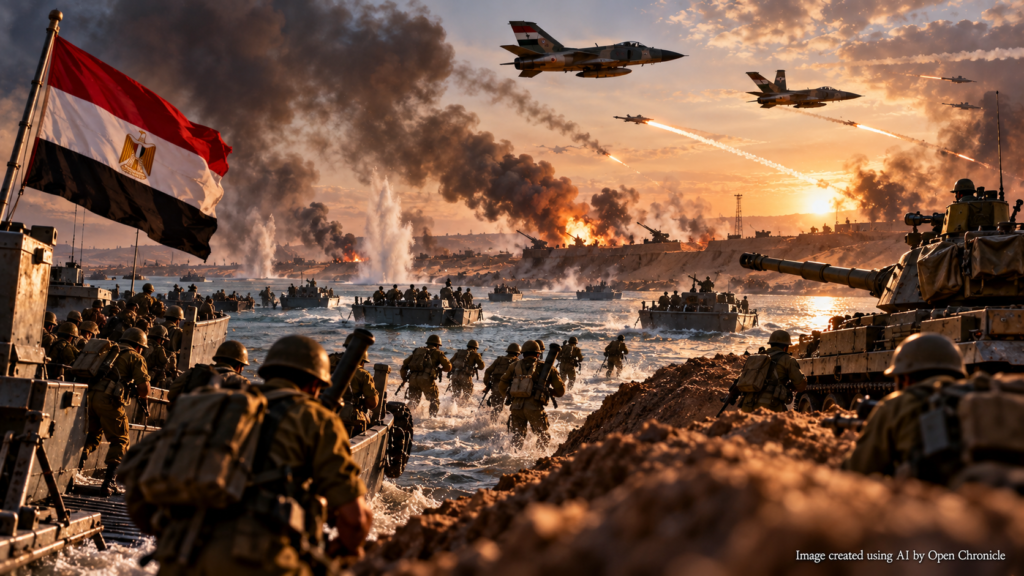
How a surprise Egyptian and Syrian offensive shattered Israel’s sense of military security, brought the superpowers dangerously close to confrontation and transformed the politics of the Middle East
By Open Chronicle History Desk
On the afternoon of October 6, 1973, one of the most consequential wars in the modern history of the Middle East began with extraordinary speed.
Across the Suez Canal, Egyptian artillery opened fire against Israeli positions in the Sinai Peninsula.
Thousands of Egyptian soldiers prepared to cross the water.
Aircraft attacked Israeli targets.
Engineers moved toward the massive sand barriers protecting Israeli defensive positions.
Hundreds of kilometers to the northeast, Syrian forces attacked Israeli positions on the Golan Heights.
Israel had been struck on two fronts.
The timing carried enormous significance.
October 6 fell on Yom Kippur, the holiest day of the Jewish calendar, when much of Israeli public life was at a standstill.
It also fell during the Muslim holy month of Ramadan.
For Egypt and Syria, the offensive represented an attempt to reverse the territorial consequences of the Six-Day War of 1967, when Israel had captured the Sinai Peninsula from Egypt and the Golan Heights from Syria, as well as the West Bank, East Jerusalem and Gaza from Jordanian and Egyptian control respectively.
For Israel, the attack shattered assumptions about deterrence and intelligence that had developed after the overwhelming victory of 1967.
What followed was not simply another Arab-Israeli war.
The conflict changed military thinking, destabilized the global economy, drew the United States and Soviet Union into an intense Cold War confrontation and eventually helped create the conditions for one of the most important diplomatic breakthroughs in the history of the Arab-Israeli conflict.
1. The Shadow of 1967
To understand October 1973, it is necessary to return to June 1967.
During the Six-Day War, Israel defeated the armed forces of Egypt, Syria and Jordan in a remarkably short campaign.
The territorial consequences were enormous.
Israel occupied the Sinai Peninsula.
It captured the Gaza Strip.
It took the West Bank and East Jerusalem.
And it seized the Golan Heights from Syria.
The military balance of the Middle East appeared to have changed dramatically.
For Israel, the war produced strategic depth and a powerful sense of military superiority.
For the defeated Arab states, 1967 was a catastrophe.
Territory had been lost.
Armies had been humiliated.
Political prestige had been shattered.
The consequences would dominate regional politics for years.
2. Egypt Without Sinai
The loss of the Sinai Peninsula was especially significant for Egypt.
Sinai represented a vast territory stretching from the Suez Canal toward Israel.
Israeli forces now stood on the eastern bank of the canal.
Egypt’s government regarded the occupation as unacceptable.
President Gamal Abdel Nasser attempted to pressure Israel through the War of Attrition, fought primarily along the Suez Canal between 1967 and 1970.
Artillery duels, air combat and commando operations inflicted casualties on both sides.
But the territorial situation remained essentially unchanged.
Then, in September 1970, Nasser died.
His successor would transform Egyptian strategy.
3. Anwar Sadat
Anwar el-Sadat initially appeared to many observers as a transitional figure.
He was not.
Sadat understood that Egypt faced a strategic dilemma.
Israel possessed a powerful military.
The United States had become Israel’s principal external supporter.
The Soviet Union supplied Egypt with large quantities of military equipment, but Moscow did not necessarily share Sadat’s appetite for a major confrontation.
Diplomatic efforts had failed to recover Sinai.
Sadat increasingly concluded that military action might be necessary.
But his objective did not require the total military destruction of Israel.
A more limited war might be enough to break the political stalemate.
4. Syria Wants the Golan Heights Back
Syria had its own objective.
The Golan Heights dominated strategically important terrain overlooking northern Israel and southwestern Syria.
Israel had captured most of the plateau in 1967.
The Syrian leadership wanted it returned.
In 1970, Hafez al-Assad came to power.
Like Sadat, Assad regarded the territorial outcome of 1967 as unacceptable.
Egypt and Syria therefore shared a fundamental objective.
They wanted to overturn the strategic status quo created by the Six-Day War.
Their military plans, however, were not identical.
5. The Problem of Israeli Air Power
Arab military planners had learned painful lessons from 1967.
Israeli air power had played a decisive role in the earlier war.
Trying to fight Israel under conditions where its aircraft could operate freely would be extremely dangerous.
Egypt therefore constructed a dense air-defense network.
Soviet-supplied surface-to-air missiles, including systems from the SA-2, SA-3 and SA-6 families, formed part of a layered defensive umbrella.
Anti-aircraft guns added further protection.
The concept was crucial.
Egyptian forces crossing the Suez Canal would initially remain within range of this air-defense network.
The objective was not necessarily to race deep into Sinai.
It was to establish and hold bridgeheads while denying Israel the unrestricted use of its air force.
6. The Bar Lev Line
Israel had constructed a chain of fortified positions along the eastern bank of the Suez Canal.
Known as the Bar Lev Line, it was intended to provide observation, warning and defensive positions against an Egyptian assault.
Behind the canal rose large sand embankments.
The defenses appeared formidable.
But Egyptian engineers had been studying them carefully.
They developed an unexpectedly practical solution.
High-pressure water pumps could cut openings through the sand barriers much faster than conventional explosives or earth-moving equipment.
When the attack came, engineering would prove as important as firepower.
7. Deception
The success of the initial offensive depended heavily on surprise.
Egypt and Syria conducted preparations while attempting to conceal their intentions.
Military movements could be explained as exercises.
Reservists had been mobilized before without war following.
Diplomatic signals were ambiguous.
Israel received warnings from several directions, but its intelligence establishment remained influenced by a prevailing assumption that Egypt would not begin a major war until it possessed certain capabilities necessary for a deeper confrontation with Israel.
This analytical framework became known in Israel as the Concept.
It proved dangerously misleading.
8. Warning Signs
Not everyone believed war was unlikely.
Warnings accumulated.
Egyptian and Syrian military activity increased.
Soviet dependents were evacuated from Egypt and Syria shortly before the war.
Israeli intelligence obtained additional information indicating that an attack might be imminent.
By the morning of October 6, Israeli leaders understood that war was likely.
But the warning came extraordinarily late.
Israel began mobilizing reserves.
There was no longer enough time to prevent the opening assault.
9. Why Yom Kippur?
The timing offered several advantages.
Yom Kippur brought Israel to an unusual degree of stillness.
Businesses were closed.
Radio and television broadcasts were largely suspended.
Road traffic was minimal.
Many soldiers were on leave.
Yet the holiday also had an unexpected consequence.
Because roads were nearly empty, mobilized Israeli reservists could move rapidly once the emergency became clear.
A day chosen partly for surprise would therefore also facilitate Israel’s mobilization.
10. October 6, 1973
At approximately 2 p.m., the offensive began.
Egyptian artillery opened an enormous bombardment across the Suez Canal.
Aircraft struck Israeli targets.
Infantry crossed the canal in assault boats.
Engineers began cutting passages through the sand embankments.
Bridges were assembled.
Anti-tank teams crossed with the infantry.
Israeli defensive positions suddenly found themselves facing a carefully prepared combined-arms assault.
The operation was known to Egypt as Operation Badr.
Its opening stages were remarkably successful.
11. Crossing the Suez Canal
The canal crossing became one of the most important Egyptian military operations of the twentieth century.
Wave after wave of soldiers crossed the water.
Engineers opened breaches in the sand barrier.
Pontoon bridges allowed tanks and heavier equipment to move into Sinai.
Egyptian flags appeared on the eastern bank.
Within hours, substantial bridgeheads had been established.
The psychological significance was immense.
Six years after the disaster of 1967, Egyptian soldiers had crossed the Suez Canal and broken through Israel’s defensive line.
12. Anti-Tank Missiles Change the Battlefield
Israeli armored doctrine had been shaped by earlier successes.
Tanks were expected to respond rapidly to breakthroughs.
But Egyptian infantry possessed large numbers of anti-tank weapons.
Among the most important was the Soviet-designed 9M14 Malyutka, known to NATO as the AT-3 Sagger.
Israeli armored counterattacks encountered infantry equipped with guided missiles, rocket-propelled grenades and supporting artillery.
The result was costly.
The opening battles demonstrated that tanks operating without adequate infantry and artillery support could be extremely vulnerable.
The lesson would be studied by militaries around the world.
13. The Syrian Offensive
At almost the same time, Syria attacked across the Golan Heights.
The situation there was potentially even more dangerous for Israel.
The Golan battlefield was relatively narrow.
Israeli forces were heavily outnumbered during the opening stages.
Syrian tanks and infantry pushed into Israeli-held territory.
Some units advanced deeply enough to create fears that the Israeli defensive position in the north might collapse.
The fighting became extraordinarily intense.
14. The Valley of Tears
One of the most famous battles occurred in the northern Golan Heights.
Israeli armored units confronted much larger Syrian formations.
The fighting lasted for days.
Destroyed tanks accumulated across the battlefield.
The area later became known as the Valley of Tears.
Israeli forces suffered severe losses but managed to prevent a decisive Syrian breakthrough.
As Israeli reserves arrived, the balance began to change.
15. Israel Mobilizes
Israel’s military structure depended heavily on reservists.
The standing army could respond immediately, but sustained war required rapid national mobilization.
Across the country, reservists reported for duty.
Civilian vehicles moved soldiers toward assembly points.
Military units were rebuilt and reinforced.
The process happened under enormous pressure.
In 1967, Israel had entered the war with the initiative.
In 1973, it was reacting to a strategic surprise.
That difference transformed the psychological character of the conflict.
16. Golda Meir
Israel’s prime minister was Golda Meir.
Her government faced decisions of extraordinary consequence.
How quickly could reserves be mobilized?
Should Israel have launched a pre-emptive strike once the attack appeared imminent?
How would Washington respond?
Could the fronts be stabilized?
The war would later produce intense controversy inside Israel regarding intelligence failures and government decision-making.
The consequences would extend far beyond the battlefield.
17. The Northern Front Turns
Once Israeli reserve formations arrived in strength, Syrian momentum slowed.
Israeli forces counterattacked.
They recovered much of the territory lost during the opening offensive.
Then they advanced beyond the pre-war ceasefire line into Syrian territory.
The fighting moved closer to Damascus.
Syria requested additional assistance from Arab allies.
Iraqi forces entered the fighting.
Jordanian units also participated on the Syrian front.
The war was expanding.
18. Egypt Holds Its Bridgeheads
In Sinai, Egyptian forces initially remained relatively close to the canal.
This was consistent with the protection offered by their air-defense system.
The strategy had worked.
Egypt had crossed the canal.
It had established bridgeheads.
It had inflicted significant losses.
And it had demonstrated that the post-1967 status quo could be broken.
From Sadat’s political perspective, that alone had enormous importance.
But military pressure from Syria would soon encourage Egypt to alter its position.
19. The Egyptian Offensive of October 14
On October 14, Egyptian forces launched a larger armored offensive eastward.
This moved substantial formations farther away from the strongest protection of the missile umbrella.
Israeli forces were prepared.
A major tank battle followed.
Egypt suffered significant losses.
The strategic initiative in Sinai began to shift.
Israel now looked for an opportunity to cross the canal itself.
20. Ariel Sharon and the Crossing
Israeli forces identified a gap between Egyptian armies.
Units commanded by Ariel Sharon played a major role in exploiting it.
Israeli troops crossed to the western side of the Suez Canal.
Bridges followed.
Israeli armored formations expanded the bridgehead.
The war had entered a dramatic new phase.
Egyptian troops remained east of the canal.
But Israeli forces were now west of it.
The geography of the battlefield had become extraordinarily complex.
21. The Egyptian Third Army
As Israeli forces expanded their position west of the canal, the Egyptian Third Army on the eastern bank faced increasing danger of encirclement.
Its supply routes were threatened.
The possibility that an entire Egyptian army might be cut off created an urgent diplomatic crisis.
The military situation was now directly connected to superpower diplomacy.
Washington and Moscow were watching every development.
22. The United States Resupplies Israel
Israel had suffered heavy losses in aircraft, tanks and ammunition.
The United States began a major resupply operation known as Operation Nickel Grass.
American transport aircraft delivered military equipment to Israel.
The airlift helped replace Israeli losses and sustain military operations.
For Washington, the war was not simply a regional conflict.
It was part of the global strategic competition with the Soviet Union.
23. The Soviet Union Resupplies Arab States
The Soviet Union supplied Egypt and Syria.
Soviet aircraft transported weapons and equipment.
Ships also carried matériel.
The Middle Eastern battlefield had become deeply connected to the Cold War.
American weapons supported Israel.
Soviet weapons supported Arab armies.
Neither superpower wanted a direct war with the other.
But both feared the consequences if their regional partners suffered catastrophic defeat.
24. The Oil Weapon
The war also produced consequences far beyond military affairs.
Arab oil-producing states used petroleum as political leverage.
Members of the Organization of Arab Petroleum Exporting Countries, OAPEC, announced production cuts and imposed embargo measures against states considered supportive of Israel, most notably the United States.
Oil prices rose dramatically.
Fuel shortages appeared.
Economic disruption spread across industrialized countries.
The 1973 oil crisis became one of the defining economic shocks of the decade.
A regional war had demonstrated the geopolitical power of energy.
25. The Cold War Becomes Dangerous
As Israeli forces threatened the Egyptian Third Army, tensions between Washington and Moscow intensified.
The Soviet leadership raised the possibility of unilateral action if necessary to enforce the ceasefire.
The United States responded by increasing the alert status of its armed forces.
American forces moved to DEFCON 3.
The moment represented one of the more dangerous superpower confrontations of the Cold War.
A war that had begun along the Suez Canal and Golan Heights now carried the risk of escalation between nuclear powers.
26. The United Nations Intervenes
Diplomatic pressure intensified.
The United States and Soviet Union worked through the United Nations Security Council.
On October 22, 1973, the Security Council adopted Resolution 338.
It called for a ceasefire and the implementation of Resolution 242, the landmark resolution adopted after the 1967 war.
Fighting did not stop immediately.
Further ceasefire efforts followed.
But the war was approaching its end.
27. Who Won the War?
The question has no simple answer.
Militarily, Israel recovered from the initial surprise.
It pushed Syrian forces back.
Its forces crossed the Suez Canal and ended the conflict on the western side of the waterway.
Yet Egypt had achieved something strategically profound.
The successful initial crossing destroyed the assumption that the territorial situation created in 1967 could continue indefinitely without serious cost.
Egyptian military performance restored national confidence after the humiliation of 1967.
Sadat could claim that Egypt had broken the political paralysis.
The war therefore produced different kinds of victory and defeat depending on whether the measure is tactical, operational, strategic, political or psychological.
28. Israel’s Trauma
Israel survived the war.
But the psychological consequences were enormous.
The image of near-invulnerability created in 1967 had been shattered.
Questions emerged immediately.
Why had intelligence failed?
Why had warnings been discounted?
Why had the armed forces been caught unprepared?
Public anger grew.
An official investigation, the Agranat Commission, examined the failures surrounding the war.
The political consequences contributed to major changes in Israeli politics during the following years.
29. Egypt’s October War
In Egypt, the conflict is commonly remembered as the October War.
The canal crossing became a central national symbol.
October 6 acquired enormous commemorative importance.
For Sadat, the war provided political space that had not existed before.
He could approach negotiations not simply as the leader of a country defeated in 1967, but as the president whose army had successfully crossed the Suez Canal.
That distinction would matter enormously.
30. From War to Diplomacy
One of the greatest historical paradoxes of October 1973 is that a war helped open the road toward diplomacy.
After the fighting, the United States intensified diplomatic engagement.
Secretary of State Henry Kissinger conducted a series of negotiations often described as shuttle diplomacy.
Disengagement agreements separated forces.
The process was slow.
But Egypt was moving toward a fundamentally different strategy.
Sadat increasingly sought to recover Sinai through diplomacy.
31. Sadat Goes to Jerusalem
In November 1977, Sadat made an extraordinary decision.
He travelled to Jerusalem.
An Egyptian president addressed the Israeli Knesset.
Only four years earlier, Egyptian and Israeli armies had been fighting one of the largest wars in the region’s history.
Now their leaders were publicly exploring peace.
The political transformation was remarkable.
32. Camp David
American President Jimmy Carter brought Sadat and Israeli Prime Minister Menachem Begin together at Camp David in 1978.
After difficult negotiations, agreements were reached that created the framework for an Egyptian-Israeli peace settlement.
In 1979, Egypt and Israel signed a peace treaty.
Israel eventually withdrew from Sinai.
Egypt recovered the peninsula.
The territorial objective that had helped drive Sadat toward war in 1973 was ultimately achieved through negotiation.
33. Egypt Changes Strategic Direction
The consequences went beyond Sinai.
Egypt gradually shifted away from its earlier close relationship with the Soviet Union and developed a much stronger strategic relationship with the United States.
This represented a major transformation in the Cold War balance of the Middle East.
The largest Arab country had changed geopolitical direction.
The war of 1973 therefore altered not only borders and diplomacy.
It changed alliances.
34. Syria’s Different Path
Syria did not follow Egypt toward a comprehensive peace treaty with Israel.
A disengagement agreement was reached in 1974.
But the broader conflict remained unresolved.
The Golan Heights continued to be one of the central territorial disputes between Israel and Syria.
Thus Egypt and Syria, partners in the October 1973 offensive, ultimately followed very different political trajectories after the war.
35. The Palestinians and the Unresolved Conflict
The Egyptian-Israeli peace process did not resolve the Palestinian question.
The conflict involving Israel, Palestinians and the occupied territories continued.
Nor did the peace treaty produce a comprehensive Arab-Israeli settlement.
The Middle East remained deeply unstable.
The legacy of 1973 therefore contains another paradox.
The war helped create peace between Egypt and Israel.
But it did not create peace across the region.
36. A Revolution in Military Thinking
Military academies studied the conflict intensively.
The war demonstrated the increasing importance of:
air-defense missile systems,
anti-tank guided missiles,
electronic warfare,
combined-arms operations,
rapid reserve mobilization,
battlefield intelligence,
logistics,
and the integration of air and ground forces.
It also demonstrated the danger of assuming that previous victories guarantee future success.
Technology had changed.
Tactics had changed.
The enemy had learned.
37. The Failure of Assumptions
Perhaps the most enduring lesson of October 6 concerns intelligence.
Israel possessed significant intelligence capabilities.
Information existed that pointed toward danger.
The failure was not simply an absence of information.
It involved interpretation.
Analysts fitted evidence into an established framework.
Because decision-makers believed they understood the conditions under which Egypt would go to war, warning signs were repeatedly interpreted through that assumption.
The history of intelligence is filled with similar problems.
The most dangerous information is sometimes not the information that is missing.
It is the information that exists but is interpreted incorrectly.
38. A War That Changed the Global Economy
The oil crisis ensured that millions of people who had never visited the Middle East felt the consequences of the war.
Petrol queues appeared.
Governments introduced energy-saving measures.
Inflation increased.
Economic growth slowed.
Western governments reconsidered energy security.
Japan and European states reassessed aspects of their Middle Eastern diplomacy.
Energy policy became inseparable from national security.
The consequences of October 1973 reached factories, homes and petrol stations thousands of kilometers from the battlefield.
39. October 6 in Historical Memory
The same date carries profoundly different memories.
For Egypt, October 6 became associated with the successful crossing of the Suez Canal and the restoration of military confidence.
For Israel, the Yom Kippur War became associated with surprise, heavy casualties, intelligence failure and national trauma.
For Syria, it remains connected to the struggle over the Golan Heights.
For the wider world, it is remembered as the beginning of a conflict that helped trigger an oil crisis and one of the most serious Cold War confrontations outside Europe.
Historical memory rarely belongs to only one side.
October 6 demonstrates why.
40. Why October 6 Matters
October 6, 1973 transformed the Middle East.
Egyptian troops crossed the Suez Canal.
Syrian forces attacked across the Golan Heights.
Israel suffered one of the greatest strategic surprises in its history.
Weapons and tactics challenged assumptions created by the Six-Day War.
The United States and Soviet Union became deeply involved.
Oil became an instrument of international political pressure.
The global economy was shaken.
And within six years, Egypt and Israel signed a peace treaty.
The war did not resolve the Arab-Israeli conflict.
But it destroyed the political status quo that had existed since 1967.
That alone changed history.
October 6, 1973: The Afternoon the Middle East Changed
Imagine the eastern bank of the Suez Canal shortly after two in the afternoon.
The horizon disappears behind artillery smoke.
Shells strike Israeli positions.
Egyptian soldiers carry assault boats toward the water.
Others are already crossing.
Engineers drag hoses toward enormous sand embankments.
Pontoon equipment waits behind them.
Aircraft pass overhead.
Across the canal, Israeli soldiers realize that this is not another exercise.
Hundreds of kilometers away, Syrian tanks are moving across the Golan Heights.
Telephones begin ringing throughout Israel.
Reservists leave synagogues and homes.
Empty roads suddenly become military arteries.
Within hours, assumptions built over six years begin collapsing.
The war would last only weeks.
Its consequences would last decades.
It would change military doctrine.
It would shake governments.
It would transform energy politics.
It would bring Washington and Moscow dangerously close to confrontation.
And, unexpectedly, it would help open a road that eventually led from the battlefield to the negotiating table.
On October 6, 1973, the post-1967 Middle East ended.
What replaced it would shape the region for generations.
Open Chronicle History · Research & Sources
Historical Sources and Further Reading
The Yom Kippur War, also known as the October War or the 1973
Arab-Israeli War, must be understood through military records,
diplomatic documentation and accounts from the different states
involved. The following sources provide material on the opening
Egyptian and Syrian offensives, Israel’s counteroffensive, Cold War
diplomacy, the ceasefire process and the wider strategic consequences
of the conflict.
01 · United Nations Security Council
Security Council Resolution 338 · October 22, 1973
Adopted as the war entered its final phase, Resolution 338 called
upon the parties to cease fighting and begin implementing Security
Council Resolution 242. It remains one of the essential primary
documents for understanding the diplomatic conclusion of the
October 1973 conflict and the framework that followed it.
02 · U.S. Department of State · Office of the Historian
The 1973 Arab-Israeli War
The Office of the Historian provides an overview of the October
1973 war within the broader history of American foreign policy.
Its documentation is particularly valuable for understanding
Washington’s response to the conflict, the American resupply of
Israel, U.S.-Soviet tensions and the diplomatic process that
followed the fighting.
03 · Israel State Archives
Israel and the Yom Kippur War
Israeli archival collections provide important primary material
concerning the government’s decision-making, military mobilization,
intelligence assessments and the national crisis produced by the
surprise attack. These records are essential for examining both
Israel’s initial failures and its subsequent military recovery.
04 · Office of the Historian · Foreign Relations of the United States
Arab-Israeli Crisis and War · 1973
The Foreign Relations of the United States documentary series
contains declassified diplomatic records covering the 1973 crisis,
including exchanges involving Washington, Cairo, Moscow and
Jerusalem. The collection provides detailed evidence of how the
regional war became intertwined with superpower strategy and the
negotiations surrounding the ceasefire.
Editorial Note
Open Chronicle History treats the outcome of the 1973 war as a
complex military and political sequence rather than a simple victory
narrative. Egyptian and Syrian forces achieved strategic surprise
and major initial battlefield successes on October 6. Egyptian forces
crossed the Suez Canal and established bridgeheads in Sinai, while
Syrian forces advanced on the Golan Heights. Israel subsequently
mobilized its reserves, counterattacked on both fronts and eventually
crossed to the western side of the Suez Canal. The military situation
at the ceasefire therefore differed substantially from that of the
opening days. At the strategic level, Egypt’s initial success helped
break the political stalemate created after the 1967 war and
contributed to the diplomatic process that eventually led to the
Egyptian-Israeli peace treaty. These military, political and
diplomatic outcomes should be assessed separately.