
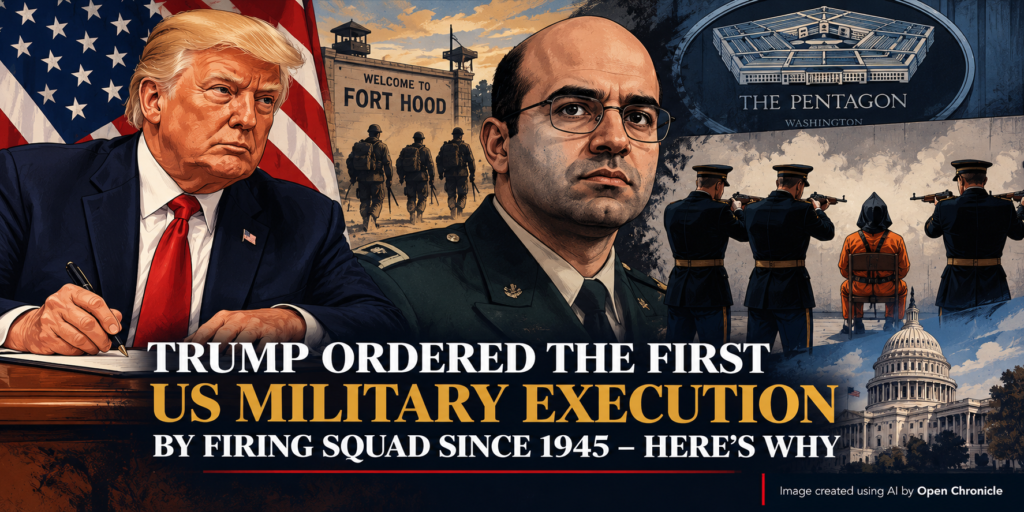
President Donald Trump has approved the execution of convicted Fort Hood gunman Nidal Hasan by US Army firing squad, reviving a method of military execution not used since the final months of 1945 and reopening a wider debate over capital punishment in the United States.
By Open Chronicle with agencies
President Donald Trump has approved the execution of Nidal Hasan by US Army firing squad, setting the stage for what would be the first American military execution by firing squad in more than 80 years.
Chief Pentagon spokesman Sean Parnell announced that Defense Secretary Pete Hegseth had recommended the method and that Trump had approved it. The Secretary of the Army will determine the time and location of the execution.
Hegseth subsequently responded publicly to the announcement with a single word: “Justice.”
The decision is historically significant. The US military has not executed a service member by any method since 1961, while its last known execution by firing squad occurred in 1945.
It also comes as the American death penalty faces renewed scrutiny following the failed lethal injection of Christa Pike in Tennessee.
The Fort Hood Attack
Hasan was an Army major when he opened fire at Fort Hood, Texas, in November 2009, killing 13 people and wounding 32 others.
During his 2013 court martial, Hasan acknowledged carrying out the shooting. Prosecutors charged him with murder rather than terrorism offences, and a military jury unanimously sentenced him to death.
Hasan had described his actions in religious and ideological terms and said he wanted to protect Muslims fighting American forces in Afghanistan. A US Senate investigation later characterized the Fort Hood shooting as the deadliest terrorist attack on American soil since September 11, 2001.
His efforts to overturn the conviction through the appeals process have since reached the Supreme Court, which rejected his petition last year.
A Presidential Decision Required
Military capital punishment operates differently from civilian death penalty systems.
A military death sentence requires presidential approval before an execution can proceed. Such authorization has been extremely rare.
The last US service member executed was Army Private John Bennett, who was hanged in 1961 after being convicted of raping and attempting to murder an 11 year old girl in Austria.
Many military death sentences imposed since then have ultimately been overturned or commuted to life imprisonment.
The most recent identified US military execution by firing squad was that of Dan Lee, a soldier convicted of murder and rape in the Philippines. He was executed on November 9, 1945.
Reports earlier this year indicated that the Army was preparing for the possibility that executions could resume under an initiative known as “Operation Resolute Justice.” Hasan is among the military prisoners currently under death sentences.
Why a Firing Squad?
The decision places renewed attention on a method of execution that largely disappeared from American practice during the 20th century.
There is no recent precedent for a US military firing squad execution, meaning the precise procedure the Army would use has not yet been publicly established.
Several US states, however, retain or have revived firing squads as an execution method.
South Carolina, for example, uses a procedure in which the condemned prisoner is secured to a chair while three shooters fire rifles from approximately 15 feet away. The shooters use live ammunition and aim at the heart.
Supporters of firing squads have sometimes argued that the method can produce death more rapidly and reliably than lethal injection.
In a 2017 Supreme Court dissent, Justice Sonia Sotomayor pointed to evidence suggesting that a properly conducted shooting could cause almost immediate death and potentially less suffering than some lethal injection procedures.
Critics counter that firing squads have their own history of failed executions.
Legal scholar Austin Sarat has argued that American capital punishment has repeatedly moved from one supposedly more humane method to another, only for problems and disturbing cases to emerge.
Historical firing squad executions include instances in which marksmen failed to strike the intended target, leaving prisoners to die slowly from their wounds.
Hasan May Still Have Legal Options
Trump’s approval does not necessarily mean Hasan’s execution will occur immediately.
Further litigation could delay or potentially prevent it.
The case of Ronald Gray illustrates how long military capital cases can remain unresolved. Gray, a former Army cook convicted of multiple murders and rapes, received a military death sentence in 1988.
President George W. Bush approved his execution in 2008, but a federal judge subsequently issued a stay while additional appeals proceeded.
Legal analysts have suggested Hasan could similarly seek habeas corpus review through the federal courts, challenging aspects of his conviction, detention or execution process on constitutional grounds.
Trump’s authorization therefore represents an important procedural step, but it may also open another phase of litigation.
A Wider Debate Over the Death Penalty
The decision comes during renewed controversy over capital punishment following the attempted execution of Christa Pike in Tennessee.
Pike, who was scheduled to become the first woman executed in Tennessee in approximately two centuries, did not die following the administration of two doses of pentobarbital. According to the information available following the procedure, she remained unconscious and on a ventilator in hospital.
The case has intensified longstanding questions about lethal injection and whether execution protocols can consistently produce the rapid and relatively painless deaths their designers intended.
Firing squads have consequently reentered the national debate as some states encounter difficulties obtaining execution drugs and face legal challenges over lethal injection procedures.
Public opinion on capital punishment also remains divided. According to the figures cited in reporting surrounding the current debate, almost half of Americans oppose the death penalty, while 23 states have abolished it.
Forty seven executions were carried out in the United States last year, the highest annual total since 2009. Twenty nine prisoners have reportedly been executed so far this year across six states.
A Rare Moment in American Military Justice
Military executions have become extraordinarily uncommon even during periods when civilian executions continued in several states.
That makes the Hasan decision significant beyond the Fort Hood case itself.
If the execution proceeds using the method approved by Trump, it would end an eight decade absence of firing squad executions within the US military and a 65 year period without any military execution.
The decision also places the military justice system within America’s broader argument over how, and whether, the state should carry out capital punishment.
For Hasan, the remaining questions now concern timing, procedure and whether another round of federal litigation will intervene before the Army can carry out the presidential order.