
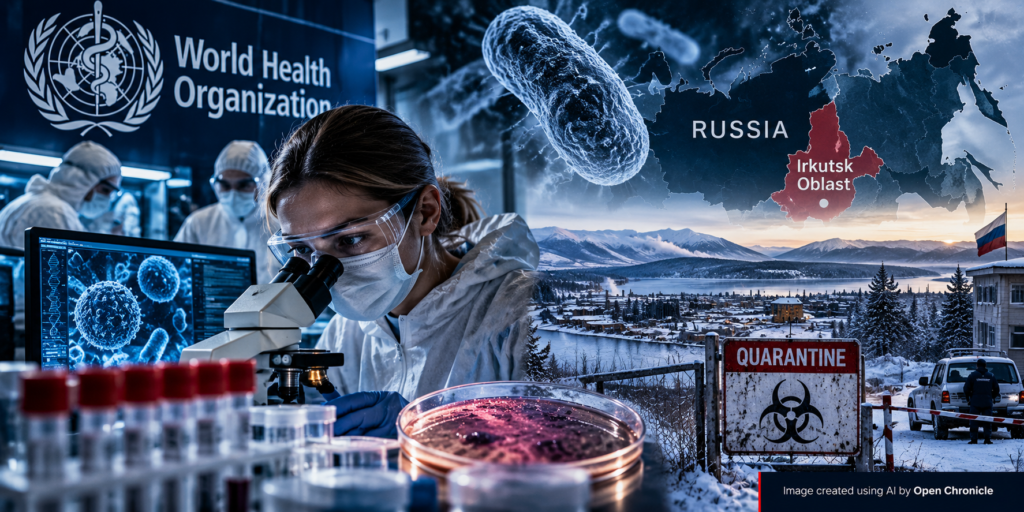
The World Health Organization says Russian authorities have reported no detected cases of plague following the death of a laboratory worker in Siberia, but Moscow has yet to identify the pathogen responsible for the 28 year old woman’s fatal pneumonia.
By Open Chronicle with agencies
The World Health Organization says Russia has informed the UN health agency that no cases of plague have been detected in the Irkutsk region following the unexplained death of a laboratory worker whose illness triggered extensive health precautions.
The WHO said Russian authorities responded to its inquiries on October 6, telling the organization that the woman’s illness initially appeared to be a typical acute respiratory viral infection.
Russian officials also told the agency that neither the deceased woman nor anyone else in Irkutsk had been diagnosed with plague.
The precise cause of her death, however, remains unknown.
WHO asks Russia to identify the pathogen
The WHO said it has requested additional information from Russian authorities about the pathogen responsible for the pneumonia that killed the woman.
The agency said it was aware of reports that the laboratory worker had died following a suspected case of pneumonic plague and that nearly 200 people who had been in contact with her were placed under medical observation and tested.
According to information provided by Russia and relayed by the WHO, testing of those contacts found no dangerous infectious disease pathogens.
The WHO said it continues to follow developments closely, is keeping other countries informed and remains prepared to assist Russian authorities if requested.
Death triggered extensive precautions
The laboratory worker was a 28 year old woman who died at a hospital in Shelekhov, near the Siberian city of Irkutsk.
The hospital was placed under quarantine following her death, while officials from Russia’s national public health watchdog travelled to the region.
Irkutsk Oblast Governor Igor Kobzev initially described the situation as a suspected case of a “particularly dangerous infection.” The illness was subsequently described as “pneumonia of unknown etiology.”
Russian health authorities said they implemented a full range of preventive measures, including contact tracing, medical observation and laboratory testing.
Despite those precautions, Russian officials maintain that testing has found no evidence of plague or another dangerous infectious disease among the woman’s contacts.
Laboratory studies dangerous pathogens
WHO spokesman Christian Lindmeier said the institute where the woman worked conducts research involving dangerous pathogens, including plague.
The institute is located in a part of Siberia where plague occurs naturally among wild animals.
Russian authorities have said testing found no microorganisms associated with the woman’s professional activities and have reported no laboratory incident involving dangerous pathogens.
The central unanswered question therefore remains the cause of the fatal pneumonia.
WHO assesses wider risk as very low
Russia has not requested the deployment of WHO experts.
According to Lindmeier, Russian authorities assessed the health risk as moderate to low within Irkutsk, low for Russia as a whole and very low for the wider WHO European region.
The WHO has nevertheless continued seeking information from Moscow while monitoring the situation.
Canada says no risk has been identified
The Public Health Agency of Canada said that no risk to Canada had been identified and that authorities were closely monitoring developments.
Canadian Health Minister Marjorie Michel similarly said there was “no risk for Canada.”
The international response reflects the unusual circumstances surrounding the case rather than confirmation of an outbreak.
At present, there is no confirmed case of plague associated with the incident, according to the information Russia has provided to the WHO.
Washington also monitoring developments
The United States is also following the case.
President Donald Trump said Monday that his administration was watching developments, while Secretary of State Marco Rubio called for Russia to provide further information.
Rubio said uncertainty surrounding the case made continued monitoring necessary, while acknowledging that the eventual explanation could prove less serious than initial reports suggested.
For international health authorities, the distinction is critical. The precautions imposed in Siberia have attracted attention because of the woman’s employment at an institute studying dangerous pathogens, but the available information does not establish that she contracted plague or that a wider outbreak has occurred.
Until the pathogen responsible for her fatal pneumonia is identified, however, the circumstances surrounding her death are likely to remain under international scrutiny.