

How intelligence services identify targets, develop human sources, collect secret information and protect clandestine activity
Open Chronicle Encyclopedia | Intelligence & Espionage
Espionage is the clandestine acquisition of information that another government, organization or individual intends to keep secret. It is among the oldest instruments of statecraft, yet the fundamental logic behind it has survived extraordinary technological change.
The tools have evolved from couriers, coded letters and concealed documents to satellites, encrypted communications, cyber operations, biometric databases and artificial intelligence. The central problem, however, remains remarkably familiar: someone possesses information that another actor wants but cannot obtain openly.
An espionage operation is the organized attempt to bridge that gap.
Popular culture often portrays espionage as a succession of car chases, weapons, disguises and sophisticated gadgets. Real intelligence operations are usually less spectacular and considerably more complex. They may involve months or years of research, cautious human relationships, fragmented pieces of information, bureaucratic analysis and continuous efforts to determine whether a source can be trusted.
Modern espionage also extends far beyond military secrets. Governments seek political intentions, diplomatic positions, technological research, economic information, weapons programmes, industrial knowledge and insight into the decision making of foreign leaders. Counterintelligence organizations simultaneously attempt to discover who is collecting those secrets and how.
An espionage operation is therefore best understood not as a single clandestine meeting, but as a system of people, information, access, risk and deception.
Activity
Espionage
Purpose
Acquisition of secret or protected information
Principal actors
States, intelligence services, recruited human sources and, in some contexts, nonstate organizations
Traditional discipline
Human Intelligence (HUMINT)
Related disciplines
SIGINT, IMINT, OSINT, cyber intelligence and counterintelligence
Central challenge
Obtaining reliable information while protecting sources, methods and identities
Principal defensive discipline
Counterintelligence
Historical origins
Ancient statecraft
Modern transformation
Digital surveillance, cyber operations, biometrics, large scale data analysis and artificial intelligence
1. What Is Espionage?
Espionage is one component of the much broader activity known as intelligence.
Intelligence organizations collect information from many sources. Satellites can observe military installations. Signals intelligence can reveal communications and electronic activity. Open source intelligence can exploit publicly available material. Cyber operations can expose information stored in digital systems.
Human intelligence, commonly abbreviated HUMINT, derives information from human sources.
The CIA describes HUMINT in its simplest form as intelligence collected by human beings rather than through technical systems such as satellites. MI5 similarly identifies human sources as one of several intelligence collection techniques alongside surveillance, communications interception and other technical methods.
The distinction matters because machines can observe capabilities while human beings may sometimes reveal intentions.
A satellite might reveal that military units are concentrating near a border.
A human source inside a government might help explain why.
That difference between observing what exists and understanding what decision makers intend to do is one of the reasons human intelligence has survived every technological revolution in intelligence collection.
2. Intelligence Is Not the Same as Espionage
The terms are often treated as interchangeable, but they describe different concepts.
Intelligence is the broader process through which information is collected, evaluated, analyzed and presented to decision makers.
Espionage concerns clandestine attempts to obtain information that is deliberately protected.
Surveillance involves observing individuals, locations, communications or activities.
Counterintelligence seeks to identify, understand and counter hostile intelligence activity.
Covert action is different again. Its purpose is generally to influence events rather than simply acquire information.
This distinction is particularly important because an intelligence service can collect enormous quantities of information without conducting espionage at all.
3. The Intelligence Requirement

Every serious intelligence operation begins with a question.
A government may want to know whether another country intends to invade a neighbour. Military planners may want information about an unfamiliar weapons system. Diplomats may need to understand another government’s negotiating position. Security agencies may be trying to determine whether a foreign intelligence service has penetrated their institutions.
These unanswered questions become intelligence requirements.
The requirement determines what information is valuable.
This is one of the fundamental differences between espionage and indiscriminate information gathering. Intelligence organizations do not simply want secrets because they are secret. They want information capable of reducing uncertainty for policymakers, commanders or investigators.
A document containing thousands of classified pages may ultimately be less valuable than a short conversation revealing what a political leader intends to do tomorrow morning.
4. Identifying the Target
Once an intelligence requirement exists, attention turns toward access.
Who might possess the information?
A target might be a diplomat, military officer, scientist, engineer, government employee, contractor, executive or someone working close to a decision maker.
But the person possessing the information does not necessarily become the immediate target of an intelligence effort.
Intelligence services may study the wider environment surrounding the desired information. Institutions, professional relationships and patterns of access can all matter.
The central question becomes:
Who can realistically provide access to what we need to know?
This begins the human dimension of espionage.
5. Officer, Agent and Source
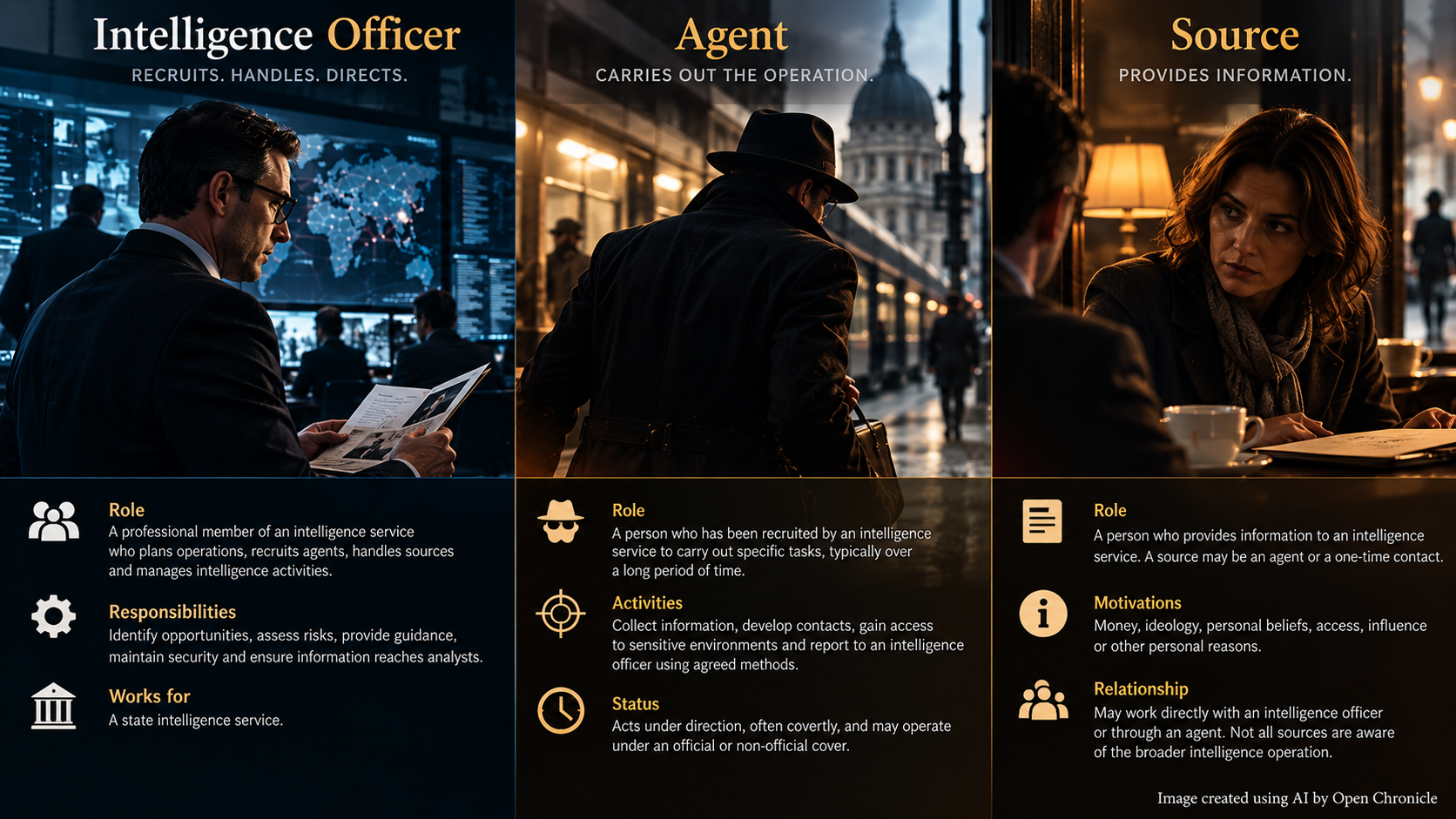
Espionage terminology can be confusing because different countries use the same words differently.
An intelligence officer is generally a professional member of an intelligence service.
A human source is a person capable of providing information.
Within British intelligence terminology, such a source may traditionally be described as an agent, while American organizations can use different terminology. MI5 explicitly notes this difference in usage.
The distinction is important.
The person secretly supplying information from inside a foreign institution may not be an intelligence officer at all.
They might be an ordinary employee who happens to occupy an extraordinary position.
6. Access

Access is the currency of human intelligence.
A person may be willing to provide information but have nothing valuable to offer.
Another person may possess extraordinary access but have no reason to cooperate.
Successful human intelligence therefore depends upon the intersection of two conditions:
Access + willingness
Access can be direct or indirect.
A source might personally participate in high level meetings. Another might maintain computer systems containing sensitive records. Someone else might work near an important individual and observe behaviour, schedules or internal disputes.
The value of a source consequently depends not merely upon status but upon what that person can actually know.
7. Why Would Someone Become a Spy?
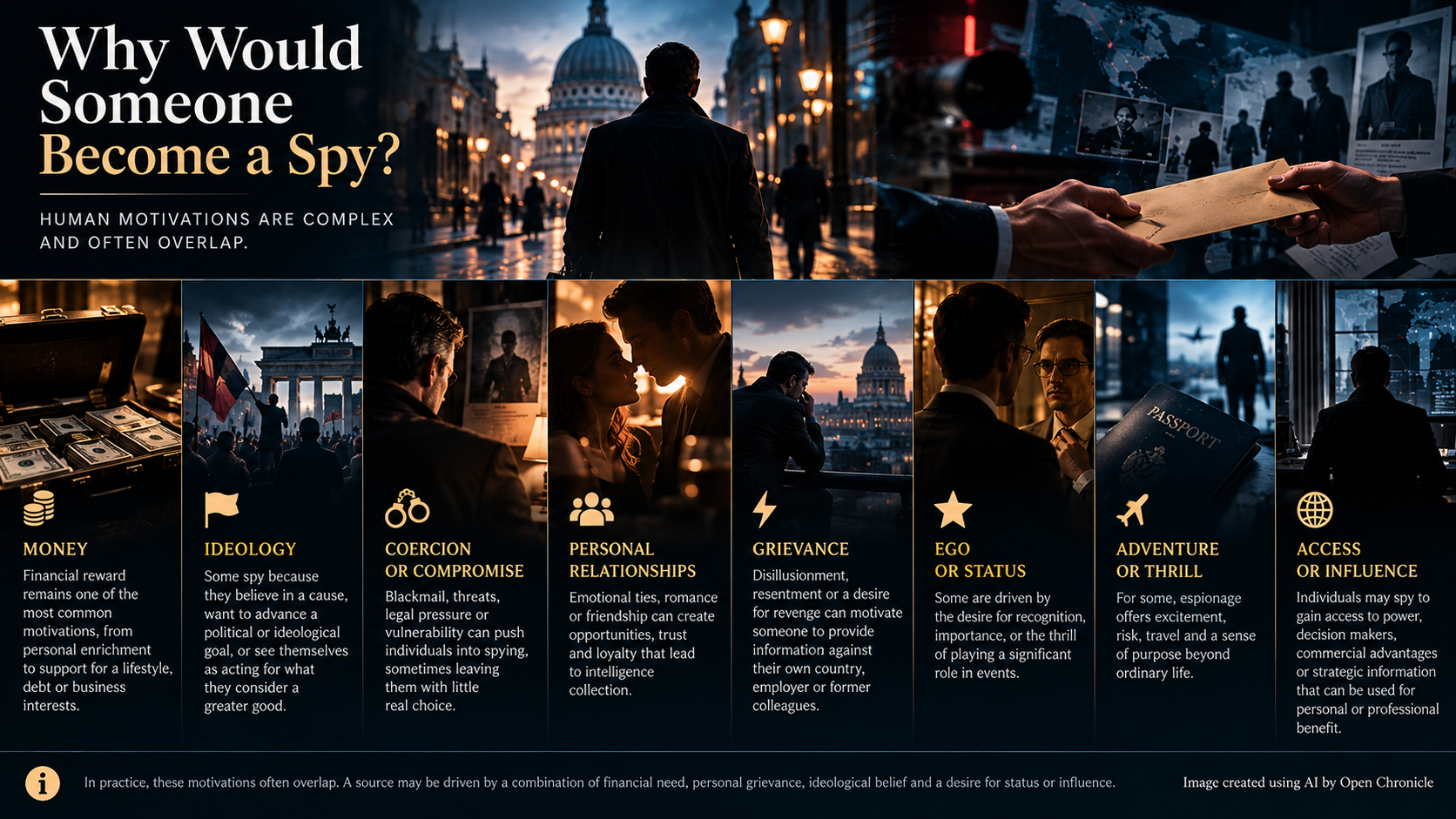
This question has fascinated intelligence researchers for generations.
Money is an obvious explanation, but it is far from the only one.
People have supplied intelligence because of ideology, patriotism, resentment, revenge, ego, personal relationships, fear, political conviction, dissatisfaction with their government or a belief that revealing information serves a greater moral purpose.
Traditional intelligence literature sometimes summarizes motivations through formulas such as MICE, meaning Money, Ideology, Compromise and Ego.
Reality is usually more complicated.
Motivations overlap and change over time.
A person initially motivated by ideology may later appreciate financial rewards. Someone beginning from resentment may develop loyalty toward the person handling them. Another may eventually regret the relationship entirely.
Espionage is ultimately conducted by human beings, and human motivation rarely fits neatly into four letters.
8. Recruitment

Recruitment is one of the most famous concepts in espionage and one of the most distorted by fiction.
The cinematic version frequently involves a dramatic proposition:
Work for us.
Actual recruitment may emerge from a much longer process of assessment and relationship building.
Before attempting to establish a clandestine relationship, an intelligence service wants to understand whether the prospective source possesses useful access, whether the information is likely to be reliable, what motivates the individual and what risks might accompany the relationship.
The objective is not simply to persuade someone to provide secrets.
It is to determine whether that person can become a sustainable and reliable intelligence source.
9. The Human Relationship
At the centre of traditional espionage lies a relationship between two people.
One possesses access.
The other represents an intelligence organization seeking information.
Technology surrounds that relationship, but does not eliminate it.
MI5 states that the human relationship between intelligence officers and their agents remains a key element of espionage, while the CIA has similarly emphasized that HUMINT can provide context and intentions that technical collection may struggle to reveal. MI5
Trust therefore becomes paradoxical.
Both participants understand that they are operating in a world defined by secrecy and deception, yet the relationship itself requires some degree of confidence.
The officer must determine whether the source is telling the truth.
The source must believe that the intelligence service will protect them.
This tension sits at the heart of human intelligence.
10. Collection
Eventually an espionage operation must produce information.
That information may take many forms:
classified documents
personal observations
technical specifications
policy discussions
military information
scientific research
economic intelligence
organizational information
political intentions
Yet possession of secret information does not automatically make it useful intelligence.
The information must still be evaluated.
Is it authentic?
Could the source be mistaken?
Could the adversary deliberately have provided false information?
Does another intelligence source support the same conclusion?
The collection of information is therefore only one stage in a much larger process.
11. Clandestine Communication

A persistent challenge in espionage is communication.
The intelligence service needs information from the source, while both sides may want to conceal the existence of the relationship.
Historically this produced an extraordinary range of clandestine communication techniques: secret writing, coded correspondence, concealed messages, couriers and other methods designed to separate the source from overt contact with an intelligence organization.
Modern technology introduced encrypted communications and digital systems, but simultaneously created new vulnerabilities.
Every electronic interaction can potentially generate metadata.
Every connected device can become part of a digital history.
The communications revolution therefore produced one of the great paradoxes of modern espionage:
It became easier than ever to communicate across the world, and harder than ever to disappear completely.
12. Surveillance
Espionage rarely exists without the possibility of surveillance.
A counterintelligence organization may attempt to understand who a suspected intelligence officer meets, where they travel and what patterns emerge around their activities.
Surveillance can involve observation, technical systems, communications information and other legally authorized investigative capabilities. MI5 publicly describes directed surveillance as covert monitoring of movements, conversations and activities, while stressing that intrusive intelligence techniques are subject to authorization and oversight under British law.
For the intelligence officer, surveillance represents danger.
For counterintelligence, it can reveal the architecture of a hostile network.
13. Cover
Intelligence officers operating abroad may require an outward identity that explains why they are present in a country and whom they meet.
This is known broadly as cover.
Some officers historically operated under diplomatic or official cover. Others have operated without publicly acknowledged government status.
Popular culture often exaggerates this into elaborate fictional identities.
In reality, the purpose of cover is more fundamental.
It must provide a plausible explanation for the officer’s presence and activities while protecting the underlying intelligence affiliation.
The strongest cover is therefore not necessarily the most imaginative.
It is the one that withstands scrutiny.
14. Compartmentalization
One of the most important principles of secret organizations is also one of the simplest:
Do not tell everyone everything.
Sensitive operations are often compartmentalized so that individuals possess only the information required for their role.
This limits the damage that can result from compromise.
If one participant is exposed, they may be incapable of revealing the entire network because they never knew it.
Compartmentalization can protect intelligence operations.
It can also create problems.
Organizations divided into too many compartments may fail to connect important information.
The history of intelligence repeatedly demonstrates the tension between protecting secrets and sharing enough information to understand them.
15. Validation: Is the Source Telling the Truth?
A source who provides information is not automatically a reliable source.
Intelligence organizations must continually assess credibility.
Previous reporting can be compared with subsequent events. Information may be checked against technical collection, open sources or reporting from other human sources.
Contradictions matter.
So does consistency.
But even a previously reliable source can become unreliable.
A source may misunderstand events, exaggerate access, deliberately fabricate information or fall under the control of an opposing intelligence service.
The intelligence officer must therefore ask one of the most important questions in espionage:
How do we know that what we have been told is true?
16. Analysis
Raw intelligence rarely reaches national leaders exactly as it was collected.
Analysts compare information from multiple sources and attempt to transform fragments into assessments.
A satellite image may show activity at a military installation.
Intercepted communications may indicate unusual command activity.
A human source may report an important meeting.
Public information may reveal economic preparations.
Individually, none may provide a complete explanation.
Together, they may reveal a pattern.
This is all source intelligence analysis, where the objective is not simply to accumulate information but to understand what it means.
17. Counterintelligence
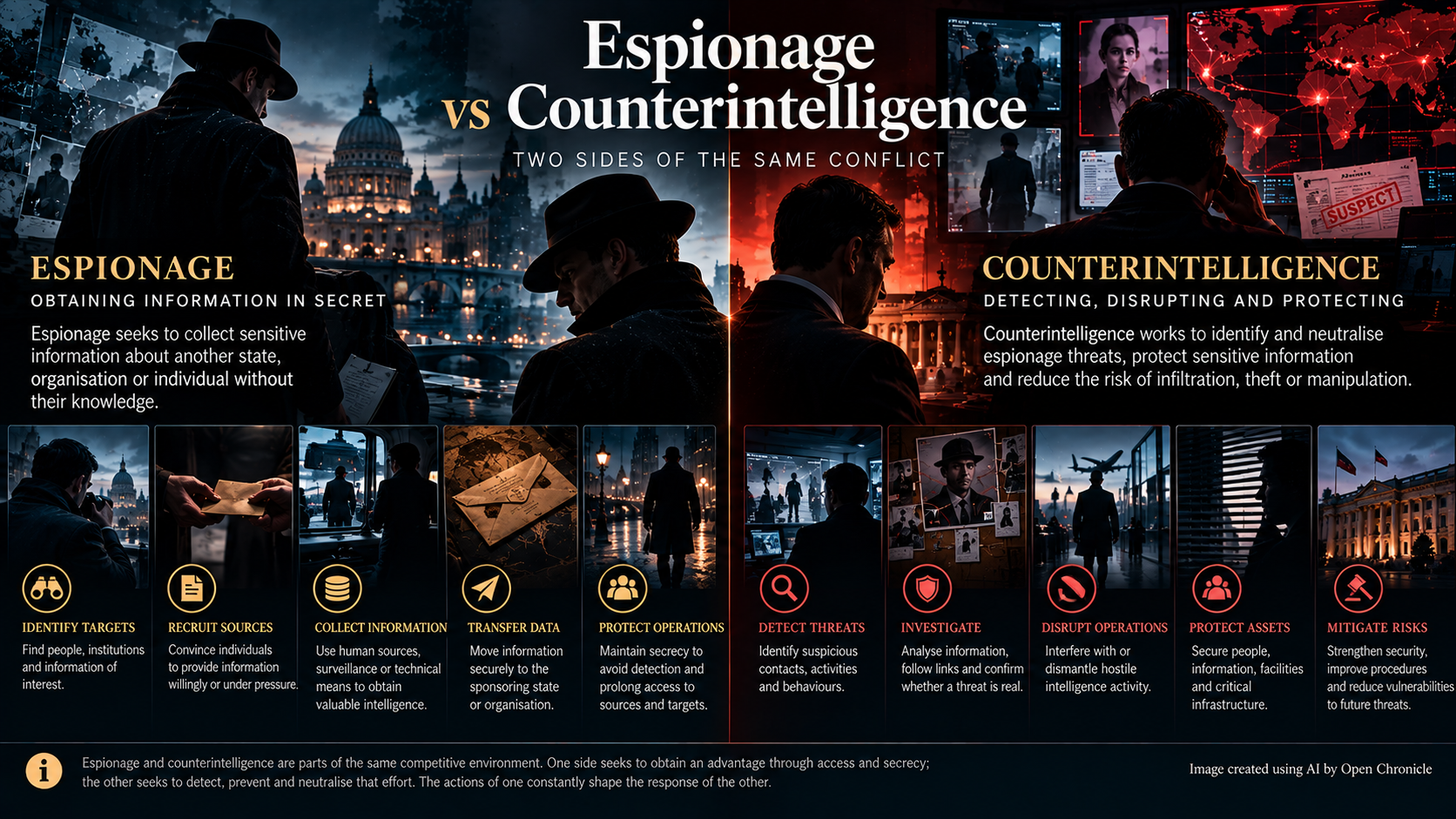
Every espionage operation exists in the shadow of counterintelligence.
Counterintelligence attempts to discover and counter hostile intelligence activity.
The FBI describes its counterintelligence mission as protecting intelligence secrets and critical assets while countering foreign intelligence activities. It also notes that contemporary espionage increasingly involves computer network theft and targets extending well beyond traditional government secrets into technology, research and intellectual property.
Counterintelligence therefore asks the opposite questions from espionage.
Espionage asks:
How can we penetrate them?
Counterintelligence asks:
How might they penetrate us?
18. Double Agents
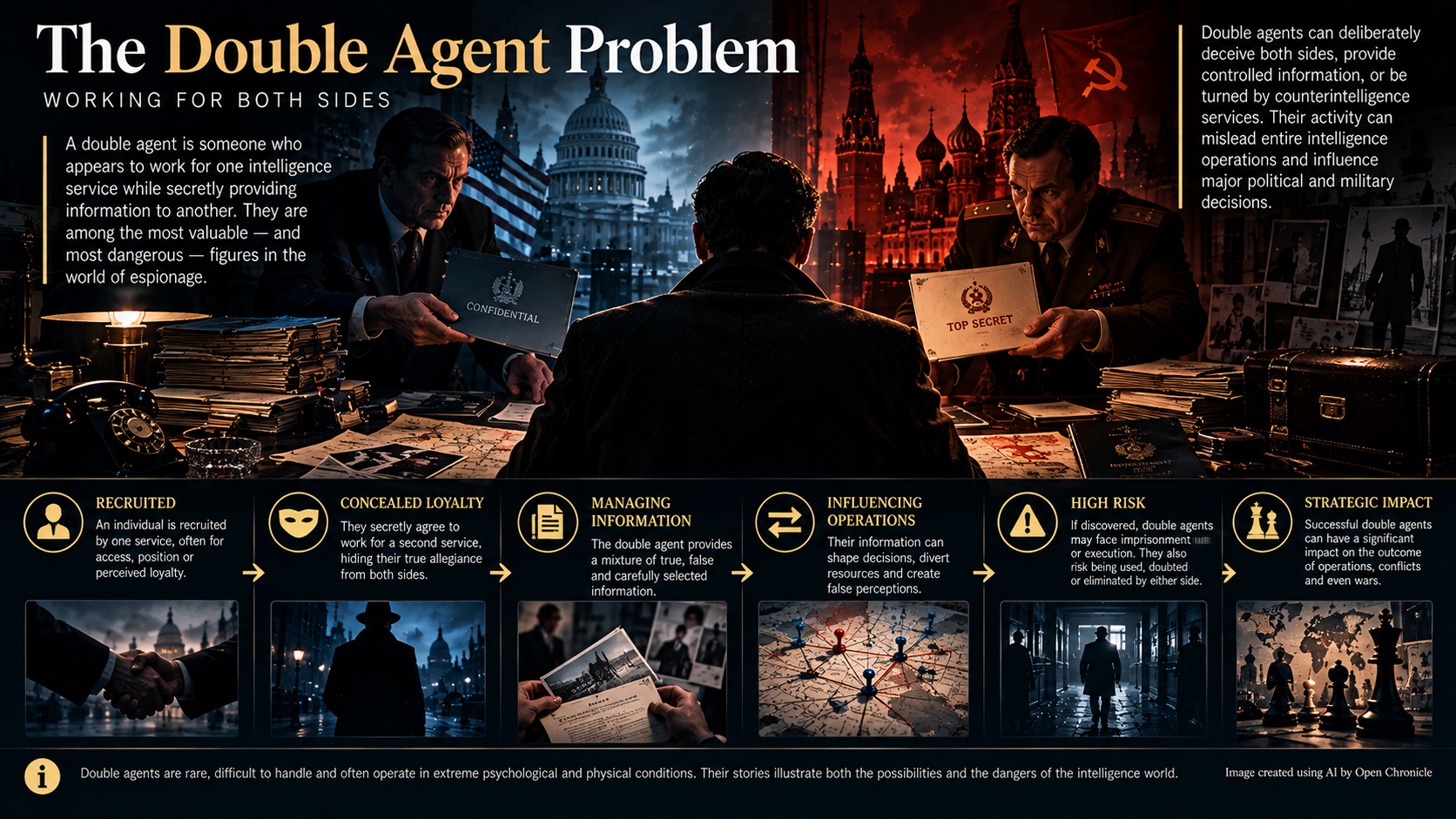
Few intelligence problems are more dangerous than the double agent.
A supposed source may actually be controlled by the adversary.
Instead of penetrating the enemy, an intelligence service may unknowingly be receiving information selected by that enemy.
The consequences can extend far beyond false reporting.
A controlled source may expose intelligence requirements, reveal investigative priorities or identify the people attempting to collect information.
The possibility of deception explains why counterintelligence and source validation remain inseparable from espionage.
19. Espionage and Deception
Intelligence organizations do not merely worry about missing information.
They must also worry about information deliberately created to mislead them.
A document may be genuine but intentionally placed where an adversary will discover it.
A source may provide mostly accurate information while inserting one strategically important falsehood.
Military activity may be designed to create an incorrect interpretation.
Deception therefore exploits one of intelligence analysis’s greatest vulnerabilities:
the desire to make incomplete information form a coherent picture.
20. When an Operation Is Compromised
Espionage operations can collapse suddenly.
A source may confess.
A communication may be intercepted.
An insider may reveal the operation.
A counterintelligence investigation may connect previously unrelated events.
Digital evidence may expose relationships that traditional surveillance failed to detect.
When compromise occurs, consequences depend upon the people involved and the political circumstances.
They may include arrest, prosecution, diplomatic expulsion, intelligence losses, compromised networks and international crises.
Sometimes the public never learns that an operation existed.
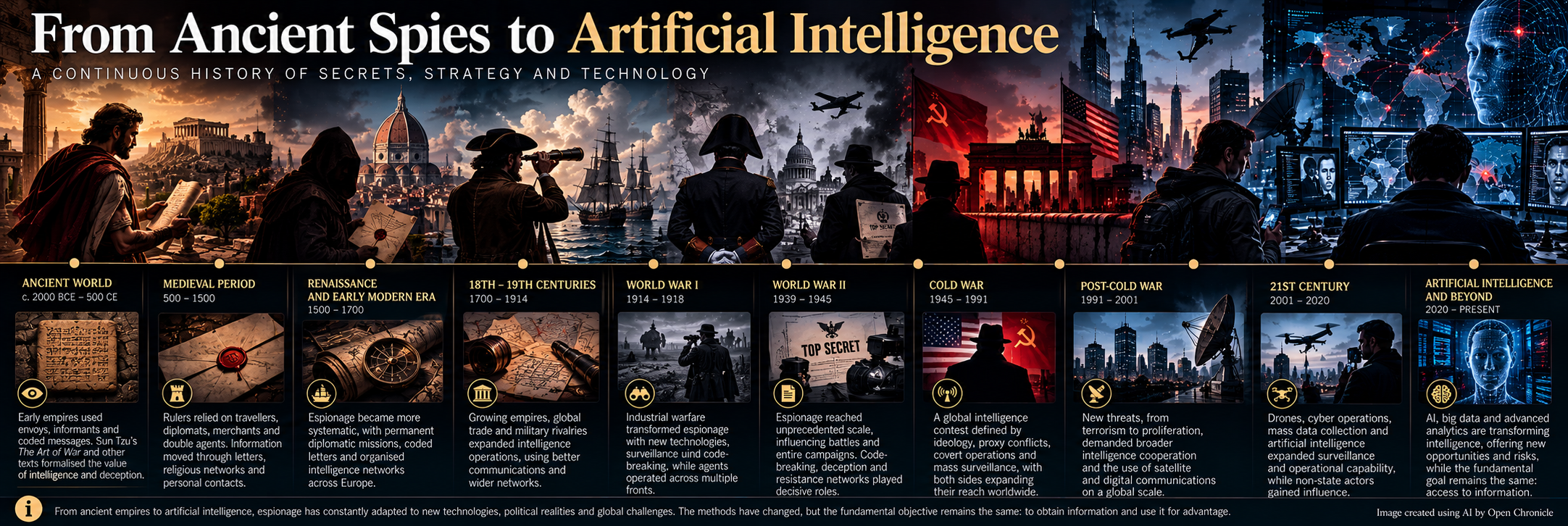
21. Espionage Before the Digital Age
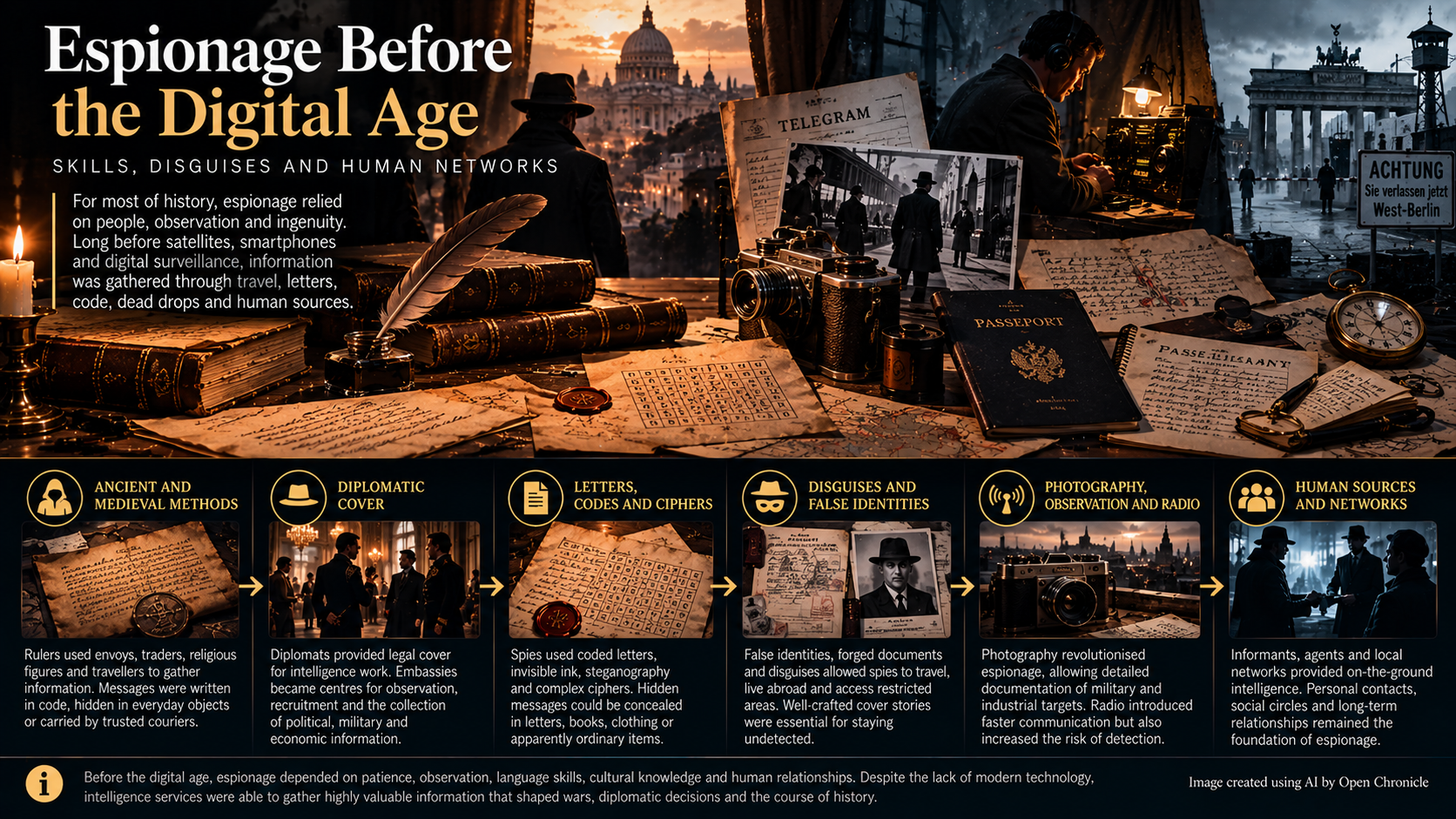
Espionage is far older than modern intelligence agencies.
Ancient rulers employed informants and secret messengers. Empires sought information about enemies, rebellions and rival courts. Diplomats gathered political intelligence long before permanent intelligence services existed.
The nineteenth century brought increasingly professional military intelligence organizations.
The two world wars accelerated the development of signals interception, cryptanalysis, clandestine networks, deception and counterespionage.
The Cold War then transformed espionage into a global institutional contest involving the CIA, KGB, MI6, Stasi and numerous allied and rival services.
Many of the popular images associated with espionage originated during this period.
22. The Digital Transformation of Espionage
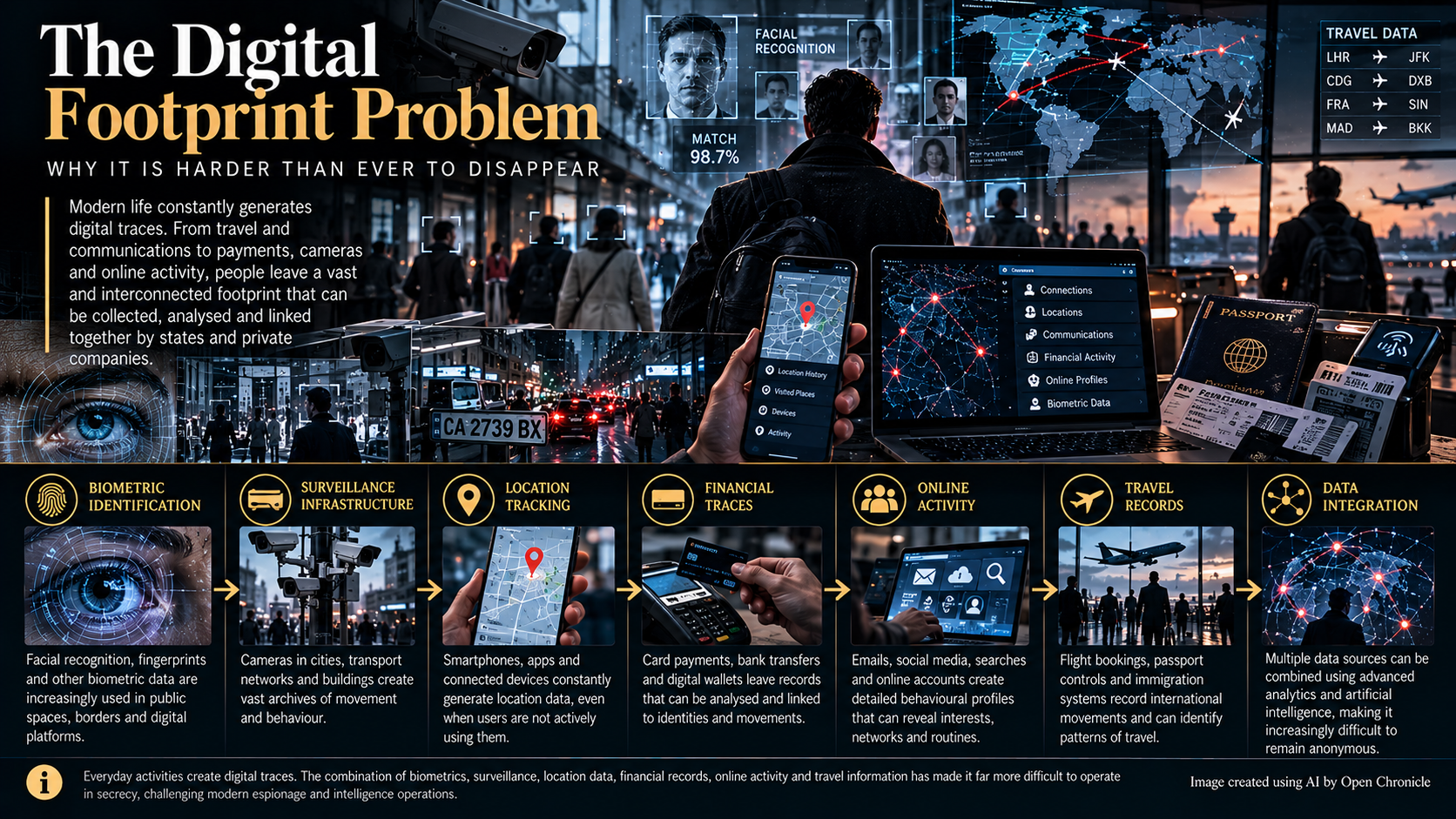
The twenty first century changed the operating environment profoundly.
Human beings now leave enormous digital trails.
Air travel generates records.
Cities contain extensive camera networks.
Phones reveal patterns of communication and location.
Financial systems generate transactions.
Social networks expose relationships.
Biometric systems can associate faces, fingerprints and other identifiers with individuals.
Large datasets can reveal patterns invisible to human investigators.
The result is sometimes described as the erosion of anonymity.
An identity that might once have survived a passport inspection may now confront years of digital history.
23. Cyber Espionage
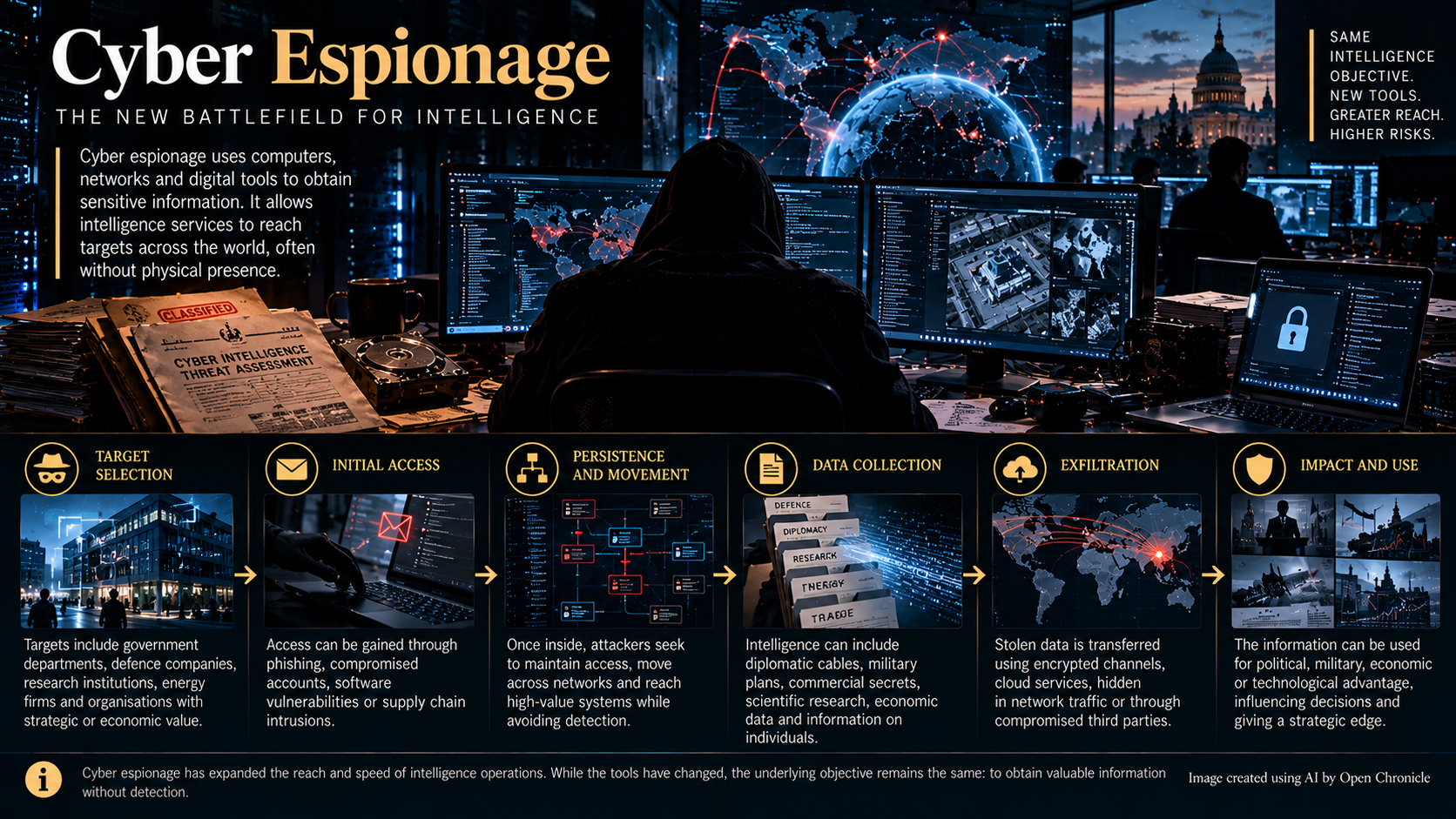
Espionage no longer requires physical access to every target.
Computer networks can contain diplomatic correspondence, industrial research, military information, source code, personnel records and strategic planning documents.
This has made cyber espionage one of the defining intelligence developments of the modern era.
The FBI notes that much contemporary spying has become cyber based and that targets include advanced technology and sensitive information across government, industry, finance, science and other sectors.
Cyber operations can collect information on a scale that would have been unimaginable to earlier intelligence services.
Yet quantity does not automatically produce understanding.
Millions of stolen files still need to be interpreted.
24. Artificial Intelligence and Espionage
Artificial intelligence introduces another transformation.
AI systems can help process enormous datasets, identify patterns, translate material and assist analysts confronted with volumes of information beyond human capacity.
They may also strengthen counterintelligence by helping discover anomalies across travel, communications and behavioural data.
But AI creates new problems as well.
Synthetic media and sophisticated fabrication may make authenticity harder to establish.
A 2026 article published by the CIA’s Studies in Intelligence argues that AI could actually increase the importance of HUMINT because trusted human sources can help corroborate information in an environment increasingly affected by artificial content and deception.
The future of espionage may therefore be neither human nor technological.
It may be the increasingly complex interaction between both.
25. Anatomy of an Espionage Operation
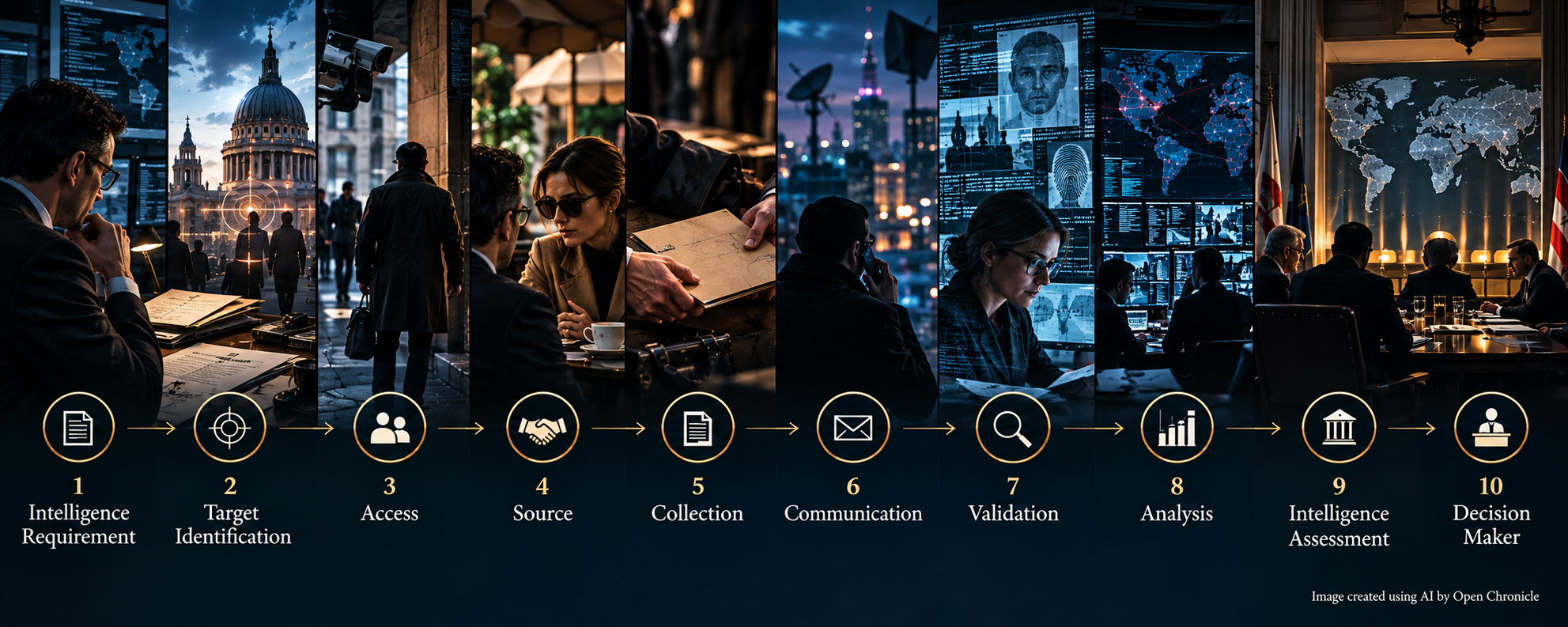
At its most abstract level, a human intelligence operation can be understood as a chain:
Intelligence Requirement
↓
Target Environment
↓
Potential Access
↓
Human Source
↓
Collection
↓
Communication
↓
Validation
↓
Analysis
↓
Intelligence Assessment
↓
Decision Maker
Running against that chain is another:
Counterintelligence
↓
Detection
↓
Investigation
↓
Identification
↓
Disruption
Espionage and counterintelligence are therefore opposing systems operating simultaneously.
Each attempts to understand what the other is doing without revealing its own knowledge.
26. Famous Cases and What They Teach
Rather than treating famous spies merely as colourful personalities, intelligence history becomes more useful when individual cases illustrate particular problems.
The Cambridge Five demonstrated the extraordinary damage that ideological penetration can cause when sources reach positions of institutional trust.
Rudolf Abel became one of the most famous Soviet intelligence figures operating in the United States during the early Cold War.
Oleg Penkovsky illustrated the strategic value that a well placed human source could provide during periods of extreme international tension.
Oleg Gordievsky demonstrated both the extraordinary value and extraordinary danger associated with penetrating a rival intelligence service.
Aldrich Ames showed how a trusted intelligence insider could compromise sources from within.
Robert Hanssen demonstrated the devastating counterintelligence consequences of an insider operating undetected for years.
Together, such cases reveal a recurring truth:
The most dangerous vulnerability in a sophisticated intelligence system may still be a human being who already has legitimate access.
27. Myth vs Reality
| The popular image | The intelligence reality |
|---|---|
| Espionage is dominated by gadgets | Technology matters, but human relationships remain fundamental |
| Spies constantly engage in violence | Intelligence collection usually depends on secrecy rather than confrontation |
| A spy knows the entire operation | Compartmentalization deliberately restricts knowledge |
| Secret information is automatically reliable | Intelligence must be evaluated and corroborated |
| One stolen document solves the mystery | Intelligence usually emerges from fragmented information |
| Technology has replaced human sources | Technology has transformed HUMINT rather than eliminating it |
| Espionage is exclusively military | Political, economic, scientific and technological information can also be targeted |
| Operations end once information is collected | Validation, analysis and protection of sources continue afterward |
28. The Human Side of Espionage
Behind the acronyms, encrypted systems and classified documents lies the defining feature of espionage:
people.
People become frightened.
People become angry.
People change political beliefs.
People fall in love.
People need money.
People seek recognition.
People misremember conversations.
People lie.
And sometimes people risk everything because they believe providing information is the right thing to do.
This is why espionage cannot be understood entirely through technology.
An intelligence operation is simultaneously a political activity, an information system and a human relationship conducted under conditions of extraordinary uncertainty.
29. The Espionage Paradox
The intelligence officer seeks truth through secrecy.
The source may have to deceive colleagues in order to reveal information.
The counterintelligence officer must sometimes conceal what is already known.
The analyst must decide whether information obtained through deception can itself be trusted.
This creates the fundamental paradox of espionage:
An institution dedicated to discovering what is true must operate in an environment built around concealment.
That paradox has existed for centuries.
Technology has not removed it.
30. Why Espionage Still Matters
Satellites can observe the Earth with extraordinary precision.
Signals intelligence can collect electronic information on enormous scales.
Cyber operations can penetrate computer networks.
Artificial intelligence can analyze quantities of data no human team could process manually.
Yet governments still want answers to questions that machines cannot reliably answer alone.
What does a leader believe?
What decision has already been made but not announced?
Is an ally privately changing position?
Is a military movement preparation for war or political signalling?
Does a weapons programme actually work?
Who inside an organization disagrees with official policy?
These are questions about intent, confidence, perception and decision making.
And sometimes the only source capable of answering them is another human being.
Open Chronicle Perspective
Espionage is often described through its tools: secret communications, surveillance systems, satellites, cyber operations and increasingly artificial intelligence.
But tools are not its defining characteristic.
Espionage exists because information is unevenly distributed.
One actor possesses knowledge that another considers important enough to obtain secretly. Around that simple imbalance grows an extraordinarily complicated system involving intelligence requirements, human sources, technology, analysis, deception and counterintelligence.
The history of espionage is therefore not merely the history of spies.
It is the history of states attempting to reduce uncertainty in a world where other states are deliberately trying to preserve it.
That is why espionage survived the telegraph, radio, satellites, computers and the internet.
And it is why it is unlikely to disappear in the age of artificial intelligence.
Did You Know?
The word HUMINT refers to intelligence obtained from human sources and remains a formal intelligence discipline despite the enormous growth of technical collection.
Counterintelligence is not simply defensive security. Historically, it has also involved understanding hostile intelligence services, their personnel, objectives and operations.
Modern intelligence organizations may combine human sources, surveillance, communications information and technical collection when investigating serious threats.
The growth of artificial intelligence may make human source validation more important rather than obsolete, particularly as synthetic information becomes increasingly difficult to distinguish from authentic material.
Sources and Further Reading
Selected official and specialist resources for further reading on espionage, human intelligence, intelligence collection, counterintelligence and the changing role of human sources in the digital age.
01 | HUMAN INTELLIGENCE
CIA Directorate of Operations
Central Intelligence Agency
An official overview of the CIA’s Directorate of Operations and its role in collecting foreign intelligence through human sources. A useful introduction to HUMINT and the continuing importance of human relationships in intelligence collection.
02 | ESPIONAGE
How Spies Operate
MI5
An official introduction to espionage from the United Kingdom’s Security Service, examining intelligence officers, agents, human sources and some of the fundamental relationships involved in clandestine intelligence activity.
03 | INTELLIGENCE COLLECTION
Gathering Intelligence
MI5
An overview of how intelligence can be gathered through human sources, surveillance, communications information and technical methods, providing useful context for understanding how different collection disciplines can contribute to a wider intelligence picture.
04 | COUNTERINTELLIGENCE
Counterintelligence and Espionage
Federal Bureau of Investigation
The FBI’s official overview of its counterintelligence mission, including foreign intelligence threats, economic and technological espionage and the protection of sensitive information and critical national assets.
05 | INTELLIGENCE AND ARTIFICIAL INTELLIGENCE
Espionage in Our AI Future: Why Human Intelligence Still Matters
Studies in Intelligence | Central Intelligence Agency | 2026
A contemporary examination of espionage in an environment increasingly shaped by artificial intelligence. The study considers why trusted human sources may remain essential for context, corroboration and the assessment of information in an era of synthetic content and increasingly sophisticated deception.
EDITORIAL NOTE
This encyclopedia article draws on publicly available material from intelligence and security institutions and specialist intelligence literature. Descriptions of espionage methods are presented for historical, educational and analytical purposes, with emphasis on the structure, evolution and study of intelligence operations rather than operational instruction.
Explore this subject
Continue exploring related Open Chronicle Encyclopedia entries through the categories associated with this article.

Staff Writers at Open Chronicle produce trusted journalism, strategic analysis and authoritative reference content across global affairs, geopolitics, defense, science, history, technology, business, culture and sport. Their work combines accurate reporting with historical perspective and analytical depth, helping readers understand not only what is happening, but why it matters. Beyond daily news coverage, Staff Writers contribute to the Open Chronicle Encyclopedia, investigative features, original research projects and long-form reports, building a comprehensive knowledge platform designed to inform, educate and preserve reliable information for a global audience.