
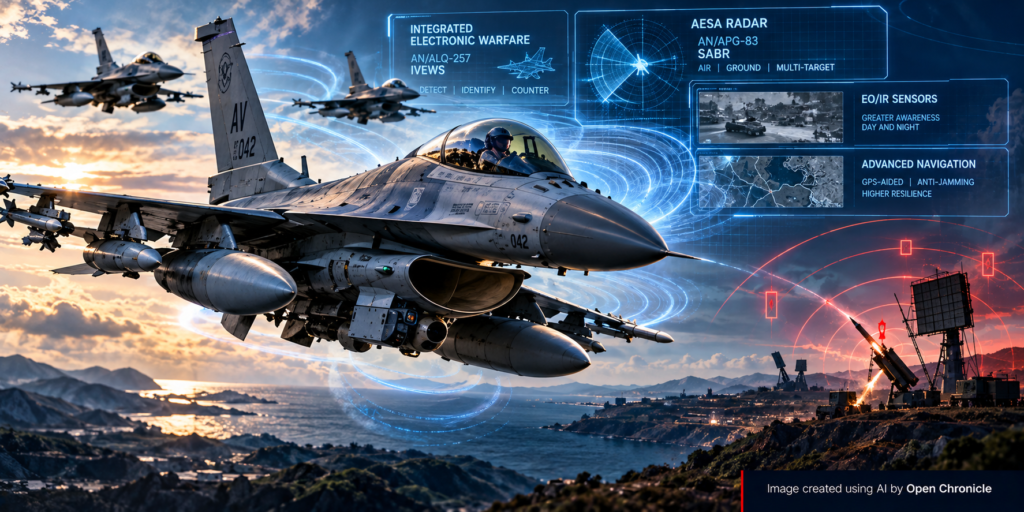
The F 16 remains one of the most important combat aircraft in Western air forces, but increasingly sophisticated radars, missiles and electronic threats are changing the environment in which it must operate. A new generation of electronic warfare, radar, sensor and navigation upgrades is intended to keep the Viper relevant well into the coming decades.
By Open Chronicle
More than half a century after the F 16 first took to the air, the fighter is undergoing another technological transformation.
The aircraft remains a frontline platform for the United States and a central component of numerous allied air forces. Yet the battlefield around it has changed dramatically. Modern fighters must operate inside an electromagnetic environment crowded with surveillance radars, sophisticated surface to air missile systems, electronic jamming, digital communications and increasingly agile radio frequency threats.
At the Air, Space & Cyber Conference in September, Northrop Grumman highlighted how electronic warfare is becoming a central part of the next stage of F 16 modernization. Breaking Defense reported that the wider modernization approach combines electronic warfare with improved radar, electro optical and infrared capabilities and navigation systems.
The objective is increasingly clear: the F 16 cannot become a stealth aircraft, but its ability to detect threats, understand the electromagnetic environment and defend itself can be substantially improved.
Electronic Warfare Becomes Central to F 16 Survivability
At the heart of the effort is Northrop Grumman’s AN/ALQ 257 Integrated Viper Electronic Warfare Suite, known as IVEWS.
The system represents a major departure from the electronic protection available to earlier generations of the F 16.
IVEWS is an internally installed electronic warfare system designed to detect, identify and counter radio frequency guided threats. Northrop Grumman says it uses an ultra wideband architecture capable of addressing a wider range of emitters, including agile and millimeter wave systems.
That distinction matters because electronic warfare has become increasingly important to aircraft survivability.
Modern air defenses do not depend on a single radar. Detection systems, tracking radars, missile guidance networks and communications systems can operate together, creating an interconnected threat environment.
A fighter therefore needs more than a warning that something is tracking it. Modern electronic warfare systems must help identify the threat, determine what it is doing and provide an appropriate response.
The US Air Force previously described IVEWS as necessary for improving the F 16’s survivability and lethality against current and emerging threats. The system was also designed with an open architecture intended to accommodate future capabilities, including adaptive or cognitive processing and fiber optic towed decoys.
IVEWS and SABR Working Together
One of the most important elements of the modernization is the relationship between electronic warfare and radar.
Modern fighters face a technical challenge because both systems operate within the electromagnetic spectrum. A powerful radar is transmitting and receiving signals while the electronic warfare suite is simultaneously trying to detect and counter hostile emissions.
Poor integration can create interference between the two.
Northrop Grumman says IVEWS was specifically engineered to operate alongside its AN/APG 83 Scalable Agile Beam Radar, or SABR.
The two systems have demonstrated what the company describes as pulse to pulse interoperability, allowing the radar and electronic warfare suite to conduct their missions simultaneously without significantly restricting one another.
This combination potentially changes the amount of information available to the pilot.
The radar searches the battlespace for aircraft and ground targets while the electronic warfare system monitors the electromagnetic environment for potential threats.
Together, they provide complementary views of the battlespace.
Bringing AESA Radar to the F 16
The APG 83 itself is one of the most significant upgrades introduced to modern F 16 configurations.
It is an Active Electronically Scanned Array radar derived from technology associated with Northrop Grumman’s radar work for newer combat aircraft.
Lockheed Martin says the system provides increased detection and tracking capability, high resolution Synthetic Aperture Radar mapping, simultaneous air to air and air to surface operations and improved electronic protection in dense radio frequency environments.
Unlike mechanically scanned radars, an AESA system electronically directs its radar beam.
That enables extremely rapid changes in where the radar is looking and allows sophisticated modes to operate with greater flexibility.
For the F 16 pilot, the result is improved situational awareness and a more detailed picture of the battlespace.
The US Air Force has already described the APG 83 and associated cockpit display improvements as critical components for keeping the F 16 relevant as the service plans to operate the aircraft into the 2040s.
More Than an Electronic Warfare Upgrade
The transformation of the Viper extends considerably beyond IVEWS.
Lockheed Martin’s broader F 16 modernization architecture includes an upgraded mission computer and avionics architecture, improved data links, advanced targeting pods, modern cockpit displays and improved navigation.
Some modernization configurations also incorporate passive Infrared Search and Track technology, providing another method of detecting aircraft without relying exclusively on radar emissions.
The concept is increasingly one of sensor integration.
Radar provides one stream of information. Electronic warfare equipment provides another. Infrared sensors add another perspective, while data links can bring information collected by other aircraft or forces into the cockpit.
The value comes not simply from installing individual sensors but from making their information useful to the pilot.
Navigation Is Becoming Part of the Electronic War
Navigation is another increasingly important component of the modernization effort.
GPS has transformed military aviation, but reliance on satellite navigation also creates vulnerabilities when adversaries possess the ability to jam or manipulate satellite signals.
Modernized F 16 configurations therefore emphasize more resilient navigation. Lockheed Martin has described its Viper capability roadmap as including precise combat navigation combining GPS aided and blended navigation with increased resistance to spoofing.
In a heavily contested electromagnetic environment, knowing the aircraft’s position reliably becomes part of the wider electronic warfare problem.
A fighter that retains radar, communications and weapons but loses trustworthy navigation data can still face serious operational limitations.
A Digital Cockpit for a Much Older Airframe
The cockpit has also evolved substantially from the original F 16.
Modern F 16V aircraft incorporate a high resolution Center Pedestal Display capable of presenting radar information, targeting pod imagery, moving maps and tactical information on a larger digital screen.
The modernization is designed to allow pilots to process the growing quantity of information generated by modern sensors.
Lockheed Martin says the display allows aircrews to make fuller use of AESA radar and targeting pod data while providing larger tactical displays and improved management of information.
This is important because adding sensors alone does not necessarily make an aircraft more effective.
If the pilot becomes overwhelmed by information, the technological advantage can quickly disappear.
An F 16 Designed to Keep Changing
IVEWS has also been designed around the expectation that electronic threats will continue evolving.
That is particularly important in electronic warfare because radar and countermeasure technologies constantly react to one another.
A new radar waveform can force the development of a new countermeasure. That countermeasure can then encourage another modification to the radar.
Software and processing power therefore become as important as the physical equipment installed aboard the aircraft.
Northrop Grumman says IVEWS uses common technological building blocks shared with other programs, allowing future upgrades to be introduced more rapidly. The company also says the system has accumulated more than 500 flight hours against advanced emitters and demonstrated an availability rate above 99 percent during hundreds of hours of flight testing.
A Global Modernization Challenge
The significance of these upgrades extends well beyond the US Air Force.
Northrop Grumman says more than 2,500 F 16s remain in service across more than 20 countries.
That enormous installed fleet creates a distinctive strategic and industrial opportunity.
Rather than replacing every F 16 with a fifth generation aircraft, operators can modernize existing aircraft with new radars, electronic warfare equipment, mission computers, displays, sensors and weapons.
Several countries are already pursuing extensive Viper modernization programs.
Poland, for example, finalized an agreement in 2025 to modernize 48 F 16 Block 52+ aircraft to the F 16V configuration. The package includes APG 83 AESA radar, a high resolution cockpit display, upgraded mission computing, electronic warfare improvements, advanced helmet mounted equipment and the Sniper targeting pod.
Greece has similarly been upgrading aircraft to the Viper configuration, incorporating APG 83 radar, new mission computers, updated Link 16 connectivity, navigation improvements and other systems.
Electronic Warfare Cannot Make the F 16 a Stealth Fighter
There are limits to what modernization can achieve.
The F 16 was designed decades before low observable shaping became a central element of modern combat aircraft design. Electronic warfare cannot change the fundamental physical characteristics of the airframe.
But survivability is not determined by stealth alone.
Detection, electronic protection, threat identification, jamming, situational awareness, networking, tactics and weapons range all contribute to whether an aircraft can operate successfully in contested airspace.
IVEWS is therefore best understood as part of a broader attempt to make the F 16 considerably harder to detect, target and engage successfully within the electromagnetic battlespace.
The F 16’s Second Digital Life
The remarkable feature of the F 16 story is no longer simply its longevity.
It is the extent to which the aircraft has become a platform for technologies that its original designers could not have anticipated.
Modern AESA radar, digital electronic warfare, infrared sensors, high speed processors, advanced data links, digital cockpits and resilient navigation are being integrated into an aircraft whose basic aerodynamic design dates from another technological era.
The result is not a fifth generation fighter.
It is something different: a mature fourth generation airframe increasingly surrounded by a twenty first century digital combat architecture.
For the thousands of F 16s expected to remain operational around the world, that electronic transformation may determine how useful the Viper remains in the increasingly contested skies of the next two decades.