
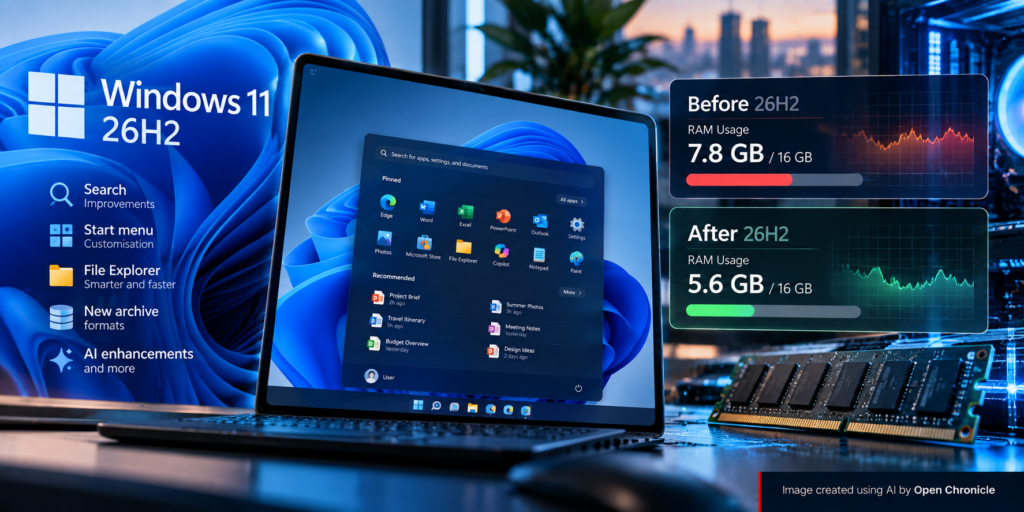
Microsoft promoted Windows 11 26H2 with improvements to Search, the Start menu, File Explorer and AI features. But one of the update’s most noticeable changes may be something the company barely mentioned: significantly lower memory consumption reported by some users.
By Open Chronicle
Microsoft’s latest Windows 11 update is attracting attention for an unexpected reason.
Windows 11 26H2 arrived with a collection of interface changes, new customization options and performance improvements. Microsoft highlighted enhancements to Windows Search, additional controls for the Start menu, a smarter File Explorer, support for new archive formats and further artificial intelligence features.
Yet reports from users suggest that one of the most significant improvements may be happening quietly in the background.
Some computers running Windows 11 26H2 appear to be using considerably less RAM.
Users Report Dramatic Reductions in Memory Usage
Reports began appearing shortly after the update became available, with users noticing lower memory consumption after upgrading their systems.
In one example, a three year old laptop equipped with 16GB of RAM reportedly used approximately 2GB less memory after installing Windows 11 26H2.
Similar experiences have been shared by users on Reddit, with some reporting reductions approaching 3GB.
The most substantial differences appear to occur while computers are idle, although users are also reporting improved responsiveness when applications are running.
If those observations prove consistent across a wider range of hardware, the improvement could be particularly valuable for computers equipped with 8GB or 16GB of memory, where background Windows processes can consume a meaningful share of available resources.
Why Lower RAM Consumption Matters
Modern operating systems deliberately use available memory to improve responsiveness, meaning high RAM consumption is not automatically a sign of poor performance.
However, reducing unnecessary background memory usage can still have significant advantages.
More available RAM gives applications additional room to operate before Windows needs to rely more heavily on virtual memory and storage. This can become particularly noticeable when users have numerous browser tabs, productivity applications, communication software and other programs open simultaneously.
Better memory management can therefore make a computer feel faster even when its processor and physical RAM remain unchanged.
For older PCs, such optimization can effectively extend the useful life of existing hardware.
Low Latency Profile May Be Part of the Story
One possible contributor to the perceived improvement is a Windows feature known as Low Latency Profile, although it has not been established that this feature is responsible for the reported reductions in RAM consumption.
The principle behind the feature involves allowing the processor to complete certain tasks as quickly as possible rather than maintaining a more consistent processing rate.
For example, when an application is opened, the system can prioritize completing that operation rapidly. Once the workload has finished, the processor can return to an idle state sooner.
The approach can improve responsiveness while potentially allowing system resources to be released more efficiently.
That could help explain why some users describe Windows 11 26H2 as feeling faster, but the precise reason for the reported memory reductions remains unclear.
Microsoft Had Already Promised Better Memory Management
The reports are not entirely unexpected.
Earlier in 2026, Microsoft indicated that Windows 11 would receive memory optimization and performance improvements designed to make the operating system more responsive, particularly under heavier workloads.
Windows 11 26H2 may therefore be delivering some of those changes.
What makes the situation unusual is that Microsoft did not prominently advertise a major reduction in RAM consumption as one of the update’s headline improvements.
That leaves open the possibility that several smaller changes to Windows memory management, scheduling and background processes are collectively producing the results users are seeing.
A Potentially Important Upgrade for Older Hardware
Much of the discussion surrounding modern Windows development has focused on artificial intelligence and increasingly powerful PCs.
Memory efficiency, however, can have a much broader practical impact.
Millions of Windows computers continue to operate with relatively modest hardware. A system with 16GB of RAM that suddenly has another 2GB available for applications could experience a noticeable improvement without any physical upgrade.
The potential benefit could be even more important on systems with only 8GB of memory.
It also comes at a time when increasingly demanding browsers, productivity applications and AI enabled software are placing greater pressure on system resources.
Early Reports Still Need Perspective
The results should nevertheless be treated cautiously.
Memory consumption varies substantially between computers depending on hardware, installed applications, startup programs, drivers, security software and Windows configuration.
A reduction observed on one machine does not necessarily mean another computer will experience the same improvement.
The reports of reductions between approximately 2GB and 3GB therefore should not yet be interpreted as a guaranteed feature of Windows 11 26H2.
Microsoft has also not formally announced that the update should reduce memory consumption by a specific amount.
An Unexpected Highlight of Windows 11 26H2
Windows 11 26H2 may ultimately be remembered less for one major new feature than for a series of refinements to Microsoft’s operating system.
Search is improving. File Explorer is becoming more capable. The Start menu offers greater customization. AI functionality continues to expand.
But for many users, none of those changes may matter as much as a computer simply feeling faster.
If the early reports of improved RAM management prove widespread, one of the most important Windows 11 26H2 improvements may be the one Microsoft barely advertised.