
Nearly half of likely American voters believe President Donald Trump is damaging Republican candidates’ chances in the November midterm elections, according to a new YouGov poll. The findings reveal growing concerns among independent voters, divisions within the Republican electorate and widespread anxiety about the economy as the battle for control of Congress intensifies.
With less than four weeks remaining before the 2026 United States midterm elections, a new opinion poll suggests that President Donald Trump’s political influence may be creating difficulties for Republican candidates seeking to retain control of Congress.
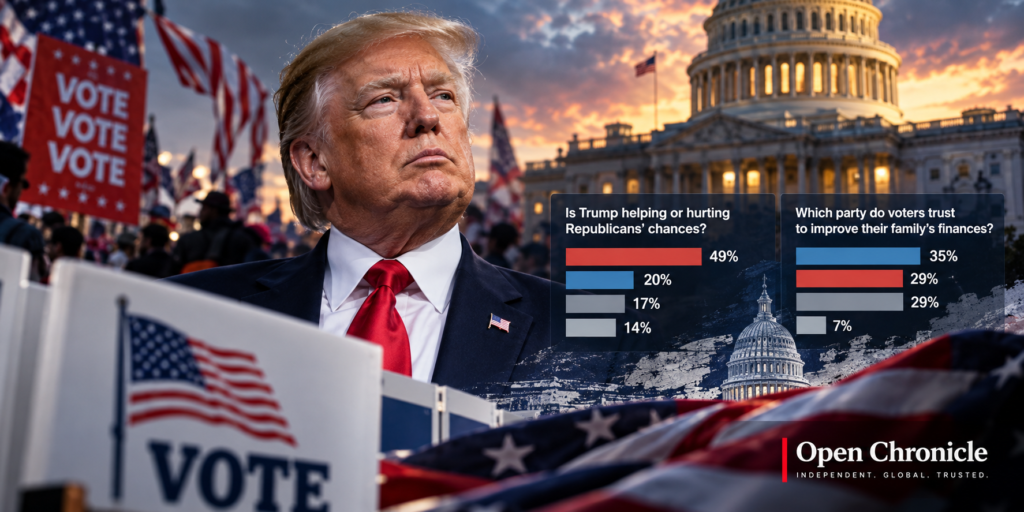
YouGov survey found that 49% of likely voters believe Trump is hurting Republican candidates’ electoral prospects, compared with just 20% who believe he is helping them.
Another 17% said the president is neither helping nor hurting Republican candidates, while 14% were uncertain.
The results point to a significant divide between Trump’s continued efforts to mobilize Republican supporters and the perceptions of voters who believe his presidency is making the party’s electoral position more difficult.
The survey was conducted between October 1 and October 5 among 1,053 US adult citizens, with a reported margin of error of plus or minus 4.2 percentage points.
Nearly Half of Voters See Trump as a Political Liability
Is Trump helping or hurting Republicans’ chances?
Source: YouGov, as reported in the supplied article. Percentages of respondents.
The 29 percentage point gap between those who believe Trump is hurting Republican candidates and those who believe he is helping represents one of the survey’s most striking findings.
The results suggest that Trump’s visibility on the campaign trail is not universally regarded as an advantage, even as the president continues to attract supporters to Republican rallies.
For Republican candidates, the challenge is to benefit from Trump’s ability to mobilize his political base while appealing to voters who are less enthusiastic about his leadership.
That balance may be particularly important in competitive congressional districts and Senate races.
Independent Voters Express the Greatest Concern
The poll reveals particularly negative perceptions of Trump’s electoral influence among independent voters.
According to the survey, 54% of independents believe the president is damaging Republican candidates’ chances.
Among Democrats, that figure rises to 77%.
More notably, 18% of Republican respondents also believe Trump is hurting their party’s electoral prospects.
Although most Republican voters do not share that assessment, the presence of criticism within the party highlights the political uncertainty surrounding the midterm elections.
Independent voters are especially important because they can influence the outcome of closely contested races.
Their responses in the survey therefore provide a potentially significant indicator of the challenges facing Republican campaigns.
However, perceptions of Trump’s influence are not the same as voting intentions, and the poll does not establish how individual congressional races will be decided.
Trump Could Face Blame for Republican Losses
The survey also asked voters who would bear responsibility if Republicans suffered electoral defeats in November.
Forty percent identified Trump as the person most responsible for potential Republican losses.
Only 10% selected Republican leaders in Congress.
The findings suggest that many voters associate the party’s electoral fortunes directly with the president, rather than with its congressional leadership.
Among Republican respondents, however, responsibility was distributed more widely.
Nineteen percent said Trump would be responsible for a defeat, while 11% blamed congressional Republican leaders.
Another 10% identified Republican candidates themselves.
Twenty-four percent attributed potential Republican losses to economic factors beyond the control of politicians.
These responses reveal differing interpretations of the political environment, even among voters belonging to the same party.
Trump Campaigns Across Republican Strongholds
Despite the poll’s findings, Trump has maintained an active campaign schedule in the weeks preceding the election.
Rather than concentrating exclusively on competitive states, the president has appeared at rallies in several traditionally Republican areas, seeking to encourage his supporters to participate in November.
His recent campaign appearances have included Texas, Nebraska, Oklahoma, Alabama and Ohio.
In Dallas, Trump campaigned in support of Republican Senate candidate Ken Paxton.
He also visited Nebraska to support Senator Pete Ricketts and Ohio to campaign for Senator Jon Husted.
In Alabama, Trump backed Senator Tommy Tuberville, who is running for governor.
The president has also appeared in Oklahoma to support congressional Republicans.
The campaign strategy reflects the importance of voter turnout, particularly in states where Republicans have traditionally enjoyed substantial electoral support.
Trump Urges Supporters to Vote as Though He Were on the Ballot
Trump has repeatedly argued that his personal appeal can motivate Republican voters.
During a recent rally in Alabama, he urged supporters to approach the midterm elections as though he were personally standing for election.
“When I’m on the ballot, we get everybody. So, just close your eyes and pretend I’m on the ballot,” he told the crowd.
His comments reflect a familiar challenge for political parties during midterm elections: persuading supporters of a president to vote when that president is not a candidate.
Trump has also acknowledged frustration among some Republican voters.
In an August interview, he suggested that supporters were dissatisfied with the party’s congressional leadership rather than with him personally.
“They’re angry at Republicans, but they’re not angry at me,” he said.
The distinction is central to his campaign message, which seeks to separate the president’s political standing from broader dissatisfaction with Republican officeholders.
Economic Anxiety Becomes a Major Electoral Issue
The poll comes amid continuing concern about the cost of living in the United States.
High gasoline prices, food costs, mortgage rates and inflation have become prominent subjects in the midterm campaign.
The ongoing war involving Iran has added another source of economic uncertainty, particularly through its effects on energy prices.
Democratic candidates have sought to connect these pressures to the Trump administration’s economic record.
Republicans, meanwhile, are attempting to defend their management of the economy and persuade voters that continued Republican control of Congress would benefit households.
The survey suggests that neither party has secured overwhelming public confidence on financial issues.
Democrats Lead Republicans on Financial Trust
Which party do voters trust to improve their family’s finances?
Source: YouGov, as reported in the supplied article. Percentages of respondents.
When asked which political party they trusted more to improve their family’s financial circumstances, 35% of likely voters selected Democrats.
Republicans received 29%.
Another 29% said they trusted neither party, while 7% were uncertain.
The six percentage point advantage for Democrats suggests a modest lead on this particular question.
However, the equally large share of respondents expressing confidence in neither party reveals substantial dissatisfaction with both political alternatives.
That uncertainty could become important in an election where economic conditions are a major concern.
Nearly Four in Ten Expect to Be Worse Off Under Republican Control
Financial outlook if Republicans control Congress
Source: YouGov, as reported in the supplied article. Percentages of respondents.
The survey also examined voters’ expectations about their personal financial situation if Republicans retained control of Congress.
According to the supplied results, 39% believed they would be worse off financially.
Another 23% expected to be better off, while 23% anticipated no difference.
The remaining 15% were uncertain.
These responses suggest that negative expectations outweigh positive ones among the surveyed voters.
They also reinforce the importance of economic confidence as a campaign issue.
For households facing higher borrowing costs and everyday expenses, perceptions of financial security may influence political preferences.
The poll does not establish whether those expectations will translate directly into voting behaviour.
The Iran War Adds Another Layer of Political Pressure
The conflict involving Iran has become another issue shaping the political environment.
According to the supplied reporting, the war remains unpopular among many American voters and has contributed to concerns about rising energy prices.
Higher oil prices can affect household budgets through gasoline, transportation and the cost of goods.
The economic consequences may extend beyond fuel purchases, particularly when higher energy costs place additional pressure on businesses and consumers.
Democratic candidates have incorporated these concerns into their criticism of the administration.
For Republicans, the challenge is to defend the president’s policies while addressing voters’ immediate economic worries.
The combination of international conflict and domestic financial pressure has made the midterm campaign more complicated.
Control of Congress Remains the Central Prize
The November elections will determine the composition of the next Congress and shape the balance of political power in Washington.
For Trump, the stakes extend beyond individual Republican candidates.
Congressional control affects the administration’s ability to advance legislation, negotiate federal spending and pursue its broader political agenda.
A change in the congressional balance could also increase oversight of the executive branch.
Republican campaigns are therefore attempting to maximize turnout while responding to voter concerns about the economy and the president’s political influence.
Democrats are seeking to capitalize on dissatisfaction with the administration and present themselves as an alternative on economic issues.
The outcome will depend on individual races, voter participation and developments during the remaining campaign period.
Trump Remains Confident Despite Polling Concerns
Despite the negative perceptions recorded in the YouGov survey, Trump has continued to express confidence in Republican prospects.
The president has publicly predicted a strong Republican performance and suggested that major developments could emerge before voters go to the polls.
He has also promised “big surprises” during the final weeks of the campaign.
Those statements reflect his public campaign position rather than evidence of a particular electoral outcome.
The survey presents a different picture, showing that substantial numbers of voters question whether Trump’s involvement benefits Republican candidates.
A Midterm Election Shaped by Trump and the Economy
The YouGov poll illustrates two important forces shaping the 2026 midterm elections.
The first is Trump’s personal influence over the Republican Party.
Although he remains central to its campaign strategy, nearly half of surveyed likely voters believe his involvement is hurting Republican candidates.
The second is economic dissatisfaction.
Concerns about inflation, energy prices, mortgages and household finances continue to shape public attitudes toward both major parties.
The survey also shows that many voters remain unconvinced that either party can improve their financial circumstances.
With less than four weeks remaining before the election, the political environment remains contested.
The findings do not predict which party will control Congress. They do, however, highlight the challenges Republicans face as they seek to mobilize Trump’s supporters while appealing to voters concerned about his presidency and the direction of the economy.
Sources and Further Reading
YouGov
Public opinion survey conducted October 1 to 5, 2026, covering perceptions of Donald Trump’s influence on Republican candidates, responsibility for potential electoral losses and household financial confidence.
Survey methodology: 1,053 US adult citizens; reported margin of error of ±4.2 percentage points. The supplied reporting describes results among likely voters but does not provide a detailed breakdown of the likely voter screening or subgroup margins of error.
Editorial Note
All polling figures in this article are drawn from the supplied YouGov reporting. The findings measure voter attitudes at the time of the survey and should not be interpreted as a forecast of the November election results.