
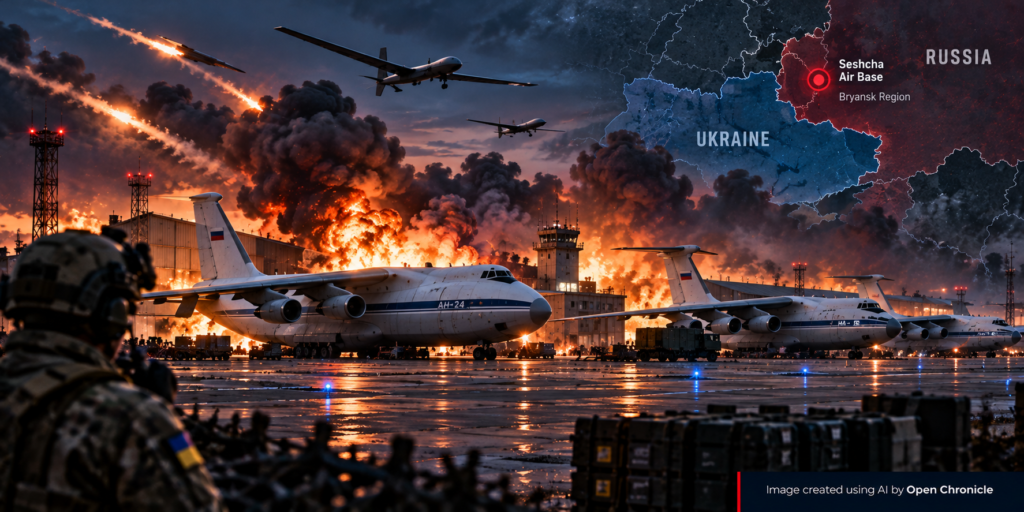
Ukrainian forces have targeted the Seshcha military airfield in Russia’s Bryansk region, a facility associated with some of Moscow’s largest military transport aircraft. The Ukrainian General Staff confirmed the operation on October 7, although the extent of the damage and the specific targets struck remain unknown.
By Open Chronicle with agencies
Ukraine’s armed forces have carried out a strike against the Seshcha military airfield in Russia’s Bryansk region, extending their campaign against military infrastructure beyond the Ukrainian border.
The General Staff of the Armed Forces of Ukraine announced the operation in a statement published on October 7, 2026.
According to the Ukrainian military, the airfield was among several Russian military facilities targeted during operations conducted on October 6 and overnight into October 7.
Seshcha is associated with Russia’s military transport aviation, including the Antonov An-124 and Ilyushin Il-76 aircraft.
However, Ukrainian authorities did not identify which facilities or aircraft were targeted, and there has been no confirmation that any transport aircraft were damaged or destroyed.
Seshcha Airfield Comes Under Attack
The Ukrainian General Staff confirmed that its forces had struck the military airfield but provided few operational details.
The statement did not identify the weapons used in the attack or specify which parts of the installation were hit.
Ukrainian authorities also said that the extent of the damage was still being assessed.
The limited information leaves several important questions unanswered, including whether the operation affected aircraft, maintenance facilities, fuel infrastructure or other military assets.
There is also no confirmed assessment of the airfield’s operational status following the strike.
The attack nevertheless places renewed attention on the military importance of Seshcha and its role within Russia’s aviation infrastructure.
Why Seshcha Matters to Russia’s Military
Seshcha is located in Russia’s Bryansk region, an area bordering Ukraine that has become increasingly exposed to the wider conflict.
The airfield is associated with Russian military transport operations and aircraft capable of moving substantial quantities of personnel, equipment and supplies.
Unlike tactical fighter bases, military transport installations support the logistical networks required to sustain armed forces over long distances.
Large transport aircraft can move vehicles, equipment, military personnel and other cargo between airfields, allowing commanders to support operations across geographically dispersed locations.
For Russia, maintaining military airlift capabilities is particularly important given the country’s vast territory and the logistical demands of its armed forces.
The Antonov An-124: One of the World’s Largest Military Transports
The Antonov An-124 Ruslan is among the largest operational cargo aircraft in the world.
Originally developed during the Soviet era, the aircraft was designed to transport exceptionally heavy and oversized cargo.
Its substantial cargo compartment and payload capacity make it valuable for transporting equipment that cannot easily be accommodated aboard smaller military aircraft.
The An-124 represents a specialized logistical capability rather than a conventional combat aircraft.
Any confirmed damage to such aircraft could therefore carry operational significance, although there is currently no evidence in the supplied Ukrainian statement that an An-124 was struck at Seshcha.
The Ilyushin Il-76: A Workhorse of Russian Military Aviation
The Ilyushin Il-76 is another important aircraft associated with Russian military transport operations.
The Il-76 has served for decades as one of the principal transport aircraft in Soviet and Russian military aviation.
Its roles include the movement of troops, military supplies and equipment.
The aircraft’s ability to operate in varied conditions has made it an important component of military logistics.
As with the An-124, however, there is no confirmed information establishing that any Il-76 aircraft were damaged in the latest attack.
Part of a Wider Series of Ukrainian Strikes
The attack on Seshcha was not an isolated operation, according to the Ukrainian General Staff.
The military statement described several strikes against Russian military targets during October 6 and the following night.
Those operations reportedly took place both inside Russia and in Russian occupied areas of Ukraine.
The statement did not provide a complete damage assessment for the Seshcha operation.
The reported attack fits within the broader pattern of Ukrainian operations against military infrastructure beyond the immediate front lines.
Such strikes can place additional pressure on the facilities and logistical systems used to support military operations.
Their actual impact, however, depends on what was hit and whether the damage affects the installation’s ability to function.
Russia Launches Major Missile and Drone Attack on Ukraine
The Ukrainian operations took place during another period of intense Russian aerial attacks.
Overnight, Russian forces launched a large missile and drone assault against Ukraine.
The attack prompted defensive operations involving Ukrainian forces and heightened military activity in neighbouring NATO territory.
Poland, which borders Ukraine, has repeatedly had to monitor the security implications of Russian aerial operations near its eastern frontier.
During the latest attack, Swedish Gripen fighter aircraft reportedly supported Polish air defence operations.
Swedish Gripens Support Polish Air Defence
The participation of Swedish Gripen fighters highlights the international dimension of the aerial security situation surrounding the war.
Sweden and Poland are both members of NATO, and their air forces contribute to the alliance’s wider defensive arrangements.
The Saab JAS 39 Gripen is a multirole combat aircraft designed for air defence and other missions.
Its reported involvement in supporting Polish defensive operations illustrates how Russian missile and drone attacks against Ukraine can trigger precautionary military activity beyond Ukraine’s borders.
The available reporting does not establish that the Swedish aircraft engaged Russian missiles or drones.
Their role should therefore be understood as support for air defence operations rather than confirmation of direct combat.
What Remains Unknown About the Seshcha Strike
Several important aspects of the attack remain unconfirmed.
The Ukrainian General Staff has not disclosed the weapons employed, the specific facilities targeted or the resulting damage.
It has also not announced the destruction of any An-124 or Il-76 aircraft.
That distinction is important because the presence of valuable military aircraft at an airfield does not establish that those aircraft were hit.
A reliable assessment of the operation will require additional evidence, potentially including official statements, verified imagery or other independently corroborated information.
Until then, the confirmed claim is limited to Ukraine’s announcement that it struck the installation.
Military Logistics Remain a Critical Dimension of the War
The reported strike against Seshcha draws attention to an aspect of modern warfare that can receive less public attention than frontline battles: military logistics.
Combat aircraft, armoured vehicles and artillery systems depend on extensive networks of transportation, maintenance, fuel distribution and equipment supply.
Military transport aviation forms part of that system.
Airfields capable of supporting large cargo aircraft can be important nodes within a country’s wider military infrastructure.
For Ukraine, operations against such facilities may be intended to impose additional logistical and operational costs on Russian forces.
For Russia, protecting those installations becomes part of the challenge of sustaining military operations while defending infrastructure across a large territory.
The actual consequences of the latest attack will depend on the damage assessment.
Another Sign of the War’s Expanding Geographic Reach
The Seshcha operation comes as the Russia Ukraine war continues to extend beyond the immediate battlefield.
Russian missile and drone attacks reach cities and infrastructure across Ukraine, while Ukrainian operations increasingly target military facilities inside Russian territory.
At the same time, neighbouring NATO countries remain alert to the security consequences of large aerial operations near their borders.
The latest events illustrate all three dimensions of the conflict.
Ukraine says it has struck a Russian military transport airfield. Russia has launched another major missile and drone attack. Swedish fighters have supported Polish air defence operations.
What remains uncertain is the physical damage inflicted at Seshcha and whether the strike has affected Russia’s military airlift capabilities.
For now, the Ukrainian General Staff’s announcement confirms the reported operation, but not its operational outcome.