
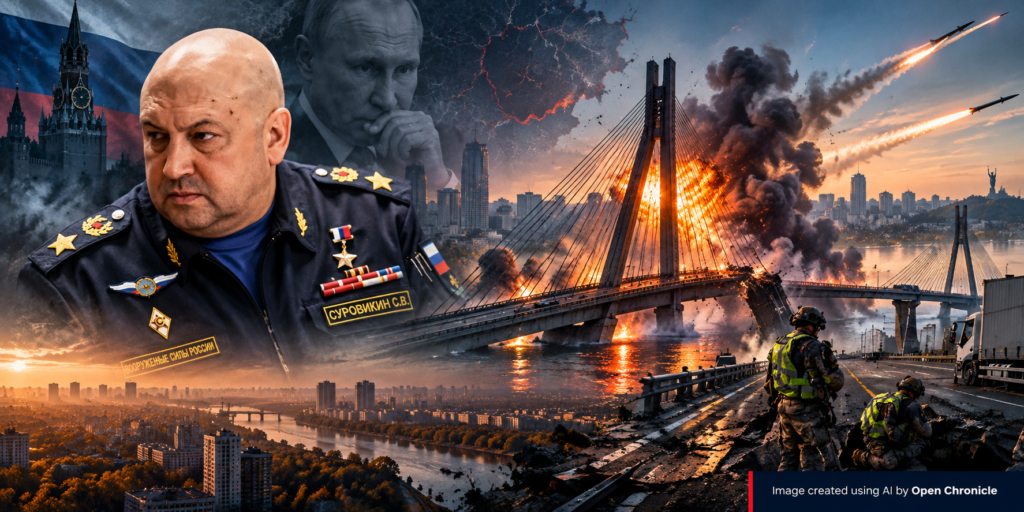
Russian President Vladimir Putin is reportedly considering a new campaign against bridges crossing the Dnipro River in Kyiv, with General Sergei Surovikin allegedly brought back into military planning. The reported strategy comes as Russian forces struggle to achieve decisive gains in eastern Ukraine and the Kremlin searches for ways to increase pressure on the Ukrainian capital.
By Open Chronicle with agencies
Russian President Vladimir Putin has reportedly instructed General Sergei Surovikin, the former commander of Russian forces in Ukraine known as “General Armageddon,” to prepare a campaign targeting bridges across the Dnipro River in Kyiv.
According to reporting attributed to The Telegraph and cited by Ukraine’s UNN news agency on October 8, the Kremlin may be preparing to shift its military approach as Russian ground operations encounter continued resistance in eastern Ukraine.
The reported objective would be to disrupt transportation across the Ukrainian capital, complicate movement between the two banks of the Dnipro and increase pressure on Ukraine’s government and civilian population.
However, the reported order to Surovikin has not been independently confirmed, and the available account does not establish that a new campaign against Kyiv’s bridges has begun.
A Possible Change in Russian Military Strategy
The reported plan comes amid growing questions about Russia’s ability to achieve its objectives through conventional ground offensives.
According to the account, Russian operations in the Donbas have failed to deliver the territorial gains Moscow expected over recent months.
Ukrainian forces continue to resist Russian advances around Pokrovsk and Lyman, two areas that have featured prominently in fighting across eastern Ukraine.
The publication describes significant Russian losses and growing difficulties maintaining the manpower required for sustained offensive operations.
Against this background, the Kremlin may be considering greater reliance on long range attacks against infrastructure and major urban centres.
Such a shift would allow Russia to exert pressure beyond the immediate front lines, although it would not necessarily resolve the military difficulties facing its ground forces.
Why Kyiv’s Bridges Matter
The Dnipro River divides Kyiv into western and eastern sections, making bridges essential components of the capital’s transportation network.
They connect residential districts, commercial areas, public services and important road and rail routes.
Disrupting those crossings could create serious difficulties for everyday movement and the operation of essential services.
The consequences would depend on which crossings were affected, the extent of any damage and the availability of alternative routes.
Bridges can have both civilian and military functions, but their strategic importance does not automatically make every attack lawful under international humanitarian law.
Any military operation against such infrastructure would need to comply with the principles of distinction, proportionality and precautions in attack.
The Return of “General Armageddon”
One of the most striking elements of the report is the alleged involvement of Sergei Surovikin.
The Russian general became widely known during his previous command responsibilities in Ukraine.
His nickname, “General Armageddon,” reflects his reputation for overseeing particularly destructive military operations.
Surovikin previously commanded Russian forces during a period marked by extensive missile and drone attacks against Ukrainian energy infrastructure.
Those attacks damaged electricity generation and distribution facilities, disrupting power supplies and affecting civilian life across Ukraine.
His reported return to planning operations against Kyiv would therefore attract particular attention.
Nevertheless, the available reporting does not independently establish his present operational responsibilities or confirm that he has received the alleged instructions from Putin.
Russian Manpower Problems Add to the Pressure
The report also points to difficulties facing Russia’s military recruitment system.
According to the account, Moscow is struggling to recruit sufficient volunteer contract soldiers to replace personnel lost during fighting.
Sustained combat operations require a continuous supply of trained personnel, equipment and logistical support.
If recruitment fails to keep pace with battlefield losses, commanders may face growing constraints on their ability to maintain offensive momentum.
The reported difficulties could help explain why Moscow might seek additional means of exerting pressure on Ukraine without depending entirely on territorial advances.
However, the scale of Russian recruitment shortfalls and their precise effect on current operations cannot be established from the supplied reporting alone.
Pressure on Civilians as a Strategic Objective
The Telegraph account suggests that the Kremlin’s possible objectives extend beyond the physical destruction of infrastructure.
According to the report, prolonged attacks on Ukrainian cities could be intended to exhaust the population and increase pressure on the government to negotiate an end to the war.
This would represent an attempt to use the cumulative effects of infrastructure disruption as a means of political coercion.
Repeated damage to transportation systems, electricity networks and other essential facilities can impose substantial economic and humanitarian costs.
Such disruption can affect emergency services, commuting, commercial activity and the delivery of basic supplies.
But attacks directed at civilians or civilian objects are prohibited under international humanitarian law. Deliberately targeting civilian populations to spread terror is also prohibited.
The reported political objective remains an interpretation attributed to the publication, rather than a confirmed statement of Russian military planning.
Ukraine’s Air Defences Face Continuing Demands
The report also raises concerns about Ukraine’s ability to defend against a prolonged campaign of missile and drone attacks.
Protecting major cities requires a combination of radar surveillance, interceptor missiles, electronic warfare systems and other defensive capabilities.
Those resources must be distributed across numerous potential targets, including cities, energy facilities, military installations and transportation infrastructure.
A sustained Russian campaign could place additional demands on Ukraine’s available defensive systems.
The publication argues that Western countries should increase supplies of air defence missiles, radars, drones and electronic warfare equipment.
The recommendation reflects concerns that prolonged attacks could exploit limitations in Ukraine’s defensive capacity.
The Wider Battle for Eastern Ukraine
The reported shift in tactics must also be understood in the context of fighting across the Donbas.
Pokrovsk and Lyman remain important locations in the military struggle for eastern Ukraine.
According to the supplied report, Ukrainian resistance in these areas has prevented Russian forces from achieving the results anticipated by the Kremlin.
The account suggests that Moscow may be searching for alternative ways to change the strategic balance.
Attacking infrastructure in Kyiv could be intended to increase the political and economic costs of continued resistance.
Yet there is no guarantee that such a campaign would produce the outcome Moscow might seek.
Ukraine has continued fighting despite repeated attacks on its cities and infrastructure throughout the war.
A New Threat to the Ukrainian Capital?
The reported plan involving Surovikin raises the possibility of another phase of intensified Russian attacks against Kyiv.
If confirmed, a deliberate campaign against the capital’s Dnipro crossings would represent a potentially significant development in Russia’s approach to infrastructure warfare.
But several critical questions remain unanswered.
There is no independently verified confirmation of Putin’s alleged order, no established account of Surovikin’s current role in the reported planning and no evidence in the supplied material that the proposed campaign has begun.
The significance of the report therefore lies in the possibility of a change in Russian military priorities rather than in a confirmed new operational development.
For Ukraine, the broader challenge remains unchanged: defending its cities and essential infrastructure while continuing to resist Russian forces along the front lines.
As the war continues, the relationship between battlefield developments, long range strikes and pressure on civilian infrastructure remains central to its future course.
Editorial Note: This article is based on reporting attributed to The Telegraph and published by UNN on October 8, 2026. Claims concerning an alleged order from Vladimir Putin, Sergei Surovikin’s involvement and the proposed targeting of Kyiv’s bridges have not been independently verified. They are presented as reported allegations, not established facts.