
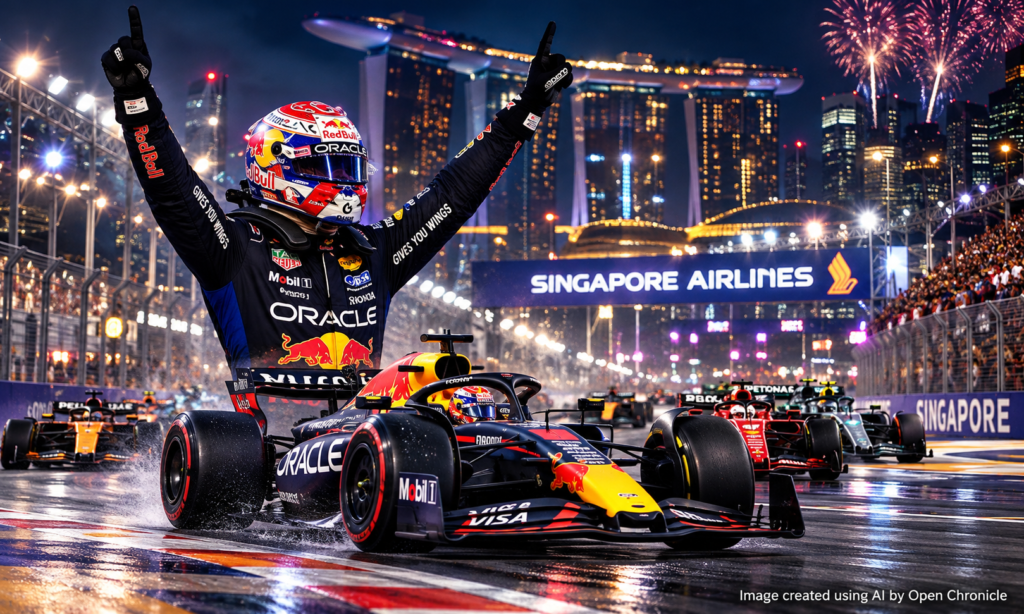
Max Verstappen completed an extraordinary Singapore weekend with his first Grand Prix victory at Marina Bay, following a dramatic Sprint triumph, pole position and a commanding Sunday performance. But while Red Bull celebrated a second consecutive Grand Prix victory, Kimi Antonelli emerged from Singapore with a 102 point championship lead, leaving the Mercedes driver within reach of his first Formula 1 world title.
By Open Chronicle Formula One Magazine
Race Report | Singapore Grand Prix | Round 17 of 23 | 9–11 October 2026
Singapore has finally surrendered to Max Verstappen.
On his 250th Formula 1 Grand Prix start, the four time World Champion delivered a controlled performance under the Marina Bay floodlights, converting pole position into his 73rd career victory and his first at one of the championship’s most demanding circuits.
Verstappen crossed the line 7.335 seconds ahead of Ferrari’s Charles Leclerc, with Mercedes championship leader Kimi Antonelli completing the podium, 24.573 seconds behind the winner.
The result marked Verstappen’s second consecutive Grand Prix victory after his breakthrough at Sepang the previous weekend. More significantly, it confirmed that Red Bull’s late season resurgence was no isolated performance.
But the weekend was about far more than Sunday’s result.
Rain disrupted Saturday’s Sprint, George Russell crashed while leading, the McLaren drivers collided, Ferrari showed genuine qualifying speed, and a succession of technical and strategic decisions shaped the Grand Prix.
By Sunday evening, Verstappen had taken almost everything available from Singapore. Antonelli, meanwhile, had taken another decisive step towards the championship.
Friday: Verstappen Announces His Intentions
Singapore’s first Sprint weekend left teams with only one hour of practice before competitive running began.
The Marina Bay Street Circuit demands precision. Its tight corners, heavy braking zones and unforgiving walls place exceptional pressure on drivers, while the combination of heat, humidity and limited cooling opportunities makes the event one of the most physically demanding on the calendar.
George Russell showed early Mercedes pace in practice, but Red Bull’s true strength became clear during Sprint Qualifying.
Verstappen produced a 1:31.156 in SQ3, beating Russell by 0.120 seconds and Leclerc by 0.243 seconds.
Oscar Piastri qualified fourth ahead of McLaren teammate Lando Norris, while Lewis Hamilton took sixth and championship leader Antonelli managed only seventh.
The session was not without controversy.
Sergio Pérez’s damaged Cadillac brought out a red flag after debris was left on the circuit. A subsequent systems issue delayed SQ2, while the FIA also investigated Verstappen for a possible yellow flag infringement.
The Dutchman retained pole after the stewards determined that no penalty was necessary.
It was an early indication of how the weekend would unfold: Red Bull was fast, Ferrari was close, Mercedes remained competitive, and operational problems were never far away.
Saturday Sprint: Rain, Russell’s Crash and McLaren’s Collision
The first major drama arrived before the Sprint had even started.
A downpour soaked sections of the Marina Bay circuit, forcing Race Control to delay the start by approximately half an hour. Conditions were particularly difficult because the surface was not uniformly wet, leaving drivers to negotiate sharply different levels of grip around the lap.
All competitors started on intermediate tyres.
When racing began, Russell launched past Verstappen and took the lead. For a few corners, it appeared that Mercedes might have the pace to challenge Red Bull.
Then Russell crashed.
The British driver lost control at the final corner on the opening lap and struck the barriers, surrendering a potentially valuable result.
Verstappen inherited the lead and controlled the remainder of the Sprint, finishing 2.591 seconds ahead of Hamilton.
Leclerc completed the podium, but the closing stages produced another major incident.
As Leclerc struggled with deteriorating intermediate tyres, Piastri and Norris closed rapidly. On the final lap, the McLaren teammates made contact at Turn 5, sending both cars into a spin.
Piastri’s race effectively ended against the barriers, while Norris recovered to eighth, salvaging the final Sprint point.
Antonelli avoided the incident and climbed to fourth, gaining valuable championship points on a day when Russell scored nothing.
Singapore Sprint: Top eight
| Pos. | Driver | Team | Points |
|---|---|---|---|
| 1 | Max Verstappen | Red Bull Racing | 8 |
| 2 | Lewis Hamilton | Ferrari | 7 |
| 3 | Charles Leclerc | Ferrari | 6 |
| 4 | Kimi Antonelli | Mercedes | 5 |
| 5 | Liam Lawson | Racing Bulls | 4 |
| 6 | Oliver Bearman | Haas | 3 |
| 7 | Nico Hülkenberg | Audi | 2 |
| 8 | Lando Norris | McLaren | 1 |
The Sprint had already changed the championship mathematics. Antonelli’s advantage over Russell increased to 89 points before Sunday’s Grand Prix.
Qualifying: Verstappen Denies Ferrari by 0.054 Seconds
Saturday’s Grand Prix qualifying session brought another extremely close contest.
Ferrari appeared to have the advantage through the opening phases. Hamilton topped both Q1 and Q2, suggesting that the SF-26 had the balance and traction required to challenge for pole position.
But Verstappen delivered when it mattered.
His first Q3 lap of 1:31.373 proved unbeatable.
Leclerc improved to 1:31.427, missing pole by just 0.054 seconds. Hamilton completed the top three with a 1:31.496, only 0.123 seconds behind Verstappen.
Antonelli qualified fourth, followed by Norris.
Russell initially qualified sixth but faced a substantial grid penalty following power unit changes. The penalty would force him to begin Sunday’s race from the back of the field.
For Red Bull, the contrast between its two drivers was stark.
While Verstappen secured pole, Isack Hadjar suffered further reliability problems and was unable to record a representative qualifying lap.
Qualifying: Top five
| Pos. | Driver | Team | Time |
|---|---|---|---|
| 1 | Max Verstappen | Red Bull Racing | 1:31.373 |
| 2 | Charles Leclerc | Ferrari | 1:31.427 |
| 3 | Lewis Hamilton | Ferrari | 1:31.496 |
| 4 | Kimi Antonelli | Mercedes | 1:31.562 |
| 5 | Lando Norris | McLaren | 1:31.712 |
Verstappen had now taken pole for both the Sprint and the Grand Prix, an impressive achievement at a venue where he had never previously won.
Sunday: Verstappen Controls the Singapore Grand Prix
The Grand Prix began with Verstappen facing immediate pressure from Leclerc.
The Ferrari driver attacked into the opening corner, but Verstappen defended his position and retained the lead.
That moment proved decisive.
Once clear of the opening sequence, Verstappen began building a gap. Leclerc initially remained within striking distance, but the Red Bull gradually established control.
Singapore’s combination of slow corners, limited overtaking opportunities and tyre management usually makes track position critical. Verstappen understood that maintaining a clean race at the front was more valuable than chasing unnecessary lap time.
The Red Bull driver started on Soft tyres before switching to Mediums during the pit stop phase.
The stop was executed cleanly, and Verstappen retained control of the race.
Even a communication problem could not disrupt him.
His radio developed difficulties, forcing Red Bull to rely on alternative communication methods, including the traditional pit board. In a sport increasingly dependent on constant exchanges between driver and pit wall, it was an unusual complication.
Yet Verstappen continued without a significant mistake.
He eventually completed the race in 1:42:00.785, winning by more than seven seconds.
It was his 73rd Formula 1 victory, his first at Marina Bay and one of the clearest demonstrations of Red Bull’s improving competitiveness during the second half of the season.
Ferrari: Leclerc Delivers, Hamilton Pays for Strategy Gamble
Ferrari arrived in Singapore with genuine hopes of victory.
The team’s qualifying performance was among its strongest of the season, with Hamilton leading both Q1 and Q2 before Leclerc narrowly missed pole.
On Sunday, Leclerc made the most of that opportunity.
He challenged Verstappen at the start and remained the closest competitor during the early stages. Although the Red Bull gradually pulled away, Leclerc protected second place and managed the changing strategic picture effectively.
A late Virtual Safety Car, triggered by Lance Stroll’s retirement, gave Ferrari another opportunity to respond.
Leclerc stopped for fresh tyres and retained enough performance to finish second, securing an important podium for the Scuderia.
Hamilton’s afternoon followed a very different trajectory.
Starting third, he remained a podium contender for much of the race but ultimately paid the price for his tyre strategy.
Hamilton chose not to stop during the Virtual Safety Car despite a call from Ferrari. The decision left him exposed on ageing tyres during the final stages.
Antonelli, Norris and Piastri all finished ahead of him, and Hamilton dropped to sixth.
The seven time World Champion subsequently acknowledged his responsibility for the decision and struggled physically in Singapore’s extreme heat.
For Ferrari, the result demonstrated both the competitiveness of its car and the narrow margins separating a strong result from a missed opportunity.
Antonelli’s Championship Lead Reaches 102 Points
Kimi Antonelli did not have the fastest car in Singapore.
He did not win the Sprint, take pole position or challenge Verstappen for victory on Sunday.
Yet he emerged from the weekend as one of its biggest beneficiaries.
The Italian secured fourth place in Saturday’s Sprint, then finished third in the Grand Prix.
Russell’s weekend, by contrast, unravelled.
His Sprint ended in the barriers after briefly taking the lead, and his Grand Prix was compromised by power unit penalties that forced him towards the back of the starting grid. He eventually finished ninth.
Antonelli now leads Russell by 102 points.
Drivers’ Championship
After Singapore · 2026
+102 Points
Antonelli leads Mercedes teammate George Russell by 102 points after the Singapore Grand Prix.
Antonelli moves within reach of securing the title at the United States Grand Prix.
With six Grands Prix remaining, Antonelli has an opportunity to settle the championship at Austin, depending on the results of the next round.
His campaign has increasingly been defined by consistency as much as outright speed.
Singapore provided another example.
McLaren: Another Weekend of Frustration
McLaren’s Singapore weekend was characterised by missed opportunities.
The Sprint collision between Norris and Piastri was particularly damaging. Both drivers had been competing near the front before their final lap contact, but the incident transformed a potentially valuable double result into a single point.
The team recovered on Sunday.
Norris finished fourth and Piastri fifth, securing 22 Grand Prix points between them.
Nevertheless, neither driver had the pace to challenge Verstappen or Leclerc for the leading positions.
The contrast with Red Bull was significant.
While Verstappen controlled the weekend from the front, McLaren spent much of its time managing traffic, recovering from incidents and attempting to extract points from an increasingly difficult competitive situation.
Red Bull’s Resurgence: A Technical Turning Point?
The strongest message from Singapore concerned Red Bull’s performance.
At Sepang, Verstappen had demonstrated that the car could win in changing conditions.
At Marina Bay, he demonstrated something different: Red Bull could dominate at a circuit demanding mechanical grip, stability under braking, traction and precise tyre management.
The improvement was particularly significant because Singapore had historically been one of Verstappen’s more difficult venues.
The team appeared to have found a more effective balance between qualifying performance and race consistency.
However, it would be premature to attribute the victory to one particular upgrade without detailed engineering evidence.
What can be established is that Red Bull delivered the complete competitive package required: Sprint pole, Sprint victory, Grand Prix pole and Grand Prix victory.
For the first time in 2026, Verstappen had won consecutive Grands Prix.
That changes the outlook for the remaining races.
Singapore Grand Prix 2026: Final Race Classification
| Pos. | Driver | Team |
|---|---|---|
| 1 | Max Verstappen | Red Bull Racing |
| 2 | Charles Leclerc | Ferrari |
| 3 | Kimi Antonelli | Mercedes |
| 4 | Lando Norris | McLaren |
| 5 | Oscar Piastri | McLaren |
| 6 | Lewis Hamilton | Ferrari |
| 7 | Liam Lawson | Racing Bulls |
| 8 | Nico Hülkenberg | Audi |
| 9 | George Russell | Mercedes |
| 10 | Oliver Bearman | Haas |
Top ten finishers. Winning time: 1:42:00.785. Verstappen’s margin over Leclerc: 7.335 seconds.
The Bigger Picture: Two Winners, Two Different Battles
Singapore delivered two important outcomes.
For Max Verstappen, it was confirmation.
After a difficult beginning to 2026, the Red Bull driver has now won twice in succession and finally conquered Marina Bay. His victory came through qualifying precision, controlled tyre management, disciplined execution and an ability to remain composed despite technical complications.
For Kimi Antonelli, Singapore was another major step towards the World Championship.
He did not need to beat Verstappen to strengthen his title campaign. He needed to finish ahead of Russell, collect substantial points and avoid the mistakes that have compromised other contenders.
He achieved all three.
Ferrari leaves Singapore with a podium and renewed evidence of its competitiveness, but also with questions about race strategy. McLaren leaves with valuable points, yet another reminder of the consequences of its internal battles.
Mercedes remains in command of the championship, but Red Bull is now setting the competitive standard.
The next challenge comes at the United States Grand Prix in Austin, from 23 to 25 October.
Verstappen will arrive chasing a third consecutive victory.
Antonelli will arrive with the possibility of becoming Formula 1 World Champion.
And the final phase of the 2026 season may prove far more complicated than the championship standings alone suggest.