
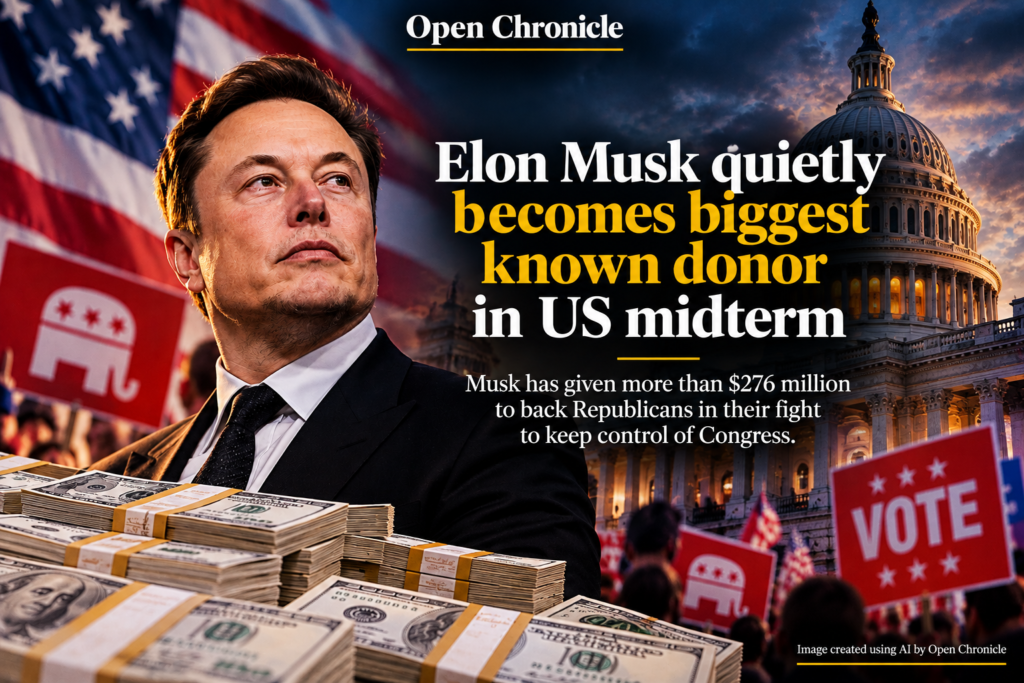
The billionaire entrepreneur has emerged as the largest publicly identified political donor in the 2026 US midterm elections, directing hundreds of millions of dollars toward Republican campaigns in an effort to preserve the party’s congressional majorities. His renewed financial involvement comes despite an earlier promise to reduce political spending and amid growing voter dissatisfaction with President Donald Trump’s administration.
By Open Chronicle with agencies
WASHINGTON, October 13, 2026 — Elon Musk has quietly become the largest known political donor in the 2026 United States midterm elections, committing more than $276 million since July to support Republican candidates and help the party retain control of Congress.
The extraordinary spending marks a significant return to political financing for the technology billionaire, who previously indicated that he intended to reduce his involvement in American electoral politics.
According to figures first reported by The New York Times and subsequently confirmed by Andrew Romeo, a spokesperson for Musk’s political action committee, the donations have been directed toward major Republican campaign organisations and voter mobilisation operations.
The largest contribution, approximately $158 million, went to the Senate Leadership Fund, the principal super PAC supporting Republican candidates for the US Senate.
Another $76 million was allocated to America PAC, Musk’s own political organisation, which has developed an extensive voter outreach operation modelled on its activities during the 2024 presidential election.
Musk also contributed $10 million to Lone Star Liberty PAC, a political group supporting Republican Senate nominee Ken Paxton in Texas.
The spending comes at a critical moment for Republicans, who face a difficult electoral environment shaped by concerns over the cost of living, public dissatisfaction with the administration and controversy surrounding the war with Iran.
Although the Republican Party has accumulated a substantial financial advantage over Democratic opponents, the outcome of the November elections remains uncertain.
A $276 Million Intervention in American Politics
Musk’s financial commitments represent one of the most substantial known interventions by an individual donor in an American congressional election cycle.
The reported contributions include:
| Political organisation | Reported contribution | Purpose |
|---|---|---|
| Senate Leadership Fund | $158 million | Supporting Republican Senate candidates |
| America PAC | $76 million | Voter mobilisation and turnout operations |
| Lone Star Liberty PAC | $10 million | Supporting Ken Paxton’s Senate campaign in Texas |
| Other reported political spending | At least $32 million | Additional contributions not itemised in the supplied reporting |
| Total reported since July | More than $276 million | Republican electoral efforts |
The three specifically identified contributions total $244 million. The remaining amount is included in the reported overall figure but is not broken down in the information available.
The figures were disclosed ahead of a federal campaign finance reporting deadline, when political committees are required to provide information about contributions and expenditures.
The scale of Musk’s spending illustrates the increasingly important role of wealthy individual donors in American elections.
Super PACs can raise and spend unlimited amounts of money to support or oppose candidates, provided they operate independently of the candidates’ official campaigns under federal election rules.
Such organisations have become major participants in congressional and presidential elections, financing advertising, voter outreach and other political activities.
$158 Million for the Battle to Control the Senate
The largest portion of Musk’s reported spending has gone to the Senate Leadership Fund.
The organisation is one of the Republican Party’s most important outside spending groups and plays a central role in financing competitive Senate races.
The reported $158 million contribution is among the largest known political donations by an individual in American electoral history, according to The New York Times.
Control of the Senate is particularly important because the chamber plays a decisive role in confirming senior government officials, federal judges and Supreme Court justices.
It also has substantial influence over legislation, federal spending and congressional investigations.
For President Trump, retaining a Republican Senate majority would help preserve the administration’s ability to pursue its legislative and political agenda.
A Democratic takeover, by contrast, could significantly complicate the president’s remaining time in office.
Musk’s financial intervention suggests that Republican donors view control of the chamber as a central priority.
The contribution also provides the Senate Leadership Fund with substantial resources for advertising and political messaging during the final weeks of the campaign.
America PAC Rebuilds Its Voter Turnout Operation
Another $76 million has gone to America PAC, the political organisation Musk established as a major force in Republican electoral mobilisation.
The group played an important role in the 2024 presidential election, when it supported efforts to increase turnout among voters considered likely to back Trump.
Its activities included extensive door-to-door campaigning and voter contact operations.
For the 2026 midterms, America PAC has reportedly rebuilt a substantial field operation.
Such campaigns aim to identify potential supporters, encourage voter registration where applicable and persuade voters to participate in the election.
The strategy reflects an important feature of modern American politics.
Campaign advertising can influence public perceptions, but the ability to mobilise supporters on election day can also be decisive, particularly in closely contested districts and states.
Musk’s investment suggests that Republicans are seeking to combine financial resources with large-scale voter outreach.
The approach could be especially important in an election where dissatisfaction with the administration threatens to reduce enthusiasm among some Republican supporters.
Texas Senate Race Becomes a Major Focus
Musk has also directed $10 million toward Lone Star Liberty PAC, which supports Ken Paxton’s campaign for the US Senate in Texas.
The contribution makes the Texas contest one of the most visible individual targets of Musk’s political spending.
Texas has long been a Republican stronghold in presidential elections, but statewide contests can attract considerable national attention and financial resources.
The Senate race has become particularly important to Musk’s political strategy, according to the supplied reporting.
His contribution is intended to support Paxton’s campaign through independent political spending.
The involvement of a billionaire donor at this scale highlights the national significance that individual Senate contests can acquire when control of Congress is at stake.
It also illustrates how super PAC financing can transform the resources available in a particular race.
A Dramatic Reversal After Promising to Spend Less
Musk’s renewed political involvement represents a notable reversal from his earlier statements.
In May, the billionaire indicated that he intended to reduce his political contributions after spending heavily in support of Trump and Republican causes.
“I think I’ve done enough,” Musk said at the time.
The remark suggested that he was preparing to step away from the intense political activity that had characterised his involvement in the 2024 presidential campaign.
Instead, the latest figures show that Musk has returned to large-scale political financing.
His approach, however, appears different.
During the 2024 election, Musk became a highly visible Trump supporter, appearing alongside the Republican candidate at campaign rallies and using his social media platform to promote political messages.
In 2026, his involvement has reportedly been less public.
Rather than dominating campaign events, Musk has concentrated much of his influence through financial contributions and political organisations.
The shift suggests a strategy focused on electoral infrastructure and campaign financing rather than personal appearances.
From Trump Ally to Government Official and Back
Musk’s relationship with Trump has undergone significant changes since the 2024 presidential election.
Following Trump’s return to the White House, Musk became closely associated with the administration’s Department of Government Efficiency, an initiative intended to reduce federal spending and reorganise government operations.
His involvement generated considerable political attention and controversy.
Supporters viewed the initiative as an effort to improve government efficiency and challenge federal bureaucracy.
Critics questioned the consequences of proposed spending reductions, administrative changes and the influence of a private-sector billionaire within government.
Musk subsequently left his government role.
His departure was accompanied by a public disagreement with Trump that appeared to threaten their political alliance.
However, the two men later reconciled.
According to the supplied reporting, Trump presented Musk with the National Medal of Science last week, marking a further public demonstration of their restored relationship.
The latest political donations suggest that Musk has once again become a major financial supporter of the president’s party.
Musk’s Wealth Gives Him Extraordinary Political Influence
The scale of Musk’s political spending is closely connected to his personal fortune.
The entrepreneur’s wealth is tied to his business interests, including Tesla, SpaceX and other technology ventures.
According to Forbes figures cited in the supplied reporting, Musk’s estimated net worth has fluctuated around $1 trillion during 2026.
The magazine reportedly placed his fortune above that threshold again last week.
Such wealth gives Musk an unusual capacity to influence political campaigns through financial contributions.
For most political donors, contributions of millions of dollars represent an extraordinary commitment.
For someone whose estimated fortune approaches or exceeds $1 trillion, even a contribution of more than $276 million represents a relatively small proportion of total net worth.
Nevertheless, the political significance of the money is substantial.
It can finance advertising campaigns, voter mobilisation operations and other activities that would otherwise be beyond the reach of many political organisations.
Musk’s spending has therefore renewed broader questions about the role of concentrated private wealth in American democracy.
Republicans Gain a Major Financial Advantage
The latest contributions have strengthened the Republican Party’s financial position ahead of the November elections.
According to the supplied reporting, Republican political organisations have accumulated a significant fundraising advantage over their Democratic counterparts.
The disparity has become one of the party’s most important assets in an otherwise challenging electoral environment.
Republicans are reportedly using their resources to expand advertising campaigns during the final weeks before voting.
Political advertisements can help candidates reach undecided voters, respond to criticism and define the issues that dominate local races.
Outside spending organisations also allow parties to support candidates beyond the financial limits imposed on direct campaign contributions.
Andrew Romeo, speaking on behalf of Musk’s super PAC, defended the scale of the investment.
“These robust investments have allowed the G.O.P. apparatus to get its message out so Republicans can have a fighting chance to defy history,” Romeo told The New York Times.
His remarks acknowledge the difficult political environment facing the party while emphasising the potential importance of its financial resources.
Midterm Elections Present a Major Test for Trump
The November 2026 elections will determine control of the House of Representatives and the seats being contested in the Senate.
Midterm elections frequently present difficulties for the party holding the White House.
Voters often use them to express satisfaction or dissatisfaction with the president’s performance.
The current political environment presents several challenges for Republicans.
Persistent concerns about high prices and household finances have contributed to public frustration.
The war with Iran has also become a significant source of political controversy.
These issues have created uncertainty about whether Republicans can maintain their congressional majorities.
A Democratic victory in either chamber could substantially alter the political balance in Washington.
It could also increase congressional scrutiny of the administration and make legislative negotiations more difficult.
For Republican leaders, the financial resources provided by Musk and other major donors offer an opportunity to defend vulnerable seats and compete more aggressively in closely contested races.
However, financial superiority does not guarantee electoral success.
Campaign outcomes also depend on candidate popularity, voter turnout, local political conditions and public attitudes toward national leadership.
Democrats Accuse Republicans of Trying to Buy the Election
Democrats responded to reports of Musk’s contributions by accusing Republicans of attempting to compensate for political weaknesses through extraordinary spending.
Lauren French, a spokesperson for the Democratic Senate Majority PAC, criticised the scale of Republican financial support.
“Republicans are hoping to buy these elections, injecting tens of millions into races to try and outrun their unpopular candidates, unpopular president, and unpopular economy,” French said.
The criticism reflects a longstanding debate over the influence of money in American politics.
Democrats argue that enormous contributions from wealthy donors can distort political competition and amplify the influence of individuals with substantial financial resources.
Republicans and their supporters, meanwhile, argue that political spending is a legitimate means of communicating with voters and supporting candidates.
Both major parties rely on wealthy donors, political action committees and outside spending organisations.
The central controversy concerns the scale of contributions and the extent to which financial resources can shape electoral outcomes.
Musk’s donations have intensified that debate because of their extraordinary size and his close association with the president.
The Growing Power of Super PACs
Super PACs have become a defining feature of American campaign finance.
Unlike traditional political action committees, which operate under contribution limits, super PACs can receive unlimited donations from individuals, corporations and certain other organisations.
They may spend unlimited amounts independently to support or oppose political candidates.
However, they are prohibited from coordinating their expenditures with candidates or official campaign committees.
The system developed following major legal decisions concerning political spending, including the Supreme Court’s 2010 ruling in Citizens United v. Federal Election Commission and subsequent federal court decisions.
Supporters argue that independent political spending is protected political expression.
Critics contend that the system allows wealthy individuals and organisations to exercise disproportionate influence over elections.
Musk’s contributions illustrate the scale that modern super PAC financing can reach.
A single donor can provide resources sufficient to support extensive advertising and voter mobilisation across multiple states.
The result is an electoral environment in which individual fortunes can play an increasingly important role in national political competition.
Can Money Overcome Voter Dissatisfaction?
The central question facing Republicans is whether their financial advantage can offset public dissatisfaction with the administration.
Campaign spending can increase a candidate’s visibility and strengthen voter outreach.
It can also help political organisations respond quickly to attacks or changing circumstances.
However, money cannot automatically reverse negative public perceptions.
If voters are deeply concerned about inflation, government performance or foreign policy, advertising may have limited influence on their decisions.
The effectiveness of Musk’s contributions will therefore depend partly on how Republican organisations deploy the funds.
Investments in voter turnout could prove especially important in closely contested races.
Advertising may also help candidates distinguish their local priorities from broader national controversies.
Ultimately, however, the outcome will depend on voter behaviour rather than fundraising totals alone.
A Lower Public Profile, but Greater Financial Commitment
One of the most striking aspects of Musk’s latest political activity is the contrast between his public visibility and financial involvement.
During the 2024 presidential campaign, he was a prominent political figure who frequently appeared alongside Trump.
In the 2026 midterms, his role has been less visible.
Yet the reported donations indicate that his financial commitment remains extraordinary.
The strategy may allow Musk to support Republican electoral efforts while avoiding some of the public controversy associated with his earlier political involvement.
It also demonstrates that political influence does not necessarily require constant public appearances.
Financial contributions can shape the resources available to campaigns and outside organisations even when donors remain largely outside the public spotlight.
The Big Picture: Billionaire Spending Reshapes the Midterm Battle
Elon Musk’s emergence as the largest known donor in the 2026 midterm elections represents a significant development in American political financing.
His reported contributions of more than $276 million have strengthened Republican efforts to defend congressional majorities at a time when the party faces serious electoral challenges.
The money is supporting Senate campaigns, voter mobilisation operations and strategically important contests such as the Texas Senate race.
It also marks a dramatic reversal from Musk’s earlier suggestion that he would reduce political spending.
For Republicans, the financial support offers an important advantage in the final weeks before the elections.
For Democrats, it provides a powerful argument about the influence of billionaire donors and the role of money in politics.
The broader implications extend beyond the immediate contest.
Musk’s involvement illustrates how the enormous wealth accumulated by a small number of individuals can translate into substantial political influence.
It also raises enduring questions about the relationship between private wealth, political competition and democratic representation.
As Americans prepare to vote in November, the effectiveness of Musk’s extraordinary spending remains uncertain.
The Republican Party may possess a considerable financial advantage, but voters will ultimately determine whether that advantage is sufficient to preserve its control of Congress.
For now, one conclusion is clear: Elon Musk has once again become one of the most consequential financial figures in American electoral politics.