
Ripple, XRP and the XRP Ledger are often treated as interchangeable. They are not. Understanding the difference reveals how blockchain technology can move money across borders, why banks might use digital assets, and what the technology can — and cannot — change about global finance.
By Open Chronicle Explained
1. What Exactly Is Ripple?
Every day, enormous amounts of money move between countries. Businesses pay international suppliers, migrant workers send earnings to their families, banks settle obligations, and financial institutions exchange currencies.
Yet moving money internationally is not always as straightforward as sending a message across the internet.
A payment may involve several institutions, different national banking systems, foreign exchange transactions, compliance checks and settlement arrangements.
Ripple is a financial technology company developing infrastructure intended to make some of these processes faster and more efficient.
Its business includes solutions for international payments and other financial services using digital-asset and blockchain-related technologies.
But an important distinction must be made immediately: Ripple is a company. XRP is a digital asset. And the XRP Ledger is a public blockchain network.
They are connected, but they are not the same thing.
2. What Is the Difference Between Ripple, XRP and the XRP Ledger?
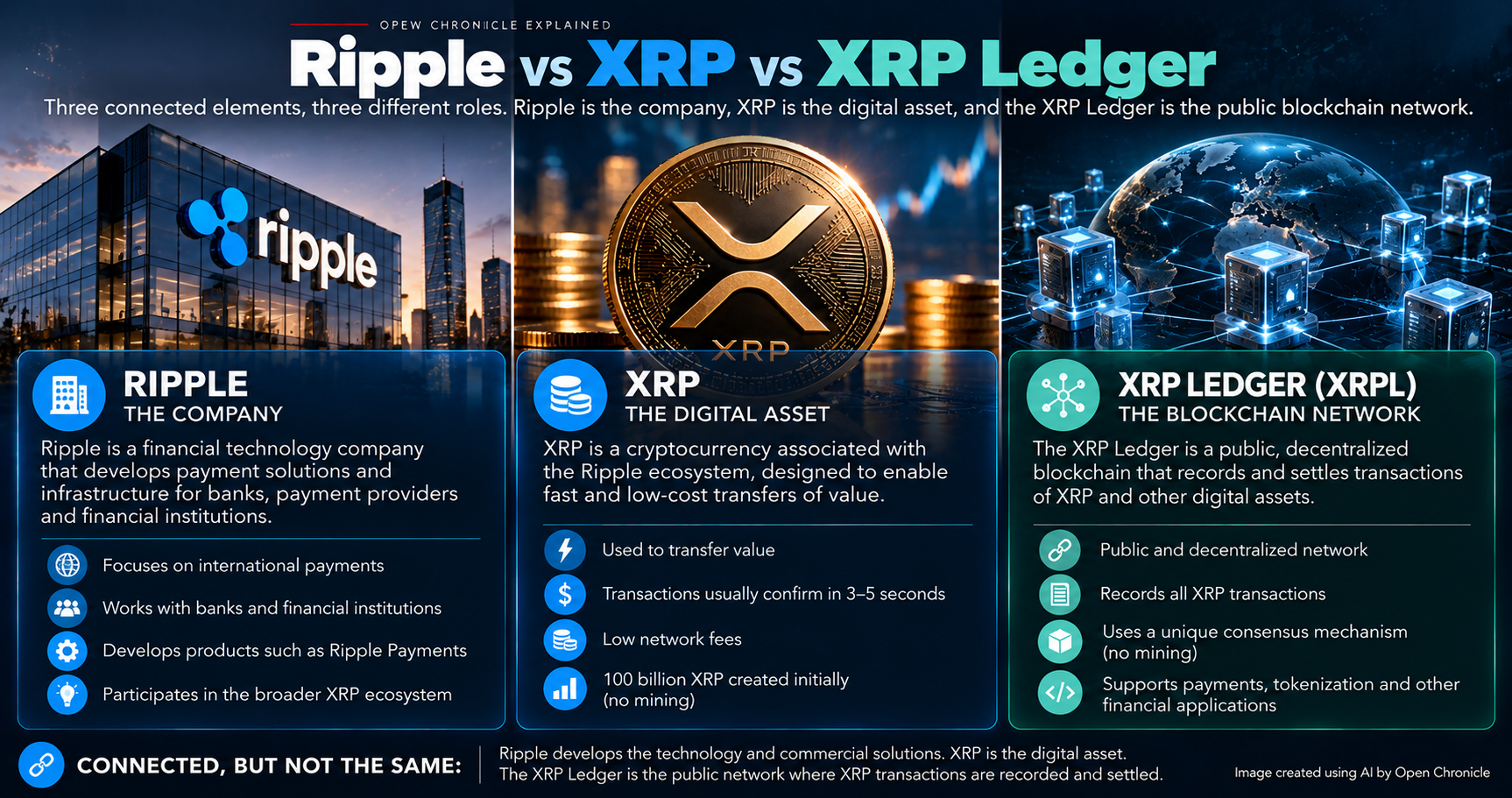
| Concept | What it means |
|---|---|
| Ripple | A financial technology company developing payment and financial infrastructure |
| XRP | A cryptocurrency native to the XRP Ledger |
| XRP Ledger (XRPL) | A public, decentralized blockchain network that records and settles transactions |
| Ripple Payments | Ripple’s commercial infrastructure for cross-border payments |
This distinction matters because the company and the network have different roles.
Ripple develops commercial products, works with financial institutions and participates in the XRP ecosystem. However, the XRP Ledger is an open network that can operate independently of Ripple.
Developers can build applications on the ledger without being customers of Ripple. Individuals can hold and transfer XRP without using the company’s payment services.
Similarly, a financial institution may use a Ripple product without necessarily using XRP in every transaction.
The central idea: Ripple is the company, XRP is the asset, and XRPL is the network.
3. Why Was XRP Created?
One of the original ambitions behind XRP was to make value transfers more efficient.
Traditional cross-border payments can involve several layers of banking infrastructure. A bank sending money abroad may rely on correspondent banking relationships and accounts maintained with other financial institutions.
This arrangement can work reliably, but it may require pre-funded liquidity, intermediary fees and operational coordination.
XRP was designed to enable the transfer of value directly over a public ledger, with rapid settlement and relatively low network transaction costs.
It can also serve as a bridge asset between different currencies.
That does not mean XRP eliminates every intermediary or replaces the international banking system. Banks and payment companies still need to manage regulation, customer identification, foreign exchange, liquidity and the delivery of funds to recipients.
The innovation is narrower but potentially significant: a digital asset can provide another way to move and settle value between participants.
4. How Could XRP Help Transfer Money From Portugal to Japan?
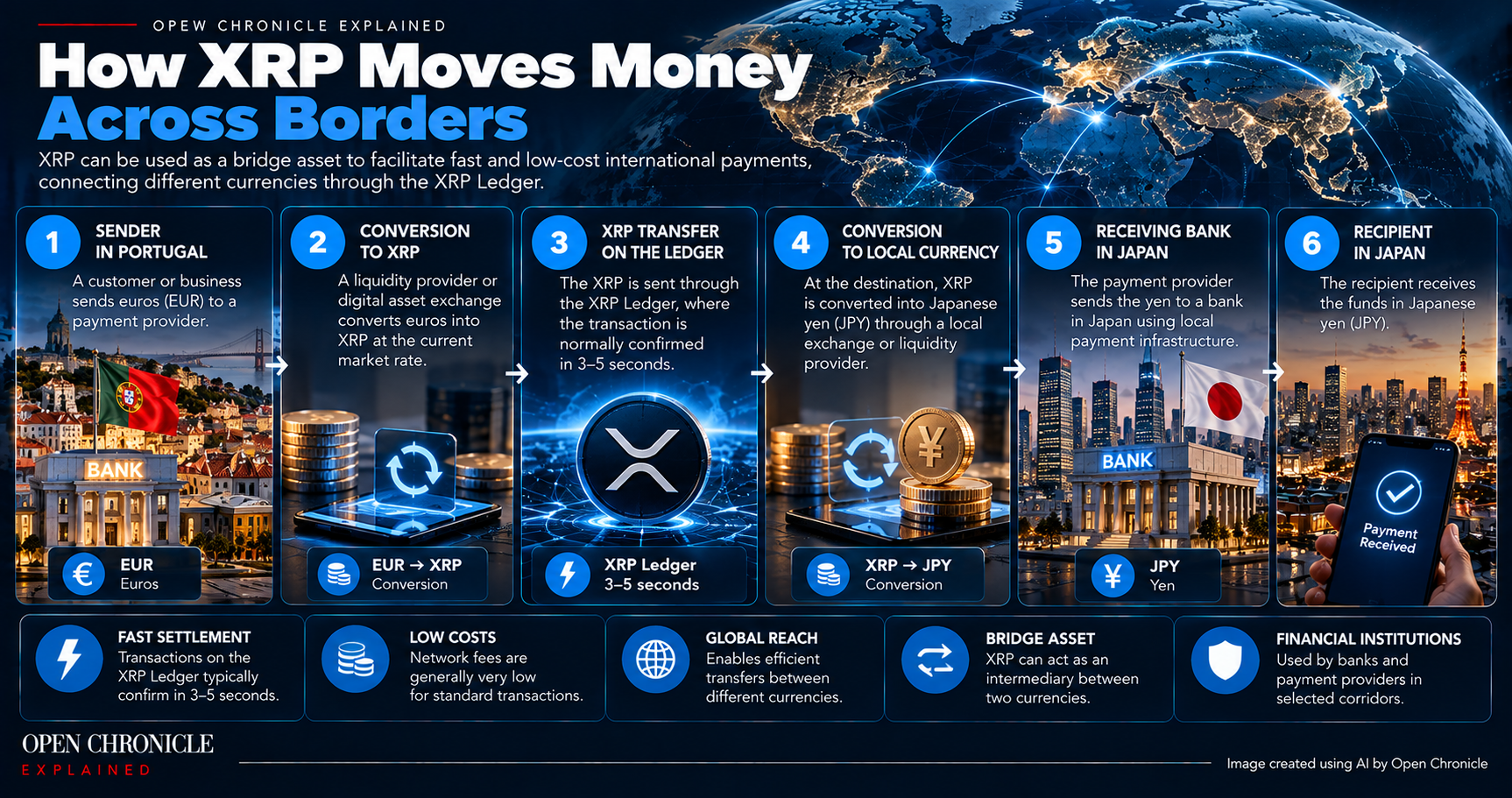
Imagine a payment provider in Portugal needs to deliver the equivalent of €10,000 to a recipient in Japan.
One possible arrangement uses XRP as an intermediary asset.
ILLUSTRATIVE CROSS-BORDER PAYMENT
Portugal
Euros (EUR)
XRP
Bridge asset
Japan
Yen (JPY)
Conceptual example only. The actual transaction would depend on available exchanges, payment providers, liquidity, regulation and applicable fees.
The process could work as follows.
First, the payment provider receives euros from the sender.
Second, a liquidity provider converts those euros into XRP at an available market rate.
Third, the XRP is transferred through the XRP Ledger to another participant.
Fourth, the receiving participant converts XRP into Japanese yen.
Finally, the payment provider delivers the yen to the recipient using the relevant local payment infrastructure.
The blockchain transfer may settle within seconds. However, the complete international payment can take longer because currency conversion, compliance procedures and local payout systems operate outside the ledger.
This is one of the most important distinctions when evaluating claims about blockchain payments: fast blockchain settlement does not necessarily mean instant end-to-end international payments.
5. How Does the XRP Ledger Actually Work?
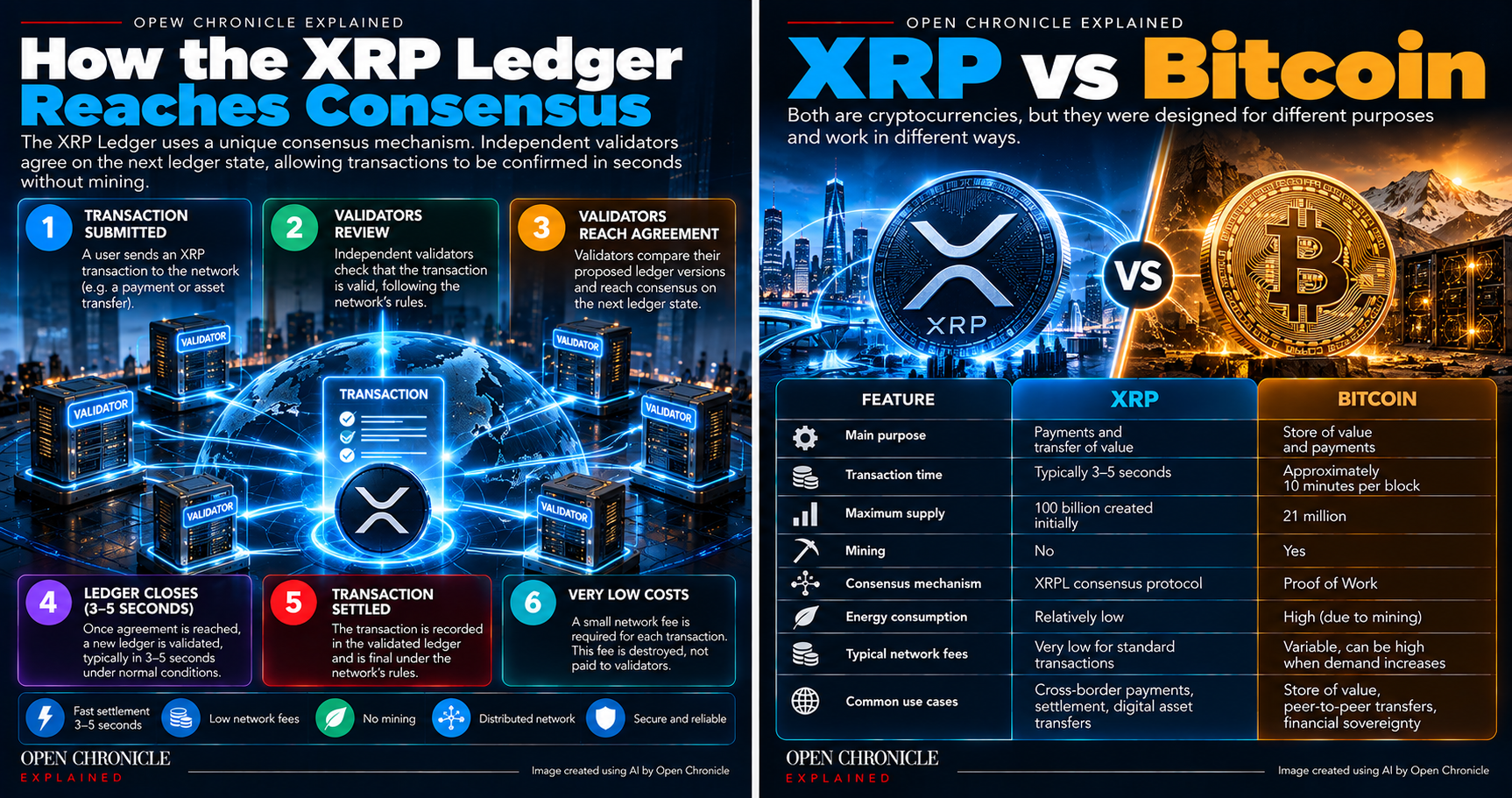
The XRP Ledger is a distributed digital record of accounts, balances and transactions.
Instead of relying on a single central database controlled by one institution, participating servers maintain copies of the ledger and agree on valid changes.
When someone submits an XRP transaction, the network must determine whether it is authorized and valid.
For example, it must verify that the sender has sufficient funds and that the transaction has not already been executed.
The network then uses its consensus mechanism to agree on the next validated ledger state.
Once the transaction is included in a validated ledger, settlement is final under the network’s rules.
The XRP Ledger typically closes ledgers in approximately three to five seconds under normal operating conditions.
This makes it substantially different from blockchain networks where confirmation depends on mining new blocks.
6. Does XRP Use Mining Like Bitcoin?
No.
Bitcoin uses a mechanism called Proof of Work.
Specialized computers compete to solve computational problems. This process helps secure the network and determines which blocks are added to the blockchain.
The XRP Ledger uses a different consensus approach.
Its validators exchange information and seek agreement on which transactions should be accepted.
The network does not require miners to compete through energy-intensive computation, and validators do not receive newly created XRP as mining rewards.
This generally makes the ledger’s consensus process much less energy-intensive than Bitcoin’s mining system.
However, lower energy consumption does not automatically mean that one network is superior in every respect.
Security assumptions, governance, decentralization, economic incentives and intended uses differ between the systems.
7. Who Validates XRP Transactions?
Validators are servers participating in the XRP Ledger’s consensus process.
They help determine which proposed transactions are valid and which ledger state should be accepted.
Each participating server uses a list of trusted validators, commonly described as a Unique Node List, or UNL.
The protocol requires sufficient agreement among the validators trusted by a server for consensus to proceed.
This design differs from Bitcoin’s mining-based security model.
It also raises a relevant question about decentralization: who operates validators, how are trusted lists selected, and how independent are the participating institutions?
Ripple is an important participant in the ecosystem, but it does not possess an exclusive right to operate validators or authorize every transaction.
The degree of decentralization should be assessed through the network’s actual validator distribution, trust-list practices and governance, rather than through a simple claim that the system is either entirely centralized or entirely decentralized.
8. Why Are XRP Transactions So Cheap?
Every XRP Ledger transaction requires a network fee.
The fee helps protect the system from excessive or abusive transaction submissions.
Unlike many conventional payment charges, this fee is not paid to a miner or validator as a reward. It is destroyed, permanently reducing the amount of XRP in existence.
Under ordinary network conditions, the minimum fee for a standard transaction is very small, although the required fee can increase when network demand is high.
This means sending XRP directly between two XRPL accounts can have a very low network cost.
But the total cost of an international payment may also include exchange spreads, liquidity-provider charges, banking fees and other operational expenses.
It would therefore be inaccurate to conclude that every payment involving XRP costs only the ledger transaction fee.
9. How Much XRP Exists?
XRP differs from cryptocurrencies that gradually create new coins through mining.
At the XRP Ledger’s inception, a total of 100 billion XRP was created.
There is no ongoing mining process that generates additional XRP.
Because transaction fees are destroyed, the total amount of XRP declines very slowly over time.
However, the existence of a fixed initial supply does not mean all XRP is freely available in the market.
Some XRP is held by individuals, exchanges, businesses and institutions. Ripple also holds a significant quantity, including XRP associated with escrow arrangements.
Escrow is a mechanism that places restrictions on when specified amounts can become available.
This distinction between total supply, circulating supply and holdings subject to escrow matters when discussing XRP’s market structure.
10. Is XRP the Same as a Stablecoin?
No.
A stablecoin is generally designed to maintain a relatively stable value against a reference asset, such as the US dollar.
XRP has no mechanism guaranteeing that one XRP will always equal a fixed amount of dollars or euros.
Its market price fluctuates according to supply and demand.
That makes XRP potentially useful as a transferable digital asset, but it also introduces exchange-rate risk.
If a payment provider holds XRP while its price falls, the value of those holdings can decline.
For this reason, payment models using XRP as a bridge asset may seek to minimize the period during which participants are exposed to price movements.
Stablecoins provide a different model: moving digital tokens intended to track the value of conventional currencies.
Both approaches have technological, operational and regulatory considerations.
11. What Is the Difference Between XRP and Bitcoin?
| Characteristic | XRP | Bitcoin |
|---|---|---|
| Network | XRP Ledger | Bitcoin blockchain |
| Consensus | XRPL consensus protocol | Proof of Work |
| Mining | No | Yes |
| Supply | 100 billion created initially | Maximum 21 million BTC |
| Typical ledger/block timing | Approximately 3–5 seconds | Approximately 10 minutes per block |
| Network fees | Usually very low for standard transactions | Variable according to demand |
| Commonly emphasized use cases | Payments, settlement and digital-asset transfers | Store of value and peer-to-peer transfers |
The timing comparison requires care.
Bitcoin’s ten-minute figure is an average block interval, not a guarantee that a payment is final after exactly ten minutes.
Similarly, XRPL’s three-to-five-second figure refers to normal ledger validation, not necessarily the completion of every commercial payment process.
Bitcoin and XRP also differ in how their networks reach agreement, how new units enter circulation and the economic incentives of their participants.
Bitcoin is frequently discussed as a digital store of value because of its monetary policy and limited issuance.
XRP is often discussed in connection with payments and liquidity.
Neither description exhausts the possible uses of either asset.
12. Does Ripple Control XRP?
This question requires separating corporate influence from protocol operation.
Ripple is closely associated with XRP historically, commercially and financially.
The company has held substantial amounts of XRP and has contributed technology, funding and development to the ecosystem.
Those connections give Ripple considerable economic importance.
But the XRP Ledger is not simply a private database owned by Ripple.
Independent participants can operate validators, submit transactions and build applications.
Ripple cannot unilaterally create additional XRP beyond the ledger’s original issuance rules.
Nevertheless, decentralization is not an all-or-nothing property. A company may have substantial influence over an ecosystem without possessing exclusive technical control of its ledger.
A serious evaluation must therefore consider both the protocol’s architecture and the concentration of economic influence.
13. Do Banks Actually Need XRP to Use Ripple?
Not necessarily.
Ripple provides commercial payment infrastructure, and the exact technology used can vary by product, customer and payment route.
Some arrangements may involve digital assets as bridge liquidity.
Others may use different settlement assets or payment mechanisms.
This is an essential point for understanding the relationship between Ripple’s commercial success and XRP’s market value.
A new Ripple customer does not automatically mean that the customer will purchase or hold XRP.
Likewise, growth in the number of transactions processed through Ripple’s business does not necessarily translate directly into an equivalent increase in demand for XRP.
The relationship depends on which products are used, how liquidity is sourced, the duration of asset exposure and the economic structure of the transactions.
14. What Else Can the XRP Ledger Do?
Although XRP is often associated with international payments, the XRP Ledger supports other financial applications.
These include the issuance and transfer of tokens representing assets, a native decentralized exchange, liquidity-related functionality and tools for developers.
Tokenization means representing an asset or claim through a digital token recorded on a blockchain.
For example, an issuer could create a token representing a financial instrument or a claim denominated in a conventional currency.
But creating a token does not automatically establish the legal rights associated with an underlying asset.
Those rights depend on the issuer, contractual arrangements, custody, regulation and the jurisdiction involved.
This distinction is particularly important as financial institutions explore tokenized deposits, securities and other digital representations of conventional assets.
15. What Happened Between Ripple and the SEC?
One of the most important chapters in XRP’s history was its legal dispute with the United States Securities and Exchange Commission (SEC).
In December 2020, the SEC brought an enforcement action against Ripple and two executives, alleging violations of US securities registration requirements involving XRP sales.
The dispute raised a fundamental question: under what circumstances can transactions involving a digital asset constitute securities transactions?
In 2023, a federal court distinguished between different types of XRP sales. It found that certain institutional sales by Ripple violated securities registration requirements, while the programmatic sales examined by the court did not.
A final judgment in August 2024 imposed a civil penalty of approximately $125 million and an injunction against specified future violations.
In August 2025, the SEC and Ripple dismissed their respective appeals, leaving that judgment in place and resolving the enforcement action.
The case illustrates why the legal treatment of cryptocurrencies depends not only on the characteristics of a token but also on how it is offered, sold and used.
It would be too simplistic to conclude that every possible XRP transaction has the same legal classification in every jurisdiction.
16. Is XRP Regulated in Europe?
Within the European Union, crypto-assets operate under an increasingly developed regulatory framework, particularly the Markets in Crypto-Assets Regulation, known as MiCA.
MiCA establishes requirements for various crypto-asset issuers and service providers, including authorization, disclosures and operational safeguards.
However, the regulation of a service provider does not eliminate the market risks associated with a cryptocurrency.
Investors can still experience significant losses. Exchanges can encounter operational problems, and the legal treatment of particular products may differ.
For readers in Portugal and elsewhere in Europe, it is important to distinguish between a cryptocurrency’s technological characteristics, the authorization status of a service provider and the legal protections associated with a particular financial product.
17. What Determines the Price of XRP?
XRP trades on cryptocurrency markets, where its price reflects buying and selling activity.
Several factors can influence that activity.
One is overall cryptocurrency market sentiment. XRP may rise or fall alongside other digital assets when investor expectations change.
Another is demand for XRP in payments, trading, liquidity provision or other applications.
Regulatory developments can also affect expectations about the asset’s future accessibility and use.
Ripple’s commercial announcements, XRP holdings and escrow releases may influence how market participants assess supply and demand.
But a key distinction remains: technological utility does not establish a particular market valuation.
An asset can perform a useful function while still being overpriced, underused or subject to substantial speculation.
18. Does Greater Ripple Adoption Mean XRP Must Become More Valuable?
Not necessarily.
Suppose Ripple expands its international payment business.
That may increase demand for its commercial infrastructure. But whether it increases demand for XRP depends on the settlement arrangements actually used.
Even when XRP is used as a bridge asset, the same units can potentially be transferred and reused across multiple transactions.
A payment network processing larger volumes therefore does not necessarily require an equivalent increase in the amount of XRP held by market participants.
Price formation also depends on available liquidity, supply, speculative demand and expectations about future use.
This is one of the most important economic questions surrounding XRP: how much of the value created by the broader payment ecosystem is captured by the token itself?
There is no automatic answer.
19. What Are the Main Risks of XRP?
Several risks deserve particular attention.
Market volatility. XRP can experience large price movements over relatively short periods.
Liquidity and execution risk. Converting significant amounts of XRP may involve price spreads, market impact or limited liquidity in particular currency pairs.
Regulatory risk. Legal requirements can change, and different jurisdictions may treat crypto-assets and associated services differently.
Competition. XRP competes with conventional payment networks, other blockchains, stablecoins and emerging tokenized banking infrastructure.
Concentration risk. Ripple’s substantial XRP holdings remain relevant to assessments of supply, governance influence and market expectations.
Technical and operational risk. Blockchain networks, exchanges, wallets and payment providers can experience failures, vulnerabilities or service interruptions.
Adoption risk. A technically efficient system may not achieve the level of commercial adoption anticipated by its supporters.
None of these risks proves that XRP will fail. Together, however, they demonstrate why the existence of a functioning technology is not sufficient to establish an investment case.
20. Is XRP Worth Investing In?
The answer depends on an investor’s objectives, financial circumstances, risk tolerance and assessment of the asset.
A useful analysis would distinguish three questions.
First, does the XRP Ledger provide a valuable technological service?
Second, will that service experience meaningful adoption in a competitive financial environment?
Third, even if adoption increases, will that development generate sufficient demand for XRP to justify its market price?
These are related but separate questions.
A positive answer to the first does not guarantee positive answers to the second or third.
Long-term investment scenarios should also consider the possibility that competing technologies become more widely adopted, regulatory conditions change or the cryptocurrency market experiences prolonged declines.
For these reasons, XRP should not be evaluated solely through optimistic price targets or announcements about Ripple’s business relationships.
21. What? How? Why?
What? — What is XRP?
XRP is the native cryptocurrency of the XRP Ledger, a public blockchain designed to support the efficient transfer and settlement of digital value.
How? — How does it work?
Transactions are submitted to a distributed ledger, validated through the XRPL consensus mechanism and normally settled within seconds. XRP can also serve as an intermediary asset in certain cross-border payment arrangements.
Why? — Why does it matter?
XRP illustrates an attempt to connect blockchain-based settlement with conventional financial systems, potentially reducing some costs and delays associated with transferring value between institutions and currencies.
Its significance lies not only in cryptocurrency trading but also in the wider debate about how money may move through future financial infrastructure.
Conclusion — Can Money Move as Easily as Information?
The internet transformed how information travels around the world.
A message can cross continents almost instantly, while international payments may still depend on institutions, compliance systems, currency markets and settlement arrangements developed over decades.
Ripple and the XRP Ledger represent one approach to modernizing part of that infrastructure.
The XRP Ledger offers rapid digital settlement. XRP provides a transferable asset that can be used for payments and liquidity. Ripple develops commercial solutions intended to connect such technologies with financial institutions.
But the distinctions matter.
Ripple’s success is not identical to XRP’s success. Fast blockchain settlement is not the same as instant international banking. And a cryptocurrency’s practical utility does not guarantee that its price will appreciate.
Understanding XRP therefore requires looking beyond price charts and examining the technology, economic incentives, market structure and regulatory environment.
The real question is not simply how much XRP might be worth. It is what role digital assets will play in the future movement of money.
Sources and Further Reading
Technical documentation, financial technology research,
official regulatory information and primary sources
supporting this explanation of Ripple, XRP and the
XRP Ledger.
XRP Ledger — Official Documentation
Technical explanations of the consensus mechanism,
accounts, transaction processing, fees and XRPL
capabilities.
Ripple — How Ripple Utilizes XRP for Cross-Border Payments
Ripple’s explanation of XRP’s role in international
payments and currency bridging.
Ripple — XRP Digital Asset
Overview of XRP’s characteristics, utility, ecosystem
and Ripple’s reported holdings.
US Securities and Exchange Commission — Ripple Litigation
Official August 2025 announcement concerning the
dismissal of appeals and resolution of the
enforcement action.
European Securities and Markets Authority — MiCA
European regulatory information on crypto-assets
and crypto-asset service providers.
This article explains Ripple, XRP and the XRP Ledger
using publicly available technical, commercial and
regulatory information. Statements made by Ripple
about its own products are distinguished from broader
conclusions about the cryptocurrency market. The
article is educational and does not constitute
financial advice, an investment recommendation or
a forecast of XRP’s future price.
Understanding the systems behind the headlines.
Explore Open Chronicle Explained →