
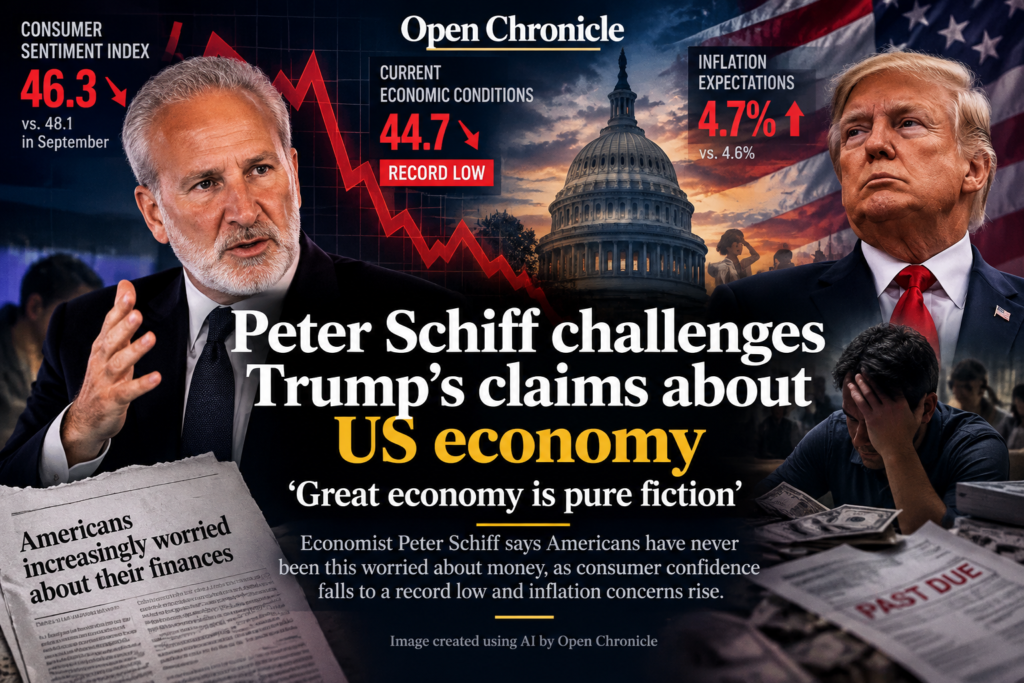
Economist Peter Schiff has accused President Donald Trump of presenting an overly optimistic picture of the American economy, arguing that households are experiencing unprecedented financial anxiety. New consumer sentiment figures, rising inflation expectations and a separate Gallup survey reveal growing public concern about personal finances despite claims of economic strength.
By Open Chronicle with agencies
WASHINGTON, October 13, 2026 — Economist and financial commentator Peter Schiff has sharply criticised President Donald Trump’s assessment of the US economy, arguing that Americans are more worried about their personal finances than at any point in the history of a major consumer confidence survey.
Schiff’s comments follow the release of preliminary October data from the University of Michigan showing another deterioration in consumer sentiment, with households increasingly concerned about inflation, purchasing power and their ability to maintain financial stability.
The latest figures reveal a significant gap between political descriptions of economic strength and the financial pressures reported by American consumers.
While the Trump administration has emphasised economic performance and presented its policies as supporting American prosperity, Schiff argues that the public’s assessment of its own financial circumstances tells a different story.
In a post published Monday on X, Schiff described claims of an exceptionally strong economy as disconnected from the experiences of ordinary Americans.
“The great economy is pure fiction,” he wrote.
His criticism comes as separate polling suggests that a majority of Americans believe their financial circumstances are deteriorating, even as some broader economic indicators continue to show resilience.
Schiff Says Americans Are More Worried Than During Previous Crises
Schiff’s central argument is that the level of financial anxiety reflected in recent consumer surveys is extraordinary when compared with earlier periods of economic and political instability.
In his social media post, the economist referred to several major crises that have shaped American history over the past seven decades.
These included the Korean War, the Vietnam War, the oil shortages and stagflation of the 1970s, the September 11 terrorist attacks, the 2008 financial crisis and the COVID-19 pandemic.
“In 75 years of this survey, Americans lived through Korea, Vietnam, gas lines, stagflation, 9/11, 2008 and COVID,” Schiff wrote.
He argued that Americans had not expressed the same degree of concern about their personal finances during those earlier periods.
His comments accompanied a video from his podcast, titled Worse Than 2008. Worse Than COVID. And They Call It a Boom, released over the weekend.
In the programme, Schiff challenged Trump’s claim that the American economy has never performed better.
He argued that such a description is difficult to reconcile with historically weak assessments of current economic conditions.
Schiff’s interpretation is strongly critical of the administration, although consumer confidence surveys measure public perceptions rather than providing a complete assessment of economic performance.
University of Michigan Consumer Sentiment Falls Again
The latest University of Michigan consumer survey provides the statistical foundation for much of Schiff’s criticism.
According to the preliminary October 2026 figures cited in the reporting, the Consumer Sentiment Index declined to 46.3 from 48.1 in September.
The decrease suggests that Americans became more pessimistic about economic conditions over the course of the month.
More significantly, the survey’s Current Economic Conditions Index fell to 44.7, described in the preliminary report as a record low.
That measure examines consumers’ assessments of their present financial circumstances and buying conditions.
A deterioration in the index can indicate that households are finding it increasingly difficult to afford major purchases or feel financially secure.
Consumer sentiment is closely watched because household spending represents a major component of American economic activity.
Although confidence and actual spending do not always move together, sustained pessimism can influence purchasing decisions, saving behaviour and demand for credit.
The latest figures therefore raise questions about how long consumer spending can remain resilient if households continue to report worsening financial conditions.
US Consumer Confidence: October 2026
| Economic indicator | Previous reading | Latest reading |
|---|---|---|
| University of Michigan Consumer Sentiment Index | 48.1 in September | 46.3 in October |
| Current Economic Conditions Index | Not specified | 44.7 |
| Year-ahead inflation expectations | 4.6% | 4.7% |
| Americans reporting worsening finances | — | 55% |
| Americans rating finances excellent or good | — | 46% |
| Americans identifying inflation and high prices as their leading financial concern | — | 31% |
Sources: Preliminary University of Michigan consumer survey and Gallup findings cited in the supplied reporting. October figures are preliminary and may be revised.
The figures suggest that household concerns are not limited to one economic indicator.
They encompass current financial conditions, expectations for future prices and broader perceptions of economic security.
Inflation Expectations Rise to 4.7%
One of the most important developments in the University of Michigan survey is the increase in consumers’ inflation expectations.
Americans now expect prices to rise by 4.7% over the coming year, compared with 4.6% in the previous survey.
Inflation expectations matter because they can influence consumer behaviour and broader economic conditions.
When households anticipate higher prices, they may adjust spending decisions, seek higher wages or reduce discretionary purchases.
Businesses may also consider expected costs when setting prices and making investment decisions.
However, consumer expectations are not the same as measured inflation.
The survey does not establish that inflation will actually reach 4.7% over the next year.
Instead, it reveals how households perceive the future direction of prices.
Those perceptions are particularly important during periods when consumers remain sensitive to the cumulative increase in living costs.
Even if the annual rate of inflation declines, prices can remain substantially higher than they were several years earlier.
That distinction helps explain why households may continue to report financial pressure despite improvements in certain economic indicators.
Gallup Finds a Majority of Americans Believe Their Finances Are Worsening
A separate Gallup survey reinforces the picture of growing household anxiety.
According to the findings cited in the supplied reporting, 55% of Americans said their financial situation was getting worse.
Only 46% described their finances as excellent or good.
Inflation and high prices were the most frequently cited financial concern, identified by 31% of respondents.
The findings suggest that dissatisfaction with personal financial conditions extends beyond the University of Michigan’s consumer sentiment survey.
However, the two surveys measure different aspects of economic confidence and use different methodologies.
They should therefore be considered complementary indicators rather than interchangeable measures.
The Gallup results indicate that many Americans feel their financial position is deteriorating, regardless of whether the broader economy is expanding.
That distinction is central to the current debate over the condition of the US economy.
Schiff Revisits the 2008 Financial Crisis
Schiff also compared today’s consumer concerns with the economic collapse of 2008.
During the financial crisis, the United States experienced a severe housing market downturn, the failure of major financial institutions and a prolonged recession.
Lehman Brothers collapsed in September 2008, while Bear Stearns had been rescued through an emergency acquisition earlier that year.
Fannie Mae and Freddie Mac were placed into federal conservatorship as authorities attempted to stabilise the mortgage finance system.
The crisis caused widespread financial losses, rising unemployment and a sharp contraction in economic activity.
Schiff argued that the level of consumer concern reflected in the latest survey is remarkable when compared with that period.
He also referred to the collapse of the dot-com bubble and the economic uncertainty surrounding Russia’s full-scale invasion of Ukraine in 2022.
His argument is that consumers’ assessments of their financial circumstances have deteriorated despite the absence of a financial system collapse identical to that of 2008.
Nevertheless, the comparison requires careful interpretation.
Historically low consumer sentiment does not automatically mean that current economic conditions are objectively worse than those experienced during the Great Recession.
Employment, income, economic output, financial stability and consumer perceptions are different indicators.
They can move in different directions.
Trump Presents a More Optimistic Economic Narrative
President Trump has repeatedly promoted a positive assessment of the American economy, emphasising the strength of economic activity and the results of his administration’s policies.
Schiff argues that the president’s claims are inconsistent with the financial concerns reported by consumers.
“But this is all a figment of Donald Trump’s imagination. The public is not buying what he is selling,” Schiff said during his podcast.
The disagreement reflects a broader debate over how economic performance should be measured.
Political leaders often point to indicators such as economic growth, investment, employment and financial market performance.
Households, by contrast, may judge the economy primarily through their ability to pay bills, afford housing, purchase food and maintain savings.
Both perspectives can capture different dimensions of economic conditions.
An economy can continue expanding while particular groups experience financial difficulties.
Similarly, strong investment or rising stock markets do not necessarily translate into immediate improvements in purchasing power for every household.
The difference between aggregate economic performance and individual financial experience is becoming an increasingly important feature of the American economic debate.
Why Americans May Feel Financially Insecure Despite Economic Growth
Several factors can contribute to weak consumer confidence even when the broader economy avoids recession.
The first is the cumulative effect of inflation.
A slowdown in the rate of price increases does not reverse earlier increases in the cost of living.
Households may therefore continue paying substantially more for essentials than they did before a period of high inflation.
The second factor is the cost of borrowing.
Higher interest rates can increase monthly payments on credit cards, personal loans and other forms of debt.
They can also make purchasing a home or financing a vehicle more expensive.
Housing affordability represents another important concern.
For younger Americans and first-time buyers, elevated property prices and mortgage costs can make homeownership difficult to achieve.
Financial insecurity can also arise from limited savings and uncertainty about future employment or income.
These pressures may affect consumer perceptions even when national employment or growth figures appear relatively stable.
The latest sentiment data suggest that many households are evaluating the economy through these immediate financial considerations.
Household Debt Adds to the Pressure
The decline in consumer confidence comes alongside separate reporting indicating growing difficulties among American families in meeting debt obligations.
According to the supplied findings from the Federal Reserve’s latest Survey of Consumer Finances, the share of families falling behind on loan payments increased from 12% in 2022 to 20% in 2025.
The proportion of families at least two months behind on their obligations also increased, exceeding 8%.
These figures, if confirmed against the complete survey, would suggest that financial pressure is affecting a growing share of households.
They also help illustrate why consumer sentiment may remain weak even when income or aggregate wealth increases.
A household can experience rising income while simultaneously facing higher repayment obligations and living expenses.
For consumers with limited financial reserves, unexpected costs can create additional difficulties.
The interaction between debt, inflation and household confidence is therefore particularly important.
Financial Anxiety Is Especially Important for Consumer Spending
Consumer spending is a central driver of the American economy.
When households feel financially secure, they are generally better positioned to make discretionary purchases, invest in durable goods and undertake major financial commitments.
When confidence deteriorates, consumers may become more cautious.
They may postpone expensive purchases, increase precautionary savings or reduce spending on nonessential goods and services.
However, weaker sentiment does not necessarily produce an immediate decline in spending.
Households may continue purchasing essential products even when they are dissatisfied with economic conditions.
Higher prices can also increase the total amount spent without indicating an equivalent rise in consumption.
This helps explain why consumer spending and consumer confidence can sometimes present contrasting pictures.
Economists and policymakers therefore examine sentiment surveys alongside employment, income, inflation and spending data rather than relying on a single indicator.
Peter Schiff’s Economic Perspective
Schiff is a prominent financial commentator known for his criticism of monetary policy, government borrowing and what he considers excessive dependence on credit.
He has frequently warned about inflation, financial market vulnerabilities and the long-term consequences of rising debt.
His commentary often emphasises the difference between nominal economic growth and improvements in real purchasing power.
In the current debate, Schiff is using consumer sentiment data to challenge the administration’s description of economic conditions.
His assessment is an interpretation of the available evidence rather than an official economic determination.
Other economists may place greater weight on employment, output, investment or other measures when evaluating the broader economy.
The disagreement illustrates the difficulty of reducing a complex economic environment to a single description of strength or weakness.
What the Latest Data Mean for the Federal Reserve
Consumer inflation expectations and household confidence are closely monitored by the Federal Reserve.
Inflation expectations can influence wage negotiations, spending decisions and business pricing behaviour.
Persistent concerns about future price increases may complicate efforts to maintain price stability.
At the same time, deteriorating consumer confidence may signal potential weakness in household demand.
The Federal Reserve must consider these developments alongside measured inflation, employment conditions and broader financial indicators.
A sustained deterioration in confidence could become more economically significant if it begins to affect actual spending or credit performance.
However, preliminary survey results alone are not sufficient to establish the future direction of monetary policy.
The central bank’s decisions depend on a wider range of economic evidence.
The Big Picture: Economic Statistics and Financial Reality Diverge
The dispute between Peter Schiff and Donald Trump highlights an important tension in the American economy.
National economic performance can appear resilient while households report considerable financial insecurity.
The preliminary October University of Michigan survey shows consumer sentiment weakening to 46.3, while its Current Economic Conditions Index has fallen to a reported record low of 44.7.
Inflation expectations have increased to 4.7%.
Gallup’s findings indicate that a majority of Americans believe their financial circumstances are worsening.
Together, the surveys suggest that concerns about affordability and financial stability remain deeply embedded in public perceptions of the economy.
Schiff has interpreted those findings as evidence that claims of exceptional economic strength are misleading.
Trump’s more optimistic assessment reflects a different emphasis on the performance of the broader economy.
Neither political claims nor consumer sentiment figures alone provide a complete picture of economic conditions.
What the latest data demonstrate is that public confidence remains exceptionally weak and that many households are struggling to reconcile economic growth with their own financial experiences.
For policymakers, the challenge is not simply to sustain economic expansion.
It is to ensure that improvements in national economic performance are reflected in the purchasing power, financial stability and living standards of American households.
Until that happens, the gap between official economic optimism and public financial anxiety may remain a defining feature of the US economic debate.