
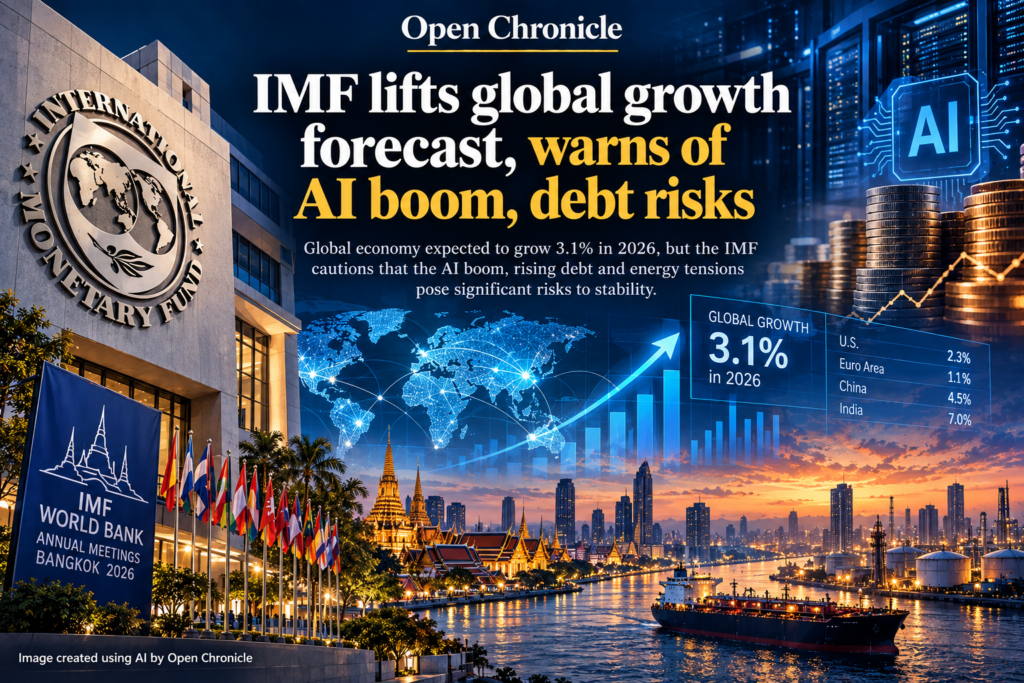
The International Monetary Fund has slightly upgraded its outlook for the world economy in 2026, supported by strong investment in artificial intelligence and resilient activity in major economies. However, the institution warns that rising public debt, financial market vulnerabilities and the economic consequences of the Middle East conflict could undermine the recovery.
By Open Chronicle with agencies
BANGKOK, October 13, 2026 — The International Monetary Fund has raised its forecast for global economic growth this year, offering a cautiously optimistic assessment of an international economy increasingly divided between countries benefiting from the artificial intelligence boom and those struggling with rising energy costs, mounting debt and geopolitical instability.
In its latest World Economic Outlook, released as finance ministers and central bank governors gather in Bangkok for the annual meetings of the IMF and World Bank, the institution forecasts global economic growth of 3.1% in 2026.
The projection represents a modest increase from the 3.0% forecast issued in July, although it remains below the 3.5% expansion recorded in 2025.
The IMF expects growth to accelerate to 3.4% in 2027, provided that energy market disruptions ease and financial conditions remain manageable.
Behind the improved headline forecast, however, the fund identifies a series of structural vulnerabilities that could complicate the global economic outlook.
These include high borrowing costs, growing public and private debt, concentrated investment in artificial intelligence, financial market volatility and the economic consequences of the war involving Iran.
The central message from the IMF is that the global economy remains resilient, but the benefits of growth are becoming increasingly uneven.
Global Growth Improves, but the Recovery Remains Uneven
The IMF’s revised forecasts suggest that the world economy has demonstrated greater resilience than previously anticipated.
Strong investment in artificial intelligence infrastructure, particularly in the United States and China, has helped offset some of the negative effects of rising energy prices.
However, the economic recovery is far from universal.
According to the IMF, just 32 countries are now responsible for approximately 95% of global economic growth, compared with 54 countries in its April assessment.
The figures suggest that economic expansion is becoming increasingly concentrated in a relatively small group of countries.
“The outlook is highly uneven,” said Silvana Tenreyro, the IMF’s director of research, during a briefing in Bangkok.
The report explains that countries are experiencing very different economic conditions depending on their exposure to energy disruptions and their ability to benefit from investment in artificial intelligence.
Economies with strong technology industries and relatively limited dependence on imported energy are performing better than those facing higher fuel costs and weaker investment.
This divergence is becoming one of the defining characteristics of the current global economic environment.
Global Economic Outlook: Key IMF Forecasts
| Indicator | 2026 forecast | 2027 forecast |
|---|---|---|
| Global economic growth | 3.1% | 3.4% |
| United States | 2.3% | 2.3% |
| Advanced economies | 2.1% | 1.9% |
| Emerging and developing economies | 3.7% | 4.4% |
| Euro area | 1.1% | 1.2% |
| China | 4.5% | Not specified |
| India | 7.0% | Not specified |
| Global inflation | 4.7% | 4.1% |
| Middle East and Central Asia | Contraction | 6.3% |
The forecasts illustrate the uneven distribution of growth, with India and China continuing to outperform many advanced economies while the Middle East faces particularly severe economic disruption.
The figures also highlight the importance of the IMF’s assumptions about oil prices, international trade and the future trajectory of artificial intelligence investment.
Artificial Intelligence Becomes a Major Engine of Global Growth
One of the most significant findings in the IMF report concerns the growing economic influence of artificial intelligence.
Investment in advanced computing infrastructure, semiconductors, data centres and related technologies has become an important source of demand.
This investment is supporting industrial activity, technology exports and capital expenditure in countries positioned to benefit from the AI revolution.
The United States and China are particularly important.
According to the IMF, the two economies account for more than three-quarters of net demand for imports of computer chips and other equipment associated with artificial intelligence.
That concentration is creating substantial opportunities for technology companies and countries involved in advanced manufacturing.
At the same time, it is contributing to widening differences between economies.
Countries with limited access to capital, advanced infrastructure or specialised technological expertise may struggle to benefit from the investment boom.
The IMF warns that the global economy is increasingly dependent on the performance of a relatively narrow group of industries and countries.
A slowdown in AI investment could therefore have consequences extending far beyond the technology sector.
The Risk of an Artificial Intelligence Investment Bubble
While the IMF recognises the contribution of artificial intelligence to economic growth, it is also warning about the financial risks associated with exceptionally rapid investment.
Technology companies and investors have committed substantial resources to building the infrastructure needed to develop and operate increasingly sophisticated AI systems.
Much of that investment is based on expectations of strong future demand and productivity gains.
However, the financial returns from these projects remain uncertain.
If revenues fail to meet expectations, investors could reassess the valuations of companies associated with the AI boom.
Such a correction could trigger losses in equity markets and reduce investment across the broader economy.
Athanasios Vamvakidis, deputy director at the IMF’s Monetary and Capital Markets Department, identified a possible AI-related stock market correction as one of several risks facing financial stability.
The concern is not necessarily that artificial intelligence lacks long-term economic value.
Rather, the danger lies in the possibility that financial markets have priced in benefits that may take longer than expected to materialise.
A sharp reassessment could affect technology companies, institutional investors, banks and other financial institutions exposed to the sector.
AI Could Transform 40% of Jobs Worldwide
Beyond financial markets, the IMF is also examining the consequences of artificial intelligence for employment.
Speaking during an event in Bangkok, IMF Managing Director Kristalina Georgieva described the technological transformation as a slow-moving but potentially powerful economic shock.
“A slow moving tsunami, but a tsunami nonetheless,” Georgieva said.
According to the IMF’s assessment, approximately 40% of jobs worldwide could be affected by artificial intelligence over time.
That does not mean that 40% of jobs are expected to disappear.
The estimate includes employment that could be augmented by AI, jobs whose tasks may be significantly changed and positions that could eventually be eliminated.
The effects are likely to vary considerably across industries and countries.
Workers performing routine administrative or analytical tasks may face substantial changes in their responsibilities.
At the same time, AI could improve productivity and create demand for new technical, managerial and service-related occupations.
The IMF argues that governments will need to prepare for these changes through education, professional training and policies that help workers adapt.
Without such measures, the technological transformation could deepen inequalities between countries, industries and income groups.
Rising Debt Becomes a Major Threat to Financial Stability
The IMF’s improved growth outlook is accompanied by a warning about rising public and private debt.
Governments around the world are facing growing pressure from higher borrowing costs, military expenditure, social spending and the need to invest in infrastructure.
At the same time, companies are borrowing substantial amounts to finance technological development, including artificial intelligence projects.
The combination creates vulnerabilities if interest rates remain elevated or economic growth weakens.
Higher borrowing costs make it more expensive for governments to refinance existing debt and fund new programmes.
For businesses, rising financing costs can reduce profitability and discourage investment.
The IMF has urged countries to strengthen their public finances and rebuild fiscal buffers.
Georgieva has called on both advanced and developing economies to improve debt management and avoid allowing financial vulnerabilities to accumulate.
Tenreyro also emphasised the importance of fiscal discipline in an environment of elevated borrowing costs.
The fund’s concern is that countries with already limited financial resources may be particularly vulnerable to another economic shock.
Bond Markets and Cybersecurity Add to Financial Risks
The IMF has identified additional risks involving government bond markets and cybersecurity.
Rising bond yields can increase financing costs across the economy.
Because government bonds serve as important reference points for interest rates, higher yields can affect mortgages, corporate borrowing and financial market valuations.
A rapid increase in yields could also create difficulties for banks and investment funds holding large portfolios of fixed-income securities.
Cybersecurity presents another challenge.
As financial institutions become increasingly dependent on digital systems and artificial intelligence, the potential consequences of cyberattacks are growing.
A major disruption involving payment networks, trading systems or financial infrastructure could spread quickly across institutions and national borders.
The IMF is encouraging regulators and financial institutions to strengthen safeguards against operational failures and malicious cyber activity.
These risks underline the need for financial stability policies to evolve alongside technological change.
Middle East War Delivers a Severe Economic Shock
The conflict involving Iran is among the most significant sources of uncertainty in the IMF’s latest assessment.
Military operations and disruptions to energy transportation have contributed to sharply higher oil and gas prices.
The IMF’s forecasts assume that oil prices will rise by nearly 41% in 2026, averaging approximately $96 per barrel.
Higher energy prices affect economies through several channels.
They increase transportation and production costs, place pressure on household budgets and contribute to inflation.
Countries heavily dependent on imported energy are particularly exposed.
The economic consequences extend beyond the Middle East, affecting manufacturers, airlines, agricultural producers and consumers across the world.
The IMF’s projections also depend on the assumption that shipments of oil and gas through the Strait of Hormuz will resume by March.
That assumption is critical because the waterway is one of the world’s most important routes for energy exports.
A prolonged disruption could lead to higher prices and weaker growth than currently forecast.
Middle East and Central Asia Face Economic Contraction
The IMF expects the Middle East and Central Asia to experience an economic contraction in 2026.
The forecast reflects the severe consequences of regional conflict, disrupted energy supplies and reduced economic activity.
Countries directly affected by military operations face damage to infrastructure, interruptions to trade and pressure on public finances.
Other economies are suffering indirectly through higher energy costs, disrupted transportation and declining confidence.
The IMF expects the region to recover strongly in 2027, forecasting growth of 6.3%.
However, that rebound depends on an improvement in security conditions and the restoration of economic activity.
A recovery from contraction can also produce a high percentage growth rate without immediately restoring living standards or output to their previous levels.
The region’s outlook therefore remains highly sensitive to developments in the conflict.
United States Maintains Steady Growth at 2.3%
The IMF expects the United States economy to expand by 2.3% in both 2026 and 2027.
The forecast suggests continued resilience despite higher energy costs and international uncertainty.
Investment in artificial intelligence is an important supporting factor.
American technology companies are among the largest investors in data centres, computing infrastructure and advanced AI systems.
Strong investment has helped sustain economic activity even as other sectors face pressure from borrowing costs and inflation.
However, the IMF’s warnings about financial market concentration are particularly relevant to the United States.
A substantial correction in technology valuations or a slowdown in AI infrastructure spending could weaken one of the economy’s principal sources of growth.
China Continues to Expand, but Growth Slows
China’s economy is expected to grow by 4.5% in 2026, compared with 5% in 2025.
The projection is broadly consistent with Beijing’s official economic objectives.
China remains a major contributor to global growth, supported by manufacturing capacity, exports and investment in advanced technology.
Its position in the international supply chain for artificial intelligence equipment also provides opportunities.
However, the economy faces structural challenges, including domestic demand pressures and the need to maintain investment while managing financial risks.
China’s performance will remain important for international trade, commodity demand and the economic prospects of other Asian countries.
India Remains the Fastest-Growing Major Economy
India is forecast to grow by 7% in 2026, making it the fastest-growing major economy in the IMF’s assessment.
Although the figure represents a slowdown from the 7.7% expansion recorded in 2025, it remains substantially above the global average.
India’s performance reflects the continued expansion of domestic economic activity and investment.
The country is also benefiting from growing interest in digital services, technology and advanced manufacturing.
However, India remains exposed to international energy prices and changes in global financial conditions.
Maintaining strong growth will require continued investment, productivity improvements and effective management of external economic risks.
Europe Faces Slower Growth and Persistent Energy Pressures
The IMF expects the euro area, comprising 21 countries using the single currency, to grow by 1.1% in 2026 and 1.2% in 2027.
The projections highlight Europe’s relatively weak economic momentum compared with the United States and major Asian economies.
European businesses continue to face challenges associated with energy costs, industrial competitiveness and international uncertainty.
Higher oil and gas prices are particularly problematic for energy-intensive industries.
The region also faces structural challenges involving productivity, investment and demographic change.
Although inflation is expected to ease globally, European policymakers must balance the need to maintain price stability with efforts to support economic activity.
The IMF’s assessment suggests that Europe’s recovery will remain gradual.
Emerging Economies Face Unequal Prospects
Emerging market and developing economies are expected to grow by 3.7% in 2026, down from 4.5% in 2025.
The slowdown reflects the effects of higher energy prices and the uneven distribution of technological investment.
Countries dependent on imported fuel face rising costs, while those with limited fiscal resources may struggle to protect households and businesses.
The IMF expects growth in this group to recover to 4.4% in 2027.
However, the outlook varies considerably.
Economies benefiting from technology investment or relatively stable energy supplies are performing better than those exposed to conflict and commodity price shocks.
The divergence reinforces concerns that global growth is becoming increasingly concentrated.
Global Inflation Expected to Ease in 2027
Despite the sharp increase in energy prices, the IMF expects global inflation to decline from 4.7% in 2026 to 4.1% in 2027.
The forecast assumes that energy market conditions gradually improve and that disruptions to international supply chains become less severe.
However, inflation remains a major concern for households and policymakers.
Higher prices for fuel, food and essential services can weaken purchasing power even when overall economic growth remains positive.
Central banks face the challenge of controlling inflation without unnecessarily restricting economic activity.
If energy prices remain elevated for longer than expected, inflation could prove more persistent.
That would complicate monetary policy and increase the risk of weaker growth.
Bangkok Meetings Focus on Economic Resilience
The IMF and World Bank meetings in Bangkok bring together finance ministers, central bank governors and international economic policymakers.
Discussions are expected to focus on global growth, financial stability, debt sustainability, artificial intelligence and the consequences of geopolitical conflict.
The meetings come at a time when governments face competing priorities.
They must support investment and economic development while protecting financial stability and preparing for technological change.
They must also respond to the consequences of war, energy disruptions and climate-related emergencies.
For the IMF, these challenges reinforce the importance of international cooperation.
The institution, which has 191 member countries, works to promote monetary cooperation, financial stability, economic growth and poverty reduction.
Its latest assessment suggests that international economic coordination will remain essential as countries confront increasingly interconnected risks.
The Big Picture: A Resilient but More Fragile Global Economy
The IMF’s revised outlook presents a world economy that continues to expand despite significant challenges.
The increase in the 2026 growth forecast to 3.1% demonstrates that investment, particularly in artificial intelligence, is helping sustain economic activity.
However, the improvement masks growing vulnerabilities.
Economic growth is becoming concentrated in fewer countries.
Artificial intelligence is generating substantial investment but also creating concerns about market valuations, debt and employment.
The Middle East conflict is disrupting energy markets and imposing severe costs on vulnerable economies.
Governments are facing growing debt burdens at a time when borrowing remains expensive.
Financial institutions must also prepare for cyber threats and the consequences of rapid technological change.
The IMF’s central warning is that the global economy cannot rely indefinitely on a narrow group of countries and industries to sustain expansion.
A durable recovery will require broader investment, stronger public finances, resilient financial systems and policies that allow more countries to benefit from technological progress.
The outlook for 2027 remains cautiously positive, with growth expected to reach 3.4%.
Whether that forecast is achieved will depend on the evolution of the Middle East conflict, the stability of energy markets, the sustainability of AI investment and the ability of governments to manage rising financial risks.
For now, the world economy is growing, but the foundations of that growth are becoming increasingly uneven.