
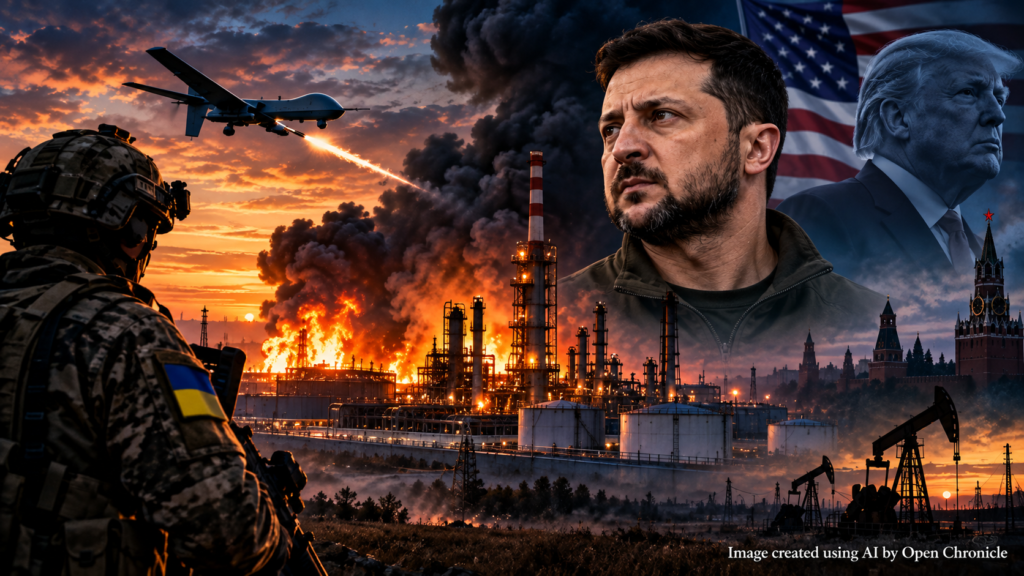
A Ukrainian drone attack has reportedly set an oil refinery ablaze in Russia’s Ryazan region, ending Kyiv’s brief suspension of strikes on Russian energy facilities. President Volodymyr Zelensky says continued Russian attacks and disputed restrictions on American intelligence and satellite communications have made the pause untenable.
By Open Chronicle News Desk
KYIV / MOSCOW / WASHINGTON | October 15, 2026
Ukraine has resumed attacks on Russian oil infrastructure, targeting a refinery in the Ryazan region after President Volodymyr Zelensky declared an end to Kyiv’s temporary suspension of strikes on Russian energy facilities.
The renewed offensive follows several days of mounting tensions between Ukraine and the United States over an energy ceasefire announced by President Donald Trump, the continued bombardment of Ukrainian infrastructure and allegations that Washington has restricted intelligence and military satellite communications.
Pavel Malkov, governor of Russia’s Ryazan region, confirmed on Thursday that a major Ukrainian drone attack had caused a fire at an oil refinery.
In a statement published on Telegram, Malkov said emergency services were responding and authorities were assessing the damage.
The reported strike came shortly after Zelensky told the Financial Times that Ukraine would no longer observe a unilateral pause on attacks against Russian refineries.
“The block (on attacking refineries) is out. We’re done,” the Ukrainian president said.
His comments marked a significant escalation in Kyiv’s disagreement with Washington over the conduct of the war and the terms under which Ukraine might suspend attacks on Russian energy infrastructure.
The developments also underscore the fragility of diplomatic efforts to limit attacks on energy facilities while the broader conflict continues.
A Brief Energy Ceasefire Unravels
The latest confrontation follows Trump’s announcement on Sunday of what he described as an energy ceasefire between Russia and Ukraine.
The arrangement was intended to reduce attacks on energy infrastructure amid rising international fuel prices.
According to the supplied reporting, Ukraine subsequently refrained from striking Russian oil refineries for approximately three days.
Washington had argued that Ukrainian attacks on Russian refining facilities were contributing to pressure on international diesel markets.
However, Kyiv became increasingly frustrated as Russian forces continued striking Ukrainian energy infrastructure.
Zelensky said on Wednesday that recent attacks had left approximately 600,000 people without electricity.
The Ukrainian president warned that his country would not indefinitely refrain from attacking Russian energy facilities while its own infrastructure remained under assault.
For Kyiv, the central issue was reciprocity.
A suspension of attacks on Russian refineries would be difficult to justify domestically or militarily if Moscow continued targeting Ukraine’s electricity system.
The breakdown illustrates a fundamental weakness in limited ceasefire arrangements: unless both parties agree on clear obligations and credible monitoring, each side may accuse the other of failing to comply.
Ryazan Refinery Hit in Overnight Drone Attack
The attack on Ryazan provides the first reported indication that Ukraine has resumed its campaign against Russian oil-processing infrastructure following the brief pause.
Regional governor Pavel Malkov said a substantial drone attack had caused a fire at a refinery.
Russian emergency personnel were dispatched to the site, while authorities began evaluating the material damage.
The governor’s statement did not establish the full extent of the damage, whether refinery operations had been suspended or how long repairs might take.
Those details remain important in assessing the strike’s economic consequences.
Russia’s refining industry is a strategic target because it processes crude oil into fuels used by civilian consumers, commercial transport and military logistics.
Disruptions to refining capacity can complicate domestic fuel distribution and increase pressure on supply networks.
However, the impact of any individual attack depends on the facilities affected, the duration of the disruption and the availability of alternative production capacity.
Ukraine has repeatedly targeted Russian oil infrastructure during the war, seeking to impose economic and logistical costs on Moscow.
The latest strike suggests that Kyiv intends to retain that capability as a means of pressure, despite American objections.
Zelensky Says Ukraine’s Patience Has Run Out
In an interview with the Financial Times published Thursday, Zelensky expressed frustration with what he described as Washington’s increasingly favourable approach toward Russia.
He criticised American interest in pursuing commercial agreements with Moscow and questioned Trump’s attitude toward Russian President Vladimir Putin.
The Ukrainian leader argued that Kyiv had already demonstrated restraint by suspending refinery attacks.
However, he suggested that Russia had failed to respond with equivalent restraint.
The decision to resume strikes therefore appears intended both as a military measure and as a political signal.
Ukraine is seeking to demonstrate that it will not accept restrictions on its operations without corresponding security benefits.
Zelensky also rejected the suggestion that Ukraine was responsible for the deterioration in its relationship with Washington.
“We didn’t destroy any relationship,” he told the newspaper.
His remarks reflect a broader concern in Kyiv that American policy may increasingly prioritise energy-market stability and negotiations with Moscow over Ukraine’s immediate security requirements.
US Intelligence Dispute Raises New Questions
The resumption of refinery attacks comes amid allegations that the United States has threatened to restrict intelligence assistance to Ukraine.
According to Ukrainian officials cited in the supplied reporting, Washington warned that it could block intelligence support unless Kyiv stopped striking Russian energy infrastructure.
Ukrainian officials also complained that they had not received American early-warning alerts concerning incoming Russian ballistic missiles in recent days.
Such information can be critical for defensive preparations.
Early-warning intelligence helps military authorities assess incoming threats and coordinate responses, particularly when ballistic missiles provide only limited time for interception.
Any interruption could complicate Ukrainian air-defence operations.
However, the reporting does not independently establish the precise scope of the alleged restrictions, whether all relevant intelligence-sharing channels were affected or whether specific Russian strikes succeeded because of reduced American assistance.
Trump has previously denied threatening to withhold missile-warning intelligence.
That denial is important because the allegations concern decisions that could have direct consequences for Ukrainian civilian protection and military operations.
Zelensky nevertheless described the reported withdrawal as dangerous, reinforcing the impression of a deepening dispute between the two governments.
Satellite Communications Become Another Flashpoint
The intelligence controversy has been accompanied by reports of restrictions affecting military satellite communications.
Ukrainian officials have complained that systems associated with Starlink and Starshield have experienced reduced performance, disrupting some military operations.
Satellite connectivity plays an important role in Ukrainian military communications, including certain unmanned systems and battlefield coordination functions.
SpaceX chief executive Elon Musk responded on Wednesday by asserting that Starshield, the company’s defence-oriented satellite programme, is controlled by the United States government.
According to Musk, decisions concerning speed or usage restrictions are made by American military authorities and ultimately the president.
The distinction between Starlink and Starshield is significant.
Starlink is a satellite internet service used in civilian and military contexts, while Starshield is designed for government and national-security applications.
The precise contractual and operational arrangements governing the equipment reportedly affected in Ukraine have not been independently established.
In his Financial Times interview, Zelensky rejected the explanation that the reported problems were merely technical.
“It was not a technical problem, it was the will,” he said.
His statement amounts to an allegation that the disruptions resulted from deliberate decisions rather than equipment failures.
That interpretation has not been independently confirmed.
Nevertheless, the controversy has intensified concerns about Ukraine’s dependence on communications systems whose operating conditions may be influenced by decisions made outside the country.
Trump, Russian Diesel and the Politics of Fuel Prices
The diplomatic tensions have also been aggravated by Trump’s reported agreement concerning diesel supplies from Russia.
According to the supplied reporting, the American president announced a diesel-supply arrangement with Moscow as fuel prices came under pressure during the ongoing US-Israeli war with Iran.
The agreement was presented as part of an effort to ease supply pressures and reduce costs for consumers.
Trump has criticised Ukrainian strikes on Russian refineries, arguing that they contribute to higher diesel prices.
The issue is politically sensitive ahead of the November US midterm elections.
Energy prices can influence household budgets, transportation costs and wider inflation expectations, making them a major concern for voters.
However, international diesel prices are affected by numerous factors, including refinery capacity, crude oil markets, shipping disruptions, sanctions and geopolitical instability.
The supplied reporting does not establish that Ukrainian strikes on Russian refineries are the principal cause of rising global diesel prices.
For Ukraine, the reported American energy arrangement creates a strategic contradiction.
Kyiv has sought to weaken Russia’s economic capacity to sustain the invasion, while Washington is pursuing measures it believes could ease fuel-market pressures.
The disagreement highlights the increasingly difficult relationship between American domestic economic priorities and Ukraine’s wartime strategy.
Zelensky Demands Patriot Interceptors in Exchange for Restraint
Zelensky has indicated that Ukraine could reconsider attacks on Russian energy infrastructure if Washington offered meaningful military assistance in return.
Speaking to the Financial Times, he said additional American-made Patriot interceptors would represent the minimum acceptable compensation for suspending strikes.
The proposal effectively links Ukraine’s willingness to exercise restraint against Russian refineries with its need for stronger air defences.
Patriot systems are among the most important capabilities available to Ukraine for countering certain ballistic and other missile threats.
Their effectiveness depends on the availability of compatible interceptor missiles, radar coverage, trained crews and integration with other defensive systems.
Ukraine has repeatedly requested additional interceptors as Russia continues attacking cities and energy infrastructure.
Zelensky’s proposal reflects a clear negotiating position.
If Ukraine is expected to stop targeting Russian energy assets, Kyiv wants tangible improvements in its ability to protect its own infrastructure.
The arrangement would also shift the debate from a unilateral suspension of attacks to an exchange of concrete security commitments.
Whether Washington would accept such a proposal remains uncertain.
Ukraine Claims Six Russian Su-34M Aircraft Damaged
In a separate development, Ukraine’s military reported a strike against the Borisoglebsk airfield in Russia’s Voronezh region.
Ukraine’s General Staff said on Thursday that six Russian Su-34M fighter-bombers had been damaged during an overnight operation.
According to the Ukrainian statement, all six aircraft sustained damage of varying degrees.
The military said it had used a Neptune missile system in the attack.
The claims have not been independently verified.
Reuters, cited in the supplied reporting, said it could not confirm the battlefield account.
The Su-34 is a Russian tactical strike aircraft used extensively in the war, including for missions involving glide bombs.
These weapons have become a major threat to Ukrainian frontline positions and settlements because they can be released from aircraft operating at some distance from their targets.
Damage to six operational aircraft, if independently confirmed, would represent a notable tactical result.
However, the available information does not establish how many aircraft were rendered inoperable, whether the reported damage was temporary or permanent, or whether the airfield’s operations were significantly disrupted.
The Ukrainian statement should therefore be treated as a military claim pending independent confirmation.
The Neptune System and Ukraine’s Expanding Strike Capabilities
Ukraine’s reported use of the Neptune missile system is also significant.
Neptune was originally developed as an anti-ship missile system and has been associated with Ukrainian efforts to expand domestically produced long-range strike capabilities.
Its reported use against an airfield would be consistent with Ukraine’s broader effort to target military infrastructure beyond the immediate frontline.
Such operations are intended to complicate Russian aircraft deployments, logistics and force protection.
However, the supplied reporting does not provide sufficient technical detail to establish the exact missile variant used or its performance during the reported strike.
The claim illustrates the growing importance of Ukraine’s domestically developed strike systems.
As access to foreign military assistance becomes politically uncertain, domestic production and technological adaptation are increasingly important components of Kyiv’s defence strategy.
Kremlin Accuses Ukraine of Undermining Peace Efforts
Moscow condemned the renewed attacks on Russian energy infrastructure.
Kremlin spokesman Dmitry Peskov said Thursday that the strike on the Ryazan refinery contradicted American efforts to reduce hostilities.
Peskov also disputed Ukraine’s assertion that it had observed the temporary energy ceasefire.
According to the Kremlin, Moscow did not consider Kyiv to have complied with the arrangement at any stage.
Ukraine rejects that account.
Kyiv maintains that it paused refinery strikes for approximately three days before resuming operations because Russian attacks on Ukrainian energy facilities continued.
The competing claims reveal the absence of a mutually accepted account of compliance.
A limited ceasefire can be particularly difficult to sustain when its terms are not clearly defined or independently monitored.
Questions can arise over which facilities are covered, when restrictions take effect and what constitutes a violation.
The current disagreement suggests that the reported energy ceasefire lacked sufficient political trust to withstand continued attacks and accusations.
Energy Infrastructure Remains Central to the War
Energy facilities have become important targets in the Russia-Ukraine conflict.
Russia has repeatedly attacked Ukrainian electricity generation, transmission and distribution infrastructure.
Such strikes can cause widespread power outages and disrupt essential services.
Ukraine, meanwhile, has targeted Russian refineries, fuel storage facilities and other energy-related assets.
The two campaigns are not identical in their objectives, target selection or effects.
Their consequences must be assessed separately, including under the applicable rules of international humanitarian law.
Energy infrastructure may have civilian functions, military functions or both.
The legality of any particular strike depends on factors including the nature of the target, the anticipated military advantage, expected civilian harm and the precautions taken.
The resumption of Ukrainian refinery strikes therefore raises both strategic and humanitarian questions.
From Kyiv’s perspective, Russian energy infrastructure can support Moscow’s military operations and wartime economy.
From Moscow’s perspective, attacks on refining capacity represent a threat to domestic fuel production and economic stability.
For international markets, prolonged disruption to energy facilities in a major oil-producing country can introduce additional uncertainty.
A Difficult Moment for US-Ukraine Relations
The latest developments point to a wider deterioration in confidence between Washington and Kyiv.
The dispute now involves several interconnected issues: Ukrainian strikes on Russian refineries, American energy policy, intelligence sharing, satellite communications and the supply of air-defence equipment.
Each issue carries operational consequences.
Together, they raise questions about the future direction of American support.
Ukraine remains dependent on foreign assistance for important elements of its defence, particularly advanced air-defence interceptors and certain intelligence capabilities.
At the same time, Kyiv has developed its own drone and missile programmes to reduce some of that dependence.
Zelensky’s decision to resume refinery attacks signals that Ukraine is prepared to act despite Washington’s objections when it believes its security interests require it.
However, confrontation with the United States also carries risks.
A prolonged dispute could complicate military planning, procurement and diplomatic coordination.
For the Trump administration, the challenge is balancing domestic energy concerns, its stated diplomatic objectives and the consequences of pressuring a country fighting a Russian invasion.
For Russia, divisions between Ukraine and its Western partners could create strategic advantages if they weaken the coordination of military assistance.
The Big Picture: Energy Warfare and the Limits of American Pressure
The collapse of the reported energy ceasefire illustrates the difficulty of separating energy security from the wider war.
Washington appears to have sought a reduction in attacks on Russian refining infrastructure at a time of heightened pressure on international fuel markets.
Ukraine initially suspended its operations but concluded that continued Russian strikes made further restraint unacceptable.
Zelensky’s demand for additional Patriot interceptors reflects an attempt to convert diplomatic pressure into concrete security assistance.
Rather than accepting restrictions without compensation, Kyiv is seeking an arrangement that strengthens its ability to defend against Russian missiles.
The dispute over American intelligence and satellite communications adds a further complication.
If Ukraine believes that essential defensive capabilities can be restricted in response to disagreements over its military strategy, its confidence in the durability of US support may weaken.
At the same time, the precise circumstances of the reported restrictions remain contested.
The claims surrounding the Borisoglebsk airfield strike also demonstrate that Ukraine continues pursuing operations against Russian military capabilities beyond the immediate frontline.
Taken together, the developments suggest that the war is entering another period of diplomatic friction and military escalation rather than a sustained reduction in hostilities.
A durable arrangement to protect energy infrastructure would require clearly defined obligations, credible verification and reciprocal compliance.
None of those conditions has been established by the reporting available for this article.
Ukraine’s renewed refinery strikes send a message to both Moscow and Washington: Kyiv is unwilling to accept limits on its military operations while Russian attacks continue and its own defensive capabilities remain uncertain.
Open Chronicle | Global News Desk
Sources and Further Reading
International reporting, official government information and energy-market analysis concerning Ukrainian strikes on Russian infrastructure, military developments and relations between Kyiv, Washington and Moscow.
01 | International Reporting
Financial Times
Interview with Ukrainian President Volodymyr Zelensky — October 15, 2026.
Reporting on Ukraine’s decision to resume attacks on Russian refineries, its concerns about US intelligence and satellite communications, and Zelensky’s demand for additional Patriot interceptors.
02 | Conflict Reporting
Reuters
Reporting on Ukrainian Strikes Against Russian Energy Infrastructure and Military Facilities — October 15, 2026.
Coverage of the reported Ryazan refinery attack, Ukrainian claims concerning Russian military aircraft and statements from the Kremlin. Battlefield claims require independent verification.
03 | Energy Ceasefire
The Jerusalem Post
Trump Announces Energy Ceasefire Between Russia and Ukraine
Reporting concerning the American announcement of an energy ceasefire and its implications for Russian and Ukrainian energy infrastructure.
04 | Energy Markets & Diplomacy
The Jerusalem Post
Trump Announces Diesel Supply Arrangement With Russia
Reporting on the reported energy agreement between Washington and Moscow amid international fuel-market pressures.
05 | Military Satellite Communications
The Jerusalem Post
Starlink and Starshield Restrictions Affect Ukrainian Military Operations
Reporting concerning Ukrainian complaints about satellite communications and their potential military consequences.
06 | Air Defence & Military Assistance
The Jerusalem Post
Ukraine’s Need for Patriot Air-Defence Interceptors
Reporting on the importance of American-made air-defence missiles for Ukraine’s defence against Russian attacks.
07 | Ukrainian Defence Information
Ministry of Defence of Ukraine
Official Ukrainian defence information, including military announcements and statements concerning operations.
08 | Diplomacy & International Relations
Ministry of Foreign Affairs of Ukraine
Official Ukrainian government information concerning diplomatic relations and international security.
09 | US Defence Policy
US Department of Defense
Official information concerning American military assistance, defence programmes and international security cooperation.
10 | International Energy Analysis
International Energy Agency
Analysis of international oil markets, refining capacity, energy security and supply disruptions.
Open Chronicle | Editorial Transparency
Editorial Note
This article is an original Open Chronicle editorial synthesis based on the supplied reporting concerning Ukrainian attacks on Russian energy infrastructure, statements by President Volodymyr Zelensky, allegations involving American intelligence and satellite communications, and Russian responses on October 15, 2026.
The material draws on reporting attributed to the Financial Times, Reuters and The Jerusalem Post, together with statements attributed to Ukrainian and Russian officials.
The reported attack on the Ryazan refinery is attributed to the regional governor’s statement. The full extent of the damage and operational consequences have not been independently verified for this article.
Ukraine’s claim to have damaged six Russian Su-34M aircraft at Borisoglebsk airfield is presented as an unverified military statement. The reporting supplied notes that Reuters could not independently confirm the claim.
Allegations that the United States threatened to restrict or withhold intelligence are attributed to Ukrainian officials. The article does not establish that any specific Russian attack succeeded because of a confirmed withdrawal of American early-warning information.
Claims concerning Starlink and Starshield restrictions are distinguished from independently established technical findings. Statements about US government control are attributed to Elon Musk and Ukrainian officials as appropriate.
The reported energy ceasefire, its duration and alleged violations are presented according to the competing accounts supplied. Neither side’s interpretation of compliance is independently established.
Discussion of the strategic implications for energy markets, military operations and US-Ukraine relations constitutes editorial analysis.
The institutional sources listed above provide relevant background and opportunities for further verification. Their inclusion does not imply confirmation of every reported development.
Open Chronicle
Independent. Global. Trusted.