
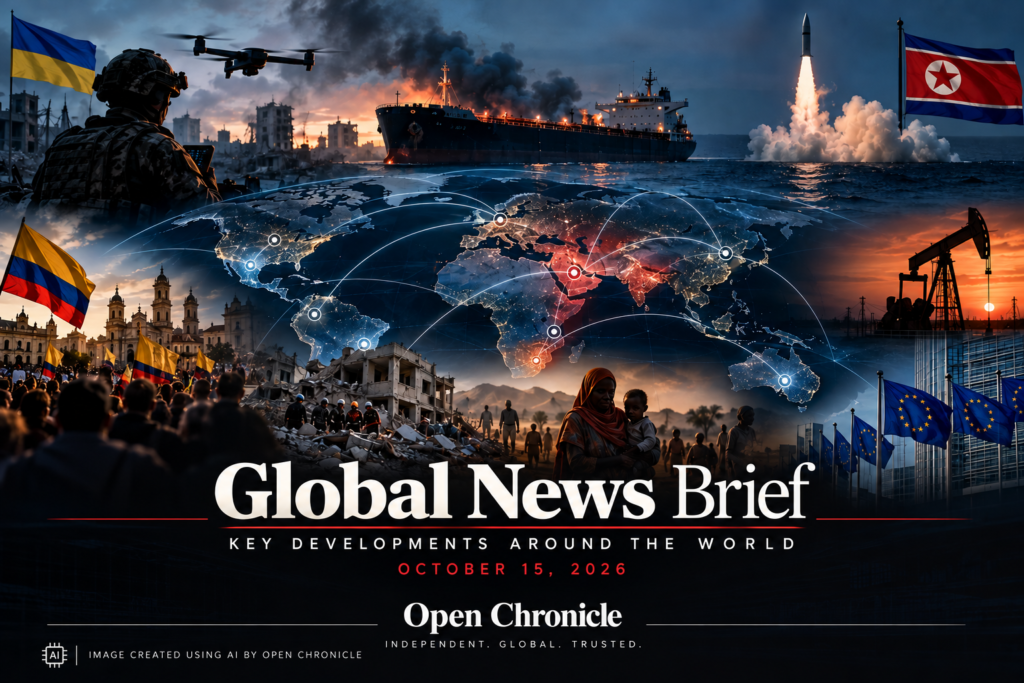
From the war in Ukraine and rising security concerns in the Black Sea to tensions in the Middle East, North Korea’s missile programme and humanitarian emergencies across Africa and Asia, Open Chronicle examines the day’s major developments by world region.
By Open Chronicle News Desk
THURSDAY, OCTOBER 15, 2026
International developments on Thursday reveal a complex global picture shaped by military conflict, geopolitical competition, economic uncertainty and mounting humanitarian pressures.
In Europe, Ukraine is confronting reported restrictions on satellite communications used in drone operations, while Romania investigates a suspected drone incident involving a commercial tanker in the Black Sea.
Across the Middle East, reports of possible American military options against Iran and threats to Gulf energy infrastructure have renewed concerns about regional escalation and international trade.
In East Asia, North Korea has reportedly tested submarine-launched cruise missiles as China opens a long-delayed cross-border bridge. In the Americas, political protests, domestic security investigations and major industrial investment proposals dominate the agenda.
Meanwhile, Sudan’s worsening humanitarian crisis, a deadly school collapse in Pakistan and severe air pollution across Southeast Asia highlight the continuing vulnerability of civilian populations.
This edition groups the principal developments by geographical region, distinguishing reported events from allegations, political statements and proposals that have not yet been independently confirmed.
EUROPE
Ukraine: Starlink Restrictions Disrupt Drone Operations
Ukraine’s armed forces are reportedly facing new operational difficulties after restrictions affecting Starlink satellite communications forced some unmanned aircraft to reduce their speed or adjust their missions.
The reported measures have revived concerns about Ukraine’s dependence on American-controlled communications infrastructure.
SpaceX’s satellite network has played an important role in maintaining connectivity during the war, including in areas where conventional communications infrastructure has been damaged.
Reports suggest that Ukrainian officials have criticised the disruption, while conflicting accounts have emerged concerning whether the restrictions originated with SpaceX or decisions involving the US government.
The precise circumstances and responsibilities remain disputed.
The controversy has also exposed Europe’s limited ability to provide an immediate, fully equivalent alternative to Starlink for Ukrainian military operations.
Why it matters: The incident illustrates how access to privately operated satellite networks can become a strategic vulnerability during modern warfare.
Romania: Suspected Drone Strike on Tanker Raises Black Sea Security Concerns
Romanian authorities are investigating reports that a Comoros-flagged tanker, YARA J, was struck by a drone near the Black Sea port of Sulina on October 14.
An explosion and fire were reported aboard the vessel, but the crew was subsequently said to be safe.
The incident coincided with aerial-security alerts near the Ukrainian border.
Romanian defence authorities reported detecting aerial targets and scrambling Romanian F-16 and Spanish F-18 fighter jets.
A Bulgarian opposition politician described the reported maritime incident as an attack on NATO territory.
However, the origin of the alleged drone strike and any connection between the tanker incident and the detected aerial targets have not been established.
Why it matters: Romania’s proximity to the war in Ukraine creates continuing risks for civilian shipping and NATO border security.
United Kingdom: King Charles Welcomes Zelensky as London Maintains Support for Ukraine
King Charles III has reportedly received Ukrainian President Volodymyr Zelensky during a visit associated with Britain’s continuing support for Ukraine.
The meeting comes amid reports of additional British assistance for Ukrainian defence and infrastructure.
Britain has also reportedly pledged approximately £17 million toward repairs at the Chernobyl nuclear facility following damage attributed to a Russian drone attack.
The developments reflect London’s continuing diplomatic and security engagement with Kyiv.
Why it matters: European support remains an important component of Ukraine’s military and political resilience.
European Union: Leaders Confront Budget, Energy and Security Disputes
EU leaders are entering discussions over the bloc’s budget, energy security, relations with China and responses to Russian hybrid operations.
Debate has intensified over how Europe should finance defence capabilities while maintaining investment in economic competitiveness and infrastructure.
Proposals for closer security coordination, including discussions of a possible European Security Council, reflect concerns about the speed and effectiveness of collective decision-making.
Cybersecurity is also emerging as an increasingly important component of European defence planning.
Why it matters: The EU faces simultaneous demands for greater strategic autonomy, stronger defence capabilities and sustainable public finances.
Russia: Shadow Fleet Sanctions Return to the International Agenda
Reports suggest that Washington is considering easing certain restrictions affecting vessels associated with Russia’s shadow fleet to reduce shipping costs.
British officials, meanwhile, have reportedly called for tighter sanctions against Russian shipping.
The contrasting approaches reflect tensions between maintaining economic pressure on Moscow and managing energy-market disruption.
No final American policy change is established by the supplied reporting.
Why it matters: Sanctions enforcement and international energy security remain closely connected.
MIDDLE EAST
Iran: Reports of Possible US Military Options Raise Escalation Concerns
Reports indicate that American military planners are considering options involving the GBU-43/B Massive Ordnance Air Blast weapon, commonly known as the “mother of all bombs”, in connection with potential operations against Iran.
The reports emerge amid continuing confrontation involving Washington and Tehran.
Considering a military option does not establish that a strike has been authorised or will occur.
The possibility has nevertheless attracted attention because of the weapon’s destructive capacity and the potential consequences of further escalation.
Why it matters: Additional military action involving Iran could intensify regional instability and disrupt global energy markets.
Saudi Arabia and Yemen: Houthi Threats to Energy Infrastructure
Reports attribute additional attacks against Saudi targets to Yemen’s Houthi movement.
One account describes an attack affecting facilities associated with Saudi Aramco, while other reports refer to threats involving civilian airports and the interception of drones.
The operational details, damage and casualties remain subject to verification.
The incidents highlight concerns about the exposure of energy and transport infrastructure to regional conflict.
Why it matters: Attacks on Saudi infrastructure could increase security costs and pressure international energy markets.
Strait of Hormuz: Shipping Disruption Threatens Global Fertiliser Supplies
A United Nations official has reportedly warned that measures to address fertiliser disruptions linked to the Strait of Hormuz must be implemented quickly to avoid a wider food-security crisis.
The Gulf region is important to international fertiliser production and distribution.
Disruption to maritime transport can raise costs for agricultural producers, particularly in countries dependent on imported fertilisers.
Why it matters: A regional maritime crisis could have consequences for food production and prices far beyond the Middle East.
Israel and Lebanon: Reports of Further Military Tensions
Reports describe continued military activity and warnings concerning southern Lebanon.
One account indicates that an Israeli airstrike injured two people, including a child.
Other reporting raises concerns about possible further Israeli military operations and civilian displacement.
The precise circumstances of the reported incidents require confirmation.
Why it matters: Continuing hostilities threaten civilian safety and regional stability.
Gulf Diplomacy: India and the United Arab Emirates Review Strategic Relations
India’s foreign minister, Subrahmanyam Jaishankar, has reportedly held discussions with his Emirati counterpart in Abu Dhabi.
The talks focused on bilateral relations and wider strategic cooperation.
India and the UAE maintain significant connections in energy, investment, trade and regional diplomacy.
Why it matters: Diplomatic coordination among major Asian and Gulf partners remains important during a period of regional uncertainty.
ASIA-PACIFIC
North Korea: Submarine-Launched Cruise Missile Tests Signal Naval Ambitions
North Korea has reportedly tested two types of submarine-launched cruise missiles.
State media described the activity as part of the country’s efforts to strengthen its strategic military capabilities.
The reported tests represent a potentially significant development in Pyongyang’s pursuit of more diversified launch platforms.
However, independent technical assessment would be needed to establish the systems’ operational readiness.
Why it matters: Submarine-launched weapons could complicate regional defence planning if North Korea develops reliable operational capabilities.
China and North Korea: Long-Delayed Border Bridge Opens
China and North Korea have reportedly opened a cross-border bridge after approximately 12 years of delays.
The project is intended to improve transport and commercial connections.
Its opening comes as Pyongyang strengthens relations with Russia and maintains its economic relationship with Beijing.
The scale of any resulting trade increase remains uncertain.
Why it matters: Improved infrastructure could support deeper economic ties despite continuing sanctions restrictions.
Japan: Reports Point to Major Semiconductor Investment in the United States
Japan is reportedly considering investments of up to $21 billion in semiconductor manufacturing facilities in New York.
The proposed investment reflects growing efforts to strengthen advanced technology supply chains.
The precise financial arrangements and project commitments remain to be confirmed.
Why it matters: Semiconductor production has become a central element of industrial policy and international economic security.
Taiwan: Alaska LNG Project Attracts Investment Interest
Taiwan has reportedly considered investing up to $4.4 billion in an Alaska liquefied natural gas project.
The proposal forms part of broader discussions about energy security and trade relationships with the United States.
South Korean participation has also featured in statements by President Trump, although the status of specific commitments remains unclear.
Why it matters: LNG investment is becoming increasingly important to energy diversification and US-Asian economic relations.
Indonesia: Toxic Haze Spreads Across Southeast Asia
Severe fires in Indonesia are reportedly generating air pollution affecting neighbouring countries, including Malaysia, Singapore and Timor-Leste.
Reports indicate that large numbers of people have sought medical treatment for pollution-related health concerns.
Singapore has reportedly recorded some of its highest air-pollution readings since 2015.
Indonesian authorities are considering or implementing measures intended to reduce the haze.
Why it matters: Transboundary pollution creates public-health, environmental and economic risks across Southeast Asia.
Pakistan: At Least 18 Reported Dead in School Roof Collapse
At least 17 students and one teacher have reportedly died after a school roof collapsed in Peshawar.
The cause of the collapse has not been established.
Authorities are expected to investigate the structural failure and assess the safety of educational facilities.
The reported casualty figures remain subject to official confirmation.
Why it matters: The tragedy raises urgent questions about school infrastructure and public safety.
Thailand: Demonstrators Criticise International Financial Institutions
Protesters in Bangkok have reportedly demonstrated against the International Monetary Fund and World Bank.
Participants criticised aspects of international economic policy and warned about the social and environmental consequences of existing development models.
The demonstrations coincide with wider discussions concerning global economic governance.
Why it matters: International financial institutions face continued scrutiny over the social impact of economic and development policies.
Australia: Government Examines Digital Safety and Naval Security
Australian authorities are addressing several security and technology-related developments.
Reports indicate that a concealed recording device was discovered aboard a naval vessel, prompting an investigation.
Separately, the government has reiterated concerns about unrestricted technology-platform access to children.
Why it matters: The developments reflect growing attention to both traditional security risks and digital governance.
AFRICA
Sudan: Famine Risk Worsens Amid Conflict and Drought
Sudan’s humanitarian crisis continues to deteriorate as armed conflict, drought and funding shortages place increasing pressure on food supplies.
Violence has disrupted agriculture, transport and access to humanitarian assistance.
Large-scale displacement has further increased the vulnerability of civilian populations.
Humanitarian organisations face major challenges reaching communities affected by fighting.
Why it matters: Sudan remains a major international humanitarian emergency, with serious risks of further deterioration.
Libya: Political Disputes Threaten Electoral Progress
Reports indicate continuing disagreements involving Libya’s High Council of State and the United Nations mission over political arrangements intended to advance the country’s electoral process.
UN representatives have reportedly warned against actions that could disrupt progress toward an agreement.
Libya’s political institutions remain divided, complicating efforts to establish a stable electoral framework.
Why it matters: Political fragmentation continues to obstruct Libya’s efforts to achieve lasting institutional stability.
Cameroon: Protests Follow Rising Concern Over Killings of Women
Reports describe public demonstrations in Cameroon following an increase in killings of women.
The protests reflect concern over gender-based violence and demands for stronger protection and accountability.
Further information is required to establish the scale of the reported increase and the authorities’ response.
Why it matters: Violence against women remains a significant human-rights and public-safety challenge.
Western Sahara: Questions Surround the Future of MINURSO
The future of the United Nations Mission for the Referendum in Western Sahara is reportedly facing renewed uncertainty.
The mission has operated for decades amid unresolved political disagreements concerning the territory.
Discussions over its mandate remain closely connected to diplomatic efforts and regional security.
Why it matters: The Western Sahara dispute continues to influence relations and security calculations across North Africa.
NORTH AMERICA
United States: Teen Arrested Over Alleged Plot Against Hindu Temple
Authorities in Illinois have reportedly arrested a teenager suspected of planning a mass shooting at a Hindu place of worship.
Reports describe alleged extremist material and preparations for violence.
Some accounts suggest the suspect expressed white supremacist and anti-Indian views.
These allegations remain subject to investigation and judicial proceedings.
The suspect is presumed innocent unless proven guilty.
Why it matters: The case has renewed concerns about hate-motivated violence and security at religious institutions.
Washington: White House Defends New Press Secretary
The White House is facing questions concerning the legal credentials of its new press secretary, Katie Zacharia.
Reports indicate that officials have defended her amid public scrutiny of statements about her professional background.
The specific claims and responses require assessment against verifiable professional records and official statements.
Why it matters: The controversy concerns transparency and public confidence in government communications.
United States: Greenland Exploration Plans Draw Scrutiny
President Donald Trump has reiterated claims that major oil, gas and mineral exploration activity will begin in Greenland.
The Arctic territory has attracted strategic interest because of its resources and geographical position.
However, exploration and extraction projects depend on commercial feasibility, environmental requirements and political authorisation.
Why it matters: Greenland remains important to debates over Arctic security and critical mineral supply chains.
United States: Montana Weapons Testing Project Announced
President Trump has reportedly announced plans for a major testing range in Montana involving hypersonic weapons, autonomous systems and space-related technologies.
The proposal reflects growing American investment in advanced military capabilities.
Details concerning funding, facilities and implementation remain to be confirmed.
Why it matters: Advanced weapons testing is increasingly central to US defence modernisation.
Canada: Relations With India Show Signs of Improvement
Canada and India are reportedly working toward improved diplomatic and economic relations.
Officials have expressed interest in pursuing a trade agreement before the end of the year.
The discussions follow a period of strained bilateral relations.
Why it matters: A diplomatic reset could strengthen commercial cooperation between two significant economies.
LATIN AMERICA AND THE CARIBBEAN
Colombia: Thousands Protest Against New President
Thousands of demonstrators have reportedly protested across Colombia against the country’s new right-wing president.
The demonstrations reflect tensions surrounding the country’s political direction.
Separate reporting indicates controversy over Colombia’s decision to open an embassy in West Jerusalem.
Arab governments have reportedly criticised the diplomatic move.
The extent to which the embassy decision influenced the demonstrations remains unclear.
Why it matters: Colombia faces significant domestic political pressures alongside potentially consequential diplomatic decisions.
Brazil: Senate Approves Shorter Workweek Proposal
Brazil’s Senate has reportedly approved legislation intended to shorten the working week.
The measure has been described as a political success for President Luiz Inácio Lula da Silva ahead of a presidential runoff.
The proposal’s final legal status and implementation requirements would need to be confirmed.
Why it matters: Working-time reform could have important implications for labour relations, productivity and economic policy.
Ecuador: Curfew Planned for Coastal Provinces
Ecuador is reportedly preparing new curfew measures in coastal provinces between November 1 and November 10.
The restrictions are intended to address criminal activity and security concerns.
The government has faced sustained challenges involving organised crime and violence.
Why it matters: Public-security policy remains a major challenge for Ecuador’s authorities.
Costa Rica: New Mega-Prison Reflects Regional Security Debate
Costa Rica has reportedly opened a large prison designed to accommodate approximately 5,100 inmates.
The project has drawn comparisons with El Salvador’s high-security prison model.
Supporters of such facilities emphasise the need to confront organised crime.
Human-rights organisations have raised broader concerns about prison conditions, detention safeguards and the consequences of punitive security policies.
Why it matters: Central American governments continue to debate the balance between public security and human-rights protections.
GLOBAL ECONOMY AND MULTILATERAL INSTITUTIONS
G20: Finance Ministers Confront Energy and Inflation Risks
G20 finance ministers and central bankers are meeting amid the economic consequences of the confrontation involving Iran.
Energy prices, shipping disruption and inflation remain central concerns.
Governments are also examining the resilience of supply chains and the financial pressures facing developing economies.
Why it matters: Regional conflicts can transmit economic shocks through global commodity and financial markets.
World Bank: Debate Intensifies Over Energy Financing
US Treasury Secretary Scott Bessent has reportedly called for changes to the World Bank’s approach to financing oil and gas projects.
Reports also describe discussion of deep-sea mineral development.
The proposals reflect disagreements over energy security, environmental commitments and development priorities.
Why it matters: Decisions by international financial institutions can influence energy investment and development strategies worldwide.
Global Food Security: Fertiliser Supply Chains Under Pressure
Disruption around the Strait of Hormuz is reportedly creating risks for international fertiliser trade.
A United Nations official has warned of the potential consequences for agricultural production if emergency measures are delayed.
Countries dependent on imported fertilisers could face higher costs and supply shortages.
Why it matters: The effects of conflict on fertiliser markets could extend into food production and household prices across multiple regions.
THE BIG PICTURE
Security, Technology and Economic Interdependence Shape the Global Agenda
The international developments reported on October 15 demonstrate the increasingly close relationship between military security, technological infrastructure and economic resilience.
Europe’s dependence on foreign-controlled satellite communications has become particularly visible through Ukraine’s reported Starlink difficulties.
In the Black Sea, civilian shipping remains exposed to risks associated with military activity near international borders.
The Middle East continues to generate concerns about energy security, maritime trade and the wider economic consequences of armed conflict.
East Asia’s developments illustrate the strategic importance of missile technology, transport infrastructure and advanced manufacturing.
Across Africa, humanitarian and political crises continue to demand international attention.
In the Americas, governments are confronting domestic security challenges, economic reforms and shifting diplomatic relationships.
These developments are not necessarily connected by a common cause.
However, they reveal a shared challenge: national decisions and regional crises increasingly produce consequences that extend across borders.
For governments, the task is to strengthen resilience while managing competing economic and security priorities.
For international institutions, it is to maintain cooperation during a period of significant geopolitical disagreement.
Open Chronicle will continue monitoring these developments as new official statements and independently verifiable information become available.
Open Chronicle | Global News Desk
Sources and Further Reading
Institutional references and further reading supporting the regional coverage of international security, diplomacy, humanitarian emergencies, energy markets and global economic developments.
01 | European & Allied Security
NATO — North Atlantic Treaty Organization
Official information concerning European security, collective defence and allied military cooperation.
02 | Romanian Defence & Airspace Monitoring
Romanian Ministry of National Defense
Official announcements concerning Romania’s defence activities and airspace monitoring.
03 | European Union Policy
European Council and Council of the European Union
EU institutional information concerning security, energy, economic policy and international relations.
04 | Humanitarian Coordination
United Nations Office for the Coordination of Humanitarian Affairs
Humanitarian updates concerning Sudan and other international emergencies.
05 | Global Food Security
World Food Programme
Food-security assessments and humanitarian assistance information.
06 | Maritime Safety & Security
International Maritime Organization
Information concerning maritime safety and commercial shipping security.
07 | International Energy Markets
International Energy Agency
Research and analysis concerning international energy markets and supply security.
08 | Global Financial Stability
International Monetary Fund
International economic analysis and financial stability information.
09 | Development Finance
World Bank
Development finance and international economic research.
10 | Global Public Health
World Health Organization
Public-health information concerning air pollution and environmental emergencies.
11 | Nuclear Safety & Security
International Atomic Energy Agency
Official information concerning nuclear safety and Ukraine’s nuclear facilities.
Open Chronicle | Editorial Transparency
Editorial Note
This regional edition of the Global News Brief is an original Open Chronicle editorial synthesis based on the supplied international news headlines and summaries for October 15, 2026.
Stories have been grouped geographically to improve readability and provide a clearer understanding of developments in Europe, the Middle East, Asia-Pacific, Africa, North America, Latin America and the global economy.
The material includes breaking-news reports, political statements, allegations and proposed government actions. Not all developments have been independently verified against primary sources for this edition.
Particular caution applies to the reported Starlink restrictions affecting Ukraine, the alleged drone incident involving the tanker YARA J, possible US military operations against Iran, allegations concerning criminal investigations and reports of attacks on civilian or energy infrastructure.
Reported casualty figures, financial commitments, military details and political developments may change as additional information becomes available.
The sources listed above provide relevant institutional background and opportunities for further verification. Their inclusion does not imply endorsement or confirmation of every reported development.
Open Chronicle
Independent. Global. Trusted.