
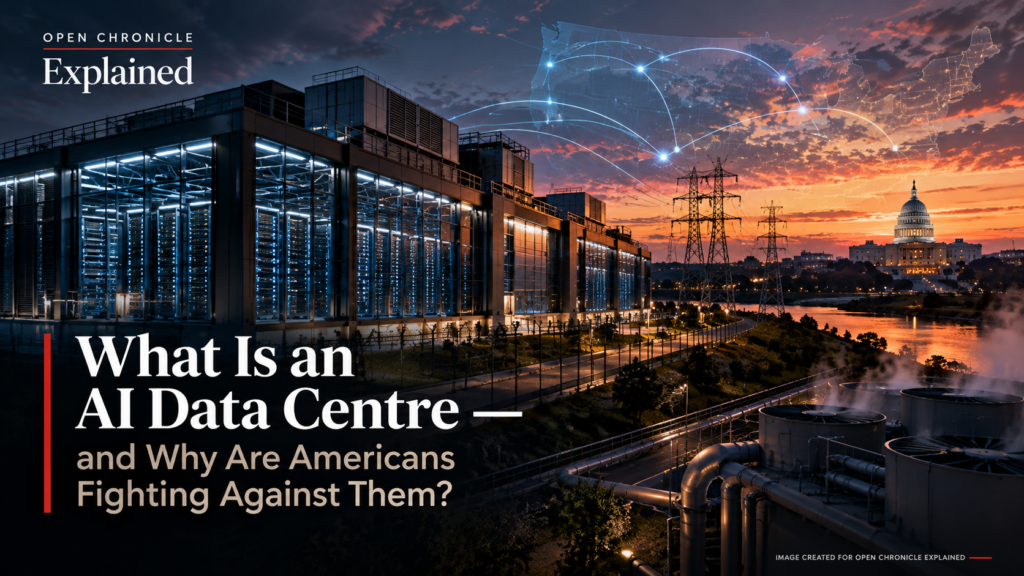
How the invisible infrastructure powering artificial intelligence became a visible battle over electricity, water, land, economic development and political power.
By Open Chronicle Explained
Every time someone asks an artificial intelligence chatbot a question, generates an image, searches the internet or stores a document in the cloud, a physical infrastructure somewhere must perform the work.
That infrastructure includes data centres: buildings filled with computers, networking equipment, electrical systems and cooling technology.
For decades, these facilities were largely invisible to the public. They supported banking transactions, business applications, streaming platforms, government systems and everyday internet services.
Artificial intelligence is changing their scale, economics and political significance.
Across the United States, technology companies and infrastructure developers are pursuing increasingly ambitious data-centre projects. Some require enormous amounts of electricity, extensive land, upgraded transmission networks and sophisticated cooling systems.
Supporters describe them as essential infrastructure for economic growth, technological innovation and national competitiveness.
Opponents question their effects on household electricity bills, water resources, farmland, local environments and public finances.
The result is an increasingly consequential debate: Who benefits from the AI revolution, and who should pay for the infrastructure required to power it?
1. What Exactly Is a Data Centre?
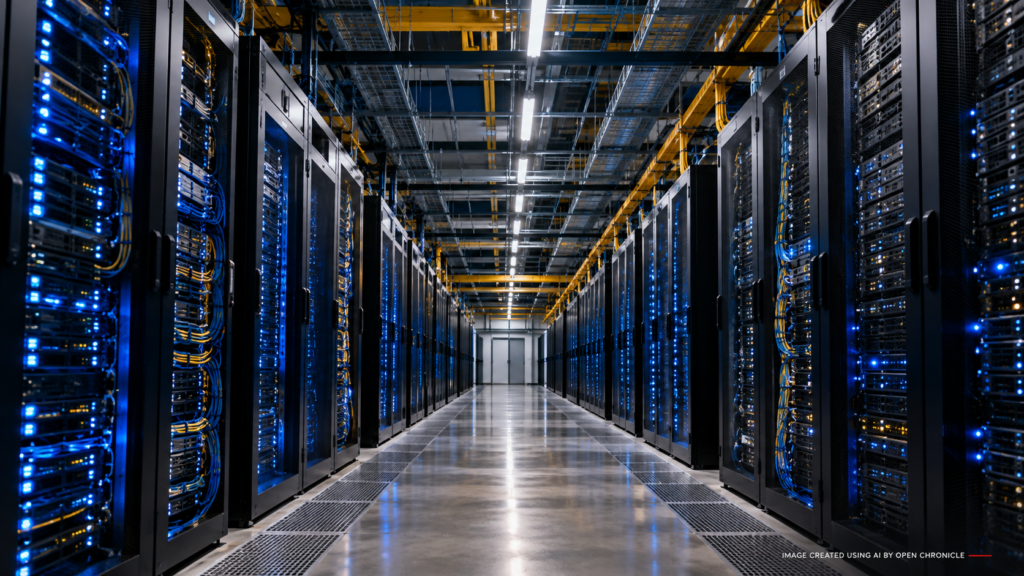
A data centre is a facility designed to house, operate and protect computer systems.
Unlike an ordinary office building, its primary purpose is not to accommodate people. It is to provide a controlled environment where computing equipment can operate continuously and reliably.
A modern data centre typically contains several interconnected systems:
-
Servers that process information and run applications.
-
Storage systems that preserve digital information.
-
Networking equipment that connects computers and transfers data.
-
Electrical infrastructure that delivers and distributes power.
-
Cooling systems that prevent equipment from overheating.
-
Backup power and security systems that protect operations against disruption.
The servers are usually installed in cabinets known as racks, arranged in rows inside specially designed rooms.
A data centre may support thousands of businesses simultaneously, operate a single company’s digital services or provide computing capacity for AI developers.
Some are relatively small. Others occupy extensive industrial campuses containing multiple buildings.
The defining characteristic is not the size of the building but the concentration of computing infrastructure inside it.
2. Why Does Artificial Intelligence Need So Many Data Centres?
Traditional internet services already require substantial computing power.
However, modern AI systems introduce additional demands.
Large AI models are developed through a process known as training. During training, specialized processors perform enormous numbers of mathematical operations to identify patterns in data and adjust the model’s internal parameters.
Once trained, the model enters another phase known as inference.
Inference occurs whenever someone interacts with the system and requests an answer, translation, image, recommendation or another output.
Both activities require computing resources.
Training can involve intensive computation concentrated over a particular period. Inference demand grows as more users and applications rely on AI services.
This distinction matters because AI infrastructure must support not only the development of new models but also their continued use.
A successful AI service may require computing capacity around the clock, serving millions of requests.
As AI applications expand into workplaces, software development, scientific research, healthcare and industrial operations, demand for specialized computing infrastructure can increase accordingly.
3. How Does an AI Data Centre Actually Work?
Consider a person in Portugal asking an AI system to summarize a long document.
The process appears simple on the screen, but several operations occur behind the scenes.
A Simplified AI Request
From a question on your screen to calculations
inside a data centre — and back again.
User Submits a Request
Text and instructions are sent to the service.
Request Reaches Computing Infrastructure
Network systems direct it to available resources.
AI Processors Run the Model
GPUs or other accelerators perform calculations.
The Response Is Returned
The result travels back through the network.
Every stage depends on physical infrastructure.
Servers require electricity, networking systems
transfer information, and cooling equipment removes
the heat generated by computing operations.
·
UNDERSTAND HOW THE WORLD WORKS
While the processors perform these operations, electrical equipment supplies energy and cooling systems remove the heat generated.
The process may take only seconds from the user’s perspective.
But at large scale, millions of similar operations place continuous demands on the underlying infrastructure.
4. Why Do AI Data Centres Consume So Much Electricity?
Computers transform electrical energy into computational work and heat.
The more powerful the processors, and the more intensively they operate, the greater the potential electricity demand.
AI facilities often rely on specialized accelerators, including graphics processing units, or GPUs, designed to perform large numbers of calculations in parallel.
A modern AI server rack can require substantially more power than many conventional enterprise computing racks.
Electricity is also needed for systems beyond the processors themselves.
These include cooling equipment, networking devices, power conversion, lighting, monitoring and other supporting infrastructure.
The total electricity consumed by a data centre is therefore greater than the energy used directly by its computing equipment.
What Is Power Usage Effectiveness?
Engineers measure the relationship between a data
centre’s total energy consumption and the energy
used by its computing equipment using
Power Usage Effectiveness (PUE).
PUE =
If a data centre consumes
120 units of energy
in total, while its IT equipment consumes
100 units:
1.20
For every 100 units of energy consumed by the
computing equipment, another 20 units are used
by supporting systems such as cooling and
power distribution.
A lower PUE generally indicates that less
energy is being used by supporting infrastructure
relative to the computing equipment. However,
a highly efficient data centre can still consume
enormous amounts of electricity if its overall
computing workload is sufficiently large.
·
UNDERSTAND HOW THE WORLD WORKS
A PUE of 1.2 means that for every 1 unit of energy consumed by the computing equipment, the facility consumes another 0.2 units for supporting systems.
A lower PUE generally indicates less overhead, although it does not by itself establish that a facility has a low environmental impact.
A highly efficient facility can still consume enormous amounts of electricity if its computing workload is sufficiently large.
5. What Does a One-Gigawatt Data Centre Mean?
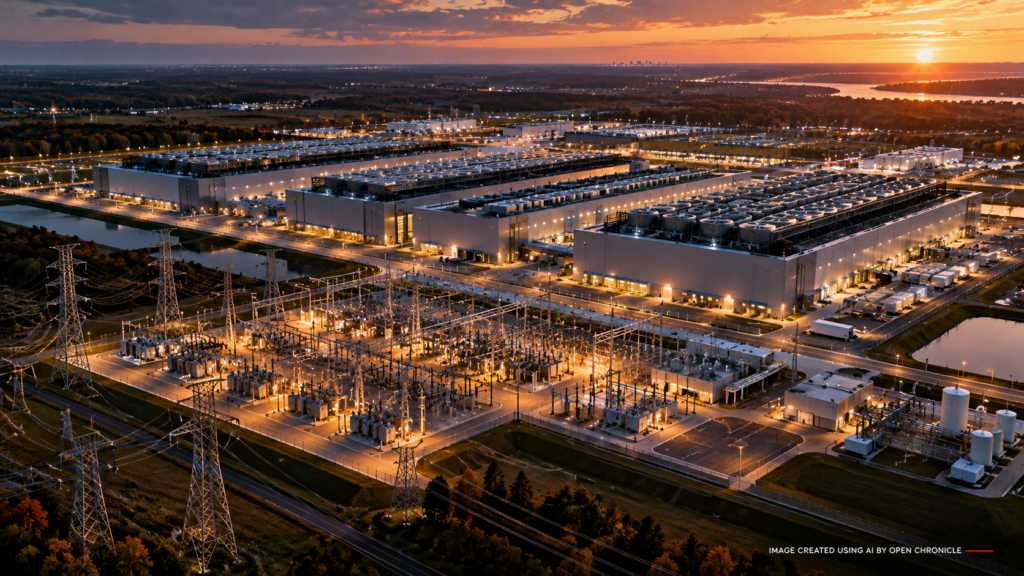
Data-centre announcements frequently refer to megawatts and gigawatts.
These measurements describe power, not the total amount of energy consumed over time.
One gigawatt equals 1,000 megawatts.
A project with a 1-gigawatt electrical demand operating continuously at full capacity would use:
Illustrative Calculation
How much electricity would a data centre
consume if it operated continuously at
one gigawatt for an entire year?
×
8,760 hours
=
8.76 TWh
Assumes continuous operation at 1 GW for a full
year. Actual consumption depends on utilization,
construction phases and whether the announced
capacity represents IT load or total facility
demand.
·
UNDERSTAND HOW THE WORLD WORKS
This illustrates why electricity planners pay close attention to large proposed facilities.
A single development can represent a major new customer for a regional power system.
The challenge becomes particularly significant when several projects seek connections in the same area.
6. Why Can Data Centres Affect Household Electricity Bills?
Electricity does not arrive at a data centre independently of the wider power system.
It is delivered through generation facilities, transmission lines, substations and distribution networks.
When a large new customer requests electricity, utilities may need to expand infrastructure.
Potential investments include new substations, higher-capacity transmission connections, transformers, generation resources and system upgrades.
These investments cost money.
The central economic question is how those costs are allocated.
If a data-centre developer pays the full incremental cost of the infrastructure it requires, other electricity customers may be better protected.
If some costs are recovered through general electricity rates, households and other businesses may bear part of the expense.
The outcome depends on utility regulation, electricity market conditions, tariffs, contractual arrangements and the design of the infrastructure.
A data centre does not automatically cause higher household bills. But poorly structured cost allocation, generation shortages or transmission constraints can expose other customers to financial risks.
This is one reason electricity pricing has become a central part of the American debate.
7. Why Do Data Centres Need Water?
Servers generate heat.
That heat must be removed to prevent equipment damage, performance problems and system failures.
Cooling technologies vary significantly.
Some facilities use air-based systems. Others use evaporative cooling, chilled-water systems, direct liquid cooling or combinations of several approaches.
Evaporative cooling can reduce electricity requirements in suitable conditions, but it consumes water as part of the heat-removal process.
Other cooling designs can reduce on-site water consumption, sometimes at the cost of different energy requirements.
Water impacts also extend beyond the facility itself.
Electricity generation may involve water consumption, depending on the energy source and generation technology.
Consequently, a complete environmental assessment should consider both direct and indirect water use.
The impact of a data centre in a water-rich region may differ substantially from the impact of an equivalent facility in a drought-prone area.
This explains why water concerns are especially important in parts of the American Southwest.
8. Why Are Some Communities Opposing Data Centres?
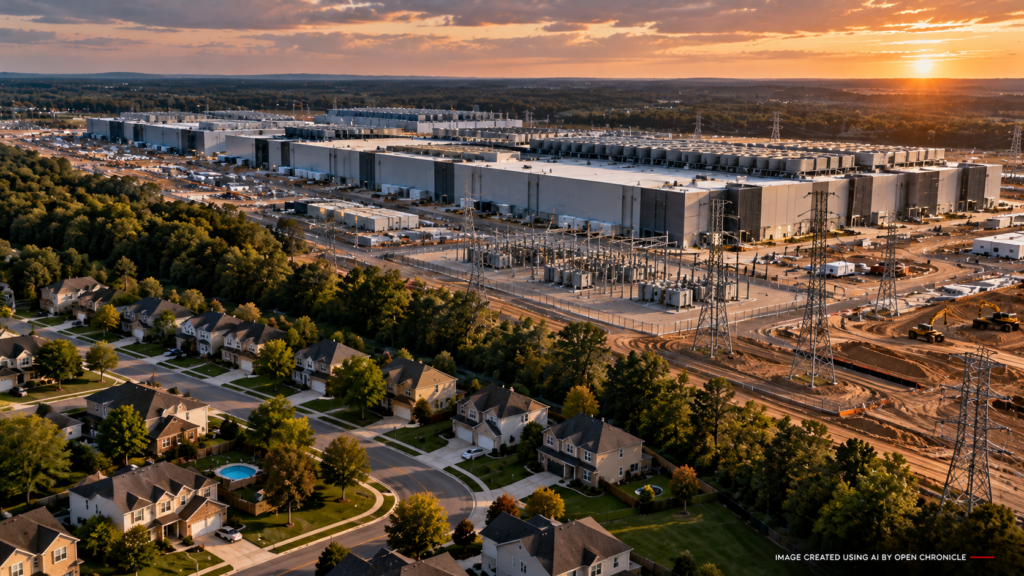
Community opposition is not always opposition to technology itself.
Residents may use cloud services, AI tools and digital platforms while objecting to a particular industrial development near their homes.
Their concerns can involve several distinct issues.
Land use is one. Large data-centre campuses can occupy extensive areas, sometimes competing with agriculture, housing or other local priorities.
Noise is another. Cooling equipment, ventilation systems, transformers and backup generators may generate sound that affects nearby properties.
Environmental concerns include water consumption, local air emissions from backup generators, construction impacts and the electricity sources used to operate the facility.
Residents may also question whether infrastructure developers have provided sufficient information about projected resource consumption and long-term consequences.
In East Fishkill, New York, opposition to a proposed large data-centre development illustrates how a community with an established technology-industry history can nevertheless challenge the scale and location of new AI infrastructure.
The controversy is not necessarily about whether computing facilities should exist.
It is often about where they should be built, under what conditions and with whose consent.
9. Do Data Centres Create Jobs?
Yes, but the number and type of jobs depend on the project and its development stage.
Construction can generate substantial temporary employment for electricians, engineers, builders, equipment installers and other specialized workers.
Once operational, however, a data centre may require fewer permanent workers than a manufacturing plant of comparable physical size or capital investment.
Automation and remote management can reduce staffing requirements.
The economic benefits may instead come from property taxes, supplier contracts, construction spending, infrastructure investment and wider business activity.
These benefits should be assessed alongside any tax incentives, public subsidies or infrastructure costs.
A large investment announcement does not automatically mean an equally large number of permanent local jobs.
The distinction between construction employment and long-term employment is essential when evaluating economic-development promises.
10. Why Do Governments Offer Tax Incentives?
Governments compete to attract major investments.
Data centres can appear particularly attractive because they involve expensive equipment, substantial construction expenditure and long-term property development.
States and municipalities may offer exemptions, reduced taxes, infrastructure support or other incentives.
Supporters argue that such policies attract investment, expand the tax base and strengthen regional technology industries.
Critics question whether the public receives sufficient economic benefits in return.
The calculation becomes more complicated when a project requires additional public infrastructure or imposes environmental costs.
A meaningful assessment should compare the value of incentives with expected tax receipts, employment, infrastructure obligations and other measurable outcomes.
It should also examine what happens if the developer changes its plans or the technology becomes obsolete sooner than expected.
11. Why Is the Backlash Becoming Political?
Data centres bring several politically sensitive issues together.
They connect household affordability with energy policy, land ownership, corporate influence, industrial development and public accountability.
These concerns do not follow traditional party boundaries neatly.
Conservative communities may object to the conversion of farmland or oppose decisions made without sufficient local control.
Progressive groups may focus on environmental impacts, corporate subsidies or the distribution of infrastructure costs.
Some residents share concerns across those ideological differences.
The controversy has therefore created unusual political alliances.
In the 2026 American midterm election cycle, data-centre development has become an issue in state and local campaigns and some congressional contests.
Reporting by S&P Global in October identified 34 data-centre-related ballot measures scheduled for November across several states, including 20 initiatives in Ohio.
Yet it would be premature to assume that data centres will determine the national election result.
Their electoral importance is likely to vary considerably between communities hosting proposed projects and areas where the issue remains distant.
12. Why Do Technology Companies Consider Data Centres Strategically Important?
Artificial intelligence is increasingly viewed as a technology with economic and national-security implications.
Advanced computing capacity can support scientific research, industrial design, cybersecurity, healthcare applications, software development and defence-related analysis.
Governments and companies therefore see access to computing infrastructure as an important competitive advantage.
For the United States, the argument extends beyond individual companies.
Supporters of rapid data-centre construction contend that domestic computing capacity is necessary to preserve technological leadership and compete with other major powers, particularly China.
But national strategic benefits do not eliminate local economic and environmental obligations.
A project can contribute to national computing capacity while still imposing significant costs on a particular community.
That tension lies at the heart of the controversy.
13. Could AI Data Centres Use Renewable or Nuclear Energy?
Yes.
Data-centre operators can obtain electricity through a range of arrangements, including utility supplies, renewable-energy contracts, dedicated generation and other power-purchasing structures.
Solar and wind generation can contribute to meeting electricity demand.
However, their output varies with weather and time of day.
Data centres typically require highly reliable electricity, which means the wider power system must balance supply and demand continuously.
Nuclear energy offers another potential source of low-carbon electricity with relatively steady output.
But new nuclear projects can involve long development timelines, high capital costs and regulatory requirements.
Natural-gas generation and grid-connected backup arrangements may also play roles, with associated emissions and infrastructure considerations.
There is no single energy solution suitable for every data centre.
The relevant questions concern reliability, cost, emissions, grid capacity, construction timelines and the availability of resources in a particular location.
14. Can Data Centres Become More Efficient?
Technological improvements can reduce the resources required for particular computing tasks.
Potential measures include more efficient processors, better software, improved server utilization, advanced cooling, heat reuse and more effective workload scheduling.
AI model design can also influence infrastructure demand.
Smaller or more specialized models may complete certain tasks using fewer computational resources than larger general-purpose systems.
However, greater efficiency does not necessarily guarantee lower total energy consumption.
If computing becomes cheaper, demand for AI services may grow.
An individual request could become more efficient while the total number of requests rises dramatically.
This is a form of the broader economic phenomenon known as the rebound effect.
The important distinction is between efficiency per task and total resource consumption.
15. What Could Responsible Data-Centre Development Look Like?
A more sustainable approach would require developers, utilities, regulators and communities to address infrastructure impacts before construction begins.
Key principles include transparent projections of electricity and water demand, clear financial responsibility for necessary grid upgrades, meaningful community consultation and credible environmental assessments.
Projects should also be evaluated against their actual economic benefits rather than investment announcements alone.
Electricity tariffs can be designed to reduce the risk that large new industrial loads transfer disproportionate costs to households.
Water-use requirements can reflect local scarcity.
Planning authorities can consider noise, land use, backup generation and the cumulative effects of multiple developments.
None of these measures eliminates every conflict.
But they can make the distribution of costs and benefits more transparent.
The underlying objective is not to prevent technological development. It is to ensure that technological development remains economically and socially accountable.
16. What? How? Why?
What? How? Why?
Three essential questions to understand
the infrastructure behind artificial intelligence.
What is an AI data centre?
A physical facility containing the computing
equipment, electrical infrastructure, networking
systems and cooling technology needed to develop
and operate AI services.
How does it work?
Specialized processors perform mathematical
calculations, supported by reliable electricity,
high-speed networking and systems that remove
the heat generated by computing equipment.
Why has it become controversial?
Because the infrastructure supporting AI can
require large amounts of electricity, land,
water and investment, raising difficult
questions about local impacts, public costs
and the distribution of economic benefits.
·
UNDERSTAND HOW THE WORLD WORKS
Conclusion — The Cloud Has a Physical Cost
Artificial intelligence is frequently presented as an almost weightless technology.
Its products appear on screens. Its services operate through networks. Its capabilities are described in terms of algorithms, models and digital intelligence.
But behind every AI system stands a physical industrial infrastructure.
There are buildings to construct, processors to manufacture, electricity to generate, transmission networks to expand and heat to remove.
Those requirements connect the digital economy to the physical world in ways that are increasingly difficult to ignore.
America’s data-centre backlash reflects that reality.
The debate is not simply a confrontation between technological progress and communities resistant to change. It is a dispute over how the benefits and costs of a rapidly expanding industry should be distributed.
The United States may need substantial new computing infrastructure to support its technological ambitions.
But building that infrastructure will require more than capital, engineering and political support.
It will also require public trust.
The defining question of the AI infrastructure boom may therefore be not how much computing power America can build, but whether it can build that power without asking local communities to bear costs they did not agree to assume.
Sources and Further Reading
Selected technical and reporting sources. These
support the broader explanation and provide
additional context; they are not a reproduction
of the linked Open Chronicle news article.
S&P Global — Data Center Backlash Shapes
Midterm Ballots
October 2026 reporting on local ballot measures,
proposed restrictions and electricity-related
concerns.
Associated Press — Data Centres and the
Midterm Elections
Reporting on land-use disputes, environmental
concerns and changing political positions
surrounding data-centre development.
Vox — No One Wants to Be Data Center Dave
Analysis of why opposition to AI infrastructure
is influencing political campaigns across
traditional party lines.
US Department of Energy
Federal research and information on energy
infrastructure, electricity systems and
data-centre efficiency.
The Green Grid
Industry research and resources on data-centre
energy efficiency and Power Usage Effectiveness
(PUE).
·
UNDERSTAND HOW THE WORLD WORKS
Understanding the systems behind the headlines.
Explore Open Chronicle Explained →