
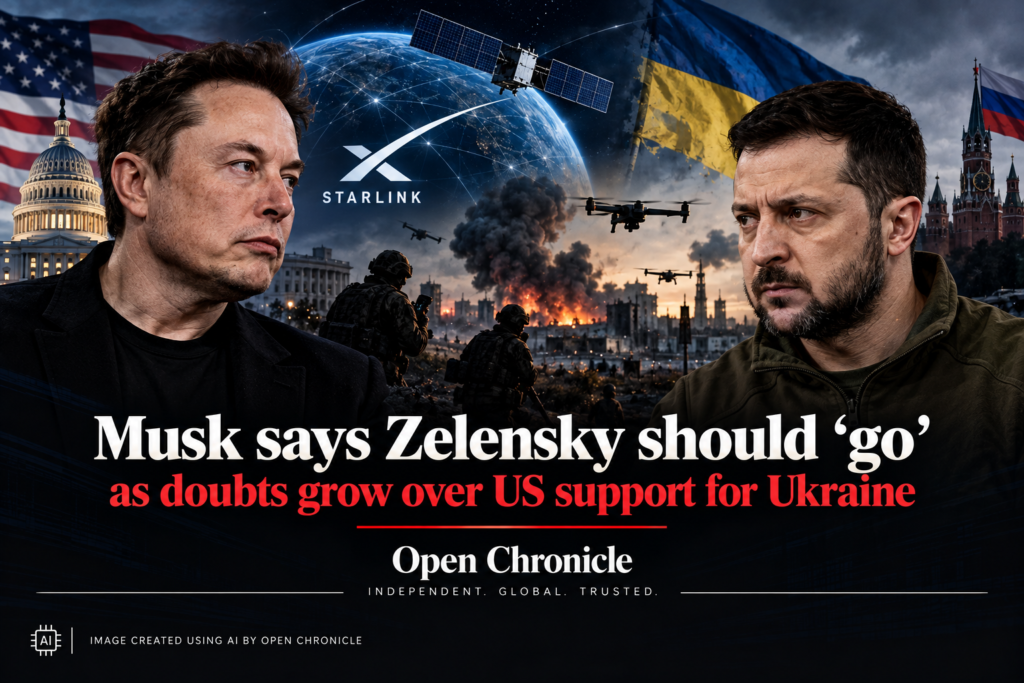
The SpaceX chief executive has called for the Ukrainian president’s departure amid a dispute over satellite communications, US military intelligence and Washington’s energy dealings with Russia. Kyiv fears that decisions made in the United States could undermine its ability to defend against Russian attacks.
By Open Chronicle News Desk
KYIV / WASHINGTON | October 15, 2026
Elon Musk has called for Ukrainian President Volodymyr Zelensky to leave office, escalating a confrontation over military satellite communications and the reliability of American support for Ukraine as Russia continues its invasion.
The SpaceX chief executive made the remarks on Wednesday, October 14, after Ukrainian officials raised concerns about restrictions affecting satellite-connected military systems used in operations against Russian forces.
Writing on his social media platform X, Musk declared: “And so the slaughter continues. Time for Zelensky to go.”
His intervention followed complaints from Kyiv that changes affecting Starlink and Starshield-related services had disrupted Ukrainian military operations, including missions involving unmanned aircraft.
The dispute has become particularly sensitive because Ukraine depends heavily on American military assistance, intelligence sharing and communications technology to defend its territory.
Musk has rejected suggestions that he personally controls the restrictions in question, arguing that decisions concerning the military Starshield system rest with the United States government.
The confrontation comes amid wider tensions between Zelensky and President Donald Trump over Washington’s approach to Russia, energy markets and the future of American support for Ukraine.
Musk Directly Challenges Ukraine’s President
Musk’s public demand for Zelensky’s departure represents a significant escalation in his criticism of Ukraine’s leadership.
As the chief executive of SpaceX, Musk oversees a company whose satellite communications technology has become an important component of Ukraine’s wartime infrastructure.
His comments therefore carry implications beyond those of an ordinary political intervention.
Since Russia launched its full-scale invasion in February 2022, satellite connectivity has helped Ukraine maintain communications across damaged infrastructure, support military coordination and operate in areas where conventional networks have been disrupted.
The technology has also been integrated into certain Ukrainian unmanned systems, although the specific equipment and contractual arrangements differ across military applications.
Musk’s latest remarks have brought renewed attention to the relationship between private technology companies and governments during armed conflicts.
They also raise questions about the influence exercised by executives whose commercial infrastructure provides capabilities considered essential to national defence.
The SpaceX chief’s statement should not be interpreted as an official American government demand for Zelensky’s resignation. No such formal position is established by the reporting supplied for this article.
Starlink and Starshield: A Critical Distinction
At the centre of the dispute is the distinction between Starlink, SpaceX’s satellite internet service, and Starshield, its defence-oriented satellite programme.
Starlink provides satellite connectivity through a large constellation of spacecraft and ground-based user terminals.
Starshield is designed for government and national-security applications, with access and operational controls determined by the relevant agreements.
Ukrainian officials have complained that changes affecting satellite-linked equipment have reduced the effectiveness of some military operations.
According to the supplied reporting, certain restrictions have affected the speed at which connected systems can operate, complicating missions involving drones.
Musk responded by directing responsibility toward the American government.
“Starshield systems are owned and controlled by the US government. Any limits on speed or usage are decided by the US military and ultimately POTUS,” he wrote on X.
POTUS is an abbreviation for President of the United States.
The statement effectively placed responsibility for any Starshield restrictions on American military authorities and, ultimately, President Trump.
However, the exact contractual arrangements governing the affected equipment, the technical mechanisms involved and the extent of any US government instructions have not been independently established in the supplied material.
It also remains important not to assume that every Starlink terminal used by Ukraine operates under the same terms as equipment associated with Starshield.
Ukraine Says Restrictions Are Affecting Military Operations
Ukrainian defence officials have suggested that recent restrictions have affected internet terminals used to support military operations against Russian-occupied territory.
Some systems reportedly experienced limitations that forced adjustments to drone missions.
The changes are particularly concerning for Ukraine because unmanned aircraft have become central to its military strategy.
Ukraine uses a wide variety of drones for reconnaissance, surveillance, targeting and strikes against military infrastructure.
Interceptor drones have also become increasingly important in efforts to counter Russian unmanned attacks.
Not all Ukrainian drones rely on Starlink, and the effect of satellite restrictions varies according to the communications architecture of each system.
Nevertheless, disruptions to specific platforms can impose operational costs, requiring units to modify procedures, change equipment or reduce certain capabilities.
The broader concern in Kyiv is that restrictions imposed outside Ukraine could affect military operations at critical moments.
For a country fighting a prolonged war against a larger adversary, reliable access to communications infrastructure is a strategic requirement rather than a matter of convenience.
Zelensky Questions the Reliability of American Support
The satellite dispute has intensified an already difficult relationship between Zelensky and the Trump administration.
According to reporting by France 24, the Ukrainian president acknowledged feeling betrayed when questioned about Washington’s recent approach to Russia.
The exchange followed Trump’s announcement of a diesel-supply arrangement involving heavily sanctioned Moscow.
Kyiv has viewed the reported energy agreement with concern because revenues from Russian energy exports remain relevant to Moscow’s wartime economy.
Ukraine has repeatedly argued that economic pressure on Russia is necessary to weaken its ability to sustain military operations.
The reported American arrangement therefore represents a politically sensitive development.
For Zelensky, the issue extends beyond the immediate commercial transaction.
It concerns whether Washington is maintaining a consistent policy of supporting Ukraine while limiting Russia’s economic capacity to continue the war.
The available reporting does not establish the complete commercial terms, sanctions implications or implementation status of the diesel arrangement.
Nevertheless, the political consequences are already evident in the increasingly confrontational exchanges between Kyiv and Washington.
Trump Links Fuel Prices to Ukrainian Strikes on Russian Refineries
The disagreement also reflects the growing influence of American domestic politics on the administration’s approach to the war.
With US midterm elections scheduled for November, fuel prices have become an important political issue.
Trump has blamed Ukrainian attacks on Russian oil refineries for contributing to supply pressures and higher prices at American petrol stations.
Ukraine has targeted Russian energy infrastructure as part of its campaign to weaken Moscow’s military logistics and economic resources.
Russian refineries and associated facilities can be important to domestic fuel supplies and military support networks.
However, the relationship between Ukrainian strikes and American retail fuel prices is complex.
International oil prices, refinery capacity, shipping costs, sanctions, regional supply conditions and broader geopolitical instability all influence fuel markets.
The supplied reporting does not establish that Ukrainian refinery strikes are the principal cause of higher US fuel prices.
Trump’s argument nevertheless illustrates how the administration’s domestic economic priorities may influence its assessment of Ukrainian military operations.
For Kyiv, that creates an uncomfortable strategic dilemma.
Operations intended to impose economic costs on Russia may conflict with Washington’s desire to stabilise energy markets ahead of an important election.
Intelligence Sharing Becomes Another Source of Tension
The dispute over satellite communications has coincided with allegations concerning American intelligence support.
According to France 24, a senior Ukrainian official confirmed that the United States had recently threatened to stop providing intelligence about incoming Russian missile launches.
Such intelligence can be important to Ukraine’s ability to detect threats, issue warnings and coordinate defensive responses.
Early warning information is especially valuable when Russia launches missiles against Ukrainian cities, energy infrastructure and other targets.
A reduction in the availability or timeliness of intelligence could complicate Ukraine’s defensive planning.
However, there is an important distinction between a reported threat to suspend intelligence sharing and evidence that intelligence was actually withheld.
Trump denied the allegation on Tuesday.
The available information therefore does not establish that Washington carried out a suspension of missile-warning intelligence or that any particular Russian attack succeeded because of an American decision.
Nevertheless, the reported disagreement has added to Ukrainian concerns about the predictability of US assistance.
Russia’s Continuing Attacks Increase the Pressure
The diplomatic confrontation is unfolding as Russia continues attacks against Ukrainian territory.
Russian missile and drone strikes have repeatedly targeted energy facilities and civilian infrastructure during the war.
Damage to electricity networks can disrupt heating, water supplies, transport, communications and essential public services.
For Ukraine, the effectiveness of its air defences depends on a combination of military equipment, radar systems, communications networks, trained personnel and intelligence.
No single technology determines the outcome of every engagement.
However, uncertainty surrounding the availability of critical capabilities can complicate operational planning.
This is particularly significant during periods of intensive Russian attacks, when defensive systems must respond to multiple threats under severe time pressure.
The combination of reported satellite restrictions, questions about intelligence sharing and disagreements over Russian energy exports has therefore become a major political concern for Kyiv.
The Strategic Problem of Dependence on Private Technology
The controversy illustrates a broader transformation in modern warfare.
Military capabilities increasingly depend on technologies developed and operated by private companies.
Satellite communications, cloud computing, artificial intelligence, cybersecurity services and commercial space infrastructure now contribute to national-security operations.
These technologies can provide governments with capabilities that would otherwise take years and substantial public investment to develop.
But dependence on commercial infrastructure also creates vulnerabilities.
Access may be shaped by contractual provisions, licensing arrangements, corporate policies, export controls or government decisions.
In Ukraine’s case, the distinction between the authority of SpaceX and that of the American government is particularly important.
Musk’s statements suggest that at least some of the disputed military systems are subject to US government control.
That does not resolve every question about the restrictions, but it highlights the difficulty of identifying responsibility when private technology and government defence programmes overlap.
The controversy also demonstrates how technical decisions can become political events when they affect an active conflict.
Europe’s Search for Greater Strategic Autonomy
The dispute is likely to strengthen arguments in Europe for developing independent military communications capabilities.
European governments have invested in satellite infrastructure, secure communications and space-based defence technologies.
The European Union’s IRIS² programme is intended to contribute to secure satellite connectivity over the longer term.
Other European satellite operators and national military systems provide capabilities that could support resilience and diversification.
However, building an immediate replacement for Starlink’s combination of coverage, available terminals, capacity and operational integration would be difficult.
A practical alternative would require not only satellites but also compatible equipment, secure networks, procurement arrangements and integration into existing military systems.
The current controversy therefore reinforces a strategic question that extends beyond Ukraine.
How much of Europe’s defence infrastructure should depend on systems controlled by companies or governments outside Europe?
The answer will influence future investment in space technology, military communications and European defence cooperation.
What the Dispute Means for Washington and Kyiv
The latest confrontation does not establish that the United States has formally abandoned Ukraine.
American support involves multiple channels, including diplomatic engagement, military assistance, intelligence cooperation and financial arrangements.
These can change independently.
Nevertheless, the reported disputes indicate growing uncertainty about the terms and reliability of that support.
For Ukraine, the immediate priority is maintaining the capabilities necessary to defend against Russian attacks.
For Washington, the administration appears increasingly focused on balancing its approach to the war with domestic economic and political considerations.
Musk’s intervention adds another dimension because of his position at the intersection of technology, commercial infrastructure and political debate.
His demand that Zelensky leave office is a political statement, not a legal or constitutional mechanism for changing Ukraine’s leadership.
The future of Ukraine’s presidency remains a matter governed by Ukrainian law and institutions.
The central unresolved question is whether the disagreements over satellite access, intelligence and energy policy will lead to lasting changes in American assistance.
The Big Picture: A Crisis of Confidence Between Allies
The confrontation between Musk, Zelensky and the Trump administration illustrates a growing crisis of confidence in the relationship between Ukraine and its most powerful external supporter.
Three issues have converged.
First, Ukraine fears that restrictions affecting satellite communications could reduce the effectiveness of some military operations.
Second, reports of possible changes to intelligence sharing have raised concerns about the reliability of American assistance, although Trump has denied threatening to withhold missile-warning information.
Third, Washington’s reported energy dealings with Russia have intensified Ukrainian doubts about the consistency of American policy toward Moscow.
Each dispute has its own technical, legal and political dimensions.
Taken together, they have created an atmosphere of uncertainty at a time when Ukraine continues to face Russian military pressure.
For Russia, disagreements between Kyiv and Washington could present a strategic opportunity if they weaken coordination or complicate Ukrainian defence planning.
That possibility does not establish that Moscow directed or influenced the decisions under dispute.
For Europe, the episode reinforces the importance of reducing dependence on external providers for critical defence technologies.
For the United States, it raises questions about the relationship between domestic political priorities, private technological infrastructure and longstanding security commitments.
And for Ukraine, the consequences are immediate.
The country must continue defending itself while confronting uncertainty about the systems and partnerships on which parts of its military effort depend.
The central issue is no longer simply whether Ukraine can access satellite communications. It is whether Kyiv can rely on the continuity of the political, technological and intelligence support essential to its defence.
Sources and Further Reading
France 24
Musk says Zelensky should ‘go’ as doubts grow over US support for Ukraine
Reporting on Musk’s public criticism of Zelensky, the Starshield dispute, American intelligence-sharing allegations and tensions between Kyiv and Washington.
France 24 — Ukraine and Starlink
Ukraine Says Starlink Restricted Operations Overnight, Disrupting Military Missions — October 14, 2026.
Reporting concerning restrictions affecting satellite-connected military operations in Ukraine.
France 24 — Ukraine War Live Coverage
Ukraine Reports Massive Russian Attack on Energy Facilities — October 14, 2026.
Developing coverage of Russian strikes, Ukrainian responses and statements concerning military communications.
SpaceX
Official information concerning Starlink satellite communications and SpaceX technology programmes.
Starlink
Official information about the satellite communications service, its infrastructure and commercial offerings.
US Department of Defense
Institutional information concerning American defence programmes, military capabilities and international security cooperation.
Ministry of Defence of Ukraine
Official Ukrainian defence information and government statements concerning military operations.
European Commission — IRIS²
Official information concerning the European Union’s secure satellite connectivity programme and strategic communications objectives.
https://defence-industry-space.ec.europa.eu/
NATO — North Atlantic Treaty Organization
Institutional information concerning allied security, military cooperation and support for Ukraine.
Editorial Note
This article is an original Open Chronicle editorial synthesis based primarily on France 24 reporting supplied for October 14–15, 2026, concerning Elon Musk’s public criticism of Ukrainian President Volodymyr Zelensky and disputes over satellite communications, intelligence sharing and American policy toward Russia.
Statements attributed to Musk, Zelensky, President Donald Trump and Ukrainian officials are presented according to the supplied reporting.
The technical nature of the reported Starlink and Starshield restrictions, the precise contractual arrangements governing affected systems and the extent of any US government instructions have not been independently verified for this article.
Musk’s assertion that the US government controls Starshield restrictions is attributed to him and should not be treated as independent confirmation of every technical or operational detail.
Allegations that Washington threatened to suspend missile-warning intelligence are distinguished from evidence that intelligence was actually withheld. President Trump’s reported denial is included.
The article also distinguishes political statements about Ukraine’s leadership from official US government policy.
Broader discussion of military communications, European strategic autonomy and the consequences of technological dependence constitutes editorial analysis rather than a claim that particular events or decisions have been independently established.
The institutional sources listed above provide relevant background and avenues for further verification. Their inclusion does not imply that each institution has confirmed every reported development.
Open Chronicle | Independent. Global. Trusted.
Tags
Elon Musk, Volodymyr Zelensky, Donald Trump, Ukraine, Russia, Russia-Ukraine War, United States, US-Ukraine Relations, SpaceX, Starlink, Starshield, Satellite Communications, Military Technology, Ukrainian Drones, Drone Warfare, Military Intelligence, Intelligence Sharing, US Military Aid, Ukraine Defence, Russian Missile Attacks, Ukraine Energy Infrastructure, Russian Oil Refineries, Energy Security, US Midterm Elections 2026, European Security, European Strategic Autonomy, IRIS2, NATO, US Foreign Policy, Kremlin, Geopolitics, International Relations, Military Affairs, Conflict and Security, Technology, World News, Open Chronicle