
OPEN CHRONICLE EXPLAINED · POLITICS & DEMOCRACY · CIVIC EDUCATION
How Americans elect Congress halfway through a presidency, why control of the House and Senate matters, and what the 2026 elections could change.
By Open Chronicle Explained
October 15, 2026 · The American Political System Explained
Introduction — An Election Without a President on the Ballot
Every four years, the United States holds a presidential election that attracts worldwide attention. Candidates compete for the White House, television networks follow the results state by state, and the outcome determines who will lead the country for the next four years.
But halfway through that presidential term, Americans return to the polls for another national election.
The president is not being elected. Yet the political consequences can be substantial.
These are the midterm elections — a central feature of American democracy that can change the balance of power in Washington, alter the direction of legislation and shape the relationship between Congress and the White House.
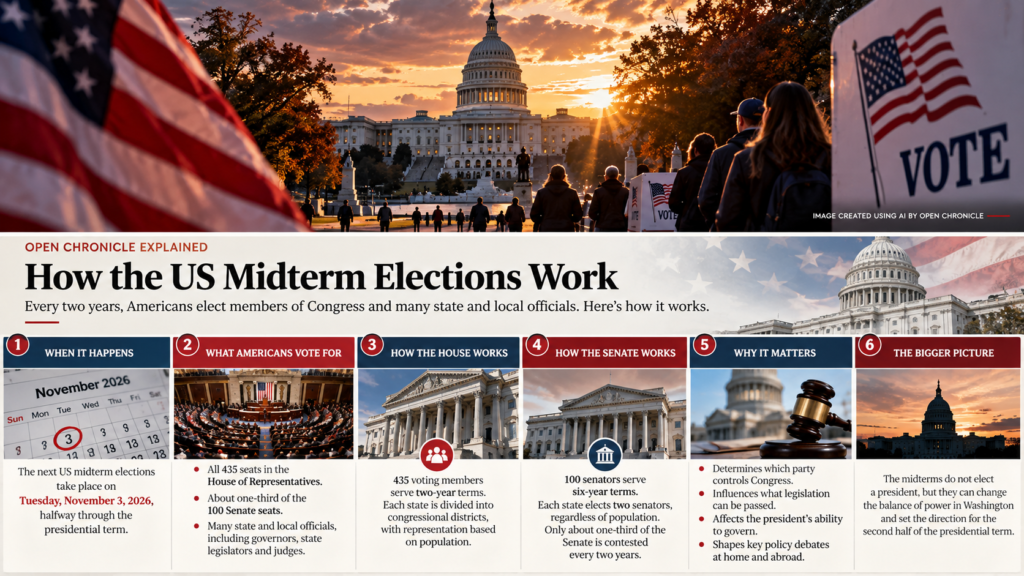
The next midterm elections take place on November 3, 2026, halfway through President Donald Trump’s second term.
Understanding the midterms requires understanding something fundamental about the United States: the president does not govern alone.
The American political system divides authority among institutions, and elections can change who controls those institutions without changing who occupies the presidency.
1. What Exactly Are the Midterm Elections?
Midterm elections are congressional elections held halfway through a president’s four-year term.
The United States elects a president every four years. Congressional elections, however, take place every two years.
This creates a repeating political cycle.
The Four-Year American Election Cycle
Presidential elections take place every four years.
Midterm elections occur halfway through
the presidential term.
President and Congress
Congress, states and localities
President and Congress
Americans elect members of Congress every
two years, but the president serves a
four-year term. The midterms can therefore
change the balance of power in Congress
without changing who occupies the White House.
·
UNDERSTAND HOW THE WORLD WORKS
The distinction is simple: congressional elections happen every two years, but only those held between presidential elections are called midterms.
Their central purpose is to elect representatives to the United States Congress, the country’s federal legislature.
Unlike a parliamentary election in many European countries, a midterm election does not automatically produce a new national government or a new president.
Instead, it changes the composition of the legislative branch.
2. What Is the United States Congress?
Congress is the legislative branch of the federal government. It debates and passes laws, approves federal spending, exercises oversight and performs other powers established by the Constitution.
It consists of two chambers: the House of Representatives and the Senate.
The Two Chambers of Congress
The United States Congress consists of two
legislative chambers, each with a different
system of representation and election.
Representation allocated among states
according to population.
Two senators represent each state,
regardless of population.
The House represents the American population
through congressional districts, while the
Senate gives every state equal representation.
Both chambers participate in federal lawmaking,
but they have different constitutional powers
and electoral cycles.
·
UNDERSTAND HOW THE WORLD WORKS
The two chambers were designed to represent different principles.
The House reflects population. A state with a large population receives more representatives than a state with a small population.
The Senate reflects the equality of states within the federal system. California and Wyoming, despite their very different populations, each elect two senators.
Both chambers participate in federal lawmaking, but they also have distinct constitutional responsibilities.
The House has the exclusive power to initiate impeachment proceedings and originate revenue bills. The Senate conducts impeachment trials, confirms many presidential appointments and considers treaties.
This division makes control of each chamber politically significant.
3. What Do Americans Vote For in the Midterms?
Every midterm election places all 435 voting seats in the House of Representatives on the ballot.
House members serve two-year terms, meaning that their constituents have an opportunity to replace or re-elect them at every congressional election.
The Senate works differently.
Senators serve six-year terms, and their elections are staggered. Approximately one-third of the Senate is elected every two years, ensuring that the entire chamber is never normally replaced in a single election.
In 2026, 35 Senate seats are scheduled to be contested, including regular and special elections.
Americans also vote in numerous elections outside Congress.
Depending on the state, ballots may include governors, state legislators, attorneys general, judges, mayors and other public officials.
Some states and localities also ask voters to decide ballot measures, which can involve taxation, infrastructure, constitutional amendments or other public-policy questions.
Consequently, the midterms are not one single nationwide contest with one winner.
They are thousands of separate electoral decisions taking place across the country.
4. How Are Members of the House Elected?
The United States is divided into 435 congressional districts, each electing one voting representative.
Most states have multiple districts. States with smaller populations may have only one.
In the general election, the candidate receiving the most votes in a district usually wins, even without an absolute majority. Some jurisdictions use different procedures.
Because each district is a separate electoral contest, the national popular vote does not directly determine which party controls the House.
A party must win enough individual districts to secure a majority of seats.
In a fully occupied 435-member House, 218 seats constitute a majority.
District boundaries also matter.
Following each decennial census, states adjust congressional districts to reflect population changes. The process is called redistricting.
In some states, political officials draw the boundaries. In others, independent or bipartisan commissions play a role.
When district boundaries are deliberately manipulated to advantage a political party or group, the practice is commonly called gerrymandering.
This is one reason why the geography of congressional elections can be as important as national voting trends.
5. How Are Senators Elected?
Every state elects two senators, but their six-year terms normally end in different election cycles.
A Senate election is conducted statewide rather than within an individual congressional district.
This creates a different political dynamic.
A candidate for the House may concentrate on the concerns of one relatively small district. A Senate candidate must appeal to voters across an entire state.
In a geographically and politically diverse state, that can require building support among communities with very different interests.
Because only some Senate seats are contested in any given election year, the political composition of the Senate can change differently from that of the House.
A party might gain seats in the House while losing ground in the Senate, or the reverse.
The two chambers therefore need to be analysed separately.
6. Why Do Midterms Matter If the President Remains in Office?
The answer lies in the American system of separation of powers.
The president heads the executive branch. Congress exercises legislative authority.
The president can propose policies, negotiate with lawmakers, direct executive agencies within the law and exercise constitutional powers.
But most major changes to federal legislation require congressional approval.
This includes important decisions concerning taxation, public expenditure, healthcare, infrastructure and many other policy areas.
Consider a hypothetical example.
A president proposes a major investment programme for electricity networks and national infrastructure.
Even if the White House strongly supports the programme, Congress may need to pass legislation authorising spending or establishing new rules.
If the president’s party controls both chambers, the proposal may face a more favourable legislative environment.
If the opposition controls one or both chambers, lawmakers may demand changes, refuse to advance the proposal or pursue alternative legislation.
Control of Congress therefore affects what a president can realistically achieve.
It does not, however, give either side unlimited power. Senate procedures, constitutional requirements, presidential vetoes and disagreements within parties can all shape the outcome.
7. What Is Divided Government?
Divided government occurs when the presidency and at least one chamber of Congress are controlled by different political parties.
For example, the White House might be controlled by a Republican president while Democrats hold a majority in the House.
Alternatively, a Democratic president might face a Republican-controlled Senate.
Divided government is not an exceptional constitutional crisis. It is a recurring feature of American political life.
Its consequences depend on the political circumstances and the willingness of elected officials to negotiate.
In some periods, divided government has encouraged compromises between parties.
In others, it has produced legislative deadlock, disputes over federal budgets and confrontations concerning the authority of the executive branch.
The system was designed so that important decisions often require agreement among separate institutions.
This can limit concentrated power, but it can also make government action slower and more difficult.
8. Can the Midterms Remove a President?
No. A normal midterm election does not remove the sitting president from office.
The president’s four-year term continues regardless of which party wins control of Congress.
However, a change in congressional control can affect presidential power.
Congress can investigate executive agencies, summon witnesses, request documents and conduct oversight hearings.
The House also has the constitutional authority to impeach a president or another federal civil officer.
Impeachment is the formal accusation of misconduct under the constitutional process. It does not itself remove a president.
Removal following impeachment requires conviction in the Senate by a two-thirds vote of senators present.
These are separate constitutional procedures, not automatic consequences of an election result.
A midterm election can change the political environment in which such powers are exercised, but it is not a presidential recall vote.
9. Why Are Midterms Often Seen as a Test of the President?
Although the president is not on the ballot, national political debates often dominate midterm campaigns.
Voters may consider inflation, employment, healthcare, immigration, foreign policy, public safety or the administration’s handling of major events.
Candidates also campaign on local concerns, their own records and their proposals for their districts or states.
Historically, the president’s party has frequently lost House seats in midterm elections.
But this pattern is not a constitutional rule, and it does not determine any particular result.
The 1998 and 2002 midterms, for example, demonstrated that the president’s party can gain House seats under particular political circumstances.
It is therefore more accurate to understand the midterms as an opportunity for voters to influence the balance of power during a presidency, rather than as a simple national referendum with one uniform interpretation.
10. Why Is Voter Turnout Important?
Voter participation can differ considerably between presidential elections and midterm elections.
Presidential contests typically attract broader national attention and higher turnout.
Midterms often involve a different electorate, with participation influenced by local races, political mobilisation, electoral rules and public interest.
This matters because election outcomes depend not only on which candidates people prefer but also on who actually votes.
A relatively small difference in turnout can be significant in a competitive congressional district or closely contested statewide election.
Voting procedures also vary by state.
Registration deadlines, early voting, absentee ballots, identification requirements and vote-counting procedures are not identical across the country.
The result is a highly decentralised electoral system, with state and local election authorities playing central roles in administering federal elections.
11. What Are the Main Political Issues in the 2026 Midterms?
The 2026 elections are taking place during President Donald Trump’s second term.
The political debate includes economic conditions, the cost of living, immigration, healthcare, federal spending, foreign policy and the direction of national institutions.
But congressional elections also involve specific state and local concerns.
A rural district may focus heavily on agriculture and land use. An urban district may place greater emphasis on housing, transport or public services.
Energy infrastructure has also become part of the political discussion.
The rapid expansion of artificial intelligence has created demand for new data centres, electricity connections and industrial facilities.
Some communities welcome the investment, construction activity and potential economic benefits.
Others question the effects on electricity prices, water resources, local infrastructure, land use and the distribution of public costs.
These disputes illustrate how an apparently technical subject can become an electoral issue.
A decision about building a data centre may begin at a local planning meeting, but it can eventually influence state politics and congressional campaigns.
That connection is particularly relevant to the Open Chronicle investigation into America’s data-centre backlash.
12. Why Does Control of the House Matter in 2026?
Every House seat is contested in 2026.
That means the election can change the political majority in the chamber.
The majority party generally has substantial influence over the selection of the Speaker, committee leadership, legislative scheduling and the advancement of bills.
The House also has an important role in government funding and oversight.
A change in majority can therefore alter which legislative proposals receive attention, which investigations are prioritised and how negotiations with the White House proceed.
However, House control alone does not guarantee that a party can enact its entire agenda.
Most legislation must also pass the Senate and be presented to the president.
13. Why Does Control of the Senate Matter?
The Senate has distinctive powers that make its composition particularly consequential.
It votes on many presidential nominations, including federal judges, Cabinet officials and ambassadors.
It also participates in lawmaking and exercises a constitutional role in treaty approval.
The Senate’s legislative procedures can require broader support than a simple majority for many measures.
As a result, even a party holding a narrow majority may encounter substantial procedural and political obstacles.
Control of the Senate influences committee leadership, the scheduling of nominations and the legislative agenda.
It can also affect the pace at which a president fills senior government and judicial positions.
For these reasons, Senate elections are important even when the presidency is not being contested.
14. What Happens After Election Day?
Election night does not always produce immediate final results.
States have different procedures for counting ballots, processing absentee votes, conducting recounts and certifying election outcomes.
In close races, determining the final winner may take additional time.
Some states also require runoff elections when no candidate satisfies the applicable winning threshold.
Once the election process is complete, newly elected members of Congress prepare to take office.
The new Congress begins on January 3, 2027.
The House elects its Speaker, congressional leadership arrangements are established, committees are organised and the legislative work of the new Congress begins.
President Trump’s term continues until January 2029, unless interrupted by a separate constitutional circumstance.
The 2026 midterms will therefore shape the legislative environment for the second half of the presidential term.
15. Why Do the US Midterms Matter Beyond America?
The United States plays a major role in international security, global finance, trade, technology and diplomacy.
Congress influences many of the policies through which American power is exercised.
It authorises and appropriates federal spending, participates in sanctions legislation, considers international trade measures and exercises oversight of foreign and defence policy.
A change in congressional control can influence debates over military assistance, defence budgets, international agreements and relations with allies.
But the effects are not automatic.
Presidential constitutional powers, existing laws, international commitments and the positions of individual legislators also matter.
For foreign governments, businesses and international organisations, the midterms are therefore an important event to follow — not because they elect a new American president, but because they can change the institutional balance within which American policy is made.
16. What? How? Why?
WHAT? — What are the US midterm elections?
National congressional elections held halfway through a president’s four-year term. Voters elect all 435 voting members of the House of Representatives and approximately one-third of the Senate, alongside many state and local officials.
HOW? — How do they work?
Voters elect representatives in individual congressional districts and senators in statewide contests. Election rules and procedures vary by state. The results determine the composition of Congress for the next legislative period.
WHY? — Why do they matter?
Because Congress makes federal laws, controls important spending decisions and exercises oversight of the executive branch. Midterm elections can change which parties control the House and Senate, reshaping the president’s ability to govern.
Conclusion — The Presidency Is Only One Part of American Power
The American presidency attracts enormous attention, but the United States was not designed to be governed by one elected office alone.
Its political system distributes authority across institutions, and the electorate has regular opportunities to change the balance between them.
That is what makes the midterm elections important.
They do not choose a new president. They do not automatically replace the administration. And they do not deliver a single national verdict on every political question.
Instead, they determine who will represent Americans in Congress, who will exercise legislative authority and how the relationship between the White House and Capitol Hill may evolve.
On November 3, 2026, Americans will vote in hundreds of congressional contests and numerous state and local elections.
The results will help determine how the United States is governed during the next two years.
To understand American democracy, it is not enough to ask who controls the White House. We must also ask who controls Congress — and what those institutions can do.
Sources and Further Reading
The following institutional and reference sources
provide background on US electoral rules,
the structure of Congress and the 2026
election cycle.
USAGov — Congressional Elections and
Midterm Elections
Official guidance explaining the timing of
congressional elections, the length of
legislative terms and the distinction
between presidential and midterm elections.
US House of Representatives —
The House Explained
Official information about the composition,
representation, legislative responsibilities
and institutional organisation of the
US House of Representatives.
US Senate — Constitution of the
United States
The constitutional foundations of Congress,
including the powers of the legislative
branch, the structure of the Senate
and the principles of federal representation.
Federal Election Commission —
Election and Voting Information
Federal election information, official
resources and reference material
relevant to the 2026 electoral cycle
and congressional contests.
USAFacts — What Are Midterm Elections?
An accessible educational explanation
of midterm elections, congressional
representation and the role of these
elections in American democracy.
·
UNDERSTAND HOW THE WORLD WORKS
Understanding the systems behind the headlines.
Explore Open Chronicle Explained →