
How a Dutch dancer accused of spying for Germany became one of the most famous women of the First World War, and why historians still debate the evidence, the trial and the making of her legend.
By Open Chronicle History Desk
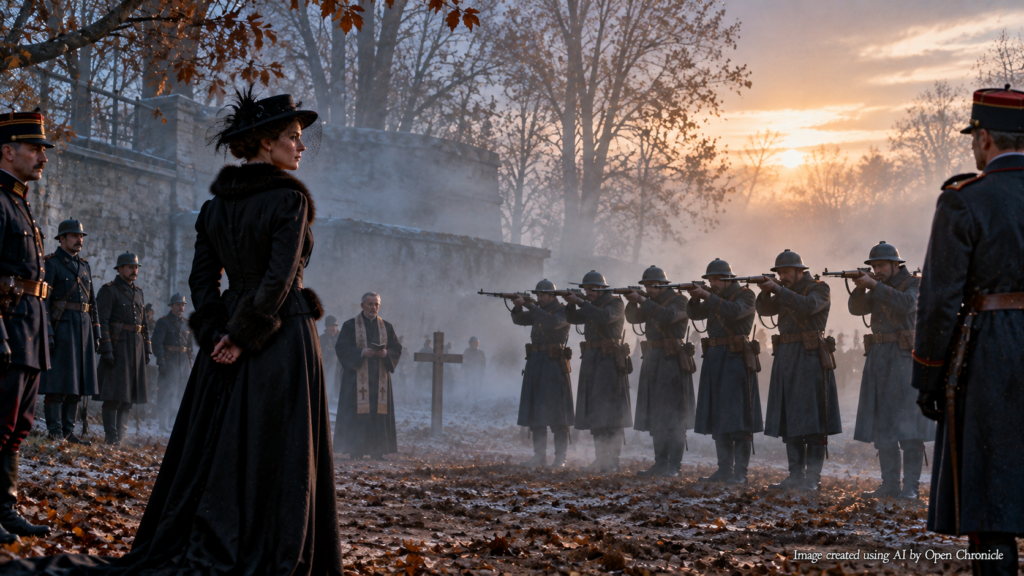
At dawn on October 15, 1917, a woman was taken from her prison cell in Paris and transported to the military grounds at Vincennes.
Her name was Margaretha Geertruida Zelle.
The world knew her as Mata Hari.
She was forty-one years old.
Once celebrated as an exotic dancer who captivated audiences across Europe, she now stood before a French firing squad, condemned for espionage on behalf of Germany during the First World War.
France was exhausted by three years of industrial warfare.
Hundreds of thousands of soldiers had died.
The Western Front had become a landscape of trenches, artillery, mud and destruction.
Earlier that year, mutinies had shaken parts of the French Army following the disastrous Nivelle Offensive.
Public confidence was fragile.
The government was determined to demonstrate that it could confront enemies both on the battlefield and behind the lines.
Mata Hari had been accused of passing information to German intelligence.
French prosecutors portrayed her as a dangerous agent whose activities had helped the enemy.
Her international travels, relationships with military officers and connections to influential men became central elements of the prosecution’s case.
But the evidence was more complicated than the legend that later emerged.
Mata Hari had accepted money from a German intelligence officer.
She had also made approaches to French intelligence.
Her motives mixed financial desperation, personal ambition, romantic attachment and questionable judgment.
Whether she delivered valuable military intelligence to Germany, and whether the accusations justified her execution, remain subjects of historical controversy.
Her death transformed her into a global symbol.
Over the following century, novels, films and popular histories would portray her as the ultimate femme fatale: a seductive dancer who used romance to steal military secrets.
Yet behind that mythology stood a real woman whose life was shaped by colonial society, personal tragedy, wartime suspicion and a judicial process conducted under extraordinary political pressure.
The story of Mata Hari is therefore more than a spy story.
It is a history of how war creates enemies, how intelligence services operate in uncertainty and how a human life can disappear beneath a powerful public myth.
1. Europe at War in 1917
By October 1917, the First World War had entered its fourth year.
The Western Front remained largely deadlocked.
France and Britain faced German forces across a vast network of trenches.
Artillery bombardments, machine guns, poison gas and repeated offensives had produced enormous casualties.
The French Army had experienced a particularly difficult year.
The Nivelle Offensive, launched in April, failed to achieve its promised breakthrough.
Mutinies followed in numerous French units.
General Philippe Pétain took command of the army and introduced measures intended to restore discipline and morale.
The French state was also concerned about espionage, sabotage and the leakage of military information.
In this atmosphere, accusations of betrayal carried extraordinary political weight.
2. The Woman Behind the Name
Mata Hari was born Margaretha Geertruida Zelle on August 7, 1876, in Leeuwarden, the Netherlands.
Her father was a hat merchant.
During her childhood, the family enjoyed a period of relative prosperity.
But financial difficulties and family disruption changed her circumstances.
Her mother died when Margaretha was still young.
Her parents’ marriage had already broken down.
These early experiences contributed to an unsettled adolescence.
She eventually sought independence through marriage.
Her life would take her far beyond the Netherlands.
3. Marriage to a Colonial Officer
In 1895, Margaretha married Rudolf MacLeod, an officer in the Royal Netherlands East Indies Army.
He was considerably older than she was.
The marriage offered the prospect of financial security and a new social position.
The couple moved to the Dutch East Indies, now Indonesia.
They lived within the structures of European colonial society.
The marriage was deeply troubled.
Accounts describe conflict, infidelity and domestic abuse.
The relationship deteriorated amid personal tragedy.
The experience would profoundly influence Margaretha’s later reinvention.
4. Life in the Dutch East Indies
The Dutch East Indies exposed Margaretha to cultures, artistic traditions and social environments very different from those of northern Europe.
European colonial society combined privilege with rigid racial and social hierarchies.
Margaretha encountered elements of Indonesian dance, dress and cultural performance.
Later, she would draw on impressions of Asian cultures to construct her stage identity.
But the exotic persona she developed in Europe was not an authentic representation of a single Indonesian tradition.
It was a theatrical creation shaped by European fantasies about the East.
Her performances belonged to the wider culture of Orientalism that influenced European art and entertainment during the period.
5. The Death of Her Son
The MacLeods had two children, Norman-John and Louise Jeanne.
In 1899, their young son died in the Dutch East Indies.
The circumstances surrounding his death have been the subject of differing accounts, including allegations of poisoning.
The precise sequence of events remains disputed.
The loss was devastating.
The marriage continued to deteriorate.
After returning to Europe, the couple separated.
Margaretha eventually lost custody of her surviving daughter.
These personal tragedies formed part of the background to her later life in Paris.
6. A New Beginning in Paris
In the early twentieth century, Margaretha moved to Paris.
The French capital was one of Europe’s great centers of art, entertainment and fashion.
The Belle Époque encouraged experimentation in theatre, dance and popular culture.
Parisian audiences were fascinated by performances presented as exotic or foreign.
Margaretha recognized an opportunity.
She began constructing a new identity.
The Dutch woman from Leeuwarden would become Mata Hari.
7. The Birth of Mata Hari
The name Mata Hari was derived from Malay and is commonly understood as referring to the sun, literally the “eye of the day.”
Margaretha adopted it as her stage name.
She presented herself through stories of an exotic upbringing and supposed connections to Eastern religious traditions.
These claims were part of her theatrical persona.
Her performances combined dance, elaborate costumes, sensuality and carefully constructed mystery.
European audiences were captivated.
Mata Hari became a recognizable figure in Parisian entertainment.
Her fame depended as much on the stories surrounding her as on the dances themselves.
8. The Exotic Dancer
Mata Hari’s performances challenged some of the conventions of respectable European society.
She appeared in revealing costumes.
She used jewelry, veils and theatrical gestures to create an atmosphere of ritual and mystery.
Her public image was deliberately provocative.
She attracted attention from journalists, artists and wealthy patrons.
But her success also reflected European fascination with imagined Eastern cultures.
Her performances were shaped by the expectations and prejudices of her audience.
She was both a creator of her own image and a participant in a commercial culture that rewarded exotic spectacle.
9. Fame and High Society
As her reputation grew, Mata Hari moved through elite social circles.
She travelled across Europe.
She met wealthy businessmen, diplomats and military officers.
Her relationships provided financial support and access to influential networks.
But her lifestyle was expensive.
Her income was irregular.
As her dancing career declined, she became increasingly dependent on wealthy companions.
These circumstances later made her vulnerable to intelligence recruitment.
10. The First World War Changes Everything
When war began in 1914, Mata Hari’s life became more complicated.
The Netherlands remained neutral.
As a Dutch citizen, she retained opportunities to travel that were unavailable to many citizens of belligerent countries.
But international travel during wartime attracted suspicion.
Passports were checked.
Borders were monitored.
Intelligence services watched people who moved between countries.
Mata Hari’s relationships with officers and her frequent journeys made her a person of interest.
Her glamorous identity, once commercially valuable, became a liability.
11. Neutrality and Espionage
Neutral countries occupied important positions in European intelligence networks during the First World War.
Diplomats, merchants, journalists and travellers could move through neutral territories.
Intelligence agencies used these routes to collect information and communicate with agents.
The Netherlands was particularly significant because of its proximity to Germany and the Allied powers.
Mata Hari’s nationality gave her a degree of mobility.
But mobility did not mean freedom from surveillance.
By 1916, her movements were attracting attention from several intelligence services.
12. German Intelligence Makes Contact
One of the central episodes in the case involved a German intelligence officer, Karl Kroemer, who approached Mata Hari in the Netherlands.
He offered her money in connection with intelligence work.
Mata Hari accepted a payment commonly reported as 20,000 francs.
German intelligence associated her with the designation H-21.
The significance of this transaction remains debated.
Accepting money from an intelligence officer was serious evidence of contact with German espionage.
But contact and payment did not automatically establish that she subsequently supplied valuable military information.
The distinction would become central to historical assessments of her case.
13. The Question of H-21
The code designation H-21 became one of the most famous details in Mata Hari’s story.
French intelligence eventually connected it to her.
German communications referring to the agent were intercepted and interpreted by French authorities.
But intelligence records require careful analysis.
An agent designation can demonstrate that an intelligence service regarded someone as a source or potential source.
It does not necessarily prove that the person delivered useful information.
Historians have debated whether German intelligence deliberately exposed Mata Hari, whether she was an ineffective recruit or whether she engaged in more substantial espionage than she later admitted.
14. A Romantic Attachment
During the war, Mata Hari developed a relationship with a Russian officer serving with French forces, commonly identified as Vadim Maslov.
He was younger than she was.
He was wounded during the fighting.
Mata Hari sought permission to visit him.
Her desire to maintain the relationship became entangled with her dealings with French intelligence.
The relationship was important because it influenced her decisions during a period when she was under financial and political pressure.
Personal motives and espionage opportunities became increasingly difficult to separate.
15. French Intelligence Approaches Her
French intelligence officer Georges Ladoux became involved in Mata Hari’s case.
He discussed the possibility of her working for France.
Mata Hari indicated a willingness to undertake intelligence activities.
She reportedly sought substantial payment.
French authorities considered whether her international contacts might provide access to useful information.
The relationship between Mata Hari and Ladoux was marked by suspicion.
French intelligence was never fully convinced of her reliability.
Mata Hari, meanwhile, appears to have believed she could use intelligence work to improve her financial position.
16. The Dangerous Game of Double Allegiance
Mata Hari’s dealings with both German and French intelligence created a dangerous situation.
She accepted money from a German officer.
She also offered her services to France.
Whether she genuinely intended to act as a double agent remains uncertain.
Her statements about her motives changed over time.
She sometimes claimed that she had accepted German money without intending to serve Germany.
She also presented herself as loyal to France.
These explanations were difficult to verify.
The intelligence world of 1916 and 1917 was filled with deception, manipulation and incomplete information.
Mata Hari entered that world without the discipline or training normally associated with professional intelligence work.
17. The Journey to Spain
In late 1916, Mata Hari travelled toward Spain.
Spain remained neutral during the war and served as an important center for intelligence activity.
She met individuals connected with German diplomatic and military circles.
These encounters later became important to the French investigation.
Mata Hari claimed that she was attempting to obtain information for France.
French authorities suspected that she was communicating with German intelligence.
The same actions could be interpreted in radically different ways depending on assumptions about her loyalty.
18. German Messages Intercepted
French intelligence intercepted German wireless communications that referred to agent H-21.
The messages contained details that French authorities believed identified Mata Hari.
These communications became crucial evidence in the case against her.
But the circumstances surrounding the messages have generated debate.
Some historians have suggested that German intelligence may have transmitted identifying information in a code that French authorities were able to read.
If so, the Germans may have knowingly exposed her.
Others have questioned whether the available evidence is sufficient to establish deliberate betrayal.
The messages remain central to understanding why French investigators considered Mata Hari a German agent.
19. Arrest in Paris
On February 13, 1917, Mata Hari was arrested in Paris.
She was staying at the Hôtel Élysée Palace.
French authorities accused her of espionage.
She was imprisoned at Saint-Lazare.
The arrest ended her public life as a celebrated performer.
She now faced the possibility of a military trial and a death sentence.
The French authorities believed they had uncovered a dangerous spy.
Mata Hari maintained that she had not betrayed France.
20. Saint-Lazare Prison
Saint-Lazare was a prison associated with women detained under the French justice system.
Mata Hari spent months there awaiting trial.
Her circumstances were very different from the luxurious hotels and fashionable residences she had once frequented.
She was isolated from much of her former social world.
Her communications were restricted.
Her lawyer, Édouard Clunet, attempted to defend her.
The case developed while France remained under severe wartime pressure.
21. The French Military Investigation
The prosecution assembled evidence from intelligence reports, intercepted communications and testimony concerning Mata Hari’s travels and relationships.
Investigators focused on her contacts with German officers.
They also examined her financial transactions.
Her acceptance of German money was particularly damaging.
But the prosecution faced difficulties in demonstrating precisely what military information she had passed to Germany.
The distinction between suspicious conduct and proven operational espionage became one of the major weaknesses later identified by critics of the trial.
22. The Accusation of Thousands of Deaths
French prosecutors portrayed Mata Hari as responsible for serious damage to the Allied war effort.
Some accusations suggested that her activities had contributed to the deaths of large numbers of soldiers.
Such claims became part of the dramatic public narrative.
But historians have not established a reliable causal connection between specific information allegedly provided by Mata Hari and particular battlefield losses.
The accusations reflected the atmosphere of wartime fear.
They should not be treated as verified measurements of her intelligence activities.
23. The Trial Begins
Mata Hari’s military trial began on July 24, 1917.
The proceedings were conducted behind closed doors.
The trial was brief.
Her defense faced significant procedural limitations.
The prosecution presented her as a German spy who had exploited her relationships with military officers.
Her private life became part of the case.
The proceedings reflected the wartime military justice system rather than the standards expected in a modern civilian criminal trial.
24. The Problem of Evidence
The historical controversy surrounding the trial concerns both evidence and procedure.
Mata Hari had demonstrable contacts with German intelligence.
She had accepted money.
She had travelled through neutral countries and met officers connected with belligerent powers.
These facts justified serious investigation.
But the case did not establish publicly verifiable proof that she had supplied military intelligence responsible for major French losses.
The trial’s secrecy and restrictions on the defense further complicated later assessments.
The available record supports neither an uncomplicated portrait of complete innocence nor the sensational claim that she was a master spy who decisively influenced the war.
25. Gender and the Femme Fatale
Mata Hari’s identity as a woman and former exotic dancer played an important role in her prosecution and public reputation.
Her sexuality was presented as evidence of dangerous manipulation.
Relationships that had once supported her celebrity became suspicious.
The idea of a seductive woman who extracted secrets from powerful men was already familiar in European literature and popular culture.
The prosecution could draw on that stereotype.
Historians have therefore examined how gender shaped perceptions of her guilt.
Her personal conduct was judged through assumptions that were not applied in the same way to male intelligence operatives.
26. A Scapegoat for France?
The possibility that Mata Hari became a scapegoat remains a major theme in historical writing.
France was experiencing military setbacks and political anxiety.
The government needed to demonstrate resolve.
The arrest of a glamorous, internationally known woman accused of spying offered a powerful public symbol.
Her case could suggest that the authorities were actively protecting the nation from hidden enemies.
This political context does not prove that the charges were fabricated.
But it helps explain why the case attracted such importance and why the authorities may have been unwilling to tolerate uncertainty.
27. The Verdict
On July 25, 1917, the military court found Mata Hari guilty.
She was sentenced to death.
The decision followed a trial lasting only a short period.
Her defense sought to challenge the outcome.
Appeals and requests for clemency failed.
Mata Hari remained imprisoned while awaiting execution.
The sentence reflected the severity with which wartime France treated espionage.
It also ensured that her case would become one of the most famous controversies in the history of military justice.
28. The Final Months
After her conviction, Mata Hari spent her remaining weeks in prison.
She continued to maintain that she had not betrayed France.
Her lawyer attempted to secure a reprieve.
The authorities did not intervene to prevent the execution.
The woman who had once performed before wealthy audiences was now almost entirely dependent on the decisions of military officials.
Her public persona could no longer protect her.
29. October 15, 1917: The Execution
Before dawn on October 15, Mata Hari was taken from Saint-Lazare prison to Vincennes.
A military firing squad awaited her.
Accounts of her final moments describe a woman who maintained her composure.
Some narratives claim that she refused a blindfold.
Others include dramatic details such as a final gesture toward the soldiers.
These accounts vary and should be treated cautiously.
The central historical fact is clear.
Mata Hari was executed by firing squad on October 15, 1917.
She was forty-one years old.
30. The Final Gesture
Popular retellings frequently claim that Mata Hari blew a kiss to the firing squad.
The image became one of the most famous details of her legend.
But the historical evidence is less secure than the story suggests.
Different witnesses and later writers offered varying descriptions.
The dramatic gesture fits the public image of Mata Hari as a fearless seductress.
That does not make it a reliably established fact.
The story illustrates how quickly the historical woman became inseparable from the fictional character created around her.
31. The Fate of Her Body
After the execution, Mata Hari’s body was not claimed by relatives.
It was transferred for medical use.
Later accounts indicate that her remains were not preserved in a way that would allow a conventional burial site to be identified today.
The absence of a known grave contributed to the symbolic nature of her legacy.
Mata Hari survived in photographs, newspaper reports, court records and popular imagination.
The physical traces of her life became secondary to the myth.
32. The War Continues
Mata Hari’s execution did not change the strategic direction of the First World War.
The Western Front remained active.
France continued fighting Germany.
The United States had entered the war earlier in 1917.
Russia was approaching revolutionary upheaval.
The conflict would continue until November 1918.
Mata Hari’s death was a relatively small event within the enormous scale of the war.
Yet it would become one of its most recognizable individual stories.
33. Intelligence Work in the First World War
The First World War transformed the scale and importance of military intelligence.
Governments intercepted communications.
Agents operated across borders.
Neutral countries became centers of espionage.
Cryptography and wireless communications acquired growing importance.
Counterintelligence services attempted to identify infiltrators and double agents.
The Mata Hari case illustrates the uncertainty of this environment.
Intelligence officers often acted on incomplete information.
Agents could be unreliable.
False reports circulated.
And the consequences of mistaken judgments could be fatal.
34. The Myth of the Master Spy
After her death, Mata Hari became famous as an exceptionally skilled spy.
The image suggested that she had manipulated generals, seduced diplomats and stolen decisive military secrets.
But the historical record does not support the full scale of that legend.
She appears to have been financially vulnerable and poorly suited to clandestine intelligence work.
Her contacts with intelligence services were real.
Her effectiveness as an agent remains unproven.
The contrast between the myth and the evidence is one of the central reasons her story continues to interest historians.
35. Cinema Creates a Legend
Mata Hari became a popular subject for cinema.
The 1931 film Mata Hari, starring Greta Garbo, helped establish her image as a glamorous and mysterious spy.
Later productions continued to reinterpret her life.
These portrayals often emphasized romance, intrigue and seduction.
They rarely reproduced the full complexity of the historical record.
Cinema transformed Mata Hari into a recognizable cultural archetype.
Her name became shorthand for a seductive female spy.
36. Declassified Records and New Research
Over time, historians gained access to additional intelligence and judicial records.
These documents complicated the traditional story.
They confirmed some aspects of Mata Hari’s contacts with German intelligence.
They also exposed weaknesses in the claims about her effectiveness and the damage she allegedly caused.
French archival material has provided important opportunities to reassess the trial.
But the opening of archives has not produced universal agreement.
Historians continue to differ over her intentions, actions and responsibility.
The evidence is more substantial than it once was, but it remains open to interpretation.
37. Was Mata Hari Innocent?
The question cannot be answered responsibly with a simple slogan.
Mata Hari accepted money from German intelligence.
She maintained contacts that raised legitimate security concerns.
She also offered her services to French intelligence.
The available evidence does not convincingly establish that she was the extraordinarily effective German spy portrayed by wartime propaganda.
Nor does it prove that every element of the accusation was invented.
Her conduct appears to have involved opportunism, deception and dangerous misjudgment.
The central historical controversy concerns whether those actions amounted to espionage warranting execution and whether the trial reliably established her guilt.
38. The Politics of Wartime Justice
Wartime governments often operate under extraordinary pressure.
Fear of betrayal can influence legal proceedings.
Public opinion may demand visible punishment.
Military authorities may prioritize security over procedural safeguards.
The Mata Hari case illustrates these dangers.
Her trial took place during a period of national crisis.
The proceedings were secret.
The defense faced restrictions.
The prosecution’s most dramatic claims were not supported by clear public evidence of specific military harm.
Her execution therefore raises questions about the relationship between national security and justice.
39. Mata Hari and the History of Women
Mata Hari’s life also belongs to the history of women navigating social and economic constraints.
She attempted to create financial independence through performance and relationships.
She reinvented her identity.
She moved through elite European society.
But the same independence that made her famous also exposed her to suspicion and moral condemnation.
Her story reflects the limits placed on women’s autonomy in the early twentieth century.
It also demonstrates how public fascination with female sexuality could shape political narratives.
40. A Name That Outlived the War
More than a century after her execution, Mata Hari remains internationally recognizable.
Her name appears in books, films, television programs and discussions of espionage.
She is frequently presented as the archetypal female spy.
Yet the historical woman was far more complicated.
She was a Dutch citizen.
A mother.
A former colonial officer’s wife.
A performer.
A financially insecure celebrity.
A woman who entered the dangerous world of wartime intelligence.
And ultimately a prisoner executed by a military court.
Her story became famous because it could be transformed into a compelling legend.
41. Why October 15 Matters
October 15, 1917 marks the execution of one of the most controversial figures associated with First World War espionage.
The event reveals the power of wartime propaganda.
It demonstrates the difficulty of evaluating intelligence evidence.
It raises questions about gender, public morality and military justice.
It also illustrates how historical memory can transform a complex individual into a simplified symbol.
Mata Hari’s importance does not depend on proving that she was either a brilliant spy or an entirely innocent victim.
Her case matters because it exposes the uncertainty, fear and political pressures surrounding espionage during total war.
October 15, 1917: The Woman Behind the Legend
Imagine the morning at Vincennes.
The war continues hundreds of kilometers away.
French soldiers stand ready.
A woman who once performed before Europe’s wealthy audiences now faces a firing squad.
Her stage name is known across the continent.
Her real name is Margaretha Geertruida Zelle.
She has been accused of betraying France.
She insists that she has not committed the crimes attributed to her.
The evidence is contested.
The political atmosphere is unforgiving.
The soldiers receive their orders.
The execution is carried out.
And the woman who called herself Mata Hari becomes a legend.
In the years that follow, the details of her life will be rewritten.
She will become a symbol of seduction.
A symbol of betrayal.
A symbol of espionage.
And, for some historians, a symbol of injustice.
But the most important historical question is not whether the legend is fascinating.
It is whether the legend has obscured the truth.
On October 15, 1917, France executed Mata Hari. More than a century later, the evidence surrounding her alleged espionage continues to challenge the mythology created in her name.
Historical Sources and Further Reading
The following historical references,
archival resources and scholarly studies
provide context for Mata Hari’s life,
her intelligence contacts, the French
military trial of 1917 and the creation
of her posthumous legend.
Mata Hari: Dutch Dancer and Alleged Spy
Historical biography examining
Margaretha Geertruida Zelle’s
early life, performance career,
wartime intelligence connections,
arrest, trial and execution.
Read the Historical Biography →
Dutch National Archives:
Historical Research Collections
The Dutch National Archives provides
access to historical records relevant
to the Netherlands and its international
connections. Its research resources
offer broader context for the Dutch
background and era in which Mata Hari lived.
This is an archival research portal,
not a specific Mata Hari case file.
Explore the National Archives →
Femme Fatale: Love, Lies,
and the Unknown Life of Mata Hari
Pat Shipman’s historical biography
reexamines Mata Hari’s personal
history, public identity, wartime
activities and the evidence used
to construct her reputation as
an exceptionally dangerous spy.
The Fatal Lover: Mata Hari
and the Myth of Women in Espionage
Julie Wheelwright’s study examines
the creation of Mata Hari’s image,
the influence of gender stereotypes,
the treatment of women in espionage
narratives and the relationship
between historical evidence and myth.
Open Chronicle History distinguishes
between Mata Hari’s documented contacts
with German intelligence and the
broader allegations concerning the
military damage supposedly caused
by her activities. The available
historical evidence does not establish
the sensational claims traditionally
associated with her reputation.
Mata Hari was arrested on February 13,
1917, tried by a French military court
in July and executed at Vincennes
on October 15, 1917. The fairness
of the proceedings and the strength
of the prosecution’s evidence
remain subjects of historical debate.
Popular accounts of her final moments,
including the frequently repeated story
of a kiss directed toward the firing
squad, should be treated cautiously.
This article separates documented
events from later theatrical,
journalistic and cinematic interpretations.