
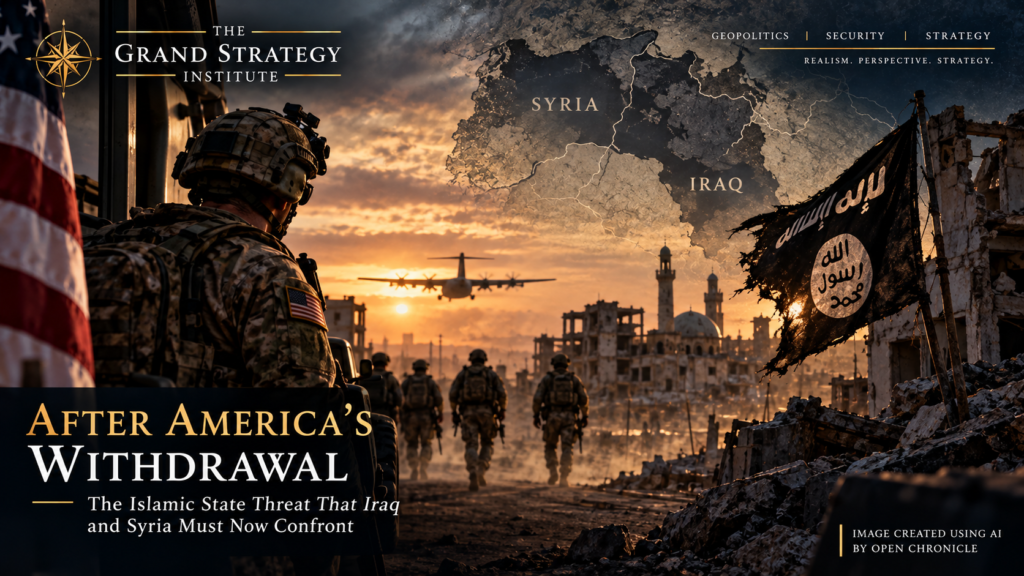
Why the departure of U.S. forces could expose a deeper security problem: the fragility of the regional counterterrorism architecture that helped dismantle ISIS’s territorial caliphate.
By The Grand Strategy Institute — Research Division Grand Strategy Analysis | 18 October 2026
The United States can withdraw its soldiers from Iraq and Syria. It cannot withdraw the strategic consequences of the war against the Islamic State.
After more than a decade of American-led counterterrorism operations, Iraq and Syria face a defining security transition. The territorial caliphate that once controlled major cities, commanded substantial resources and governed millions of people has been dismantled. Yet the organization behind it has not disappeared. Its networks, ideological appeal, clandestine financing, operational experience and capacity to exploit political instability remain significant security concerns.
The central question is no longer whether ISIS can hold territory on the scale it did between 2014 and 2019. It is whether the states that inherited the battlefield can prevent the organization from adapting, rebuilding and exploiting the gaps left by departing American forces.
That question reaches beyond Iraq and Syria. It concerns Jordan, Türkiye, Lebanon, the Gulf states and Europe. It also concerns Washington, which may discover that reducing its military exposure does not necessarily reduce the threats to its interests.
The withdrawal marks the end of one model of counterterrorism. What replaces it may determine whether the Islamic State remains a contained insurgency or becomes the center of another regional security crisis.
1. The End of an American Military Era
The American-led campaign against ISIS was never simply a conventional military operation. It was a multinational security system built around intelligence collection, surveillance, precision airpower, special operations, logistical support and partnerships with local ground forces.
Its military achievements were substantial.
Iraqi forces, supported by the international coalition, retook Mosul in 2017. In Syria, the Syrian Democratic Forces, backed by coalition capabilities, captured the Islamic State’s final territorial stronghold at Baghouz in March 2019.
These victories destroyed the organization’s territorial state-building project. They did not eliminate the insurgency.
ISIS subsequently reorganized around dispersed cells, rural sanctuaries, clandestine support networks, targeted violence and opportunities created by weak governance.
The American military presence helped local partners confront these threats while providing Washington with direct access to operational intelligence and regional security developments.
Its withdrawal therefore represents more than the removal of troops.
It transfers responsibilities that were previously shared with the world’s most technologically capable military to governments and security institutions with uneven resources, different political priorities and unresolved mutual suspicions.
The strategic test is whether those institutions can sustain the same level of coordination without the American military serving as their principal operational integrator.
2. A Reduced Terrorist Threat Is Not an Eliminated Terrorist Threat
One of the most dangerous assumptions in counterterrorism is that declining attack numbers necessarily demonstrate the permanent degradation of an organization.
Sometimes they do. Sustained reductions in violence can reflect successful intelligence penetration, leadership losses, disrupted financing and improved local security.
But declining attacks can also reflect organizational adaptation.
An insurgent movement may temporarily reduce its operational tempo to preserve personnel, rebuild clandestine networks, accumulate resources or avoid attracting overwhelming military attention.
For ISIS, this distinction matters.
The organization has repeatedly demonstrated an ability to survive territorial defeat by returning to asymmetric methods. Instead of attempting to govern large populations, it can attack vulnerable checkpoints, transportation routes, security personnel, local officials and civilian targets.
Its operational objectives may include undermining public confidence, provoking sectarian retaliation, discrediting governments and demonstrating that security authorities cannot protect their populations.
The recent incidents described in the reporting supplied for this assessment suggest an increasingly varied threat environment in Syria. Attacks against transport infrastructure, commercial vehicles, security facilities and public locations indicate the potential breadth of vulnerabilities.
However, not every reported bombing or violent incident can automatically be attributed to ISIS. Responsibility must be established through credible investigations, corroborated claims or reliable official findings.
The analytical distinction is essential: the diversification of terrorist violence is a warning indicator, but the identity, coordination and capabilities of the perpetrators require separate verification.
3. Syria Has Become the Most Uncertain Variable
Syria presents a particularly difficult counterterrorism environment because the challenge is not confined to locating and eliminating ISIS cells.
It involves rebuilding a coherent security state after years of civil war, fragmented territorial control and competing military institutions.
For much of the campaign against ISIS, the Syrian Democratic Forces played a central role in holding territory, operating detention facilities and working with the United States.
The changing position of the SDF and the reconfiguration of authority in northeastern Syria have introduced new uncertainties.
Effective counterterrorism requires more than formal control over territory. It requires functioning command structures, reliable intelligence networks, professional detention systems, local legitimacy and the capacity to respond quickly to emerging threats.
Integrating previously separate armed formations into a unified security apparatus is an exceptionally demanding undertaking.
Former adversaries may possess different training, loyalties, institutional cultures and relationships with local communities.
In addition, personnel screening becomes critical when governments absorb fighters or security officials whose backgrounds cannot be fully established.
Reports of extremist infiltration into security institutions underline the risks.
The problem is not simply whether Damascus can deploy soldiers across the country. It is whether those soldiers belong to a sufficiently coherent, accountable and trusted security structure to conduct sustained counterterrorism operations.
A government can expand its territorial authority faster than it develops the institutions necessary to govern that territory securely.
That gap creates opportunities for ISIS.
4. Iraq Faces a Different but Equally Serious Challenge
Iraq possesses a more established counterterrorism apparatus than Syria, including experienced military, intelligence and special operations institutions.
Its forces have accumulated extensive experience confronting ISIS insurgents, dismantling networks and conducting counterterrorism operations.
Nevertheless, Iraq faces persistent vulnerabilities.
ISIS can exploit sparsely populated areas, difficult terrain, administrative boundaries and gaps between security jurisdictions.
Its cells do not require major urban strongholds to remain dangerous. Small groups can use intimidation, targeted killings, improvised explosive devices and attacks against security personnel to sustain an insurgent presence.
Iraq also confronts political and institutional complications.
The coexistence of regular security forces, intelligence agencies, Kurdish security structures and armed groups with varying degrees of state affiliation creates coordination challenges.
Even when these actors share an interest in preventing an ISIS resurgence, they may disagree over authority, territorial jurisdiction, intelligence sharing and political priorities.
The departure of American forces removes one external source of operational coordination.
It also reduces the capacity for direct U.S. observation of how Iraqi security institutions respond to emerging threats.
The result is not necessarily an imminent security collapse. Iraq has considerably greater counterterrorism capacity than it possessed during the early stages of ISIS’s territorial expansion.
But that capacity must now operate under a different strategic arrangement.
Its effectiveness will depend increasingly on domestic institutional cohesion and regional intelligence cooperation.
5. The Prison System May Be the Most Dangerous Weakness
The detention of suspected ISIS members is one of the most consequential and least publicly visible components of the post-caliphate security order.
Prisons are not merely facilities where captured militants are held. They are potential recruitment environments, intelligence repositories and strategic targets.
ISIS understands this.
During its earlier insurgency in Iraq, the organization treated the liberation of imprisoned members as a way to replenish experienced personnel and rebuild operational networks.
The campaign commonly known as Breaking the Walls, conducted in 2012 and 2013, demonstrated the importance the organization attached to prison attacks.
That history makes the detention crisis in Iraq and Syria particularly alarming.
In January 2026, U.S. Central Command announced an operation to transfer ISIS detainees from northeastern Syria into Iraqi custody. The initial movement involved approximately 150 detainees, with plans covering as many as 7,000. The stated objective was to prevent escapes amid deteriorating security around Syrian detention facilities.
The transfer illustrates a fundamental shift in responsibility.
The United States was no longer simply helping local partners capture ISIS suspects. It was facilitating the relocation of a large detainee population into a system that would increasingly depend on Iraqi institutions for security, prosecution and long-term management.
The commentary published by Defense One on 17 October reported that Iraq had received approximately 5,700 ISIS-affiliated prisoners from a population encompassing numerous nationalities. That figure should be understood as the authors’ reported total, distinct from CENTCOM’s earlier announced transfer ceiling.
This creates at least four interconnected challenges.
First, prison security must remain sufficiently robust to prevent coordinated breakouts.
Second, authorities must distinguish individuals accused of serious crimes from those whose legal status remains unresolved.
Third, detention conditions must not become catalysts for radicalization, recruitment or organized resistance.
Fourth, the international community must address the continued presence of foreign nationals whose home governments have been reluctant to assume responsibility.
The consequences of failure could be considerable.
A major prison breakout would not simply increase the number of fugitives. It could return experienced operatives, organizers and recruiters to ISIS networks.
Conversely, indefinite detention without credible legal procedures risks producing grievances that extremist organizations can exploit.
Prison management is therefore a strategic counterterrorism function, not merely a domestic criminal justice responsibility.
6. The Syrian Detention Crisis Reveals the Fragility of the Transition
The situation in northeastern Syria demonstrates how quickly an apparently contained threat can become unstable when political authority changes.
For years, the SDF administered detention facilities holding suspected ISIS members while also managing camps containing people with actual, alleged or familial links to the organization.
This arrangement was never intended to serve as a permanent solution.
It depended on fragile political circumstances, external support and a security force whose relationship with Damascus remained contested.
The January 2026 confrontation between Syrian government forces and Kurdish-led authorities exposed these weaknesses.
As control shifted across parts of northeastern Syria, a detention crisis emerged around Shaddadi. Syrian authorities and the SDF offered conflicting accounts of responsibility for prisoner escapes.
Reuters reported the competing accusations alongside the wider dispute over the transfer of detention facilities, border crossings and other strategic assets to Damascus.
The underlying strategic problem is clear even where responsibility for particular incidents remains disputed.
Detention security cannot be separated from political settlements.
If the armed forces responsible for guarding prisons are simultaneously involved in territorial disputes, institutional integration or military confrontation, the capacity to maintain secure detention may deteriorate.
ISIS does not need to control those political developments to benefit from them.
It needs only to recognize and exploit the resulting vulnerabilities.
This is why the transition in northeastern Syria must be judged not only by maps showing which government controls which territory, but also by whether detention facilities remain secure, intelligence records remain accessible and experienced security personnel remain available.
7. The Missing American Capabilities
The withdrawal of American ground forces does not automatically eliminate every form of U.S. intelligence cooperation, diplomatic influence or potential military support.
Nevertheless, a physical military presence provides advantages that are difficult to replicate entirely from a distance.
The counterterrorism capabilities at risk
Intelligence and surveillance
Persistent monitoring of insurgent movements, networks and emerging threats.
Precision airpower
Rapid support against identified threats, subject to authorization and available basing.
Special operations
Specialized support for complex counterterrorism missions and partner-force development.
Logistics and sustainment
Transport, equipment maintenance, communications and operational continuity.
Intelligence fusion
Combining information from local forces, international partners and technical systems.
Operational relationships
Established channels of trust, coordination and institutional knowledge.
The most important capability may not be any individual weapon system.
It is the ability to connect information, decisions and operations across multiple security organizations.
An intelligence report becomes operationally useful when it can be assessed, corroborated, shared and acted upon in time.
That process requires compatible systems, trusted relationships and established procedures.
American forces helped provide this connective structure.
Without them, Iraq and Syria must develop arrangements capable of delivering comparable coordination, even if the underlying military resources are less sophisticated.
This is the difference between possessing counterterrorism units and possessing an effective counterterrorism system.
8. A Regional Security Architecture Must Replace the Coalition Model
A durable post-withdrawal strategy cannot depend exclusively on Baghdad and Damascus acting independently.
ISIS networks have historically exploited borders, jurisdictional gaps, smuggling routes and disagreements among neighboring states.
Regional cooperation is therefore essential.
Jordan has a direct interest in preventing instability and extremist infiltration across its northern frontier.
Türkiye possesses substantial military and intelligence capabilities, but its security priorities in northern Syria have not always aligned with those of Kurdish-led forces.
Lebanon faces the consequences of instability in neighboring Syria, including border security concerns and the movement of people and illicit goods.
The Gulf states can contribute financial resources, intelligence cooperation and support for institutional stabilization.
European governments retain an interest in preventing international terrorist networks from rebuilding operational capacity.
However, the phrase regional cooperation can obscure the difficulties involved.
States may share a common adversary while disagreeing over territorial authority, minority rights, militia integration, border management and the legitimacy of particular security actors.
A regional framework will therefore need practical mechanisms rather than declarations of solidarity.
These should include structured intelligence exchanges, secure channels for urgent threat reporting, agreed procedures for cross-border investigations and cooperation on terrorist financing.
The purpose should not be to recreate an American-led coalition under a different name.
It should be to establish a regional security architecture whose members possess sufficient responsibility, capacity and mutual confidence to sustain operations over time.
9. The Kurdish Question Cannot Be Treated as Secondary
One of the most difficult questions concerns the future of Kurdish-led security structures in northeastern Syria.
The SDF played a central role in the campaign that dismantled ISIS’s territorial caliphate.
Its personnel accumulated operational knowledge of local networks, detention facilities, insurgent routes and communities affected by years of conflict.
Such experience cannot be reproduced instantly.
If security integration proceeds through coercion, institutional dismantling or political exclusion, important intelligence and operational capabilities could be lost.
At the same time, the Syrian state has a legitimate interest in establishing coherent national security institutions and preventing indefinite military fragmentation.
These objectives are not inherently incompatible.
A negotiated integration process could preserve experienced personnel, establish clear command arrangements and protect institutional continuity while bringing security structures under accountable national authority.
But the process requires credible guarantees and political compromise.
The risk is that competition over the future of Kurdish autonomy becomes more urgent for regional governments than the shared requirement to prevent an ISIS resurgence.
If that happens, counterterrorism may become a casualty of the struggle to define Syria’s political order.
10. The Political Conditions That Helped ISIS Rise Have Not Disappeared
Military pressure can degrade an insurgent organization. It cannot, by itself, resolve the political conditions that enable recruitment and regeneration.
ISIS’s earlier expansion was facilitated by a combination of state weakness, sectarian polarization, armed conflict, institutional breakdown and grievances among communities that felt excluded or threatened.
The circumstances of 2026 are not identical to those of 2014.
Iraq has stronger security institutions, ISIS lacks its former territorial base and regional governments possess a much clearer understanding of the organization’s methods.
Nevertheless, the broader lesson remains relevant.
Communities that perceive state institutions as predatory, discriminatory or incapable of providing protection may become more vulnerable to coercion by armed groups.
This does not mean political grievances automatically produce terrorism.
It means that extremist organizations can exploit unresolved grievances, local disputes and the absence of credible public authority.
In Iraq, this makes the relationship between national institutions and local communities especially important.
In Syria, reconstruction, justice, political inclusion and the treatment of minorities will influence whether the new security order acquires lasting legitimacy.
A counterterrorism strategy that relies exclusively on raids, arrests and surveillance may contain immediate threats while leaving the conditions for future mobilization unresolved.
The enduring defeat of ISIS requires a state that is not only capable of using force, but also capable of governing.
11. Iran, Militias and the Competition for Influence
The American withdrawal also alters the balance of power between Washington and Tehran.
Iran has long cultivated relationships with Iraqi political movements and armed organizations. Some of these groups maintain significant influence within Iraq’s security and political environment.
The removal of American troops reduces the immediate possibility of confrontation between U.S. forces and Iran-aligned militias on Iraqi territory.
That is a potential stabilizing benefit.
However, it may also reduce one of the constraints on armed groups that operate with considerable autonomy from the Iraqi state.
Reuters reported that Iran and allied organizations welcomed the September 2026 American withdrawal, while Iraqi officials and security observers expressed concerns about the resulting balance of power.
The relationship between Iranian influence and the ISIS threat is complex.
Iran-backed armed groups have fought ISIS. Their opposition to the organization is real.
Yet the expansion of militia influence can create other security problems, particularly where armed organizations operate outside effective state control or contribute to sectarian tensions.
A state cannot establish lasting security if multiple armed actors retain competing claims to legitimate force.
For Iraq, the challenge is therefore twofold.
It must prevent ISIS from rebuilding while also strengthening the state’s authority over armed organizations.
Success against one threat does not automatically produce success against the other.
12. Washington’s Withdrawal Is Not Necessarily a Strategic Defeat
There is a credible argument in favor of ending the American military presence.
Iraq and Syria cannot indefinitely depend on foreign troops to manage their internal security.
A permanent American deployment risks creating political resentment, encouraging dependency and exposing personnel to attacks by armed groups.
It also imposes financial and operational costs while diverting military resources from other priorities.
The United States faces substantial strategic demands in Europe, the Indo-Pacific and the wider Middle East.
Maintaining every inherited deployment indefinitely is not a sustainable grand strategy.
Moreover, Iraqi forces are not the same institutions that confronted ISIS’s initial expansion. Years of combat experience, training and institutional development have strengthened their capabilities.
The withdrawal may encourage greater local ownership and political responsibility.
The relevant question is therefore not whether American troops should have remained forever.
It is whether the transition was sufficiently supported by alternative arrangements capable of preserving essential counterterrorism functions.
A well-managed withdrawal can represent successful burden-sharing.
A poorly managed withdrawal can convert a relatively modest military commitment into a much larger future security problem.
The distinction depends on what happens after the last troops depart.
13. The Lessons of 2011 Must Be Applied Carefully
The American withdrawal from Iraq in 2011 is frequently cited as a warning.
Within three years, ISIS captured Mosul and declared its caliphate.
That sequence is historically important, but it does not establish that the withdrawal alone caused the organization’s rise.
The collapse of security in 2014 involved multiple factors: Iraqi political dysfunction, sectarian grievances, institutional weaknesses, the Syrian civil war and the operational evolution of the Islamic State’s predecessor organizations.
Reducing this complex history to a single American decision would be analytically misleading.
Nevertheless, the period demonstrates how rapidly a deteriorating security environment can be exploited by a resilient insurgency.
The most relevant lesson is institutional rather than purely military.
Counterterrorism achievements can be reversed when political fragmentation, poor governance and declining operational coordination reinforce one another.
The danger in 2026 is not necessarily a repetition of 2014.
It is the possibility that governments underestimate a dispersed terrorist organization because it no longer resembles the territorial enemy they defeated.
14. Three Scenarios for the Post-Withdrawal Security Order
The future of ISIS in Iraq and Syria is uncertain. Three broad scenarios help identify the variables that will determine the outcome.
Three Scenarios for the Post-Withdrawal Security Order
A structured assessment of possible counterterrorism outcomes in Iraq and Syria following the American military withdrawal.
Managed Regional Containment
Iraq and Syria establish workable intelligence-sharing mechanisms, preserve experienced security personnel and maintain secure detention systems. ISIS remains capable of isolated violence but cannot rebuild a substantial territorial or operational network.
Key Condition
Effective institutional cooperation
Persistent Insurgency and Uneven Security
ISIS exploits local security gaps, expands recruitment and conducts periodic attacks without regaining large territorial holdings. Governments contain major offensives but struggle to eliminate dispersed networks.
Key Condition
Fragmented but functioning security institutions
A Major Counterterrorism Reversal
Political conflict, detention failures and security fragmentation enable ISIS to rebuild operational capacity. Coordinated attacks and prison breakouts trigger regional instability and renewed demands for international intervention.
Key Condition
Multiple institutional failures occurring together
These are analytical scenarios, not statistical forecasts.
The evidence does not support assigning precise probabilities to each outcome.
The second scenario is a particularly important planning consideration because an enduring, low-level insurgency can impose substantial economic, political and security costs even without territorial conquest.
The third scenario is less a prediction than a warning about the consequences of simultaneous institutional breakdown.
The future of the counterterrorism campaign will depend less on the absence of American forces than on the resilience, legitimacy and cooperation of the institutions that replace them.
15. What a Credible Post-American Counterterrorism Strategy Requires
A sustainable strategy should be built around six priorities.
First, preserve intelligence continuity. Iraq, Syria and regional partners need reliable mechanisms for exchanging information about cross-border networks, financing and emerging threats.
Second, secure detention facilities. Governments must maintain professional prison management, legal safeguards, reliable records and appropriate international oversight.
Third, protect institutional expertise. Security transitions should preserve the knowledge of personnel who have spent years confronting ISIS networks.
Fourth, strengthen border cooperation. Neighboring states must address jurisdictional gaps without allowing counterterrorism to become a justification for arbitrary cross-border intervention.
Fifth, connect security operations with governance. Reconstruction, local legitimacy, accountable policing and credible judicial systems are necessary to reduce opportunities for extremist recruitment.
Sixth, retain external support without reproducing permanent dependency. The United States and European partners can continue providing training, intelligence cooperation, diplomatic support and technical assistance through arrangements that respect local sovereignty.
The most important principle is continuity.
A successful military withdrawal requires more than the orderly departure of troops and equipment. It requires a transition in which essential security functions remain operational.
16. The Strategic Cost of Getting the Transition Wrong
A renewed ISIS threat would impose consequences far beyond the immediate battlefield.
For Iraq, it could undermine investment, reconstruction, political stability and confidence in state institutions.
For Syria, it could complicate national reunification and delay the restoration of effective governance.
For Jordan and Türkiye, it could increase border-security pressures.
For Europe, it could intensify concerns about international terrorist networks and the unresolved status of foreign nationals linked to ISIS.
For Washington, it could recreate the dilemma that successive administrations have tried to escape: whether to accept growing regional insecurity or commit military resources to contain it.
The economic consequences would also matter.
Persistent insecurity discourages infrastructure development, raises operating costs and makes it harder for governments to deliver public services.
The greatest danger is a cycle in which security deterioration weakens governance, weakened governance enables extremist activity and renewed extremist activity further undermines public confidence.
Breaking that cycle requires a political and institutional response as much as a military one.
Strategic Assessment: The War Against ISIS Is Entering Its Most Political Phase
The destruction of ISIS’s territorial caliphate was a military achievement of historic significance.
The next phase will be less visible and potentially more difficult.
It will be measured through the reliability of intelligence cooperation, the security of prisons, the professionalization of national forces and the ability of governments to establish legitimate authority over previously contested territory.
The United States has reduced its direct military exposure.
Iraq and Syria have gained greater responsibility for their own security.
Regional powers now face stronger incentives to cooperate, even where their political interests diverge.
Yet none of these developments guarantees that ISIS will remain contained.
The United Nations’ July 2026 assessment warned that ISIS and its affiliates continued to adapt to counterterrorism pressure. Its analysis of Syria also highlighted the risks associated with detention transitions, dispersed networks and the movement of the threat toward urban targets.
The central strategic judgment is that the withdrawal is not inherently a mistake, but its success cannot be measured by the withdrawal itself.
It must be measured by whether the regional security system that follows can prevent the Islamic State from rebuilding.
The New Strategic Reality
America’s departure does not end the campaign against ISIS. It changes who must sustain it, how intelligence must be shared and which institutions will bear the consequences of failure.
For Iraq and Syria, sovereignty now comes with a greater security burden.
For Washington, disengagement remains incomplete so long as terrorist threats can affect American interests and partners.
For the wider region, cooperation is no longer simply a diplomatic preference. It is becoming a condition for preserving the achievements of the past decade.
The defining question is not whether the United States has finished its war against ISIS.
It is whether Iraq, Syria and their neighbors can prevent the next one.
Key Findings
Twelve strategic findings on the American military withdrawal, the evolving Islamic State threat and the future of regional counterterrorism in Iraq and Syria.
The withdrawal changes the counterterrorism system, not the underlying threat.
ISIS has lost its territorial caliphate but retains the ability to exploit security and political weaknesses.
Iraq is better prepared than in 2014, but institutional vulnerabilities remain.
Security fragmentation and uneven coordination continue to matter.
Syria represents the greatest uncertainty.
The integration of armed forces and transfer of authority in northeastern Syria could either strengthen or undermine counterterrorism capacity.
Detention facilities are strategic security assets.
Prison escapes could return experienced militants to clandestine networks.
The detainee crisis is international.
Iraq and Syria cannot resolve the legal and humanitarian consequences without cooperation from other states.
American capabilities are difficult to replace immediately.
Intelligence fusion, surveillance, logistics and established operational relationships are particularly important.
Regional cooperation is essential but politically difficult.
Türkiye, Jordan, Lebanon and other partners have overlapping interests but competing priorities.
Kurdish security expertise should not be discarded.
Institutional integration must preserve effective counterterrorism capabilities.
Iranian influence and the ISIS threat are distinct but interconnected challenges.
Iraq must address both without allowing either to undermine state authority.
Withdrawal does not automatically mean strategic failure.
The quality of the transition matters more than the continued presence of foreign troops.
An ISIS resurgence is a risk, not a certainty.
A sustained insurgency is possible without a return to large-scale territorial control.
The Decisive Variable Is Institutional Resilience
Lasting success requires legitimate governance, secure detention, effective intelligence and reliable regional partnerships.
The success of the American withdrawal will ultimately be measured not by the departure of U.S. troops, but by the ability of Iraq, Syria and their regional partners to prevent the Islamic State from rebuilding.
Sources and Further Reading
The following sources provide the reporting and documentary basis for this assessment. Strategic judgments, scenarios and recommendations are those of The Grand Strategy Institute Research Division.
US Withdrawal Won’t End the Region’s ISIS Dilemma
Commentary by Caroline D. Rose and Julie Chernov Hwang examining the operational consequences of the American withdrawal, detention risks and the need for regional cooperation.
Twenty-Third Report of the Secretary-General on the Threat Posed by ISIL (Da’esh), S/2026/638
Primary international assessment of the evolving ISIS threat, including regional networks, detention challenges and developments in Iraq and Syria.
U.S. Forces Launch Mission in Syria to Transfer ISIS Detainees to Iraq
Official announcement detailing the transfer operation, its security rationale and the number of detainees initially moved.
U.S. Forces Exit Iraq, Leaving Opening for Iran
Reporting on the final American withdrawal, Iraqi reactions, Iranian influence and concerns about ISIS.
Inherent Resolve Mission in Iraq and Syria Transitioning
Official explanation of the phased transition, continued counterterrorism priorities and proposed bilateral security relationships.
From an Inherited Threat to National Leadership: The Approach of the New Syria to Countering Da’esh
Documentation concerning Syria’s emerging national counterterrorism responsibilities and the challenges of institutional transition.
Editorial Research Note:
This assessment draws on the 17 October 2026 commentary by Caroline D. Rose and Julie Chernov Hwang, supplemented by United Nations documentation, U.S. government statements and independent reporting. It distinguishes confirmed developments from reported allegations, contested accounts and forward-looking strategic judgments. The scenario analysis does not constitute a prediction of an inevitable ISIS resurgence. Information assessed through 18 October 2026.
The Grand Strategy Institute
Continue Exploring Strategic Analysis
Return to The Grand Strategy Institute for strategic assessments, long-form analysis and research examining geopolitics, military affairs, international security, emerging technologies and the changing international order.
← Back to The Grand Strategy Institute