
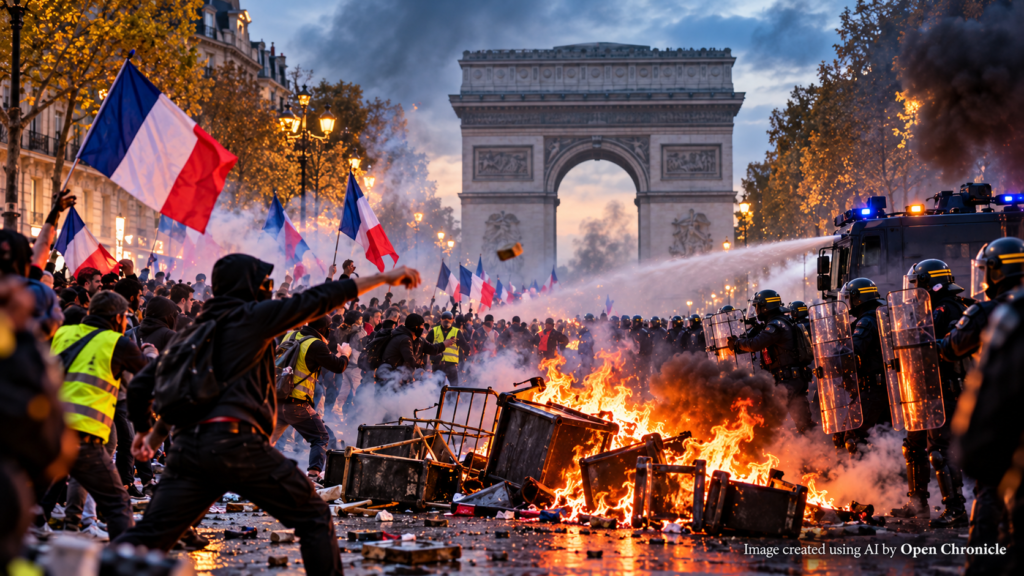
At least 272 people have been arrested as demonstrations against rising living costs and in support of student grievances spread across France. While hundreds of thousands reportedly joined largely peaceful marches, violent confrontations with police, burning vehicles and attacks on public buildings have intensified political tensions.
By Open Chronicle News Desk with Agencies
PARIS, FRANCE | October 17, 2026
France was shaken by a new wave of nationwide demonstrations on Saturday as protests over rising living costs, public services and student grievances escalated into violent clashes with police in Paris and several major cities.
Cars were set ablaze, shops were looted and public buildings were damaged as groups of masked demonstrators confronted riot police, who responded with tear gas and water cannon.
The French Interior Ministry reported at least 272 arrests across the country, including in the capital, as authorities attempted to contain what Interior Minister Laurent Nuñez’s office described as a growing number of violent incidents.
The demonstrations brought together high school students, trade union supporters, former participants in the Yellow Vest movement and citizens frustrated by the rising cost of everyday life.
The CGT trade union estimated that more than 500,000 people participated in Saturday’s demonstrations nationwide, although that figure was not independently confirmed in the supplied reporting.
Despite the violence, large numbers of demonstrators marched peacefully, waving French flags, singing the national anthem and calling for economic and social reforms.
The unrest comes at a politically sensitive moment for France, with student-led demonstrations and mounting economic dissatisfaction increasingly influencing the country’s presidential election campaign.
Paris Becomes the Centre of Violent Confrontations
Some of the most serious disturbances occurred around Place de la République, a major public square northeast of central Paris that has frequently served as a gathering point for demonstrations.
Groups of protesters wearing hoods and masks threw fireworks, paving stones and other objects at police officers.
Security forces responded with tear gas and water cannon in an effort to disperse the crowds and prevent further violence.
Associated Press reporters at the scene described thick black smoke rising from burning cars, bicycles and other vehicles.
Rubbish bins were set on fire, a kiosk was engulfed in flames and several shops were looted as confrontations spread through surrounding streets.
Several people were reportedly injured during the clashes, although the supplied account did not provide a confirmed nationwide casualty figure.
Police also attempted to prevent smaller groups from approaching government buildings, according to the Interior Ministry.
The authorities deployed additional security measures around sensitive locations, including the presidential palace, parliament and government offices.
Metro Stations Closed as Authorities Tighten Security
The disturbances significantly disrupted transport across the French capital.
Several Paris Métro stations were closed at the request of police, including stations near the Champs-Élysées and major government institutions.
The closures were intended to restrict access to areas considered vulnerable to further confrontations and to facilitate police operations.
The disruption affected residents, commuters and visitors as the demonstrations continued into the evening.
While violent groups confronted security forces in parts of central Paris, the majority of demonstrators participated in a separate peaceful march moving toward the northwestern districts of the capital.
Participants sang La Marseillaise, France’s national anthem, carried national flags and played musical instruments, including trumpets and violins.
The contrasting scenes illustrated the complexity of the protest movement: widespread peaceful participation alongside smaller groups engaging in violence and property destruction.
Lyon, Marseille and Other Cities Report Violence
The unrest extended far beyond Paris.
In Lyon, France’s third-largest city, approximately 20,000 people reportedly participated in demonstrations.
A fire broke out inside a tourist office during disturbances in the city.
The supplied reporting did not establish the full extent of the damage or whether anyone was injured in the incident.
In Marseille, France’s major Mediterranean port city, several shops and a municipal police station were damaged.
Groups of protesters also briefly entered the lobby of City Hall.
Marseille Mayor Benoît Payan condemned the incident, describing the intrusion as unacceptable.
Speaking to BFM TV, Payan said the damage inside City Hall was limited.
The Interior Ministry also reported violence involving masked groups in Rennes, Toulouse, Montpellier and Grenoble.
The geographical spread of the disturbances demonstrated that the protests had developed into a nationwide challenge rather than an isolated confrontation in the capital.
Yellow Vest Movement Re-emerges Amid Cost-of-Living Crisis
Saturday’s demonstrations were partly driven by calls circulated on social media to revive the Yellow Vest movement, which emerged in 2018.
Originally sparked by opposition to fuel taxes, the movement developed into a broader protest against economic inequality, declining purchasing power and perceptions that government policies favoured wealthier citizens.
Its fluorescent yellow safety vest became one of the most recognisable symbols of social protest in modern France.
Eight years later, many demonstrators again wore yellow vests as they expressed anger over increases in fuel, energy and food prices.
The return of the symbol reflects the continuing political resonance of the movement’s original grievances.
Although the current protests involve a broader coalition, including students and organised labour, their economic demands echo those that brought hundreds of thousands of people into the streets in 2018 and 2019.
Protesters Denounce Economic Inequality and Declining Public Services
Among those participating in the Paris demonstrations was Sonia Mabrouk, 40, who travelled from a western suburb with her high school-aged daughter.
Mabrouk, who had previously taken part in Yellow Vest demonstrations, said she wanted to protest against deteriorating public services and policies she believed disproportionately affected lower-income households.
She criticised government decisions that, in her view, benefited wealthier citizens while placing greater financial pressure on poorer families.
“There’s a general sense of frustration and anger,” she said as she marched alongside peaceful protesters.
Her concerns reflected wider complaints expressed during Saturday’s demonstrations.
Participants highlighted the rising cost of essential goods, pressure on household budgets and dissatisfaction with the condition of public services.
The movement has also drawn attention to the economic pressures facing families with school-aged children and young adults.
Student Protests Become a National Political Force
The demonstrations follow several weeks of unrest in French secondary schools.
Since mid-September, student groups have organised blockades and protests over a range of grievances.
The movement has expanded rapidly, with students encouraging wider public participation and receiving support from political organisations and trade unions.
According to the supplied reporting, recent weeks have seen thousands of arrests, hundreds of injuries and incidents in which school buildings were set on fire.
The unrest has also generated debate over policing methods and the treatment of young demonstrators.
The participation of high school students has given the protests a distinctive political dimension, bringing younger voices into debates about economic policy, public services and government accountability.
The movement’s influence on the presidential election campaign has further increased its national significance.
CGT Trade Union Backs Demonstrations
The Confédération Générale du Travail (CGT), one of France’s major labour organisations, supported Saturday’s demonstrations.
The union called for higher wages and pensions, lower prices and stronger public services.
Its demands reflect longstanding concerns about purchasing power and the ability of households to cope with rising costs.
The CGT estimated that more than half a million people joined the demonstrations across France.
As with many large-scale protests, turnout estimates can differ substantially between organisers and police authorities.
The supplied reporting does not include a corresponding nationwide police estimate, making it difficult to establish a definitive participation figure.
Nevertheless, the demonstrations’ geographical reach and the involvement of multiple social groups suggest substantial mobilisation.
Jean-Luc Mélenchon Joins Paris Demonstration
Far-left presidential candidate Jean-Luc Mélenchon participated in Saturday’s protest in Paris.
Mélenchon has supported the high school student movement and has positioned himself alongside demands for social and economic change.
His presence underscores the growing political importance of the demonstrations.
The protests have become a significant issue in the presidential election campaign, with opposition figures seeking to connect public dissatisfaction over living costs and public services to broader criticisms of government policy.
However, the demonstrations include participants with different political affiliations and motivations.
Their scale should not be interpreted as evidence of uniform support for any particular political party or presidential candidate.
Police Tactics Face Scrutiny After Serious Injuries
The response of French security forces has become another central issue.
Protesters and civil liberties advocates have raised concerns about injuries allegedly caused by police riot-control weapons.
The supplied reporting refers to particularly severe injuries suffered by teenage demonstrators during recent weeks of unrest.
One incident involved a 15-year-old who reportedly lost a hand.
Following that case, Interior Minister Laurent Nuñez suspended the use of a particular type of police stun grenade against young demonstrators.
The decision reflects the seriousness of concerns surrounding the use of certain crowd-control weapons.
The precise circumstances of the teenager’s injury and the findings of any investigation were not detailed in the supplied account.
French authorities face pressure to investigate allegations of excessive force while also responding to attacks on officers and public property.
The distinction between peaceful assembly and violent conduct remains essential to assessing the legality and proportionality of police operations.
Interior Ministry Condemns Escalating Violence
The Interior Ministry reported an increase in violent incidents during Saturday’s demonstrations.
These included attacks on police officers, looting and damage to public buildings.
At least 272 arrests were recorded nationwide, according to the ministry.
The authorities have sought to prevent violent groups from approaching government institutions and other sensitive locations.
However, the widespread nature of the demonstrations has complicated security operations.
Police forces have had to manage large peaceful crowds while responding to smaller groups involved in confrontations and property destruction.
The continuing unrest presents a difficult operational challenge, particularly when demonstrations occur simultaneously across multiple cities.
Political Consequences Could Extend Into Election Campaign
The protests are unfolding against a backdrop of economic uncertainty and increasing political competition.
Rising energy and food prices have intensified public concerns about purchasing power, while dissatisfaction with public services has added to broader criticism of government priorities.
The participation of students has expanded the movement’s political reach and placed youth grievances at the centre of national debate.
For opposition parties, the demonstrations present an opportunity to challenge government policies and mobilise dissatisfied voters.
For the authorities, the immediate priority is restoring public order without deepening public resentment over policing methods.
The political consequences will depend partly on whether the demonstrations continue, whether further violence occurs and how the government responds to demands for economic relief and institutional accountability.
What Happens Next?
The immediate situation remains uncertain.
Further demonstrations could take place if student organisations, trade unions and Yellow Vest supporters continue coordinating their activities.
Authorities will also need to assess the damage caused by Saturday’s disturbances and investigate incidents involving arson, looting and attacks on police officers.
The treatment of detained protesters and allegations of excessive police force are likely to attract continued scrutiny.
Meanwhile, political parties and presidential candidates will be watching closely for signs that the movement is expanding beyond its current participants.
The government’s ability to address concerns about living costs and public services could prove important in determining whether the protests subside or intensify.
The Big Picture: France Confronts a New Wave of Social Unrest
Saturday’s demonstrations illustrate how economic grievances, student activism and political dissatisfaction can converge into a broader national protest movement.
The revival of Yellow Vest symbolism demonstrates that concerns about inequality and purchasing power remain powerful forces in French politics.
The involvement of high school students has introduced a generational dimension, while trade union participation has strengthened the movement’s economic demands.
At the same time, violent confrontations, arson and looting risk overshadowing the demands of peaceful demonstrators and complicating efforts to find a political response.
The police response has also become a source of controversy, particularly following serious injuries involving young protesters.
For France, the central challenge is balancing the protection of public order with the democratic right to peaceful protest, while addressing the economic pressures that have brought large numbers of people into the streets.
With demonstrations spreading across the country and political tensions rising, the unrest could become a defining issue in France’s developing presidential election campaign.
Sources and Further Reading
The following sources provide news coverage and institutional context concerning the demonstrations in France, public security operations and the social and economic demands associated with the protests.
1. Associated Press — France Protests and Nationwide Clashes
Reporting on demonstrations in Paris and other French cities, police operations, arrests, student mobilisation and the revival of Yellow Vest protests.
2. French Ministry of the Interior — Public Security and Official Communications
Official information concerning public order, security operations and statements by French authorities.
3. Confédération Générale du Travail (CGT) — Labour and Social Demands
Trade union information concerning wages, pensions, purchasing power, public services and mobilisation.
Editorial Note
This article is an original Open Chronicle news synthesis based on the supplied reporting concerning nationwide demonstrations and violent clashes in France on October 17, 2026.
Descriptions of police operations, arrests, property damage, protest participation and statements attributed to officials and demonstrators are drawn from the supplied account. The reported arrest total of 272 is attributed to the Interior Ministry, while the estimate of more than 500,000 participants is attributed to the CGT.
The article distinguishes largely peaceful demonstrations from violent incidents involving smaller groups. Allegations of excessive police force and accounts of serious injuries are presented within the limits of the supplied reporting.
The listed sources provide relevant reporting and institutional context, but the October 17 events and figures have not been independently verified for this article.
Open Chronicle | Independent. Global. Trusted.