
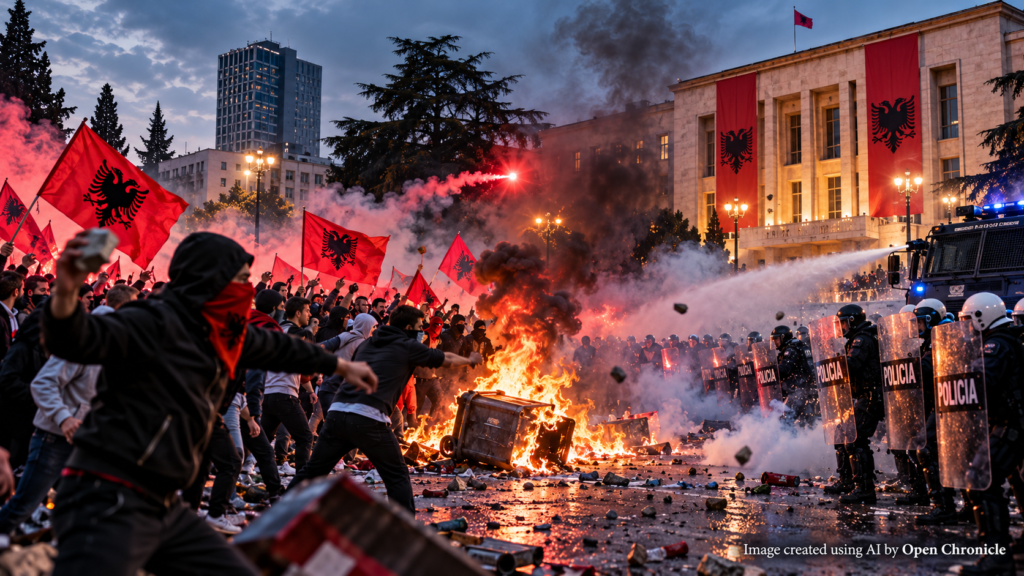
Anti-government demonstrations have intensified in Albania’s capital, with protesters throwing petrol bombs and fireworks at police as students join demands for Prime Minister Edi Rama’s resignation. The unrest has also renewed scrutiny of a controversial luxury tourism development linked to Jared Kushner.
By Open Chronicle News Desk with Agencies
TIRANA, ALBANIA | October 17, 2026
Violent clashes erupted near the office of Albanian Prime Minister Edi Rama in central Tirana on Saturday as anti-government protests entered their fifth consecutive day, marking a significant escalation in the political unrest gripping the Balkan country.
Demonstrators threw rocks, petrol bombs, flares and fireworks at security forces, while riot police responded with tear gas, water cannon and baton charges in an effort to disperse crowds and regain control of the streets.
The confrontation intensified as high school and university students joined a broader protest movement demanding Rama’s resignation.
As night fell, parts of the capital descended into disorder. Burning rubbish bins filled streets with smoke, vehicles were set alight, and groups of protesters pushed against police cordons near government buildings.
The unrest represents a serious challenge to Rama, who has governed Albania since 2013 and is currently serving his fourth term as prime minister.
Despite growing pressure from demonstrators, the Socialist Party leader has rejected calls to step down, accusing his political opponents of encouraging violence and attempting to destabilise the country.
Violent Confrontations Spread Across Central Tirana
The latest clashes began near the prime minister’s office, one of the main focal points of the demonstrations.
According to the supplied reporting, protesters hurled projectiles at police positions, including stones, fireworks and incendiary devices.
Security forces responded by deploying tear gas and water cannon, while officers equipped with riot-control gear carried out baton charges to disperse groups attempting to advance toward government buildings.
The violence subsequently spread through parts of central Tirana.
Witness accounts described streets covered with rocks and debris, burning rubbish containers and smoke drifting between buildings as police attempted to establish security perimeters.
Some demonstrators reportedly attacked government offices, while others set vehicles on fire.
At several points, protesters pushed through police cordons, forcing officers to withdraw before attempting to re-establish their positions.
The supplied account does not provide independently confirmed figures for injuries, arrests or property damage resulting from Saturday’s confrontations.
Students Join the Anti-Government Movement
A significant development in the latest unrest has been the participation of high school and university students.
Their involvement has broadened the demonstrations beyond established political groups and activists, adding a younger generation to the movement demanding political change.
The students joined protests already fuelled by dissatisfaction with the government and opposition to controversial development projects.
The expansion of the demonstrations could complicate the authorities’ response, particularly if student participation continues to grow.
Youth-led protests have historically played an important role in political mobilisation across the Western Balkans, where concerns over employment opportunities, public accountability and political representation have frequently contributed to broader movements for reform.
However, the precise motivations of all the student groups involved in the current demonstrations have not been established in the supplied reporting.
Seven Police Officers Suspended Amid Investigation
The unrest has also prompted scrutiny of the conduct of security forces.
According to an official identified in the supplied account as Hita, seven police officers have been suspended pending investigations into allegations that they exceeded their authority while responding to the demonstrations.
The suspensions indicate that the authorities are examining possible misconduct during police operations.
The reporting does not specify the precise incidents under investigation or whether formal disciplinary or criminal proceedings have been initiated.
The issue of police conduct is likely to remain politically sensitive as the demonstrations continue.
Security forces face the challenge of protecting public institutions and preventing violence while respecting the rights of peaceful demonstrators.
Allegations of excessive force could further inflame tensions if protesters believe the authorities are responding disproportionately to public dissent.
At the same time, attacks involving petrol bombs and other incendiary devices present serious risks to officers, demonstrators and bystanders.
The Flamingo Movement and the Controversial Coastal Development
The latest wave of protests follows months of demonstrations in Tirana associated with the so-called Flamingo movement.
According to the supplied reporting, the movement emerged in opposition to a major luxury tourism development planned for Albania’s southern coastline.
The project has attracted attention because of its reported links to an investment firm founded by Jared Kushner, the son-in-law of US President Donald Trump.
Opponents have raised objections to the development, making it a prominent issue within the wider protest movement.
The controversy has brought together questions about tourism investment, political accountability and the future of Albania’s coastal development.
Albania has sought to expand its international tourism industry, viewing foreign investment and major hospitality projects as potential sources of economic growth.
Its Adriatic and Ionian coastlines have attracted increasing interest from international investors.
However, large tourism developments can also generate disputes over environmental protection, land use, access to coastal areas and the distribution of economic benefits.
The supplied material establishes that opposition to the Kushner-linked project helped mobilise the Flamingo movement, but it does not provide sufficient evidence to determine the full range of objections, the project’s current legal status or the position of its developers.
The connection to a company founded by Kushner has nevertheless added an international political dimension to a domestic Albanian controversy.
Prime Minister Edi Rama Rejects Calls to Resign
Rama has made clear that he does not intend to leave office in response to the protests.
In a video statement, the prime minister accused conservative political opponents of encouraging disorder for political advantage.
“I will not allow anyone to jeopardize the future of this country … not for the political gain of those who use their wicked hand to create disorder and destruction,” Rama said.
He presented the government’s response as a matter of maintaining public security and protecting Albania’s institutions.
“My responsibility is clear in these difficult hours: to protect our citizens, guarantee justice and move Albania forward,” he added.
The remarks indicate that Rama intends to resist the demonstrators’ demands while portraying the violence as an attempt to undermine the country’s stability.
His accusations against conservative opponents remain political claims rather than independently established findings about who organised or instigated the clashes.
The prime minister’s refusal to resign sets the stage for a potentially prolonged confrontation if demonstrations continue.
A Political Test for Albania’s Long-Serving Leader
Rama has been one of the dominant figures in Albanian politics for more than a decade.
A former mayor of Tirana, he became prime minister in 2013 and has remained in power through successive electoral victories.
His government has promoted infrastructure investment, tourism development and closer integration with European institutions.
At the same time, Albania’s political landscape has frequently been characterised by intense rivalry between the governing Socialist Party and conservative opposition forces.
Disputes over government accountability, electoral processes and the influence of political and economic interests have periodically triggered major demonstrations.
The current unrest combines familiar political tensions with newer disputes over foreign investment and development.
The participation of students and the intensity of the clashes suggest that the protests could develop beyond their original focus.
Nevertheless, the supplied reporting does not establish that the demonstrators represent a majority of Albanian voters or that the government has lost parliamentary support.
European Integration Adds to the Stakes
The crisis is unfolding as Albania continues its long-term effort to deepen relations with the European Union.
As an EU candidate country, Albania is expected to demonstrate progress in areas including the rule of law, judicial independence, democratic governance and the protection of fundamental rights.
The handling of large-scale demonstrations could therefore attract attention from European institutions and international observers.
The use of force by police, investigations into alleged misconduct and the government’s response to peaceful dissent may become important measures of institutional accountability.
At the same time, the authorities have a responsibility to investigate attacks on police officers, arson and damage to public property.
The challenge for Albania’s institutions will be to distinguish legitimate protest activity from criminal violence while ensuring that law enforcement actions remain proportionate and subject to oversight.
Continued instability could also affect investor confidence and Albania’s international image, particularly given the government’s ambitions to expand tourism and attract foreign capital.
What Happens Next?
The immediate outlook will depend on whether protest organisers continue to mobilise demonstrators and whether the government can restore public order without provoking further confrontation.
Several developments will be particularly important.
The first is whether student participation continues to increase, potentially expanding the movement’s social and political reach.
The second is the outcome of investigations into the conduct of the seven suspended police officers.
A third concern is whether additional clashes lead to injuries, arrests or significant damage to public infrastructure.
The government’s response to demands for political accountability and the controversy surrounding the coastal tourism project may also influence the movement’s direction.
For now, Rama has ruled out resignation, and there is no indication in the supplied reporting that the government has agreed to negotiations with protest representatives.
The absence of a clear political resolution raises the possibility of further demonstrations.
The Big Picture: Albania Faces a Test of Political Stability
Five days of unrest in Tirana have transformed an anti-government protest movement into a wider confrontation over political authority, policing and public accountability.
The involvement of students has added momentum to demonstrations that initially drew attention through opposition to a controversial tourism development.
The reported use of petrol bombs, arson and other forms of violence has heightened the risks for civilians and security forces, while allegations of excessive police conduct have created additional pressure on the authorities.
Rama’s refusal to resign indicates that the government is preparing to withstand the political challenge rather than concede to protesters’ central demand.
For Albania, the consequences extend beyond the immediate clashes.
The country must manage domestic political tensions while preserving institutional credibility, maintaining public security and continuing its European integration ambitions.
The coming days will reveal whether the unrest begins to subside or develops into a more sustained national political crisis.
For now, Tirana remains at the centre of a confrontation that is testing both the resilience of Albania’s government and the country’s ability to manage dissent through democratic institutions.
Sources and Further Reading
The following sources provide reporting and institutional context concerning the demonstrations in Albania, the country’s European integration and the protection of fundamental rights.
1. The Independent — Albania Protests and Clashes in Tirana
Reporting on the anti-government demonstrations, confrontations with police and the political crisis surrounding Prime Minister Edi Rama.
2. European Commission — Albania and EU Enlargement
Official information concerning Albania’s European integration, democratic institutions and reform priorities.
3. Human Rights Watch — Albania
Independent human rights reporting relevant to freedom of assembly, policing and institutional accountability.
Editorial Note
This article is an original Open Chronicle news synthesis based on the supplied reporting concerning anti-government demonstrations and clashes in Tirana on October 17, 2026.
Descriptions of the violence, the suspension of seven police officers, the Flamingo movement and Prime Minister Edi Rama’s statements are drawn from the supplied account and have not been independently verified for this article.
The discussion of Albania’s European integration, tourism development and political institutions provides explanatory context. Allegations concerning the involvement of political opponents in organising violence are presented as claims attributed to the prime minister, not established facts.
The sources listed above include general reporting and institutional reference pages rather than direct verification of every development described.
Open Chronicle |Independent. Global. Trusted