
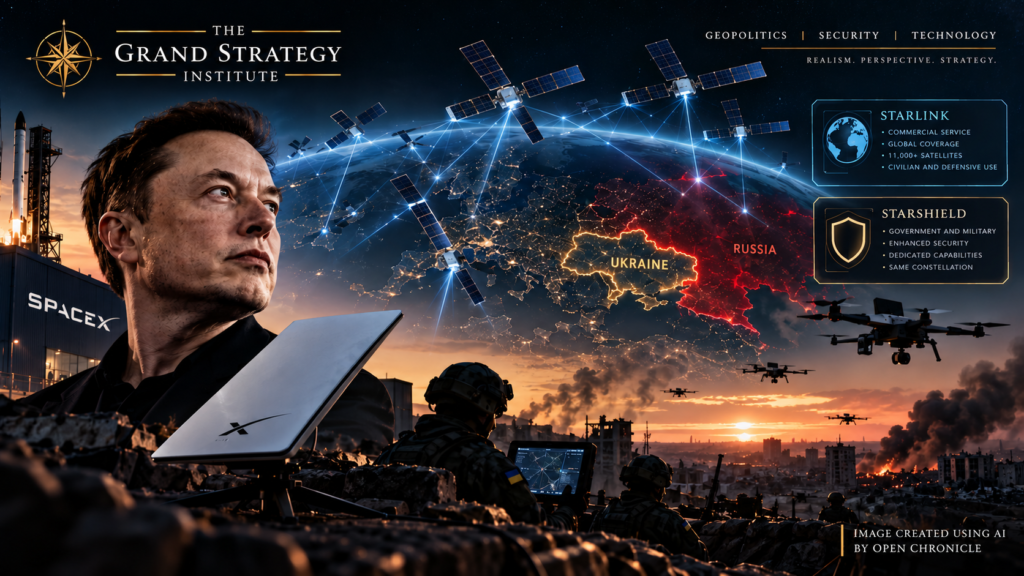
Ukraine’s latest dispute over satellite connectivity exposes a fundamental vulnerability in modern warfare: armies increasingly depend on commercial infrastructure they do not own, cannot fully control and may be unable to replace during a crisis.
By The Grand Strategy Institute Research Division
Grand Strategy Analysis | 17 October 2026
The most important weapon on a modern battlefield may not be a missile, a drone or a tank.
It may be the communications network connecting them.
In Ukraine, that network has increasingly depended on satellites operated by a private American company.
SpaceX.
Its Starlink constellation helped Ukrainian forces preserve communications during the opening stages of Russia’s full-scale invasion in 2022. It subsequently became an important component of battlefield connectivity, supporting military coordination, communications in damaged infrastructure environments and the operation of some unmanned systems.
But the same technology that gave Ukraine a military advantage has exposed an uncomfortable dependency.
A commercial service can become essential to national defence without becoming subject to the command authority of the military that depends upon it.
That contradiction has returned to the centre of international attention following Ukrainian complaints that restrictions on military-grade Starlink services have hampered drone strike missions and air defence operations.
Elon Musk has defended the distinction between Starlink, the commercial satellite internet service, and Starshield, SpaceX’s military and intelligence offering.
According to Musk, Starlink is intended for civilian and defensive activities, while Starshield systems are owned and controlled by the United States government, with operational restrictions determined by American authorities.
The distinction sounds straightforward.
In practice, it opens a much larger strategic question.
Can a military capability genuinely be considered sovereign when its communications depend on infrastructure controlled by an external commercial provider?
1. The Satellite Network That Changed the War
When Russia launched its full-scale invasion of Ukraine in February 2022, communications infrastructure immediately became a strategic target.
Military operations depend upon the ability to transmit information reliably between headquarters, frontline units, reconnaissance systems, artillery formations and political authorities.
Destroying or disrupting those connections can undermine an army even when its soldiers and weapons remain intact.
Ukraine faced precisely this problem.
Russian attacks and electronic warfare threatened conventional communications infrastructure.
Satellite connectivity provided an alternative.
Starlink terminals were relatively portable, could be deployed quickly and connected to a constellation operating in low Earth orbit.
Unlike traditional geostationary satellite systems, which rely on spacecraft positioned much farther from Earth, Starlink uses large numbers of satellites closer to the planet.
That architecture offers lower latency and the ability to distribute connectivity across many orbital assets.
For Ukraine, the operational implications were considerable.
Military units could communicate across dispersed positions. Commanders could maintain contact with formations operating in damaged infrastructure environments. Information from reconnaissance systems could be shared more rapidly.
Starlink did not create Ukraine’s military resilience.
But it contributed to the communications infrastructure supporting that resilience.
Its importance also revealed a vulnerability.
A network capable of supporting national defence remained commercially owned.
2. The Difference Between Starlink and Starshield
Starlink and Starshield belong to the same corporate ecosystem, but they are marketed for different purposes.
Starlink is primarily a commercial broadband service.
It serves households, businesses, aircraft, ships and other customers requiring satellite internet connectivity.
Starshield is designed for government, defence and intelligence missions.
SpaceX describes Starshield as building upon Starlink’s technology and operational experience while offering capabilities tailored to national security requirements.
These include secure communications, Earth observation and hosted payload services.
The distinction is significant.
Commercial broadband and military satellite communications operate under different requirements.
Military users may need stronger information assurance, dedicated terminals, controlled gateways, specialised encryption, mission-specific performance and contractual guarantees.
But the distinction between services does not necessarily imply complete separation of their underlying physical infrastructure.
That is where the strategic problem begins.
3. One Corporate Ecosystem, Different Systems of Control
Starshield is not simply Starlink with a different name.
It encompasses specialised government services and, in some cases, dedicated spacecraft and payloads.
SpaceX’s published description identifies three principal mission areas: secure communications, Earth observation and hosted payloads.
Its government offering incorporates additional security capabilities intended for sensitive national security operations.
However, some Starshield communications services use infrastructure derived from or shared with the broader Starlink network.
That can include orbital connectivity, ground infrastructure and elements of the supporting technical architecture.
The British Ministry of Defence has described an arrangement involving dedicated terminals and separate gateways while using the same underlying satellite constellation and associated infrastructure.
This distinction matters because military independence has several layers.
A government may control the operational use of a service without owning the satellites providing it.
It may own particular spacecraft while relying on a private contractor to maintain the supporting network.
It may possess dedicated terminals while remaining dependent on proprietary software, network management and ground infrastructure.
Consequently, the phrase government-controlled does not necessarily mean technologically independent.
The decisive questions are contractual and operational.
Who authorises the service?
Who can change its technical parameters?
Who maintains the infrastructure?
Who controls software updates?
Who can suspend access?
And what happens when the military customer and the service provider disagree?
4. The October 2026 Restrictions Exposed a New Battlefield Vulnerability
The immediate dispute concerns reported restrictions affecting military-grade satellite connectivity used by Ukrainian forces.
On 14 October, Ukrainian officials said that terminals supporting certain drone operations were losing connectivity when moving faster than approximately 160 kilometres per hour.
Presidential adviser Serhiy Beskrestnov reported that the restrictions had been introduced without adequate warning.
Ukrainian military units described disrupted missions, including operations involving drones used against Russian forces and systems supporting air defence.
The consequences were not confined to offensive strikes.
Ukraine also relies on unmanned interceptors to counter Russian attack drones.
A speed restriction affecting communications with fast-moving platforms can therefore interfere with defensive missions.
This distinction is critical.
A technical limitation that appears to regulate offensive military activity may also degrade systems intended to protect civilian populations.
The restrictions reportedly interrupted communications for periods sufficient to undermine drone control.
Even brief interruptions can be operationally significant.
An unmanned aircraft travelling at 160 kilometres per hour covers approximately 44 metres every second.
A ten-second interruption therefore corresponds to more than 400 metres of travel.
Whether the aircraft remains controllable depends on its onboard autonomy, navigation system, communications architecture and mission profile.
But the underlying principle is straightforward.
A satellite service does not need to be completely switched off to become militarily unusable.
A change in speed limits, latency, service classification or network permissions can be enough.
5. The Restrictions Were Not Fully Resolved
By 17 October, Ukrainian officials were reporting that some access had improved, but important limitations remained.
President Volodymyr Zelenskyy said that interceptor drones continued to experience problems associated with speed restrictions.
Ukrainian officials were seeking a solution through discussions involving SpaceX and the United States government.
This makes the incident more consequential than a short technical outage.
The initial disruption demonstrated how rapidly operational capabilities could be affected.
The continuing restrictions demonstrated how difficult it could be to restore full functionality once service conditions changed.
The incident also revealed a problem of military planning.
Commanders need to know which capabilities will be available when an operation begins.
A communications system that can change unexpectedly creates uncertainty even when it normally performs exceptionally well.
For a military force engaged in continuous combat, uncertainty itself carries a cost.
6. Who Actually Ordered the Restrictions?
The question of responsibility is politically sensitive.
Musk has argued that Starshield systems are controlled by the United States government and that restrictions on their use are determined by American military or political authorities.
Subsequent reporting has added important context.
Reuters reported on 16 October that, according to two American officials and a Western official familiar with the matter, instructions to limit the Starshield service originated within the White House.
Those officials did not identify the individual responsible for the decision.
Other reporting has indicated that the restrictions occurred amid growing tensions between Washington and Kyiv over Ukrainian strikes against Russian energy infrastructure.
President Donald Trump has denied ordering the disruption.
These accounts should not be collapsed into a single uncontested narrative.
The available reporting supports the conclusion that the restrictions were real and operationally consequential.
It also provides evidence that the decision involved American government authorities.
It does not establish every element of the internal decision-making process, including the precise role played by Musk personally.
That uncertainty is important.
The strategic implications differ depending on whether a restriction originates from a commercial provider’s policy, a contractual interpretation, a military authority or a presidential decision.
Yet all four possibilities expose the same structural vulnerability.
Ukraine depends on a system whose critical decisions may be made outside Ukraine.
7. When Connectivity Becomes a Diplomatic Instrument
The most serious implication is not technological.
It is political.
Military assistance has always been a means of influence.
Governments can withhold weapons, delay ammunition deliveries, restrict intelligence sharing or attach conditions to military aid.
Satellite communications introduce another mechanism.
An ally may possess drones, trained operators and available targets but lose the ability to employ certain systems effectively if network access is restricted.
This gives connectivity a role similar to other strategic dependencies.
A country that relies on another state for ammunition can be pressured through ammunition deliveries.
A country that relies on another state for intelligence can be pressured through intelligence sharing.
A country that relies on an externally controlled satellite network can be pressured through the network itself.
The difference is speed.
Weapons deliveries can be reduced over weeks or months.
Digital service conditions can potentially change much faster.
The ability to alter battlefield connectivity creates a form of strategic leverage that operates at the speed of software.
That does not prove the October restrictions were intended as coercion.
It establishes why the possibility matters.
8. The Commercial Rules of War
Musk’s distinction between civilian and military services raises another question.
Can a commercial communications company realistically distinguish defensive military operations from offensive ones?
Consider an air defence drone intercepting an incoming Russian attack drone.
Its mission is defensive.
Now consider a Ukrainian drone striking an ammunition depot used to support Russian attacks.
The operation is offensive in tactical terms.
But Ukraine may regard it as part of its broader defence against invasion.
International humanitarian law does not classify every offensive military operation as unlawful.
A military action can be offensive at the tactical level while forming part of a state’s exercise of self-defence.
The legality of a particular attack depends on additional considerations, including the nature of the target, distinction, proportionality and precautions.
This means a commercial rule prohibiting offensive military use is not equivalent to a legal rule prohibiting unlawful military activity.
It is a corporate or contractual policy.
Such policies may be legitimate business decisions.
But they can produce consequences that are strategically and legally more complicated than the distinction initially suggests.
A communications provider may seek to avoid direct participation in warfare.
Yet restricting communications can affect defensive and offensive operations simultaneously.
The company may not intend to determine military outcomes.
Nevertheless, its service decisions can influence them.
9. The Pentagon Faces the Same Dependency
Ukraine is not the only military organisation confronting the consequences of reliance on SpaceX.
The Pentagon itself has developed substantial relationships with Starlink and Starshield.
American defence and intelligence agencies have purchased satellite communications services and supported dedicated national security satellite programmes.
SpaceX’s ability to manufacture satellites at scale, launch them frequently and operate a large constellation offers important advantages.
Traditional military space systems have often been expensive, specialised and slow to replace.
Commercially derived constellations offer a different model.
Large numbers of spacecraft can provide distributed coverage and greater resilience against the loss of individual satellites.
But this model also concentrates critical capabilities within a small number of commercial providers.
That concentration can create contractual and financial disputes.
During the 2026 conflict with Iran, Reuters reported disagreement between SpaceX and the Pentagon over the appropriate price for satellite connectivity used by American military drones.
The reported dispute involved service tiers costing approximately $5,000 and $25,000 per terminal.
SpaceX argued that certain military applications required a more expensive service category.
The significance extends beyond the specific prices.
A capability that has become operationally essential can remain commercially negotiable.
That creates a new form of defence procurement risk.
The military may control the mission.
The contractor may control the service architecture required to execute it.
10. The Hidden Economics of Satellite Warfare
The dispute between SpaceX and the Pentagon reveals a structural change in the economics of military communications.
Historically, governments often purchased specialised satellites through defence programmes.
The resulting infrastructure was expensive, but the state generally exercised substantial control over its military purpose and operation.
Commercial satellite constellations offer a different model.
Governments can purchase connectivity as a service rather than develop every component independently.
This reduces the time required to introduce new capabilities.
It can also reduce initial investment and provide access to technologies that evolve more quickly than traditional defence procurement systems.
But service-based procurement introduces recurring dependencies.
A military customer may pay for connectivity, capacity, service priority, dedicated terminals, security features and operational availability.
Each of these can become a contractual issue.
And once military systems have been designed around a particular communications provider, changing providers may become technically difficult and expensive.
The supplier’s position consequently becomes stronger over time.
This is the military equivalent of technological lock-in.
The more indispensable the service becomes, the more difficult it becomes for the customer to negotiate from a position of independence.
11. The Problem of a Single Point of Strategic Failure
Starlink’s orbital architecture is distributed across thousands of satellites.
That distribution provides significant resilience.
Destroying one satellite does not destroy the network.
Disrupting one ground terminal does not eliminate global connectivity.
But physical distribution should not be confused with complete strategic decentralisation.
A constellation can contain thousands of spacecraft while still depending on centralised management systems, software, authentication mechanisms, ground infrastructure and contractual authority.
This creates a paradox.
The network may be highly resilient against physical attack while remaining vulnerable to decisions made through its management architecture.
The risk is not necessarily that one individual can personally deactivate an entire military.
The more defensible concern is that a limited number of institutions retain authority over services upon which many military organisations depend.
The October restrictions illustrate the importance of that distinction.
Ukraine did not need to lose access to every satellite to experience operational disruption.
Changes affecting particular terminals or service conditions were sufficient.
12. Russia Is Watching
Russia has strong reasons to study this episode.
Since the beginning of the full-scale invasion, Russian forces have attempted to disrupt Ukrainian communications through electronic warfare, cyber operations and attacks on physical infrastructure.
Starlink complicated those efforts.
Its distributed satellite architecture made Ukrainian communications harder to suppress through conventional means.
But the October incident demonstrates that communications dependency has dimensions beyond enemy interference.
A network may remain technically functional while particular users lose access to capabilities they previously possessed.
For Russian military planners, the lesson is potentially significant.
The resilience of an adversary’s communications architecture depends not only on its resistance to jamming or physical destruction but also on the political and commercial relationships supporting it.
That does not mean Russia can reproduce the American government’s authority over Starshield.
It means Moscow can observe how external dependency affects Ukrainian military operations.
Russia is also developing its own satellite communications capabilities.
Those efforts reflect a broader recognition that satellite connectivity is becoming integral to unmanned warfare.
The strategic competition is therefore moving beyond the question of which country possesses more drones.
It increasingly concerns which country can sustain reliable communications with those drones under conditions of conflict.
13. The European Strategic Autonomy Problem
For European governments, the incident raises questions extending beyond Ukraine.
NATO members increasingly rely on American technology for intelligence, communications, precision weapons, space services and military command systems.
That relationship provides major advantages.
The United States possesses capabilities that would be costly and time-consuming for individual European states to reproduce.
But reliance on those capabilities creates political dependencies.
Britain has adopted Starshield services.
New Zealand has evaluated the technology for military applications.
Other American partners are examining similar systems.
These arrangements can strengthen operational capability while creating reliance on infrastructure controlled through American government and commercial relationships.
The critical issue is not whether the United States is a reliable ally in general.
It is whether European governments possess sufficient alternatives if access to an essential service becomes restricted during a political disagreement.
European strategic autonomy does not necessarily require replacing every American system.
That would be financially inefficient and operationally unrealistic.
It does require identifying which capabilities are so essential that their interruption could prevent independent military action.
Satellite communications belong near the top of that list.
14. Can Europe Build an Alternative?
Europe already possesses important space capabilities.
The European Union’s Galileo system provides satellite navigation services, including a regulated service intended for authorised government users.
European institutions also operate or support Earth observation and secure communications programmes.
The European Union’s IRIS² initiative is intended to develop a secure satellite communications constellation.
Commercial operators such as Eutelsat OneWeb provide additional low Earth orbit connectivity.
These capabilities matter.
But they should not be described as immediate, fully interchangeable substitutes for Starlink and Starshield.
Different constellations offer different coverage, terminal characteristics, service capacities, network architectures and military integration options.
A military drone designed around one communications system cannot necessarily switch to another without engineering modifications.
An alternative satellite service may provide excellent connectivity for headquarters or vehicles while being unsuitable for a particular fast-moving unmanned aircraft.
The European challenge is therefore broader than launching satellites.
It includes developing terminals, secure gateways, software, military interfaces, procurement arrangements and sufficient network capacity.
Most importantly, it requires ensuring that alternative services are operationally available before a crisis.
A replacement developed after access is interrupted may arrive too late.
15. The Next Military Competition Is About Infrastructure Ownership
The Starlink–Starshield controversy belongs to a larger transformation.
Modern military power increasingly depends on infrastructure developed and operated by private technology companies.
Cloud computing.
Artificial intelligence.
Satellite communications.
Cybersecurity.
Geospatial intelligence.
Autonomous systems.
Semiconductor manufacturing.
Data centres.
Software platforms.
Many of these capabilities are dual-use.
They support civilian economies while also providing essential military functions.
This creates an increasingly complex relationship between governments and companies.
States remain responsible for national defence.
But private enterprises may control essential technological infrastructure.
The resulting power relationship is not simply one of governments purchasing equipment from contractors.
In some cases, contractors operate the systems through which military operations become possible.
That is a substantial change.
A defence contractor manufacturing artillery shells does not normally decide how an army uses each shell after delivery.
A company operating a communications network may retain continuing technical control over the service after a military customer begins using it.
The strategic relationship no longer necessarily ends when the government purchases the capability. It continues throughout the capability’s operational life.
16. The Legal and Political Accountability Gap
This raises difficult questions about accountability.
Suppose a government orders a satellite service restriction that interferes with a partner’s air defence operations.
Who bears political responsibility?
The government issuing the instruction?
The military organisation implementing it?
The commercial company operating the infrastructure?
Or the customer that failed to secure alternative communications?
The answer depends on the legal and contractual arrangements involved.
The same complexity applies when a commercial provider independently establishes limits on military use.
Private companies can set contractual conditions and seek to avoid involvement in particular military activities.
Governments can impose national security restrictions.
Military customers can negotiate service guarantees.
But these relationships become problematic when operational decisions affect human lives and the chain of responsibility is unclear.
Ukraine’s experience demonstrates why military communications agreements require more than technical performance specifications.
They also require transparent rules governing service continuity, emergency restrictions, notification procedures and dispute resolution.
A military cannot effectively plan around a capability whose operating conditions may change without warning.
17. The Future of Military Communications Must Be Redundant
The immediate lesson for Ukraine is not necessarily to abandon Starlink or Starshield.
Both offer substantial operational value.
Replacing them abruptly could create additional vulnerabilities.
The more practical objective is reducing dependence on any single service.
That means building a layered communications architecture.
Satellite systems should complement terrestrial networks.
Different satellite providers should be integrated where technically feasible.
Military platforms should be designed to accommodate alternative communications systems.
Command structures should retain the ability to operate under degraded connectivity.
Critical functions should not depend unnecessarily on continuous access to one proprietary network.
This approach is consistent with a fundamental principle of military resilience.
No essential capability should possess an easily exploitable single point of failure.
The challenge is that redundancy costs money.
Maintaining several communications pathways is more expensive than relying on the most efficient provider.
But the October incident demonstrates that efficiency and resilience are not the same thing.
A system can be commercially efficient during peacetime and strategically vulnerable during war.
18. From Satellite Superiority to Connectivity Sovereignty
The strategic vocabulary of space warfare is changing.
For decades, military space power was primarily associated with satellites performing specialised functions.
Reconnaissance.
Navigation.
Early warning.
Secure communications.
Weather observation.
Those capabilities remain essential.
But large commercial constellations have created a new category of military dependence.
Connectivity itself has become a continuously supplied strategic service.
This suggests the emergence of a concept that defence planners may increasingly need to consider: connectivity sovereignty.
Connectivity sovereignty does not necessarily mean owning every satellite.
It means possessing sufficient legal authority, operational assurance, technological alternatives and institutional resilience to maintain essential communications when political or commercial relationships deteriorate.
A state may have access to excellent satellite communications without possessing connectivity sovereignty.
Ukraine’s experience illustrates that distinction.
The question is not simply whether the network works.
It is whether the state can depend on the network when its most important interests are at stake.
Strategic Assessment
The Grand Strategy Institute assesses that the October 2026 Starlink–Starshield restrictions represent an important warning about the changing foundations of military power.
The immediate consequences are operational.
Ukrainian officials have reported disrupted drone missions, limitations affecting high-speed unmanned platforms and interference with capabilities supporting air defence.
Some connectivity has subsequently improved, but restrictions remained a concern as of 17 October.
The institutional consequences are more complex.
Starlink and Starshield are distinct offerings within the SpaceX ecosystem. Starshield includes government-oriented security features and dedicated capabilities, but some services depend on infrastructure derived from the wider Starlink network.
Public reporting indicates that American government authorities were involved in the decision to impose restrictions. The precise internal decision-making process and the responsibility of individual actors remain incompletely established.
The wider strategic implications are substantial.
First, commercial satellite networks have become essential military infrastructure.
Second, technical resilience does not guarantee political or contractual independence.
Third, externally controlled connectivity can become a source of strategic leverage.
Fourth, governments purchasing military communications services must consider continuity of access as seriously as bandwidth, coverage and security.
Fifth, European defence autonomy increasingly depends on alternatives to externally controlled digital infrastructure, not merely on additional weapons and larger armed forces.
Finally, Ukraine’s experience demonstrates that the next generation of military vulnerability may emerge not from the destruction of equipment but from restrictions imposed on the systems connecting that equipment.
The battlefield is becoming more digital.
But digital warfare does not eliminate political dependency.
It can intensify it.
The New Strategic Reality
There was a time when military independence could be measured primarily through armies, weapons, industrial capacity and territorial control.
Those measures remain essential.
But they are no longer sufficient.
A country may manufacture its own drones and still depend on foreign satellite connectivity.
It may possess sophisticated weapons but require external software services.
It may control its soldiers while relying on another government’s infrastructure to connect them.
And it may discover that access to a critical capability can change faster than its military organisation can adapt.
The Starlink–Starshield controversy is therefore not simply a dispute about Elon Musk, SpaceX or Ukrainian drones.
It is an early demonstration of a new strategic condition.
The military power of the twenty-first century will increasingly depend on who controls the networks through which weapons, intelligence and decisions are connected.
And the most consequential question may no longer be who owns the weapon.
It may be who controls the connection that allows the weapon to function.
Key Findings
Twelve strategic findings on the Starlink–Starshield controversy, Ukraine’s battlefield connectivity and the growing dependence of military operations on commercially operated satellite infrastructure.
Satellite Connectivity Is Critical Military Infrastructure
Ukraine’s experience demonstrates that communications services can directly affect reconnaissance, drone operations and air defence.
Starlink and Starshield Are Not Fully Independent
Starlink and Starshield serve different customers and missions. Their institutional separation does not imply complete technological independence.
October Restrictions Had Operational Consequences
Ukrainian officials reported interrupted missions and problems affecting drones travelling above approximately 160 km/h.
Partial Restoration Did Not Eliminate the Problem
Ukrainian officials continued to report limitations as of 17 October.
Responsibility Requires Careful Distinction
Reporting links the restrictions to American government instructions, but the complete decision-making chain has not been publicly established.
Technical Changes Can Produce Immediate Military Effects
Connectivity restrictions may affect operations without physical attacks on satellites.
Commercial Contracts Can Become Strategic Dependencies
Governments increasingly purchase continuing services rather than exclusively owned military equipment.
The Pentagon Faces Related Procurement Challenges
The reported 2026 pricing dispute with SpaceX illustrates tensions between commercial service categories and military requirements.
Network Resilience Is Not Operational Sovereignty
A physically distributed constellation may still depend on centralised service management.
European Strategic Autonomy Requires Alternatives
Independent capabilities must include terminals, gateways, capacity and military integration.
Communications Redundancy Is Becoming Essential
Military organisations need alternative communications pathways and the ability to operate under degraded connectivity.
The Central Strategic Issue Is Control
The decisive question is whether governments can guarantee essential military communications during political, commercial or military crises.
Military power increasingly depends not only on who owns the weapons, but on who controls the communications infrastructure that allows those weapons to function.
Sources and Further Reading
The following sources support the factual reporting and provide the documentary basis for the analysis. The strategic interpretations are those of The Grand Strategy Institute Research Division.
Order to Limit Starshield for Ukraine Came From Inside White House, Sources Say
Reporting based on American and Western officials concerning the origin of the restrictions and the remaining uncertainties surrounding responsibility.
Presidential Adviser Says Ukraine Is in Talks to Lift Speed Limit on Military Satellite Network
Details of the reported speed restrictions, operational effects and efforts to restore full service.
Starshield: Supporting National Security
Primary description of Starshield’s government communications, Earth observation, hosted payloads and security architecture.
What Is Starshield, SpaceX’s Military Version of Starlink?
Explanation of the distinction between the commercial and military offerings and their shared technological foundations.
Pentagon Spars With SpaceX Over Starlink Price Hike During Iran War
Reporting on service pricing, Pentagon procurement and the commercial implications of military satellite connectivity.
Ukraine Says SpaceX Limits Starlink Operations, Disrupting Military
Initial reporting on Ukrainian military complaints, affected drone missions and the lack of advance notification.
This analysis distinguishes reported operational disruptions, official statements, commercial service arrangements and strategic interpretation. The precise decision-making process behind the October 2026 restrictions has not been fully established in public reporting. The Grand Strategy Institute Research Division treats unresolved questions of responsibility separately from the documented military implications and the broader structural dependence on commercially operated satellite infrastructure.
The Grand Strategy Institute
Continue Exploring Strategic Analysis
Return to The Grand Strategy Institute for strategic assessments, long-form analysis and research examining geopolitics, military affairs, international security, emerging technologies and the changing international order.
← Back to The Grand Strategy Institute