
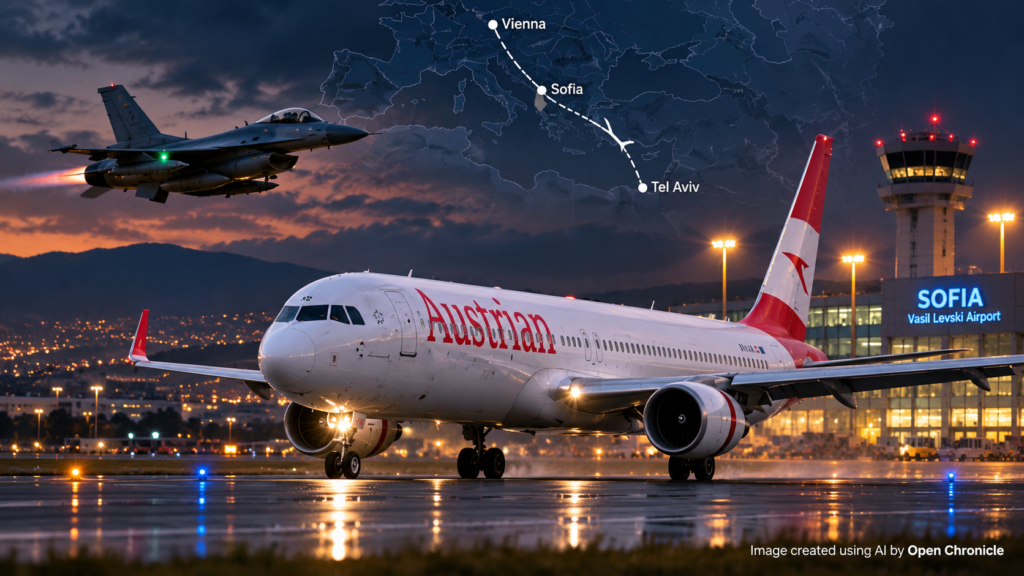
An Airbus A320 carrying 57 passengers and crew was escorted by a military fighter jet before landing safely in Sofia. The aircraft later continued to Vienna as Bulgarian authorities opened an investigation into the security alert.
By Open Chronicle News Desk with Agencies
SOFIA / VIENNA / TEL AVIV — October 19, 2026
An Austrian Airlines passenger aircraft travelling from Tel Aviv to Vienna was forced to make an emergency landing in Bulgaria on Sunday evening, October 18, following a reported bomb threat that prompted a military escort and an investigation by Bulgarian authorities.
The Airbus A320 was carrying 51 passengers and six crew members when the threat was reported during the flight, according to information released by Bulgarian authorities and reported by Bulgarian state television.
The aircraft was diverted to Vasil Levski Sofia Airport, where it landed safely after being escorted by a Bulgarian Air Force fighter jet.
No injuries were reported in the information provided, and the aircraft subsequently continued its journey to Austria, arriving safely in Vienna during the early hours of Monday.
The incident comes amid heightened aviation security concerns involving flights to and from Israel, following a separate attempted aircraft hijacking reported on a Flydubai service in late September.
Bomb Threat Reported During Flight
According to Bulgarian state television, a member of the aircraft’s crew reported receiving a bomb threat while the plane was travelling between Israel and Austria.
The precise nature of the threat, including how it was communicated and whether it referred to an explosive device on board, was not immediately established in the available reporting.
The flight crew subsequently diverted the aircraft to Sofia.
Bulgarian authorities coordinated the response, with a military fighter aircraft reportedly dispatched to escort the Airbus A320 during the final stage of its journey.
The deployment of military aviation reflects the seriousness with which authorities treat potential threats involving civilian passenger aircraft.
Such incidents require rapid coordination between air traffic controllers, aviation security agencies, military authorities and airport emergency services.
However, the presence of a fighter escort does not, by itself, establish that an explosive device was present or that an attack was imminent.
Aircraft Lands Safely in Sofia
Flight-tracking information cited from FlightAware indicated that an Austrian Airlines flight departed Ben Gurion Airport in Tel Aviv at approximately 6:46 p.m. local time on Sunday.
The aircraft landed at Vasil Levski Sofia Airport roughly three hours later.
The diversion interrupted the scheduled journey to Vienna, requiring the passengers and crew to remain in Bulgaria while authorities responded to the security alert.
Bulgarian state television reported that the incident was under investigation.
The supplied information does not establish whether investigators discovered any suspicious objects, whether passengers were evacuated or what security procedures were carried out after landing.
There was also no immediate confirmation in the available account concerning the origin of the threat or the identity of the person responsible.
Flight Continues to Vienna After Security Alert
Despite the disruption, the aircraft was eventually able to resume its journey.
Flight-tracking information indicated that the plane departed Sofia during the early hours of Monday and subsequently landed safely in Vienna.
The continuation of the flight suggests that the immediate security situation was sufficiently resolved for the aircraft to return to service.
However, the available reporting does not specify which checks were completed before departure or whether the threat was formally determined to be a hoax.
The investigation remained an important part of the authorities’ response.
For the passengers and crew, the diversion represented a significant interruption to an international journey that had already been operating in a region affected by heightened geopolitical tensions.
Fighter Jet Escort Highlights Aviation Security Procedures
The reported military escort illustrates the procedures that can be activated when a civilian aircraft becomes the subject of a potentially serious security threat.
National authorities may deploy military aircraft to monitor or escort a passenger plane when circumstances warrant additional precautions.
Such operations are generally coordinated with civilian air traffic control to ensure that the aircraft can reach a suitable airport safely.
An emergency diversion may also involve preparing airport emergency services, establishing a secure parking area and conducting inspections before passengers or crew are allowed to continue their journey.
The precise measures taken in Sofia have not been fully detailed in the supplied reporting.
Nevertheless, the safe landing and subsequent continuation to Vienna indicate that the aircraft was able to complete its journey without a reported physical attack.
Incident Follows Attempted Flydubai Hijacking
The bomb threat occurred less than three weeks after a separate aviation security incident involving a Flydubai flight travelling between the United Arab Emirates and Israel.
On September 30, a co-pilot reportedly attempted to seize control of an aircraft during a flight from Dubai.
According to statements attributed to authorities in the United Arab Emirates, the co-pilot, identified as an Omani national, allegedly intended to take control of the aircraft and crash it into the passenger terminal at Israel’s main international airport.
The alleged plan was described by UAE authorities as an attempt to cause mass casualties.
The incident reportedly developed less than three hours after the aircraft departed Dubai.
A confrontation inside the cockpit was followed by a sudden loss of altitude, with the aircraft descending from approximately 33,000 feet to 17,000 feet in around one minute, according to the supplied reporting.
Passengers and crew reportedly intervened during the emergency, helping to stabilise the situation.
The aircraft was subsequently diverted to an airport in Saudi Arabia, where it landed.
Most passengers on board were reportedly Israeli nationals.
The circumstances of that incident were described in reporting published on October 9.
There is no evidence in the supplied information establishing any operational connection between the September Flydubai incident and Sunday’s bomb threat involving the Austrian Airlines aircraft.
The two events are separate security cases.
Security Concerns Surrounding Flights to and From Israel
The latest diversion comes against a backdrop of continuing regional tensions affecting the Middle East.
International airlines operating routes to Israel must regularly assess security conditions, including airspace restrictions, military activity and potential threats to civilian aviation.
Aviation authorities and carriers may adjust routes or introduce additional precautions when security assessments identify elevated risks.
Bomb threats present a particular challenge because authorities must respond quickly even when the credibility of the information has not yet been established.
The priority is to protect passengers and crew while allowing investigators to determine whether the threat represents a genuine danger.
In this case, the decision to divert to Sofia provided an alternative landing location where Bulgarian authorities could respond.
The involvement of a military fighter aircraft also demonstrated the coordination required when a potential aviation security emergency crosses international borders.
Investigation Focuses on Origin and Credibility of Threat
Bulgarian authorities are investigating the circumstances surrounding the reported bomb threat.
Among the central questions are how the warning was received, whether it contained specific information and whether the individual responsible can be identified.
Investigators may also examine communications records and other available evidence, although the supplied reporting does not specify which investigative measures have been undertaken.
At this stage, there is no confirmed information establishing that explosives were present on the aircraft.
Nor has the supplied account identified a suspect or confirmed any arrests.
Until authorities release additional findings, the incident should be treated as a reported bomb threat rather than a confirmed attempted bombing.
The Big Picture: Civilian Aviation and Regional Instability
The emergency diversion of an Austrian Airlines aircraft from Tel Aviv to Sofia highlights the vulnerability of international aviation to security alerts, even when no physical attack ultimately occurs.
A single threat can disrupt flight operations, trigger military involvement and require coordination among multiple national authorities.
The incident also demonstrates the importance of established emergency procedures.
The Airbus A320 landed safely, and the passengers and crew were subsequently able to continue their journey to Vienna.
The separate Flydubai incident in September adds to concerns about the security challenges facing commercial aviation in the region, although the available information does not suggest that the two cases are connected.
For airlines, regulators and governments, maintaining passenger safety requires constant vigilance, reliable intelligence and effective international cooperation.
The immediate emergency has ended, but the investigation into the bomb threat remains essential to establishing what happened and whether further security measures are necessary.
Sources and Further Reading
1. ITV News — Co-pilot’s Attack on Flydubai Flight Aimed at Mass Casualties, UAE Says
Reporting on the separate September 30 aviation security incident involving a Flydubai flight.
2. FlightAware — Flight Tracking
Flight-tracking platform referenced in the supplied account for the aircraft’s movements between Tel Aviv, Sofia and Vienna.
3. Bulgarian Civil Aviation Administration
Official Bulgarian civil aviation authority providing regulatory and aviation safety information.
4. Austrian Airlines — Official Website
Airline information and official passenger communications.
Editorial Note
This article is an original Open Chronicle news synthesis based on the supplied reporting concerning the diversion of an Austrian Airlines flight from Tel Aviv to Sofia on October 18, 2026, following a reported bomb threat.
The passenger and crew figures, reported fighter jet escort, flight-tracking details and subsequent arrival in Vienna are drawn from the supplied account and have not been independently verified for this article.
The reference to the September 30 Flydubai incident provides relevant aviation security context. The two incidents are treated as separate events, and no connection between them has been established.
The explanation of aviation security procedures provides general operational context and does not imply that every procedure described was implemented during the Sofia diversion.
The sources listed above provide background and potential avenues for verification rather than direct confirmation of every development reported.
Open Chronicle | Independent. Global. Trusted.