
GLOBAL NEWS BRIEF | MONDAY, OCTOBER 19, 2026
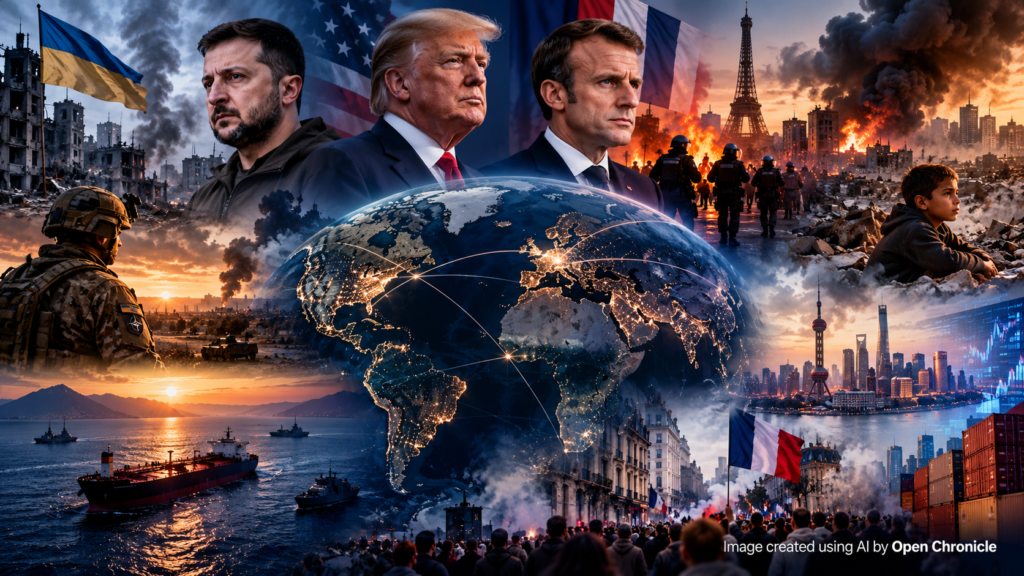
Diplomatic tensions over Ukraine, widespread unrest in France, an escalating security crisis in the Middle East and mounting humanitarian concerns dominate the international agenda. From Washington and Kyiv to Gaza, Tehran, Beijing and Brasília, governments are confronting an increasingly interconnected series of political, economic and security challenges.
By Open Chronicle News Desk with Agencies
WORLD NEWS | October 19, 2026
The international news agenda on Monday is dominated by renewed disagreements over the war in Ukraine, growing instability in the Middle East, violent protests across Europe and fresh warnings about humanitarian emergencies in Gaza and Central Africa.
US Secretary of State Marco Rubio has denied reports that Washington suspended intelligence sharing with Ukraine, while President Donald Trump has continued to criticise Ukrainian strikes against Russian oil infrastructure. Russian President Vladimir Putin, meanwhile, has reportedly proposed a trilateral summit involving Trump and Chinese President Xi Jinping.
In France, President Emmanuel Macron has rejected Interior Minister Laurent Nuñez’s offer to resign following widespread riots, instead demanding an urgent plan to prevent further violence.
Across the Middle East, the Gaza humanitarian crisis is deepening amid reports of major food assistance cuts, while tensions involving Iran, Saudi Arabia and the Houthis are raising new concerns about regional security and international shipping.
Elsewhere, Canada is mourning four military personnel reportedly killed in a devastating training-base fire, Brazil’s presidential runoff campaign has become increasingly confrontational, and China’s economy has recorded stronger quarterly growth despite persistent domestic weaknesses.
The following regional briefing brings together the principal developments reported on October 19.
EUROPE
France: Macron Rejects Interior Minister’s Resignation After Nationwide Riots
French President Emmanuel Macron has reportedly rejected Interior Minister Laurent Nuñez’s offer to resign following a weekend of violent demonstrations that left major cities dealing with widespread damage.
The president has instead instructed the government to develop an urgent security plan aimed at deterring further rioting, protecting public buildings and preventing additional attacks on businesses.
The decision follows Macron’s televised condemnation of individuals he accused of attempting to undermine the Republic.
Demonstrations initially focused on the cost of living, housing pressures and student conditions before violence erupted in several cities.
Reports describe extensive arrests, injuries among police and emergency personnel, looting and arson.
The historic town hall in Limoges has become a prominent symbol of the unrest, with images reportedly showing extensive fire damage.
Macron has acknowledged legitimate public grievances while insisting that peaceful protest must be distinguished from criminal violence.
The government’s response is facing criticism from different political directions. Right-wing opponents accuse it of failing to maintain order, while progressive groups question police tactics.
The crisis comes ahead of France’s 2027 presidential election, intensifying an already polarised political environment.
Cost-of-Living Demonstrations Spread Across Europe
Reports indicate that demonstrations over living costs, housing affordability and education have extended beyond France to other European countries, including Italy, Spain, Belgium and Portugal.
Milan has reportedly experienced a second day of street confrontations linked to economic grievances.
The demonstrations do not necessarily constitute a single coordinated movement. However, they reflect overlapping concerns about household purchasing power, housing shortages and the affordability of essential services.
Governments face the challenge of responding to economic dissatisfaction while protecting the right to peaceful assembly and preventing violence.
Albania: Anti-Government Protests Enter Sixth Day
Albania’s political crisis has reportedly entered a sixth consecutive day of demonstrations.
Police and protesters have clashed in Tirana as opposition groups continue demanding political accountability and the resignation of the prime minister.
The Albanian government has rejected calls to step down.
The unrest has renewed concerns about political polarisation and institutional stability in a country seeking closer integration with the European Union.
Hungary: Political Transition Raises Questions About Press Freedom
Following reports of Viktor Orbán’s electoral defeat, Hungarian journalists are describing a possible easing of political pressure.
The development has renewed debate about media independence, political influence over public institutions and the future direction of Hungary’s relationship with the European Union.
The extent of any institutional changes will depend on the policies implemented by the incoming political leadership.
Greece: Migrant Deaths Renew Concerns About Aegean Sea Crossings
Greek authorities have reportedly confirmed multiple migrant deaths in separate incidents in the Aegean Sea.
One incident near Lesbos involved a collision between a migrant vessel and a Greek coast guard boat, reportedly killing six people, including an infant.
Other reports place the combined death toll from two incidents at 12.
The circumstances remain subject to investigation.
The deaths have renewed attention to maritime rescue operations, border enforcement and the dangers faced by migrants attempting to reach European territory.
Poland and NATO: Allies Discuss Russia’s Hybrid Activities
NATO allies and partner countries are meeting in Bucharest to strengthen their response to Russian hybrid activities.
The discussions reportedly concern threats involving cyber operations, sabotage, disinformation and other forms of interference below the threshold of conventional armed conflict.
Poland is also preparing to participate in a European digital infrastructure consortium in 2027, reflecting wider efforts to strengthen technological cooperation and resilience.
RUSSIA AND UKRAINE
Rubio Denies US Suspended Intelligence Sharing With Kyiv
US Secretary of State Marco Rubio has denied reports that Washington suspended intelligence sharing with Ukraine.
His comments follow claims that Ukrainian authorities experienced interruptions or limitations in receiving certain intelligence information from American partners.
Rubio has reportedly urged Ukrainian President Volodymyr Zelensky to concentrate on efforts to end the war.
The dispute comes amid wider disagreements over military assistance, battlefield operations and Washington’s diplomatic approach to Moscow.
Zelensky has separately raised concerns about delays in US weapons deliveries, including Patriot air-defence missiles.
Ukrainian officials have suggested that some delays may reflect political decisions rather than technical problems.
The precise arrangements governing intelligence cooperation and weapons transfers remain unclear from the available reports.
Trump Criticises Ukrainian Refinery Strikes and Defends Russia Diplomacy
President Donald Trump has renewed criticism of Ukrainian attacks against Russian oil refineries.
Trump reportedly argued that Washington should avoid driving Moscow away from potential peace negotiations.
His remarks reflect an approach that places considerable emphasis on preserving diplomatic channels with Russia.
The president has also accused Zelensky of being insufficiently committed to ending the conflict.
Ukrainian officials have rejected suggestions that Kyiv should accept peace terms compromising its sovereignty or security.
The disagreement highlights the difficult balance between military pressure, sanctions and negotiations.
Reports also suggest that Washington has delayed a decision on additional Russian sanctions, although the precise legal and diplomatic arrangements require confirmation.
Putin Reportedly Proposes Summit With Trump and Xi
Russian President Vladimir Putin has reportedly proposed a trilateral meeting with Donald Trump and Chinese President Xi Jinping to discuss a possible settlement of the Ukraine war.
The proposed summit would bring together the leaders of three major powers at a moment of heightened international tension.
No confirmed meeting date, venue or agreed negotiating framework has been established in the supplied reporting.
China has repeatedly presented itself as supporting a diplomatic resolution while maintaining important political and economic relations with Moscow.
Any negotiations involving Washington, Moscow and Beijing would raise questions about Ukraine’s direct participation and the role of European governments.
Russian Missile and Drone Attacks Strike Kyiv
Russian missile and drone attacks have reportedly caused casualties and damage in the Ukrainian capital.
One reported strike killed a 21-year-old woman and damaged infrastructure near a Kyiv metro station.
Ukrainian officials have also reported that a major overnight attack left more than half a million people without electricity.
Zelensky has complained that Ukraine did not receive advance warning from partners concerning certain ballistic missile threats.
The reports highlight the continuing vulnerability of civilian infrastructure and the importance of air-defence systems.
The casualty and infrastructure figures remain subject to official updates.
Ukrainian Drone Campaign Targets Russian Energy Infrastructure
Ukraine’s campaign against Russian energy infrastructure is continuing.
Recent reports describe extensive drone attacks on facilities in St Petersburg and the surrounding Leningrad region, including oil-related installations.
Russian authorities have claimed to intercept exceptionally large numbers of drones, while local reports describe fires, casualties and property damage.
The scale of the attacks and interception figures have not been independently established in the supplied material.
The operations underline the growing importance of energy infrastructure in the military and economic confrontation between Russia and Ukraine.
MIDDLE EAST AND NORTH AFRICA
Gaza: Food Assistance Cuts Threaten Hundreds of Thousands
The World Food Programme is reportedly preparing to end food assistance for approximately 500,000 people in Gaza because of a funding shortfall.
The announcement comes amid persistent humanitarian needs and extensive damage to civilian infrastructure.
Humanitarian agencies have repeatedly warned that reduced funding can affect food distribution, nutrition programmes and assistance for vulnerable families.
Reports also describe funerals for 75 Palestinians whose remains were recovered from rubble.
The reported assistance reductions have raised renewed concerns about the international community’s capacity to sustain humanitarian operations.
The precise implementation timetable and the number of people affected should be checked against the latest World Food Programme statements.
Iran and Israel Exchange Accusations Amid Regional Tensions
Iranian officials have accused Israeli Prime Minister Benjamin Netanyahu of attempting to push the United States towards a wider war.
Iran’s foreign minister has reportedly suggested that Netanyahu is using regional confrontation to divert attention from his domestic legal and political difficulties.
These are allegations made by Iranian officials, not independently established motives.
Israeli political leaders are also preparing for a contentious election, with Netanyahu reportedly receiving an endorsement from President Trump.
The exchanges reflect the growing intersection between domestic political calculations and regional security tensions.
Strait of Hormuz: Oil Tanker Reportedly Strikes Mine
Iran’s Islamic Revolutionary Guard Corps has reported that an oil tanker struck a mine and caught fire in the Strait of Hormuz.
The incident has renewed concerns about the safety of shipping through one of the world’s most important energy transit routes.
Separate reports suggest that thousands of seafarers have been affected by maritime disruptions.
The cause of the tanker incident, the vessel’s condition and the extent of any casualties require independent confirmation.
The continuing instability has increased international attention to maritime security, energy supply routes and the potential economic consequences of prolonged disruption.
Saudi Arabia and Yemen: Houthi Threats Raise Security Concerns
Houthi representatives have reportedly declared much of Saudi airspace unsafe while identifying exceptions for the holy cities of Mecca and Medina.
The warning follows reports of missile and drone attacks affecting Saudi territory.
A hostile projectile reportedly struck the Saudi city of Najran, injuring six people.
The United States has advised Americans in parts of the Middle East to exercise heightened vigilance.
The developments suggest that the conflict involving Yemen’s Houthis is becoming increasingly important to the wider Gulf security environment.
Reports also describe renewed fighting in Yemen’s Marib and Taiz regions.
Egypt Considers Military Support for Saudi Arabia
Egyptian authorities are reportedly continuing discussions about the possibility of military support for Saudi Arabia.
President Abdel Fattah al-Sisi has indicated that Egypt would not remain indifferent to threats against Saudi security.
However, the reported statements should not be interpreted as confirmation that Egyptian forces have been deployed.
The issue reflects the close strategic relationship between Cairo and Riyadh and their shared concerns about Red Sea security.
Any military involvement would carry significant implications for the regional balance of power.
Bahrain and Russia Discuss Gulf Security
Bahrain’s King has reportedly met Russian Foreign Minister Sergei Lavrov to discuss regional security and the protection of strategic waterways.
Lavrov is also expected to hold talks in Tehran concerning bilateral relations and wider Middle Eastern developments.
The diplomatic activity reflects Moscow’s efforts to maintain relationships with Iran and Gulf Arab governments despite growing tensions between them.
Gulf ministers have separately expressed support for Saudi Arabia while encouraging dialogue between Iran and the United States.
Lebanon and Syria: Regional Security Pressures Continue
Lebanon is facing renewed concerns about Hezbollah’s activities and the possibility of internal escalation.
French diplomatic officials have reportedly discussed arrangements for southern Lebanon following the United Nations Interim Force in Lebanon, or UNIFIL.
In Syria, authorities have condemned reported Israeli military incursions into areas of Quneitra and Daraa and renewed demands concerning the occupied Golan Heights.
These developments illustrate the interconnected nature of security challenges across the Levant.
Israel and the West Bank: Arrests Follow Attacks on Diplomats and Journalist
Israeli police have reportedly arrested eight suspects following attacks involving settlers in the occupied West Bank.
The reported victims include a US journalist and European diplomatic representatives.
The incidents have drawn international criticism and renewed concerns about the safety of civilians, journalists and diplomatic personnel.
The arrests do not establish the criminal responsibility of the suspects, which remains subject to legal proceedings.
NORTH AMERICA
Canada: Four Military Personnel Killed in Alberta Base Fire
Canada is mourning four service members reportedly killed in a major fire at Canadian Forces Base Wainwright in Alberta.
The incident occurred during military training on Saturday, October 17.
Later reporting indicates that 39 people were injured, with some accounts describing 19 as critically injured.
Strong winds are believed to have accelerated the spread of a grass fire through the training area, although the precise cause remains under investigation.
Prime Minister Mark Carney described the disaster as one of Canada’s worst peacetime military tragedies.
Hospitals across Alberta were placed under significant pressure as injured personnel were transported for emergency treatment.
The Royal Canadian Mounted Police and military authorities are investigating.
United States: Russia Policy and Midterm Elections Dominate Debate
President Trump’s approach to Russia and Ukraine is generating political controversy ahead of the US midterm elections.
The administration is facing questions about sanctions, military assistance to Kyiv and the terms of any potential peace agreement.
Domestic concerns about inflation and economic confidence are also featuring prominently in political debate.
Reports suggest that Trump’s approval ratings have weakened, although individual polling figures require verification against their original surveys.
Miami Court Reportedly Issues Warrant in 1996 Cuba Aircraft Case
A judge in Miami has reportedly issued an arrest warrant for former Cuban leader Raúl Castro in connection with the 1996 shootdown of civilian aircraft.
The reported development relates to a longstanding dispute over the destruction of planes operated by the exile organisation Brothers to the Rescue.
The precise legal basis, jurisdiction and enforceability of the reported warrant require confirmation from court records.
Mexico: Hurricane Trudy Weakens After Pacific Coast Impact
Hurricane Trudy has reportedly weakened off Mexico’s Pacific coast after bringing heavy rain and strong winds.
Authorities are assessing damage and continuing recovery operations.
Heavy rainfall, flooding and disruption to transport can remain dangerous even after a tropical cyclone weakens.
LATIN AMERICA AND THE CARIBBEAN
Brazil: Lula and Bolsonaro Clash in Presidential Runoff Campaign
Brazil’s presidential campaign has intensified following a confrontational televised debate involving Luiz Inácio Lula da Silva and a Bolsonaro candidate.
The supplied headlines differ on the candidate’s identity, with some naming Jair Bolsonaro and another identifying Flávio Bolsonaro.
The identity of the runoff candidate therefore requires confirmation before publication as an established fact.
Reports describe personal attacks and sharp disagreements over corruption, economic management and political leadership.
Corruption remains a prominent concern among Brazilian voters.
The runoff is shaping up as a deeply polarised contest with important implications for Brazil’s domestic policy and international relationships.
Ecuador: Priest Dies After Crucifix Falls During Mass
A priest in Ecuador has reportedly died after a large crucifix fell on him during a religious service.
Video footage described in the supplied reports appears to show the incident.
The circumstances of the accident, including whether structural failure or installation problems were involved, remain subject to investigation.
The tragedy has drawn widespread attention because of its occurrence during a religious ceremony.
Colombia: Maritime Boundaries and Cultural Protests
Colombia’s president is reportedly preparing to sign a decree concerning maritime boundaries around the San Andrés, Providencia and Santa Catalina archipelago.
The region has long been strategically important because of maritime jurisdiction, fishing rights and relations with neighbouring countries.
Separate reports describe protests outside a Colombian museum over the removal of exhibits.
The developments highlight different aspects of the country’s ongoing debates about sovereignty, heritage and public institutions.
ASIA AND THE INDO-PACIFIC
China: Economy Grows 4.5% in Third Quarter
China’s economy reportedly expanded by 4.5% in the third quarter of 2026, supported by stronger exports.
The figure suggests resilience in external demand despite persistent weaknesses in domestic consumption and other parts of the economy.
Chinese policymakers continue to face pressure to stimulate household spending and address structural economic challenges.
Beijing is also preparing for further policy discussions concerning domestic demand and anti-corruption measures.
China and Philippines: Diplomatic Relations Reach Critical Point
China has warned that relations with the Philippines are at a critical juncture following another diplomatic dispute.
The Philippines has reportedly summoned China’s ambassador over remarks interpreted by Manila as threatening.
The disagreement comes amid longstanding tensions over maritime claims and security activities in the South China Sea.
The dispute remains important to regional stability because of the Philippines’ security relationship with the United States.
Japan Seeks Communication With Russia
Japan has indicated that it intends to maintain necessary diplomatic communication with Russia despite difficult bilateral relations.
Relations have deteriorated significantly since Russia’s invasion of Ukraine.
Tokyo continues to balance its support for Ukraine with regional security concerns involving Russia, China and North Korea.
Japan’s prime minister has also reportedly sent a monetary offering to the controversial Yasukuni Shrine, a gesture that can generate diplomatic criticism from neighbouring countries.
South Korea: Religious Leader Sentenced in Abuse Case
A South Korean religious leader has reportedly received a 33-year prison sentence for sexual abuse.
The case has renewed attention to institutional accountability and the protection of victims.
Details of the conviction, appeals process and court findings should be checked against judicial reporting before further conclusions are drawn.
Australia: Political and Defence Developments
Australian Prime Minister Mark Carney’s counterpart has reportedly condemned an attack involving independent parliamentarian Helen Haines.
The nature and circumstances of the reported incident remain unclear in the supplied headlines.
Australia has also announced plans for an unmanned submarine capable of carrying mines and aerial drones.
The defence development reflects growing interest in autonomous maritime systems and their potential role in Indo-Pacific security.
Bangladesh and Saudi Arabia: Execution Dispute
Bangladesh has reportedly stated that it was not informed in advance about the execution of Bangladeshi citizens in Saudi Arabia.
The report raises questions about consular notification, diplomatic communication and the rights of foreign nationals facing capital punishment.
The number of individuals involved and the circumstances of the cases require confirmation.
India: Festival Tragedy and Aviation Concerns
Reports from India describe a deadly incident in which a speeding truck struck participants at a Hindu religious festival.
The supplied headlines give different death tolls, including 15 and at least 19.
Authorities will need to establish the final casualty figures and circumstances of the collision.
Separate reporting describes an emergency landing involving an air ambulance carrying an Indian patient in Bangladesh.
AFRICA
DR Congo: Ebola Outbreak Spreads to Eighth Province
A fast-moving Ebola outbreak involving Bundibugyo virus has reportedly spread to an eighth province in the Democratic Republic of the Congo.
The latest affected area has been identified as North Ubangi.
The outbreak is particularly concerning because there is no approved vaccine or virus-specific treatment for Bundibugyo Ebola.
Public health authorities are relying on surveillance, laboratory testing, contact tracing and supportive medical care to contain transmission.
The reported expansion has renewed concern about regional health security.
Kenya: Additional Ebola Case Reported
Kenya has reportedly confirmed an eighth Ebola case amid concerns about the regional spread of the outbreak.
The report suggests that surveillance and cross-border coordination remain important priorities.
The precise connection between cases in different countries and the current status of transmission require confirmation through official epidemiological reporting.
Nigeria: Plateau State Reports Thousands of Tuberculosis Cases
Nigeria’s Plateau State has reportedly recorded approximately 11,000 tuberculosis cases during 2026.
The figure highlights the continuing burden of tuberculosis, a major infectious disease that requires sustained screening, diagnosis and treatment.
Public health officials face challenges involving access to healthcare, treatment continuity and early detection.
Sudan: Reported Attack on Displacement Camp in West Darfur
An attack attributed to the Rapid Support Forces has reportedly killed 11 people at a displacement camp in West Darfur.
The allegation comes amid the continuing humanitarian consequences of Sudan’s civil war.
Civilians displaced by fighting remain particularly vulnerable to violence, food insecurity and inadequate medical care.
The identity of those responsible and the casualty figures require independent verification.
Mali: Allegations of Civilian Deaths in Drone Strikes
A report has accused Malian forces and their Russian military partners of killing numerous civilians in drone strikes.
The allegations raise serious concerns about civilian protection and accountability in counterinsurgency operations.
The findings should be assessed against the underlying report, available evidence and responses from the accused parties.
GLOBAL ECONOMY, TECHNOLOGY AND HUMANITARIAN ISSUES
Food Inflation Threatens to Intensify
International reporting suggests that global food inflation could rise through 2027 as geopolitical conflict, supply disruptions and El Niño-related weather conditions affect agricultural production.
Higher food prices would place additional pressure on households already struggling with living costs.
Food-importing countries and lower-income communities are especially vulnerable to sustained price increases.
The forecasts remain dependent on weather patterns, commodity markets and geopolitical developments.
Energy Security Remains Under Pressure
Instability around the Strait of Hormuz, attacks on energy infrastructure and uncertainty over Russian fuel exports are continuing to influence energy markets.
Reports suggest that some Russian diesel exports may be redirected under evolving sanctions arrangements.
However, the exact terms of any reported US-Russia agreement or sanctions waiver require official confirmation.
The wider situation highlights the connection between diplomatic decisions, maritime security and global fuel prices.
Technology: AI Investment and Market Volatility
Technology markets are facing renewed scrutiny following reports of a major decline in semiconductor stock valuations.
The correction has revived questions about the sustainability of investment expectations surrounding artificial intelligence.
Separate reports describe growing consumer concern about retailers using AI-assisted pricing systems.
The developments illustrate how AI is influencing both financial markets and everyday consumer transactions.
Biodiversity and Environmental Policy
Governments and environmental organisations are gathering for international biodiversity discussions amid warnings about accelerating ecological damage.
The debate concerns habitat loss, biodiversity protection, conservation finance and the long-term economic consequences of environmental degradation.
Environmental pressures are increasingly intersecting with food security, public health and international development.
THE BIG PICTURE
A World Confronting Multiple, Interconnected Crises
The international developments of October 19, 2026, reveal a global environment in which military conflicts, political instability, economic pressures and humanitarian emergencies are becoming increasingly interconnected.
The war in Ukraine remains a central issue in relations between Washington, Moscow, Beijing and European capitals.
Disagreements over intelligence sharing, weapons deliveries, sanctions and diplomatic negotiations are complicating efforts to find a settlement.
In the Middle East, tensions involving Iran, Israel, Saudi Arabia and Yemen are raising the risk of further regional escalation while humanitarian conditions in Gaza remain critical.
Europe is confronting a different form of instability, with economic grievances and political dissatisfaction producing demonstrations that are testing governments’ capacity to maintain public order.
Across Africa, infectious disease outbreaks and armed conflicts continue to place pressure on already vulnerable populations.
At the same time, economic developments in China, global food inflation and volatility in energy markets are shaping the broader international outlook.
The central challenge facing governments is not simply managing individual crises, but preventing their interaction from generating wider instability. Diplomacy, institutional resilience, humanitarian assistance and credible public communication remain essential to that effort.
Sources and Further Reading
The following sources provide reporting and institutional information concerning selected developments covered in the October 19, 2026 edition of the Open Chronicle Global News Brief. They offer further context on diplomatic developments involving Ukraine, political unrest in France, the Canadian military tragedy and China’s latest economic performance.
1. Reuters — Rubio Denies US Paused Intelligence Sharing With Ukraine
Reporting on US Secretary of State Marco Rubio’s denial that Washington suspended intelligence sharing with Ukraine and the public disagreement with President Volodymyr Zelensky concerning intelligence cooperation and efforts to end the war.
2. Reuters — Macron Rejects Interior Minister’s Resignation
Reporting on President Emmanuel Macron’s decision to reject the resignation offered by Interior Minister Laurent Nuñez following widespread unrest in France, including the government’s response to the riots and concerns about public security.
3. Canadian Department of National Defence — Four Service Members Killed
Official Canadian government communication concerning the deaths of four Canadian Armed Forces members during military training at Canadian Forces Base Wainwright in Alberta, providing an institutional reference for the reported tragedy.
4. National Bureau of Statistics of China — Third-Quarter Economic Results
Official economic data concerning China’s third-quarter performance in 2026, including the reported 4.5% year-on-year GDP growth rate and broader indicators of economic activity.
Editorial Note
This Global News Brief is an original Open Chronicle editorial synthesis of international headlines and reporting supplied for October 19, 2026, supplemented by selected independently consulted sources.
Several developments have been corroborated through contemporary reporting and official institutional releases. Other items remain based on the supplied headline summaries and should be treated as preliminary, particularly where casualty figures, legal proceedings, military claims or political statements are disputed or incomplete.
Conflicting information, including the identity of Brazil’s presidential runoff candidate and casualty figures from incidents in Greece and India, requires additional confirmation before publication.
The briefing groups developments by region, removes repeated headlines and distinguishes reported claims from established facts wherever the available information permits.
Open Chronicle | Independent. Global. Trusted.