
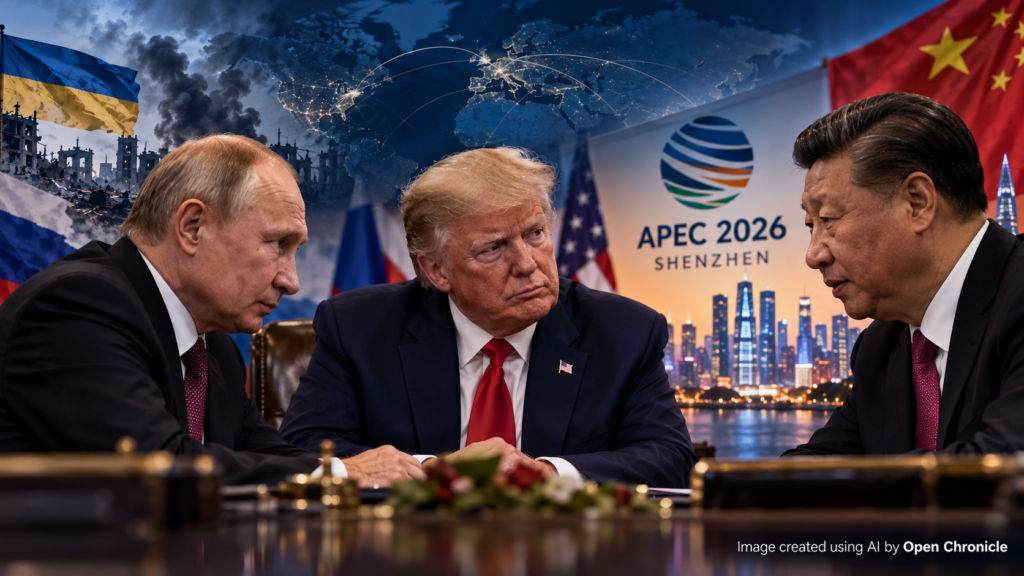
Russian president reportedly seeks a three-way meeting in China as Washington considers new energy arrangements with Moscow and questions grow over the future of Ukraine peace negotiations.
By Open Chronicle News Desk with Agencies
MOSCOW / WASHINGTON / BEIJING — October 19, 2026
Russian President Vladimir Putin has proposed a trilateral summit with US President Donald Trump and Chinese President Xi Jinping next month to discuss a possible settlement of the war in Ukraine, according to a report by The Wall Street Journal.
The proposal, reportedly raised during an October 9 telephone conversation between Putin and Trump, would bring together the leaders of three of the world’s most influential powers at a critical moment for international diplomacy.
Moscow is seeking a negotiated outcome that would protect its strategic interests, while Washington is weighing the diplomatic and economic consequences of closer engagement with Russia.
The proposed meeting could take place on the sidelines of the Asia-Pacific Economic Cooperation (APEC) summit in Shenzhen, China, on November 18–19, according to people familiar with the discussions cited by the newspaper.
However, no agreement to hold the summit has been announced, and significant uncertainty remains over its agenda, participants and political objectives.
Kremlin Confirms Discussions but Says No Agreement Has Been Reached
Kremlin spokesman Dmitry Peskov acknowledged that discussions concerning a possible trilateral meeting were underway but cautioned that no concrete arrangements had been established.
“There is no clear understanding yet regarding the meeting itself or its potential agenda, although all three parties acknowledge the hypothetical possibility of such a meeting taking place,” Peskov told The Wall Street Journal, according to the report.
The statement suggests that Moscow’s proposal remains exploratory rather than an established diplomatic initiative.
A former Russian intelligence officer briefed on the matter reportedly said Putin had suggested similar three-way meetings involving Trump and Xi on several previous occasions.
The Russian president is understood to regard direct negotiations among Washington, Moscow and Beijing as a potentially important mechanism for addressing major international security disputes.
For the Kremlin, such a format could provide an opportunity to present Russia as an indispensable participant in decisions concerning Europe’s security architecture.
It could also strengthen Moscow’s argument that the war in Ukraine cannot be resolved without addressing broader Russian demands concerning NATO, Western military assistance and the balance of power in Europe.
Trump Has Not Accepted the Proposal
According to a senior US official cited by the newspaper, President Trump has not agreed to participate in the proposed summit.
However, the official suggested that Trump could remain receptive to the idea because of his stated determination to end the war in Ukraine.
Trump has repeatedly presented a negotiated settlement as a central objective of his foreign policy.
His administration has also expressed frustration over the continuing conflict, particularly disagreements surrounding military assistance, economic sanctions and Ukrainian attacks against Russian energy infrastructure.
The possibility of a meeting with Putin and Xi would represent a significant diplomatic development.
Nevertheless, the absence of a formal commitment from Washington means that the proposal should not be interpreted as an indication that negotiations have entered a decisive phase.
Any eventual agreement would also raise fundamental questions about Ukraine’s participation in discussions concerning its territory, sovereignty and future security arrangements.
Russian Diesel Deal Signals Possible Shift in US Energy Policy
The summit proposal comes amid reports of a significant change in Washington’s approach to Russian energy exports.
According to The Wall Street Journal, the October 9 conversation between Putin and Trump also resulted in an agreement under which the United States would purchase Russian diesel fuel and facilitate its sale on international markets.
The reported arrangement is intended to help reduce fuel prices at a time when energy costs are placing pressure on the American economy.
High fuel prices have become an increasingly sensitive political issue ahead of the US midterm elections, with Republicans facing voter concerns about inflation and household expenses.
If implemented as described, the arrangement would mark a notable departure from the restrictive energy policies adopted toward Russia following its invasion of Ukraine.
It would also illustrate the tension between Washington’s economic priorities and its efforts to maintain pressure on Moscow.
The precise volume of diesel involved, the financial terms of the arrangement and the mechanisms through which purchases would be conducted were not specified in the supplied reporting.
Nor has the reported agreement been independently confirmed for this article.
Sanctions Decision Raises Questions About Washington’s Russia Strategy
The newspaper also reported that Trump suspended the implementation of sanctions against Russia on Friday under legislation he had signed the previous month.
The reported suspension would represent another important element in the administration’s evolving relationship with Moscow.
Economic sanctions have been a central component of Western efforts to constrain Russia’s ability to finance its military operations and obtain access to international markets.
Any decision to delay or ease restrictions could affect Russia’s economic position and alter the incentives surrounding negotiations.
Supporters of diplomatic engagement may argue that maintaining economic channels could encourage Moscow to remain involved in peace discussions.
Critics, however, could view sanctions relief before a negotiated settlement as a concession that reduces pressure on Russia without securing corresponding commitments.
The legal scope and duration of the reported suspension, together with its relationship to the diesel arrangement, remain unclear from the available account.
These details would be essential to determining whether Washington is undertaking a temporary economic adjustment or a broader strategic reassessment.
China Emerges as a Potential Diplomatic Host
The Kremlin has reportedly suggested holding the proposed summit during the APEC gathering in Shenzhen.
Russian officials are said to have approached Beijing through diplomatic channels to explore the possibility.
According to people familiar with the discussions, Chinese officials indicated that Beijing would not oppose the meeting if Trump agreed to participate.
China’s position reflects the diplomatic complexity of its relationship with both Russia and the United States.
Beijing has maintained close political and economic ties with Moscow while seeking to protect its own commercial relationships with European countries.
Chinese leaders have also consistently emphasised the importance of dialogue in resolving the Ukraine conflict.
A summit involving Putin, Trump and Xi could reinforce China’s international diplomatic profile.
However, it could also create political complications for Beijing.
Beijing Concerned Ukraine Talks Could Overshadow APEC
Some Chinese officials are reportedly concerned that a high-profile meeting focused on Ukraine could overshadow the economic and regional cooperation agenda of the APEC summit.
The gathering is intended to provide a platform for discussions about trade, investment, regional integration and economic development across the Asia-Pacific.
China is expected to use the event to emphasise its economic influence and diplomatic leadership.
A trilateral meeting dominated by the Ukraine war could shift international attention toward the geopolitical relationship among the United States, Russia and China.
Such an outcome might complicate Beijing’s efforts to present itself as a stabilising economic partner.
It could also increase scrutiny of China’s relationship with Russia at a time when European governments remain deeply concerned about Moscow’s military campaign.
For Xi, the challenge would be to balance strategic cooperation with Putin against the economic importance of maintaining constructive relationships with Western markets.
A New Yalta? Questions Over Russia’s Strategic Ambitions
One of the most striking elements of the reported proposal concerns Putin’s alleged long-term ambitions for a trilateral format.
A former Russian intelligence officer cited by The Wall Street Journal suggested that Putin envisages a meeting resembling a second Yalta summit.
The original Yalta Conference, held in February 1945, brought together US President Franklin D. Roosevelt, British Prime Minister Winston Churchill and Soviet leader Joseph Stalin to discuss the final phase of the Second World War and the postwar international order.
The conference subsequently became associated with the division of influence in postwar Europe, although the emergence of the Cold War reflected a broader series of political and military developments.
According to the former intelligence officer, Putin sees a possible summit with Trump and Xi as an opportunity for the three powers to discuss a new international arrangement based on spheres of influence.
That interpretation remains an attributed assessment rather than an officially declared Kremlin objective.
Nevertheless, it raises important questions about Moscow’s conception of international security.
A diplomatic process organised primarily around the interests of major powers could generate concern among smaller countries whose sovereignty and security might be directly affected.
For Ukraine, such a framework would be particularly sensitive.
Kyiv has consistently argued that decisions about its territory and political future must not be imposed by external powers.
Ukraine’s Role Remains the Central Question
The proposed summit would involve the leaders of Russia, the United States and China, but the supplied reporting does not indicate whether Ukrainian representatives would participate in any associated negotiations.
That omission would likely become a major source of controversy if the initiative progressed.
Ukraine has repeatedly insisted that any peace settlement must respect its sovereignty and territorial integrity.
European governments have similarly emphasised the principle that decisions about Ukraine’s future cannot be made without Ukrainian participation.
A summit that excluded Kyiv from substantive negotiations could therefore face resistance even before formal discussions began.
The same concern applies to European security.
Any arrangement involving NATO, sanctions, territorial questions or long-term security guarantees would have direct consequences for European states.
The diplomatic challenge would be to reconcile the influence of major powers with the rights and interests of countries most directly affected by the conflict.
Europe Faces the Prospect of a Changing Diplomatic Balance
The possibility of a US-Russia-China summit comes at a moment of considerable uncertainty for European governments.
The war in Ukraine has fundamentally altered Europe’s security environment, accelerating defence spending, military cooperation and debates about strategic autonomy.
European capitals have also become increasingly concerned about the reliability and direction of US foreign policy.
A trilateral initiative could create opportunities for diplomatic progress if it led to a credible negotiating process involving Ukraine and its European partners.
However, it could also intensify fears that major security decisions might be discussed outside established transatlantic frameworks.
For NATO members, the critical issue would not simply be whether Trump and Putin meet, but whether any negotiations respect existing security commitments and the sovereignty of European states.
The involvement of China would add another dimension, potentially linking the Ukraine settlement to wider questions about trade, technology, Taiwan and the global strategic balance.
The Big Picture: Diplomacy, Energy and the Future World Order
Putin’s reported summit proposal illustrates how the Ukraine war has become entangled with broader questions about international power, economic interests and diplomatic influence.
For Russia, a meeting with the American and Chinese presidents could provide international recognition of Moscow’s continuing strategic importance.
For Trump, the summit might offer an opportunity to pursue his objective of ending the war while presenting himself as a central figure in a major diplomatic initiative.
For Xi, participation could strengthen China’s role as a global diplomatic actor, but it would also carry risks for Beijing’s relations with Europe.
The reported diesel arrangement and sanctions decision introduce an additional dimension.
They suggest that economic considerations, particularly energy prices and domestic political pressures, may increasingly influence Washington’s approach to Russia.
Yet the central challenge remains unchanged.
Ending the war would require more than an agreement among powerful leaders. It would require a settlement capable of addressing Ukraine’s sovereignty, security guarantees, territorial disputes and the long-term stability of Europe.
A trilateral summit could become an important diplomatic opening, but it could also expose fundamental disagreements over who has the authority to shape the international order.
For now, Putin’s proposal remains a possibility rather than a confirmed diplomatic event.
Whether it develops into formal negotiations will depend on decisions in Washington and Beijing, the Kremlin’s willingness to make concessions and, ultimately, whether Ukraine is given a meaningful role in determining its own future.
Sources and Further Reading
1. The Wall Street Journal
Reported details of the proposed trilateral summit, the October 9 conversation and the alleged energy arrangements.
2. Kremlin — Official Presidential Website
Official Russian presidential statements and diplomatic communications.
3. Asia-Pacific Economic Cooperation (APEC)
Institutional information concerning APEC meetings and regional cooperation.
4. Council of the European Union — Sanctions Against Russia
Background on the European sanctions framework and its objectives.
Editorial Note
This article is an original Open Chronicle news synthesis based on the supplied reporting attributed to The Wall Street Journal concerning President Vladimir Putin’s proposed trilateral summit with Donald Trump and Xi Jinping.
The proposed meeting, the reported October 9 telephone conversation, the alleged Russian diesel purchase arrangement and the suspension of US sanctions are presented according to the supplied account. These specific developments have not been independently verified for this article.
Statements attributed to Kremlin spokesman Dmitry Peskov and unnamed officials are identified as reported claims. The comparison with the 1945 Yalta Conference represents an interpretation attributed to a source cited in the reporting, not an established negotiating objective.
The historical and geopolitical sections provide editorial context and analysis. The institutional sources listed above are references for further reading and do not independently confirm every reported development.
Open Chronicle | Independent. Global. Trusted.