
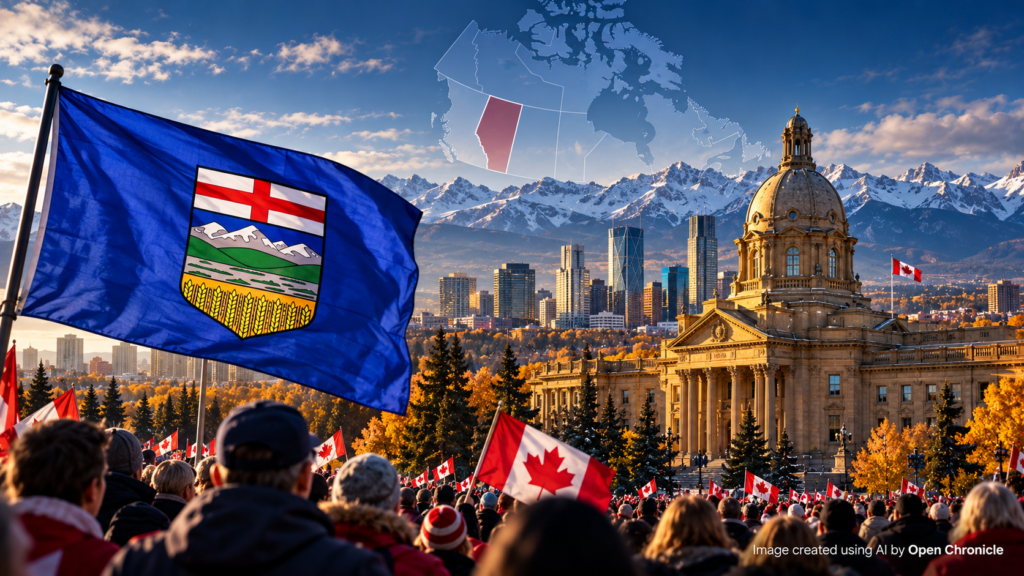
More than three-quarters of voters opposed a proposal to begin the process toward independence, delivering a political victory for Prime Minister Mark Carney as Alberta’s longstanding tensions with Ottawa remain unresolved.
By Open Chronicle News Desk with Agencies
EDMONTON, CANADA — October 20, 2026
Voters in Canada’s oil-rich province of Alberta have overwhelmingly rejected a proposal that could have opened the door to eventual independence, delivering a significant victory for Canadian unity at a time of heightened tensions with the United States.
Early results on Tuesday showed approximately 76% of voters opposing the initiative, compared with around 23% supporting the beginning of a process that could ultimately lead to separation from Canada.
More than one million ballots had been counted when the figures were reported, indicating a decisive defeat for the separatist campaign.
The referendum was not a direct vote on Alberta becoming an independent country. Instead, voters were being asked whether the province should begin a legal and political process that could eventually lead to a second referendum on separation.
The outcome strengthens Prime Minister Mark Carney’s position as his government confronts trade tensions and territorial rhetoric from US President Donald Trump.
However, the result also highlights the continuing divisions between Alberta and Canada’s federal government over energy policy, economic priorities and provincial autonomy.
A Decisive Vote for Canadian Unity
The referendum produced a substantial majority against beginning the process toward separation.
With more than one million votes counted, approximately three out of every four voters opposed the proposal.
Supporters of Canadian unity celebrated the result as evidence that Alberta’s longstanding frustrations with Ottawa had not translated into a desire to leave the federation.
Thomas Lukaszuk, a former Alberta deputy premier who led the Forever Canadian campaign against separation, welcomed the outcome.
“We are a solid country that’s united from coast to coast to coast,” Lukaszuk told supporters.
The result represents a political setback for separatist organizations that had hoped to transform regional discontent into a formal movement toward independence.
Nevertheless, the campaign demonstrated that a significant minority of Albertans remains dissatisfied with the province’s relationship with the federal government.
Delayed Results After Extended Voting Hours
The release of referendum results was delayed after more than 100 polling stations were required to extend their operating hours on Monday.
Late openings at several locations meant that some voters needed additional time to cast their ballots, delaying the counting and publication of results.
Advance participation had already been substantial.
More than 1.35 million Albertans, representing approximately 43% of eligible voters, had cast advance or special ballots before referendum day.
The figures demonstrated considerable public engagement with a question that could have had profound constitutional, economic and political consequences.
The supplied early results did not establish the final turnout or certified vote totals.
What Alberta Was Actually Voting On
The referendum did not ask voters to approve immediate independence.
Instead, the proposal sought public authorization to begin a process that could eventually produce a second vote on whether Alberta should leave Canada.
A victory for the separatist side would therefore not have automatically created an independent Alberta.
It would have initiated a further political and legal process involving questions about constitutional authority, negotiations with the federal government and the practical consequences of separation.
Among the most difficult issues would have been the division of public assets and liabilities, citizenship arrangements, trade relations, federal programmes and the management of energy resources.
The rejection of the proposal means that this process will not begin on the basis of the referendum result.
For supporters of national unity, the outcome removes an immediate source of uncertainty over Canada’s territorial integrity.
Alberta’s Oil Wealth and Longstanding Grievances
Alberta occupies a distinctive position within Canada.
The western province is home to some of the world’s largest proven oil reserves and is a major contributor to Canada’s energy production and export economy.
Its petroleum industry has shaped the province’s economic development, political culture and relationship with the federal government.
Alberta is also known for its conservative traditions, ranching heritage and close cultural and economic connections with the American West.
These characteristics have contributed to a political identity that sometimes differs sharply from the priorities of Ottawa and other Canadian provinces.
Disagreements over federal taxation, environmental regulation, energy infrastructure and the distribution of economic benefits have repeatedly fueled resentment.
For some Albertans, the central question is whether the province receives fair treatment within the Canadian federation.
For others, the benefits of remaining part of Canada outweigh the frustrations associated with federal policy.
The referendum brought these competing perspectives into direct confrontation.
Separatist Supporters Say Alberta Has Been Treated Unfairly
Among voters supporting the initiative, dissatisfaction with Ottawa was a recurring theme.
Dustin Degenhardt, a voter in Wainwright, argued that Alberta had been economically disadvantaged by the federal government.
“Alberta has essentially been treated as, you know, a colony,” he said after voting Monday.
“They want to take and take and take from us and not return anything.”
His comments reflected a broader perception among some separatist supporters that Alberta contributes disproportionately to the national economy without receiving sufficient political influence or financial benefits.
Taylor MacIsaac, another voter in Wainwright, also supported the proposal.
“I think it’ll be good for Alberta to separate personally, as a very conservative individual that grew up in rural Alberta,” she said.
Her position illustrated the role that regional political identity played in the referendum.
For some supporters, separation represented more than a dispute over fiscal policy. It was also a question of cultural identity, political representation and the future direction of the province.
Other Voters Questioned the Cost and Priorities of the Referendum
Opposition to the proposal was not limited to voters who rejected separatism on constitutional or patriotic grounds.
Some Albertans questioned whether the referendum itself represented an appropriate use of public resources.
Dave Malka, 59, of Edmonton, criticized spending money on what he described as a “referendum on a referendum” instead of addressing immediate public needs.
He pointed to health care as an area where government attention and funding could have been better directed.
His criticism reflected concerns that a prolonged constitutional debate could distract from the province’s practical challenges.
Health services, public spending and economic stability remain important issues for Alberta’s residents.
For these voters, the referendum presented an unnecessary political exercise rather than a solution to the province’s problems.
Mark Carney Secures an Important Political Victory
Prime Minister Mark Carney had urged Albertans to reject the separation initiative decisively.
Speaking at a rally in Edmonton on Friday, the city where he grew up, Carney framed the referendum as a defining moment for the country.
“Vote like Canada’s future depends on it because it does,” he told supporters.
The result provides Carney with an important political victory at a time when his government is confronting significant external and domestic pressures.
Canada’s relationship with the United States has been strained by President Trump’s trade policies and repeated suggestions concerning Canadian sovereignty.
Against that backdrop, the possibility of separatist momentum in one of Canada’s most economically important provinces carried implications beyond Alberta’s borders.
A decisive rejection of the proposal reinforces the federal government’s argument that Canadians remain committed to national unity despite regional disagreements.
However, the vote does not eliminate the political grievances that helped generate support for the separatist movement.
Trump’s Trade War Adds a New Dimension to Canadian Unity
The referendum unfolded during an unusually tense period in Canada–United States relations.
President Trump’s trade measures and rhetoric concerning Canada’s political future have increased concerns about economic security and national sovereignty.
For supporters of Canadian unity, these external pressures strengthened the argument against internal fragmentation.
An independent Alberta would face difficult questions about its relationship with both Canada and the United States.
The province’s energy sector depends heavily on integrated transportation networks, international markets and cross-border infrastructure.
Any movement toward separation could create uncertainty for investors, businesses and communities dependent on these economic relationships.
At the same time, Alberta’s substantial natural resources have long encouraged some separatists to argue that the province could sustain itself economically outside the federation.
The referendum exposed the contrast between those competing visions.
Separatist Movement Vows to Continue
Despite the defeat, separatist leaders have indicated that their movement will continue.
Supporters argue that the campaign has transformed what was once a marginal political cause into a more visible force within provincial politics.
The referendum gave separatist organizations an opportunity to organize supporters, mobilize voters and place questions of provincial autonomy at the centre of public debate.
Although the proposal failed, the reported level of support suggests that dissatisfaction with Ottawa remains politically significant.
The movement may now focus on provincial policy, future electoral campaigns or renewed demands for greater autonomy within Canada.
Whether it can maintain momentum after such a decisive defeat remains uncertain.
The Big Picture: Canadian Unity Prevails, but Alberta’s Divisions Remain
The referendum represents an important moment in Canada’s continuing debate over federalism, regional identity and national cohesion.
For Prime Minister Mark Carney, the result is a clear political success.
For supporters of Canadian unity, it demonstrates that the majority of Albertans prefer to address their grievances within the existing federation rather than begin a process toward independence.
For separatists, the defeat exposes the limits of public support for their cause while leaving open the possibility of continued political mobilization.
The outcome also carries wider significance.
At a time of international economic uncertainty and renewed pressure on Canadian sovereignty, Alberta’s voters have rejected a proposal that could have introduced years of constitutional instability.
Nevertheless, the economic and political tensions between Alberta and Ottawa remain.
The federal government will continue to face demands for greater recognition of the province’s energy interests, economic contributions and regional priorities.
Alberta has rejected the path toward separation, but the challenge of reconciling provincial identity with Canadian national unity remains an enduring feature of the country’s political landscape.
Sources and Further Reading
Para complementar a notícia, estas são as referências institucionais e jornalísticas relevantes:
1. Associated Press — International News
Cobertura internacional do Canadá e de acontecimentos políticos. A página geral não confirma, por si só, os resultados apresentados.
2. Elections Alberta — Official Electoral Authority
Autoridade eleitoral provincial, para consultar informações e eventuais resultados oficiais.
3. Government of Alberta
Informação institucional sobre o governo provincial, políticas públicas e estrutura administrativa.
4. Government of Canada
Informação oficial sobre as instituições federais e as relações entre o governo canadiano e as províncias.
Editorial Note
This article is an original Open Chronicle news report based on the supplied account of Alberta’s October 2026 referendum concerning a possible process toward separation from Canada.
The reported vote percentages, ballot figures, polling delays and statements attributed to political figures and voters have been preserved from the supplied material. These details have not been independently verified against certified electoral results for this article.
The article distinguishes between the proposal to initiate a possible separation process and an immediate vote for independence. Its discussion of constitutional, economic and political consequences provides general editorial context rather than a description of formally agreed separation arrangements.
The institutional references above are provided for further reading and verification and should not be interpreted as confirmation of every reported detail.
Open Chronicle | Independent. Global. Trusted.