
OPEN CHRONICLE EXPLAINED | MONEY & ECONOMY
Why the world’s most valuable metals do not always move together — and what their prices reveal about the global economy.
By Open Chronicle Explained
Introduction — Four metals, four different markets
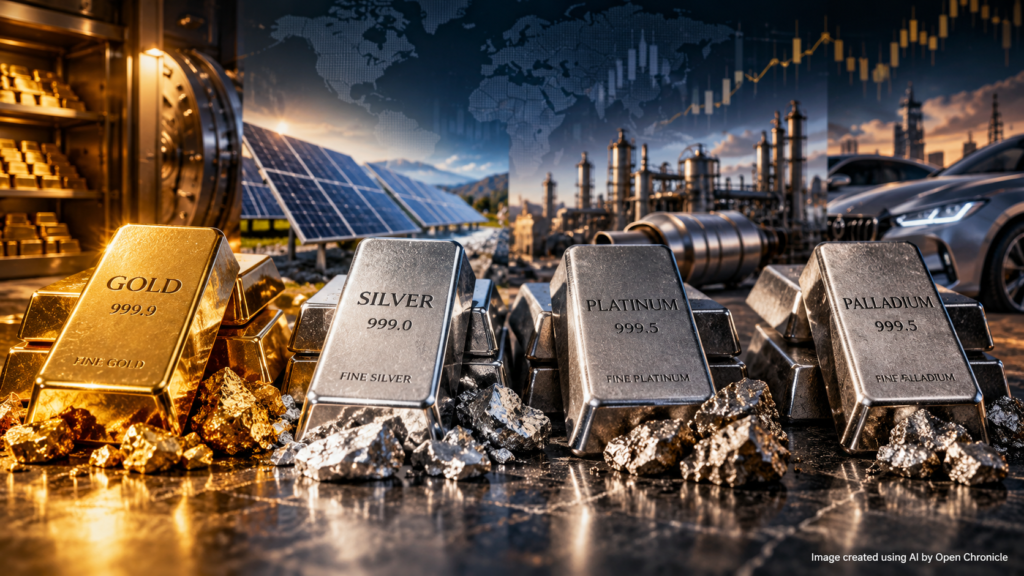
Gold, silver, platinum and palladium are frequently grouped together under a single financial category: precious metals.
They share several characteristics. All are naturally occurring, relatively scarce, internationally traded and valuable in forms ranging from jewellery to industrial products. Their prices respond to supply and demand, financial conditions and changing expectations about the future.
Yet treating precious metals as a single investment category can be misleading.
Gold is closely associated with monetary reserves, investment demand and financial uncertainty. Silver combines investment appeal with substantial industrial consumption. Platinum serves jewellery manufacturers, chemical industries and vehicle-emissions technology. Palladium is particularly sensitive to automotive manufacturing and the evolution of combustion-engine vehicles.
As a result, these metals can behave very differently during the same economic event.
A financial crisis might encourage investors to purchase gold while weakening industrial demand for platinum. An expansion in manufacturing might support silver and platinum even if gold struggles against rising interest rates. A change in automotive technology might alter palladium demand independently of broader commodity prices.
Understanding precious metals market performance therefore requires more than watching whether prices rise or fall. It requires understanding what each metal does, who buys it and why its market changes.
1. What does precious metals market performance actually mean?
The Four Major Precious Metals
Gold, silver, platinum and palladium are all valuable metals, but their markets are driven by different combinations of investment demand, industrial applications, technological change and global supply conditions.
Gold
Investment demand, central-bank reserves, jewellery and financial uncertainty.
Silver
Investment, electronics, electrical systems and photovoltaic technology.
Platinum
Catalytic converters, industrial processes, jewellery and specialist technologies.
Palladium
Gasoline-vehicle emissions systems, industrial demand and automotive technology.
Gold is especially sensitive to monetary and investment conditions. Silver combines financial and industrial demand. Platinum depends heavily on manufacturing and supply conditions, while palladium is particularly exposed to changes in automotive production and emissions-control technology. These differences explain why precious metals do not always move in the same direction.
In financial markets, performance generally refers to how the value of an asset changes over a specified period.
For precious metals, this usually means measuring the percentage change in market prices over a day, month, year or longer investment horizon.
How to Calculate Price Return
Price return measures the percentage change in an asset’s price between two points in time. It is one of the simplest ways to compare the performance of precious metals.
Example: Silver Price Performance
Silver’s price increased by 20% over the selected period.
Price return measures the change in the quoted market price. It does not account for dealer premiums, transaction fees, storage costs, taxes or currency fluctuations. Actual investor returns may therefore differ from the percentage shown.
Suppose silver begins a year at $25 per troy ounce and ends at $30.
Its price return would be 20%.
That does not necessarily mean an investor earned 20%. Physical metal purchases can involve dealer premiums, storage, insurance and selling costs. Financial products may introduce management fees, tracking differences or other expenses.
The measurement period also matters. A metal might deliver strong returns over five years while experiencing substantial losses during individual months.
Consequently, market performance should be assessed through several dimensions: price return, volatility, liquidity, purchasing-power changes and the risks involved in holding the asset.
2. Gold — The metal of monetary confidence
Gold occupies a distinctive position in the international financial system.
For centuries, it served as money, supported monetary arrangements and symbolised accumulated wealth. Although most modern currencies are no longer convertible into gold at a fixed rate, central banks continue to hold it as part of their international reserves.
Gold is also purchased by private investors, jewellery manufacturers, financial institutions and households.
Its market performance reflects the interaction of these different sources of demand.
One of the most important influences is the level of real interest rates — interest rates adjusted for inflation.
Unlike a government bond or savings account, gold does not pay interest. When investors can earn attractive inflation-adjusted returns from relatively safe financial assets, the opportunity cost of holding gold may increase.
When real yields decline, that opportunity cost may fall.
However, the relationship is not mechanical. Gold can rise even when interest rates are relatively high if geopolitical uncertainty, reserve diversification or concerns about financial stability create sufficient demand.
The US dollar also matters because international gold prices are commonly quoted in dollars. A strengthening dollar can make gold more expensive for buyers using other currencies, although exchange-rate effects vary.
Central-bank purchases, exchange-traded investment products, jewellery demand and mine production all contribute to the balance.
Gold is therefore not simply an inflation hedge. Its price reflects a broader assessment of monetary conditions, financial confidence and demand for diversification.
3. Silver — Between investment and industry
Silver has a dual economic identity.
Like gold, it is used for jewellery, coins, bars and investment products. Unlike gold, a substantial share of its demand comes from industrial applications.
Silver’s electrical conductivity, thermal properties and chemical characteristics make it useful in electronics, electrical systems, photovoltaic equipment and specialist manufacturing.
This creates a complicated relationship with economic growth.
When industrial production expands, manufacturers may require more silver. At the same time, investors may purchase silver because they expect monetary instability, inflation or rising precious-metal prices.
These two sources of demand can reinforce one another.
But they can also conflict.
During an economic downturn, demand for industrial silver may weaken even while demand for precious metals as financial assets increases.
Silver can also experience sharper percentage price movements than gold. Its smaller market, industrial exposure and changing investor flows can contribute to greater volatility.
An important recent development illustrates why industrial demand must be analysed carefully: manufacturers can reduce the amount of silver used per product, or substitute other materials, even as production volumes grow.
The growth of solar installations, for example, does not automatically translate into proportionate growth in silver consumption.
Silver’s performance must therefore be understood through both financial-market conditions and technological changes in industrial production.
4. Platinum — Scarcity meets industrial demand
Platinum is associated with luxury jewellery, but its economic importance extends well beyond personal adornment.
It is used in catalytic converters, chemical processes, petroleum refining, laboratory equipment and other specialist industrial applications.
Its supply is geographically concentrated, particularly in Southern Africa, making production vulnerable to disruptions involving electricity, labour, mining investment and infrastructure.
This concentration can create periods of supply uncertainty.
Demand, meanwhile, depends partly on automotive production and industrial activity.
Platinum is used in emissions-control systems, including those fitted to certain combustion-engine vehicles. It also has applications in emerging hydrogen technologies, although the commercial scale and timing of future demand remain uncertain.
Platinum’s price can therefore be influenced by several competing developments: economic growth, mining output, environmental regulation, substitution between platinum-group metals and investment flows.
A useful lesson is that scarcity alone does not guarantee rising prices.
An asset can be physically rare but still decline in value if demand weakens faster than supply.
5. Palladium — The metal shaped by the automotive industry
Palladium is another member of the platinum-group metals, but its demand profile differs significantly from gold’s.
It has been extensively used in catalytic converters for gasoline-powered vehicles, where it helps reduce harmful exhaust emissions.
Consequently, automotive production, emissions standards and the technologies used by vehicle manufacturers can have a major influence on its market.
Supply concentration is another important factor. Russia and South Africa have historically played major roles in palladium production, exposing the market to geopolitical and operational risks.
However, palladium also faces longer-term demand uncertainty.
Battery-electric vehicles do not require exhaust catalytic converters. Increasing electric-vehicle adoption can therefore reduce demand for palladium in this application, although the speed of the transition differs across countries and vehicle segments.
Manufacturers may also substitute platinum for palladium in certain catalytic applications when technical conditions and relative prices make substitution attractive.
Palladium illustrates an essential principle of commodity markets: a metal can be strategically important today while facing structural changes in tomorrow’s demand.
6. Why do precious metals prices rise and fall?
Several forces operate across the four markets, but their importance differs.
Interest rates and monetary policy. Changes in interest rates influence the relative attractiveness of metals compared with yield-bearing financial assets. The effect is generally most prominent in gold investment demand.
Inflation and purchasing power. Some investors purchase precious metals to protect wealth against currency depreciation. However, metal prices do not track consumer inflation consistently over short periods.
Economic growth. Industrial expansion can support demand for silver, platinum and palladium, while recessions may weaken manufacturing-related consumption.
Geopolitical uncertainty. Wars, sanctions, financial instability and disruptions to trade can affect investment demand, supply chains and mining operations.
Mining and recycling. Precious-metal supply depends on production costs, mining investment, ore quality and the recovery of metals from used products. Supply often adjusts slowly.
Technological change. New applications can create demand, while efficiency improvements, substitution and changing technologies can reduce consumption.
No single variable explains every market movement. Prices emerge from the interaction of these forces and from investors’ expectations about what may happen next.
7. Why gold can rise while platinum falls
Imagine a period of economic uncertainty in which investors fear a recession.
Some investors move capital into gold because they want to diversify away from riskier financial assets.
At the same time, vehicle manufacturers reduce production forecasts, weakening expected demand for platinum and palladium.
Gold could rise while the industrial precious metals decline.
Now imagine a different situation: global manufacturing activity accelerates, automotive production expands and investors become less concerned about financial instability.
Platinum and palladium might benefit from stronger industrial demand, while gold experiences less investment interest.
These are illustrative scenarios rather than fixed rules. Actual prices also depend on supply conditions, inventories, exchange rates and expectations already reflected in market valuations.
The central point is that precious metals do not all respond to the same economic story.
8. How to read a precious metals performance chart
A comparative chart commonly displays the percentage performance of gold, silver, platinum and palladium over a chosen period.
To interpret it correctly, readers should consider the starting date, ending date, currency and method of comparison.
One useful technique is to index all four metals to the same starting value, such as 100.
If gold rises by 15%, its index becomes 115. If platinum declines by 10%, its index becomes 90.
This allows a fairer comparison of relative performance than placing their absolute prices on the same axis.
Illustrative Indexed Performance
Hypothetical values, not historical market data. All metals begin at 100.
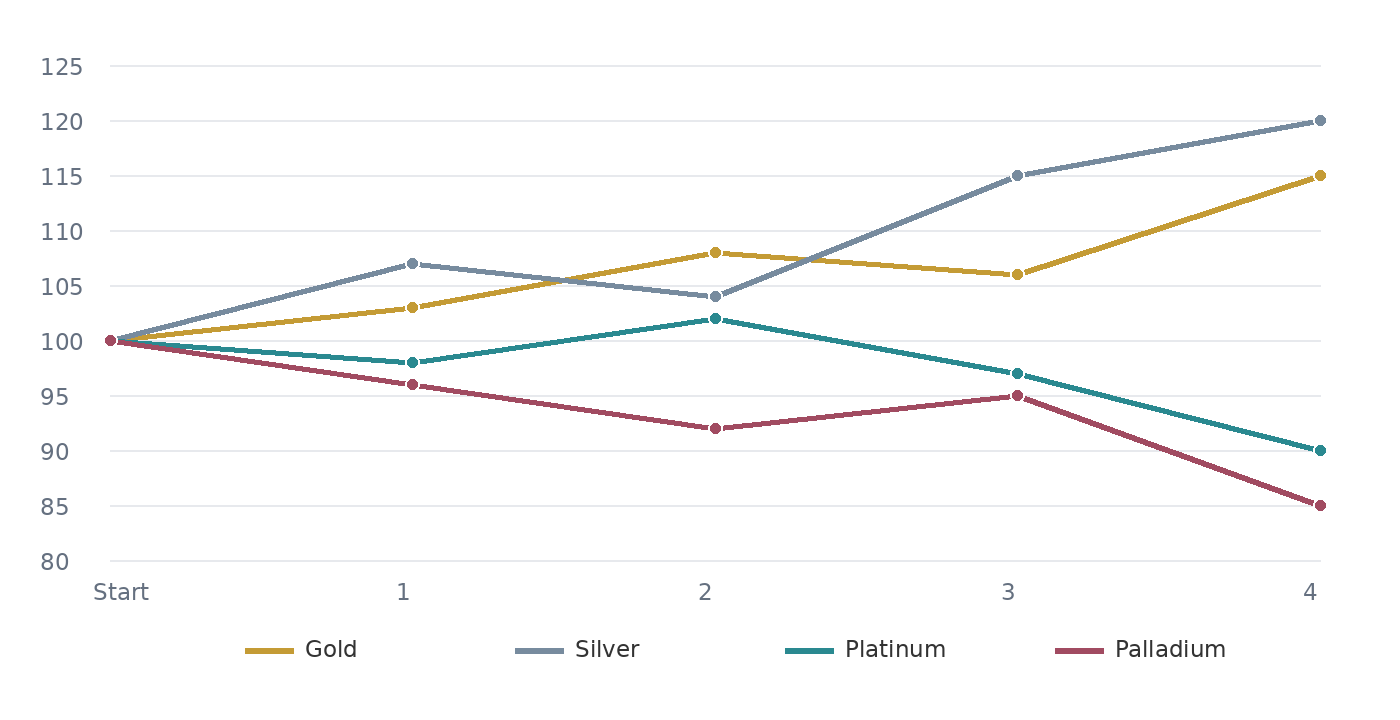
Illustrative example only. Indexed values are hypothetical and do not represent investment returns.
A chart should also be read alongside volatility.
A metal that rises 20% after experiencing repeated large declines presents a different risk profile from one that achieves a similar return through smaller price movements.
Currency is another essential consideration.
A European investor measuring returns in euros may experience different results from an American investor measuring returns in dollars, even when both hold the same quantity of gold.
For this reason, performance is not merely a question of which line finishes highest.
9. Are precious metals reliable protection against inflation?
Precious metals are often described as inflation hedges, but the expression requires qualification.
Over very long periods, gold has sometimes preserved purchasing power during major monetary disruptions. Yet its price can fluctuate substantially, and it may underperform inflation for extended periods.
Silver, platinum and palladium have additional industrial exposures that complicate their relationship with consumer prices.
Inflation can also produce opposing effects.
Rising prices may increase demand for assets perceived as stores of value. But if central banks respond by raising interest rates, higher yields can make non-interest-bearing metals less attractive.
The net result depends on monetary policy, economic confidence and the specific metal concerned.
Precious metals may contribute to diversification, but none should be treated as an automatic guarantee against inflation or financial losses.
10. The environmental and geopolitical dimensions
Precious metals also carry environmental and social implications.
Mining can require substantial energy and water, disturb ecosystems and create risks involving waste management, pollution and local communities.
The consequences vary according to mining methods, regulatory enforcement and geographic conditions.
Supply concentration creates additional challenges. Political instability, sanctions, electricity shortages or transport disruptions in major producing countries can affect international markets.
Recycling offers an important secondary source of supply, particularly for metals recovered from jewellery, industrial equipment and automotive catalytic converters.
As technology changes, recycling systems may become increasingly important for managing supply constraints and reducing some of the environmental pressures associated with primary extraction.
These considerations show why precious metals are not merely financial instruments. They are physical resources embedded in industrial systems, international trade and political geography.
11. What should readers watch when assessing precious metals?
A useful market assessment combines financial and physical indicators.
For gold, relevant information includes real interest rates, the US dollar, central-bank reserve activity and investment flows.
For silver, industrial demand, manufacturing trends, photovoltaic technology and investment activity are particularly important.
For platinum, readers should monitor mining conditions, automotive demand, industrial applications and substitution.
For palladium, the development of gasoline-powered vehicle production, electric-vehicle adoption, recycling and supply concentration deserve attention.
Across all four markets, prices should be compared over consistent periods and in the same currency.
Readers should also distinguish between a price increase driven by temporary speculation and one supported by a sustained change in supply or demand. Even then, neither type of movement guarantees future performance.
Conclusion — Precious metals tell different economic stories
Precious metals have fascinated societies for thousands of years, but their modern markets are far more complex than their traditional association with wealth and rarity suggests.
Gold reflects monetary confidence and investment demand. Silver links financial markets to industrial production. Platinum combines supply constraints with manufacturing applications. Palladium is deeply connected to the changing automotive industry.
Their prices respond to inflation, interest rates, geopolitical events, technology, industrial activity and market expectations — but not in identical ways.
Understanding precious metals market performance means recognising these differences rather than assuming that all valuable metals behave alike.
The most important question is not simply whether a metal’s price is rising.
It is why the price is changing, what economic forces are responsible, and whether those forces are likely to persist.
Sources and Further Reading
The following institutional publications provide additional research and context on precious metals markets, including investment demand, industrial consumption, monetary conditions and global supply trends.
World Gold Council
Research on central-bank purchases, investment demand, interest rates and the economic forces influencing gold prices. The publication provides context for understanding gold’s role in monetary reserves and international financial markets.
The Silver Institute
Research on global silver supply, industrial consumption, investment demand and changes in photovoltaic manufacturing. The survey provides a comprehensive perspective on the economic and technological factors shaping the international silver market.
World Platinum Investment Council
Quarterly analysis of platinum production, automotive and industrial demand, jewellery consumption and investment flows. These reports help explain the relationship between platinum supply, manufacturing activity and changing market conditions.
World Gold Council
Background analysis of inflation, economic growth, monetary policy and geopolitical risk as influences on precious-metal investment. This research offers additional context for interpreting gold prices within broader global financial conditions.
This article provides an educational explanation of precious metals markets. It does not constitute financial advice or recommend buying or selling any particular metal. The illustrative performance chart uses hypothetical values and does not represent historical returns. Market conditions, prices and supply-and-demand forecasts can change.
Understanding the systems behind the headlines.
Explore Open Chronicle Explained →