
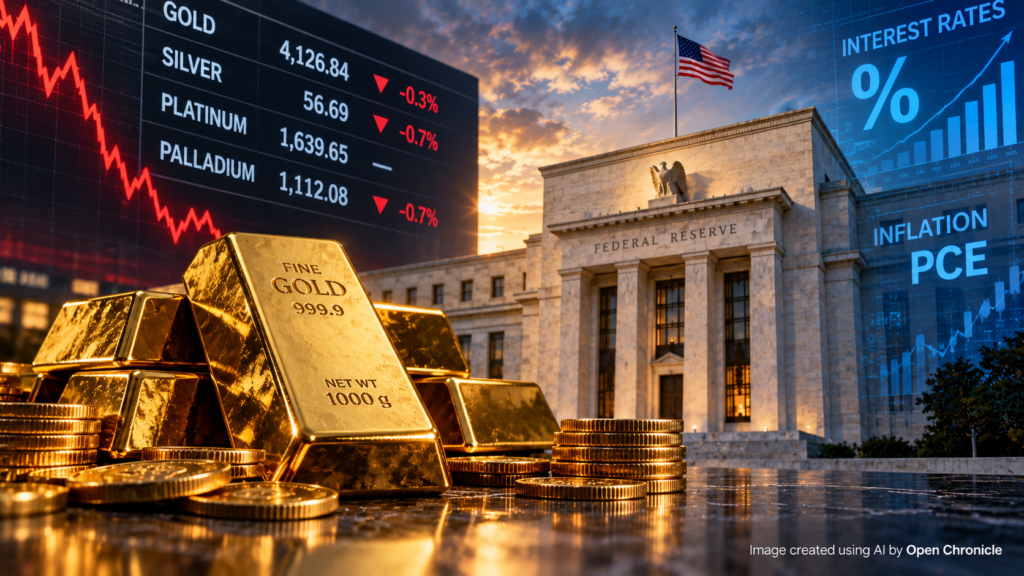
Gold slipped below $4,130 an ounce on Tuesday as investors adopted a cautious approach ahead of the Federal Reserve’s October policy meeting and upcoming US inflation figures. Silver and palladium also declined, while platinum remained largely unchanged.
By Open Chronicle News Desk with Agencies
NEW YORK / LONDON — October 20, 2026
Gold prices declined during Tuesday’s trading session as global financial markets turned cautious ahead of the US Federal Reserve’s next monetary policy meeting and the release of important American inflation data.
Spot gold fell 0.3% to $4,126.84 per ounce, while US gold futures for December delivery declined by the same percentage to $4,146 an ounce, according to the market figures provided.
The retreat came as investors reassessed expectations for US interest rates, inflation and the broader direction of monetary policy.
Although gold remains an important asset for investors seeking protection against economic and geopolitical uncertainty, its performance is closely influenced by interest-rate expectations, movements in the US dollar and changes in government bond yields.
With the Federal Reserve’s next policy decision approaching, traders are looking for clearer indications of whether borrowing costs will remain unchanged or move higher in the coming months.
Gold Retreats in Spot and Futures Markets
The latest trading figures indicate a modest but broad decline in gold prices.
Spot gold, which reflects the price of the metal for immediate delivery, fell 0.3% to $4,126.84 per ounce.
Meanwhile, US gold futures for December delivery dropped 0.3% to $4,146 an ounce.
The figures place futures approximately $19.16 above the reported spot price.
This difference reflects the separate pricing mechanisms of spot and futures markets, which can be influenced by financing costs, delivery schedules and market expectations.
Despite the decline, gold continues to trade at historically elevated nominal price levels according to the supplied figures.
The immediate market focus, however, is less on the absolute price of the metal than on the potential implications of the Federal Reserve’s next policy decision.
Federal Reserve Meeting Takes Centre Stage
Investors are preparing for the Federal Reserve’s monetary policy meeting scheduled for October 27–28.
The meeting is expected to provide further guidance on the direction of US interest rates and the central bank’s assessment of economic conditions.
The Federal Reserve faces the continuing challenge of balancing inflation control with economic growth and labour-market stability.
Its monetary policy decisions influence borrowing costs across the American economy and have important consequences for international financial markets.
For gold investors, the central question is whether interest rates will remain at their current levels or move higher.
A more restrictive monetary policy outlook could place pressure on precious metals, particularly if it strengthens the dollar or pushes government bond yields upward.
Conversely, indications that the Federal Reserve is approaching a period of lower interest rates could provide support for gold.
Market participants will therefore examine not only the policy decision itself but also the accompanying statement and any subsequent comments from Federal Reserve officials.
US Inflation Data Could Influence the Next Policy Decision
Another important development for investors will be the release of US personal consumption expenditures inflation data.
The Personal Consumption Expenditures Price Index, commonly known as the PCE price index, is a closely watched measure of inflation.
The Federal Reserve uses the PCE index when assessing progress toward its long-term inflation objective of 2%.
The index measures changes in prices paid by consumers for goods and services and provides a broad view of inflationary pressures across the economy.
Particular attention is generally paid to the core PCE index, which excludes volatile food and energy prices.
A higher-than-expected inflation reading could reinforce expectations that the Federal Reserve will maintain restrictive monetary conditions.
A weaker reading, by contrast, could strengthen arguments for a less restrictive policy stance.
For gold, these outcomes matter because inflation expectations and interest-rate forecasts can influence both the metal’s investment appeal and its opportunity cost.
Markets Price in High Probability of Unchanged Rates
According to the supplied market data attributed to CME Group’s FedWatch tool, traders are pricing in an 83% probability that the Federal Reserve will leave interest rates unchanged at its upcoming October meeting.
The same account cites a 94% probability of an interest-rate increase at the December meeting.
These figures suggest that investors are distinguishing between the immediate policy outlook and expectations for the end of the year.
However, the reported December probability requires confirmation against the underlying FedWatch contract data, including the specific target-rate range and meeting date.
FedWatch probabilities are derived from futures-market pricing and can change rapidly as economic indicators and central-bank communications evolve.
They should not be interpreted as official Federal Reserve forecasts or commitments.
The apparent contrast between expectations for October and December also illustrates the uncertainty surrounding the future path of US monetary policy.
For investors, this uncertainty can encourage short-term repositioning in gold and other interest-rate-sensitive assets.
Why Higher Interest Rates Can Weigh on Gold
Gold differs from many financial assets because it does not generate regular interest payments or dividends.
Investors holding physical gold generally depend on price appreciation rather than recurring income.
When interest rates rise, the relative attractiveness of interest-bearing assets can increase.
US Treasury securities, bank deposits and other fixed-income investments may offer higher returns, increasing the opportunity cost of holding non-yielding assets such as gold.
Higher interest rates can also support the US dollar.
Because gold is generally priced internationally in dollars, a stronger American currency can make the metal more expensive for buyers using other currencies.
This relationship can reduce international demand, although the effect is neither automatic nor uniform.
Gold prices are also influenced by central-bank purchases, geopolitical uncertainty, inflation expectations, investment flows and changes in financial-market confidence.
Consequently, gold can sometimes rise even during periods of elevated interest rates if other sources of demand are sufficiently strong.
Silver and Palladium Decline as Platinum Holds Steady
The weakness in gold was accompanied by declines in other precious metals.
Silver fell 0.7% to $56.69 an ounce.
Palladium also declined 0.7%, reaching $1,112.08 an ounce.
Platinum was comparatively stable, trading at $1,639.65 an ounce.
Precious Metals Market Performance
| Precious Metal | Reported Price | Daily Change |
|---|---|---|
| Gold — Spot | $4,126.84/oz | −0.3% |
| Gold — US December Futures | $4,146.00/oz | −0.3% |
| Silver | $56.69/oz | −0.7% |
| Platinum | $1,639.65/oz | Broadly unchanged |
| Palladium | $1,112.08/oz | −0.7% |
Prices are in US dollars per troy ounce and reflect the supplied October 20, 2026, market snapshot. They are not independently verified live quotations.
The movements illustrate how monetary policy expectations can affect several precious metals simultaneously.
However, each metal also responds to distinct supply-and-demand conditions.
Silver has significant industrial applications, including electronics and solar energy technologies.
Platinum and palladium are used extensively in industrial processes, particularly automotive emissions-control systems.
As a result, their prices can also respond to manufacturing activity, vehicle production trends and developments in global supply chains.
Investors Assess Dollar Strength and Bond Yields
Beyond the Federal Reserve’s policy decisions, investors will be watching the US dollar and Treasury yields.
Gold often faces pressure when the dollar strengthens because the metal becomes more expensive for holders of other currencies.
Rising Treasury yields can also increase competition for investment capital.
Conversely, falling yields and a weaker dollar may improve the relative attractiveness of gold.
The supplied market account does not provide specific movements in the US Dollar Index or Treasury yields during Tuesday’s session.
It is therefore not possible to establish how much of the reported decline was directly attributable to those factors.
Nevertheless, both indicators are likely to remain important reference points as markets approach the Federal Reserve meeting.
Gold’s Safe-Haven Appeal Remains an Important Factor
Gold is widely regarded as a potential safe-haven asset during periods of economic instability, financial uncertainty and geopolitical tension.
Investors may increase their exposure to the metal when they are concerned about inflation, currency depreciation or broader financial-market risks.
Central banks also hold gold as part of their international reserves.
These sources of demand can sometimes counterbalance the negative effects of higher interest rates.
The current market environment presents competing forces.
On one side, uncertainty over monetary policy and the possibility of sustained elevated interest rates may limit short-term demand.
On the other, geopolitical instability and concerns about the global economic outlook can continue to support interest in gold.
The balance between these factors will help determine whether Tuesday’s decline develops into a broader correction or remains a temporary market adjustment.
What Investors Will Watch Next
The coming days are expected to bring several developments capable of influencing precious-metal prices.
The Federal Reserve’s October 27–28 meeting will be a central event, particularly if policymakers provide new guidance on the likely direction of interest rates.
The upcoming PCE inflation release will offer additional evidence about the persistence of inflationary pressures in the United States.
Investors will also monitor movements in the dollar, government bond yields and broader financial-market sentiment.
For gold, a significant change in expectations about US monetary policy could produce renewed volatility.
However, the direction of the next price movement cannot be determined from the current market snapshot alone.
The Big Picture: Gold Faces a Monetary Policy Test
Tuesday’s decline in gold prices reflects the cautious atmosphere surrounding the next Federal Reserve decision.
With spot gold at $4,126.84 an ounce and December futures at $4,146, the market remains sensitive to changes in expectations about inflation and interest rates.
The accompanying declines in silver and palladium suggest that the cautious sentiment extended beyond gold, although platinum remained comparatively stable.
The immediate challenge for investors is assessing whether the Federal Reserve will maintain its current policy stance or signal a change in the months ahead.
Inflation data will play an important role in shaping those expectations.
At the same time, gold’s longer-term performance will continue to reflect a combination of monetary policy, currency movements, central-bank demand and geopolitical developments.
For now, precious-metal markets are entering a period of heightened attention to US economic data, with the Federal Reserve’s next decision likely to influence trading sentiment well beyond the United States.
Sources and Further Reading
1. Federal Reserve — Monetary Policy
Official information about Federal Reserve monetary policy, objectives and decisions.
2. CME Group — FedWatch Tool
Market-implied probabilities for future Federal Reserve interest-rate decisions.
3. US Bureau of Economic Analysis — PCE Price Index
Official information on the Federal Reserve’s preferred inflation measure.
4. World Gold Council — Goldhub
Research, market data and analysis concerning gold demand, investment and pricing.
Editorial Note
This article is an original Open Chronicle financial news synthesis based on the supplied market data concerning gold and other precious metals on October 20, 2026.
The reported spot and futures prices, percentage movements and prices for silver, platinum and palladium are reproduced from the supplied information. These figures have not been independently verified against live exchange or market-data feeds.
The probabilities attributed to CME Group’s FedWatch tool, including the reported 83% likelihood of unchanged rates in October and 94% probability of a December rate increase, require direct verification against the tool’s historical data. They should not be treated as independently confirmed market expectations.
The discussion of interest rates, inflation, Treasury yields and the US dollar provides general financial context. It does not establish that any single factor directly caused the reported price movements.
This article is intended for general news and financial information and does not constitute investment advice.
Open Chronicle | Independent. Global. Trusted.