
OPEN CHRONICLE SCIENCE | SPACE EXPLORATION · PLANETARY SCIENCE
Japan’s MMX spacecraft has begun an ambitious journey to investigate the origins of Phobos and Deimos, collect material from the surface of a Martian moon and return extraterrestrial samples to Earth.
By Open Chronicle Science Desk
Japan has opened a new chapter in planetary exploration with the launch of the Martian Moons eXploration mission, better known as MMX, an ambitious scientific expedition designed to investigate two of the Solar System’s most enigmatic natural satellites.
Developed by the Japan Aerospace Exploration Agency (JAXA), the spacecraft was launched aboard an H3 rocket from the Tanegashima Space Center on 20 October 2026, beginning a journey that could fundamentally change our understanding of the origin and evolution of Mars’ moons.
Its principal destination is Phobos, the larger and innermost of the two small moons orbiting the Red Planet. Unlike previous missions that observed these bodies from a distance, MMX aims to approach Phobos, examine its surface in detail, collect samples and eventually transport them back to Earth.
The mission will also investigate Deimos, Mars’ smaller and more distant moon, providing scientists with an opportunity to compare two objects whose origins have remained uncertain for generations.
At the centre of the expedition is a question that reaches far beyond Mars itself: how do moons form around terrestrial planets?
Scientists have long debated whether Phobos and Deimos are captured asteroids or remnants of material ejected into orbit following a massive collision with ancient Mars.
Both explanations have important implications for the history of the Solar System.
By combining orbital observations, surface measurements and laboratory analysis of returned samples, MMX could provide the evidence needed to distinguish between competing theories.
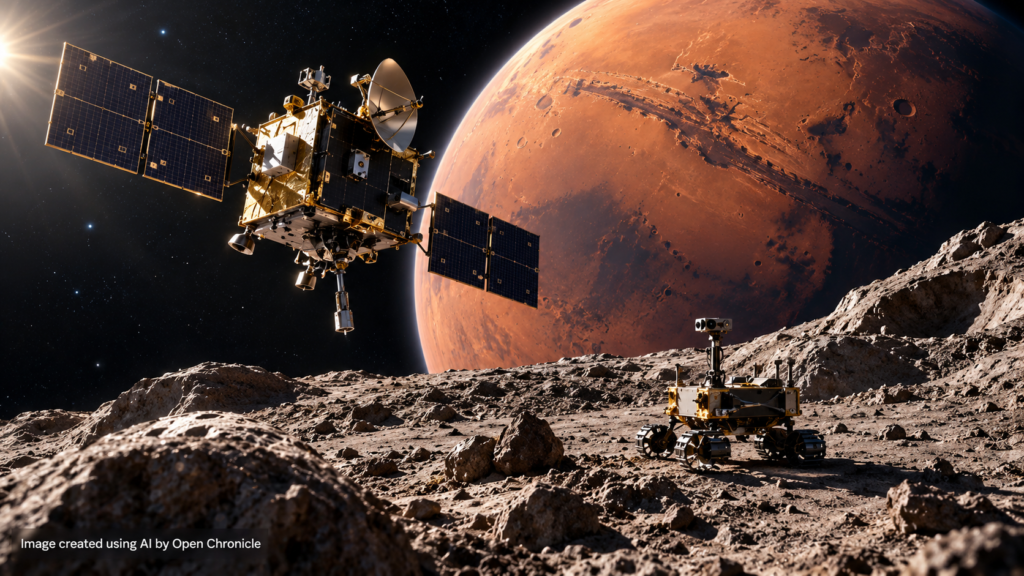
The spacecraft also carries a small European rover, IDEFIX, developed through a collaboration between the German Aerospace Center (DLR) and the French space agency CNES. The rover will investigate the physical properties of Phobos’ surface in an environment where gravity is only a tiny fraction of Earth’s.
If the mission proceeds according to plan, samples collected from Phobos will reach Earth in 2031, offering researchers an unprecedented opportunity to study material from a Martian moon directly.
For planetary scientists, those samples could become a valuable archive of the early history of Mars and the processes that shaped the inner Solar System.
1. A New Era in Japanese Planetary Exploration
Japan has developed considerable expertise in robotic exploration and the return of extraterrestrial material.
Its Hayabusa programme demonstrated that spacecraft could travel to small celestial bodies, collect samples under extremely challenging conditions and bring them safely back to Earth.
Hayabusa returned microscopic material from the asteroid Itokawa in 2010, while Hayabusa2 delivered samples from the carbon-rich asteroid Ryugu in December 2020.
Those missions helped establish Japan as a major contributor to sample-return science.
MMX builds upon that experience but introduces a substantially different set of challenges.
Unlike the asteroids previously visited by Japanese spacecraft, Phobos orbits a planet with a significant gravitational field and a complex dynamical environment.
The spacecraft must navigate around Mars while conducting prolonged observations of a small, irregularly shaped moon.
It must also approach Phobos closely enough to acquire material from its surface without losing control of its trajectory.
After completing its scientific operations, the spacecraft will need to depart the Martian system and begin the long journey back to Earth.
The mission therefore combines several demanding technologies: interplanetary navigation, precision orbital operations, surface sampling, autonomous spacecraft control and sample-return engineering.
Its scientific value depends on the successful integration of all these systems.
2. Phobos: A Small Moon with an Enormous Scientific Mystery
Phobos is an irregularly shaped natural satellite measuring approximately 27 kilometres along its longest dimension.
It orbits Mars at an average distance of roughly 9,400 kilometres from the planet’s centre, making it one of the closest-orbiting natural satellites in the Solar System relative to the surface of its parent planet.
A complete orbit takes approximately seven hours and 39 minutes.
Because Phobos travels around Mars faster than Mars rotates, it appears to rise in the west and set in the east when observed from the Martian surface.
The moon is heavily cratered and covered by a layer of loose surface material known as regolith.
Its most prominent geological feature is Stickney, an enormous impact crater approximately nine kilometres across.
The crater occupies a substantial fraction of Phobos’ surface and provides evidence of a violent collisional history.
Long grooves and linear features extend across parts of the moon, although their origins remain the subject of scientific investigation.
Some may be associated with impact processes, while others have been linked to tidal stresses or the movement of surface material.
Phobos is also unusual because its orbit is gradually shrinking.
Tidal interactions with Mars cause the moon to move slowly closer to the planet.
Over geological timescales, Phobos may eventually break apart under tidal forces or collide with Mars, although the precise outcome and timing depend on its internal structure and dynamical evolution.
Understanding the moon’s composition and mechanical properties is therefore important not only for reconstructing its past but also for predicting its distant future.
3. Deimos: The Smaller and More Distant Companion
Deimos, the outer moon of Mars, is smaller and more distant than Phobos.
It measures approximately 15 kilometres along its longest dimension and completes an orbit around Mars in about 30.3 hours.
Like Phobos, it has an irregular shape and a dark surface.
However, its appearance differs in important ways.
Deimos has a relatively smooth-looking surface, partly because loose material has accumulated within and around impact craters.
Its orbital motion also differs from that of Phobos.
Deimos orbits farther from Mars and moves more slowly than the planet rotates.
Consequently, it appears to rise in the east and set in the west when viewed from the Martian surface.
Both moons were discovered in 1877 by the American astronomer Asaph Hall.
Their names were inspired by figures associated with Ares, the Greek god of war, whose Roman counterpart is Mars.
Despite nearly 150 years of astronomical observations and multiple spacecraft encounters, their origin remains unresolved.
That uncertainty is precisely what makes the MMX mission so important.
4. Were Mars’ Moons Captured Asteroids?
One longstanding explanation proposes that Phobos and Deimos originated as asteroids.
According to this hypothesis, the objects formed elsewhere in the Solar System and were subsequently captured by the gravitational influence of Mars.
Several observations initially appeared to support this interpretation.
Both moons have dark surfaces and spectral properties resembling those of certain primitive asteroids.
Their irregular shapes also resemble those of small bodies found in the asteroid belt.
Such similarities suggest that they may contain ancient materials dating back to the earliest stages of Solar System formation.
However, the capture hypothesis faces a major difficulty.
Both Phobos and Deimos occupy nearly circular orbits that lie close to Mars’ equatorial plane.
Objects captured from independent heliocentric orbits would not necessarily settle naturally into such configurations.
Additional processes would be required to remove orbital energy and reduce eccentricity and inclination.
Researchers have proposed mechanisms involving interactions with gas, collisions, tidal evolution or temporary capture.
These possibilities remain subjects of theoretical investigation.
If Phobos originated as a captured asteroid, its mineralogical and isotopic composition could preserve evidence of formation in a region of the Solar System distinct from Mars.
That possibility makes laboratory analysis of returned samples especially valuable.
5. The Giant-Impact Hypothesis
An alternative explanation suggests that Phobos and Deimos formed from debris produced by a major collision with Mars early in its history.
Large impacts were common during the formation of the terrestrial planets.
Earth’s Moon is widely understood to have formed following a giant collision, although the details of that event remain actively investigated.
A similar process may have occurred around Mars.
In this scenario, a substantial impact would have ejected Martian material, together with material from the impactor, into orbit.
Some of the debris could have formed a temporary disk around the planet.
Through gravitational interactions, collisions and accretion, portions of that disk may have assembled into one or more satellites.
This explanation offers a natural mechanism for producing moons with relatively low orbital inclinations and eccentricities.
However, it raises questions of its own.
Scientists must explain how the debris evolved, why the present moons are so small and how their observed compositions relate to the materials expected from a giant impact.
Some models suggest that larger moons may once have existed around Mars before migrating inward and disappearing.
Others propose complex histories involving repeated moon formation, destruction and reaccretion.
These scenarios can be investigated using numerical simulations, but their predictions require observational tests.
The MMX samples may provide precisely the kind of evidence needed.
6. A Third Possibility: The Remains of an Ancient Moon
The origin of Phobos and Deimos may be more complicated than either a straightforward capture event or a single giant impact.
Some researchers have investigated whether the two moons could be remnants of a larger progenitor body that fragmented during the evolution of the Martian satellite system.
In this scenario, Phobos and Deimos might share a common ancestry.
Their present orbits would represent the outcome of a longer dynamical history involving tidal interactions, collisions and orbital changes.
The hypothesis has been explored through numerical modelling, although important uncertainties remain.
Other studies have examined temporary capture mechanisms and the possibility that a disrupted asteroid could produce material that eventually formed the present moons.
These models demonstrate that the origin problem cannot necessarily be reduced to two mutually exclusive explanations.
Different processes may have operated at different stages.
A body could have been captured, disrupted and subsequently reassembled.
Alternatively, material generated by an impact could have undergone multiple episodes of orbital evolution before producing the moons observed today.
Determining which sequence of events actually occurred requires evidence about the composition, age and internal history of the satellites.
That is why sample-return missions are so valuable.
They allow scientists to move beyond remote observations and test hypotheses directly against physical material.
7. What MMX Will Measure
The MMX spacecraft carries scientific instruments designed to investigate the composition, geological structure and physical environment of Phobos and Deimos.
These instruments will examine the moons at different spatial scales and through different measurement techniques.
High-resolution imaging will reveal surface features, crater distributions, boulders and possible geological boundaries.
Multispectral observations will help identify variations in surface materials.
Infrared spectroscopy will provide information about minerals and other compounds through their interactions with electromagnetic radiation.
Gamma-ray and neutron measurements can help determine the abundance of chemical elements in near-surface material.
Laser ranging will support precise measurements of spacecraft distance and surface topography.
Together, these observations will help researchers identify suitable locations for sampling and place the returned material within a broader geological context.
This last point is particularly important.
A laboratory sample is scientifically more valuable when researchers know where it originated, what surrounding materials were present and how its location relates to the geological history of the body.
Without such context, interpreting the age and composition of a sample becomes more difficult.
MMX is designed to connect detailed remote sensing with direct laboratory investigation.
8. The Instruments Behind the Science
Among the mission’s instruments is MEGANE, a gamma-ray and neutron spectrometer developed through collaboration involving NASA and the Johns Hopkins University Applied Physics Laboratory.
MEGANE will investigate the elemental composition of Phobos.
By measuring radiation produced through interactions between cosmic rays and surface materials, the instrument can provide information about elements present within the upper layers of the regolith.
Another major instrument is MIRS, an infrared spectrometer intended to study the mineralogical properties of the Martian moons.
Infrared observations can reveal absorption features associated with particular minerals and chemical bonds.
The spacecraft also carries imaging systems designed to observe surface features and support navigation.
TENGOO provides high-resolution imaging, while OROCHI performs multispectral observations.
A LIDAR system measures distances using laser pulses and supports topographic investigation.
These instruments serve complementary purposes.
A region that appears visually uniform may contain important chemical variations.
Conversely, areas with similar spectral properties may display different geological structures.
Combining measurements can help distinguish surface alteration processes from differences in original composition.
The spacecraft’s observations will also provide information about the distribution of dust, boulders and other hazards relevant to sampling operations.
9. IDEFIX: A European Rover on a Martian Moon
One of the most innovative components of MMX is the small rover IDEFIX.
Developed jointly by the German Aerospace Center and the French space agency CNES, the rover is designed to operate on the surface of Phobos.
Its mission presents engineering challenges very different from those faced by rovers on Mars or the Moon.
Phobos has extremely weak gravity.
A vehicle operating there must avoid movements that could cause it to bounce, lose traction or become destabilised.
Even relatively small mechanical forces can have significant consequences in such an environment.
IDEFIX has been designed to accommodate these conditions.
The rover will examine the surface at close range, providing information about terrain structure, regolith properties and local environmental conditions.
Its scientific equipment includes instruments for studying the mineralogical and thermal characteristics of the surface.
The RAX Raman spectrometer will investigate material composition, while the miniRAD radiometer will measure thermal properties.
Cameras will document the surrounding terrain and help scientists interpret the measurements.
These observations could reveal whether the surface consists primarily of loose dust, compacted particles, rocky fragments or combinations of different materials.
They may also help explain how regolith behaves under extremely weak gravity.
Such information is important for understanding the geological evolution of small bodies and for planning future robotic operations.
10. Landing Where Gravity Is Almost Absent
Operating near Phobos requires a different approach from landing on a conventional planetary surface.
The moon’s gravitational attraction is extremely weak.
A spacecraft approaching too rapidly could rebound from the surface or fail to maintain a stable contact configuration.
MMX must therefore control its relative motion with great precision.
The spacecraft is expected to operate in specialised trajectories around Mars that allow repeated close observations of Phobos.
These trajectories are designed to accommodate the gravitational influence of Mars while maintaining favourable conditions for studying the moon.
The sampling operations will involve carefully controlled approaches to the surface.
The spacecraft must identify a suitable location, descend safely, collect material and depart without compromising its ability to return to Earth.
Because communication signals require several minutes to travel between Earth and Mars, the mission cannot depend entirely on immediate human commands.
Autonomous navigation and onboard control systems are therefore essential.
The spacecraft must respond to local conditions while operating within parameters established by mission controllers.
These technical challenges make the MMX mission an important demonstration of advanced robotic exploration.
11. How to Collect Samples from Phobos
The mission’s sample-return system is designed to collect at least 10 grams of material from Phobos.
Although this quantity may seem small, modern analytical techniques can extract substantial scientific information from tiny samples.
MMX includes complementary sampling methods.
One involves collecting material from beneath the immediate surface, while another uses a pneumatic system to acquire loose particles.
The combination is intended to increase the likelihood of obtaining scientifically useful material.
The precise depth and composition of the collected samples will depend on local surface conditions and the success of the sampling operations.
After collection, the material must be securely contained to reduce contamination and preserve its scientific value.
The samples will then remain aboard the spacecraft during the return journey.
A return capsule is expected to separate from the spacecraft as it approaches Earth.
The capsule will enter the atmosphere and descend toward a designated recovery region in Australia.
Once recovered, the samples will be transferred to specialised facilities for documentation, curation and scientific analysis.
Strict handling procedures will be important because terrestrial contamination could complicate the interpretation of trace chemical compounds and isotopic signatures.
The objective is to preserve the material as a reliable record of its extraterrestrial origin.
12. What Can Ten Grams of Extraterrestrial Material Reveal?
One of the most remarkable aspects of modern planetary science is the amount of information that can be extracted from a relatively small quantity of material.
Ten grams of regolith may contain thousands of individual mineral grains, microscopic rock fragments and particles with different geological histories.
Researchers can examine these materials using several complementary techniques.
Mineralogical analysis
X-ray diffraction, electron microscopy and spectroscopic methods can help identify the minerals present in the samples.
Different minerals form under different physical and chemical conditions.
Their presence may therefore reveal whether the original material experienced high temperatures, collisions, interactions with water or other geological processes.
If the samples contain mineral assemblages resembling known Martian materials, this could support a connection with the planet’s crust or mantle.
If they instead resemble primitive asteroid material, the results could strengthen certain capture scenarios.
However, neither resemblance would automatically establish a definitive origin.
Isotopic measurements
Isotopes are forms of the same chemical element that contain different numbers of neutrons.
Their relative abundances can preserve information about the formation and evolution of planetary materials.
Oxygen isotopes, for example, are frequently used to compare meteorites and planetary reservoirs.
Other isotope systems can help investigate the timing of geological events or the effects of exposure to cosmic radiation.
By comparing the isotopic characteristics of Phobos samples with Martian meteorites and other extraterrestrial materials, scientists may be able to identify important relationships.
Such comparisons will require careful consideration of possible mixing between materials of different origins.
Radiometric dating
Certain radioactive isotopes decay at predictable rates, providing natural clocks for geological investigation.
Depending on the minerals present, researchers may be able to estimate when particular components formed or experienced major thermal events.
These ages could help establish whether the material originated during the earliest stages of Solar System history or underwent later modification.
However, regolith is often a mixture of particles with different histories.
An age measured in an individual grain may date the formation of that mineral rather than the formation of Phobos itself.
Distinguishing these events will be a major interpretative challenge.
Space weathering and impact history
Phobos has been exposed to micrometeorite impacts, solar radiation and energetic particles over immense periods.
These processes can alter the physical and chemical properties of surface grains.
Laboratory analysis may help determine how space weathering has modified the moon’s appearance.
This information could explain why its surface resembles certain asteroids even if its original material had a different composition.
It could also improve the interpretation of remote observations of other small bodies throughout the Solar System.
13. Could Phobos Contain Material from Mars?
An especially intriguing possibility is that the surface of Phobos contains fragments originally ejected from Mars.
Large impacts on the Martian surface can accelerate rocks and dust to high velocities.
Some material may escape the planet entirely, while other fragments can enter trajectories that bring them into contact with nearby objects.
Because Phobos orbits relatively close to Mars, its surface may have accumulated a small proportion of Martian ejecta over time.
If such particles are present in the returned samples, they could provide information about the composition and geological history of Mars.
This possibility is particularly valuable because obtaining material directly from the Martian surface and returning it to Earth is an exceptionally demanding undertaking.
However, material collected from Phobos would not be equivalent to a carefully selected geological sample obtained directly from an identified location on Mars.
Its original source region might be unknown, and individual particles could have experienced significant alteration during ejection, transport and exposure to space.
Nevertheless, the discovery of identifiable Martian fragments within the returned material could provide an additional scientific opportunity.
It might allow researchers to investigate aspects of Mars’ crustal composition and impact history alongside the primary investigation of Phobos itself.
14. Mars, Its Moons and the Early Solar System
The scientific importance of MMX extends beyond the two Martian satellites.
Understanding their origins may help researchers reconstruct the early evolution of the inner Solar System.
Approximately 4.6 billion years ago, the Solar System formed from a rotating cloud of gas and dust.
Within the protoplanetary disk, solid particles gradually accumulated into larger bodies.
Collisions, gravitational interactions and the movement of material between different regions played central roles in planetary formation.
Some collisions resulted in growth, while others produced fragmentation and debris.
The terrestrial planets emerged from this dynamic environment.
Their histories were shaped by impacts, internal differentiation, volcanic activity and interactions with surrounding material.
Natural satellites preserve evidence of these processes.
Earth’s Moon provides one example of how the study of a satellite can reveal important information about the formation of its parent planet.
The Martian moons may offer a different perspective.
If Phobos and Deimos formed from impact-generated debris, they could preserve evidence of a major event in Mars’ early history.
If they originated as captured bodies, they might instead provide information about the movement and capture of primitive material during planetary evolution.
Either outcome would have implications for models of how planets acquire and retain satellites.
MMX may therefore help scientists understand not only Mars but also the broader processes responsible for shaping planetary systems.
15. An International Mission Led by Japan
Although JAXA leads MMX, the mission reflects extensive international scientific cooperation.
NASA contributes to the mission through scientific instrumentation and research collaboration.
European participation includes the IDEFIX rover developed by DLR and CNES, as well as other scientific and technical contributions.
Research institutions from multiple countries are involved in preparing observations, interpreting measurements and planning the analysis of returned samples.
This international dimension is important because planetary sample-return missions require expertise across numerous disciplines.
Spacecraft engineers must develop reliable navigation, communication and propulsion systems.
Geologists and planetary scientists must interpret the physical history of extraterrestrial materials.
Chemists and physicists must design measurements capable of identifying extremely small differences in composition.
Specialists in sample curation must ensure that recovered material remains scientifically useful for decades.
The Hayabusa missions demonstrated the long-term value of this approach.
Samples returned from Itokawa and Ryugu continue to generate scientific discoveries years after their arrival on Earth.
MMX could establish a similar research legacy.
Some of its samples may be preserved for future generations, allowing scientists to apply analytical technologies that do not yet exist.
16. The Long Road Home: Why 2031 Matters
The return of samples to Earth will be one of the mission’s most demanding phases.
After completing its investigations near Mars, MMX must depart the Martian system and enter a trajectory that brings it back toward Earth.
Interplanetary travel depends on the relative positions of planets and the orbital mechanics governing spacecraft trajectories.
Mission planners must account for propulsion capabilities, communication constraints and the timing of planetary alignment.
The spacecraft must also preserve the integrity of the sample container throughout the return journey.
As it approaches Earth, the return capsule will separate from the main spacecraft.
The capsule must survive atmospheric entry, during which its exterior will experience intense heating.
A successful landing and recovery operation will then allow the samples to be transported to laboratories.
The planned return in 2031 is therefore not simply the final stage of a long voyage.
It is the moment when years of spacecraft observations and engineering operations can be connected to direct laboratory evidence.
Only then will scientists begin to answer some of the mission’s most important questions with the full range of analytical techniques available on Earth.
17. What If the Results Challenge Both Leading Theories?
Scientific missions do not always produce the answers researchers expect.
The MMX samples could support one of the leading hypotheses about the origin of Mars’ moons.
But they might also reveal a more complicated history.
For example, the returned material could contain a mixture of components with different origins.
Some particles might preserve characteristics associated with primitive asteroids, while others could resemble Martian geological material.
Such a result would require scientists to determine whether the mixture formed during the moon’s original assembly or accumulated through later impacts.
The samples could also reveal evidence of thermal alteration, irradiation or other processes that obscure the original composition.
It is possible that no single measurement will resolve the origin question.
Instead, researchers may need to combine laboratory findings with orbital dynamics, surface geology and numerical simulations.
This is how planetary science often progresses.
A mission may eliminate some hypotheses, strengthen others and reveal new questions that had not previously been considered.
The scientific value of MMX will not depend solely on identifying one definitive origin scenario.
Its broader contribution will be the new constraints it places on our understanding of the Martian system.
18. The Future of Exploring Small Worlds
MMX belongs to a growing generation of missions designed to investigate small bodies through direct observation and sample return.
Asteroids, comets and irregular moons are increasingly recognised as valuable archives of planetary history.
Unlike large planets, some small bodies have experienced relatively limited internal geological processing.
They may therefore preserve materials dating back to the earliest stages of Solar System formation.
Others have undergone complex histories of collision, disruption and reaccretion.
Studying these objects can reveal how material moved and evolved during planetary formation.
The technologies developed for MMX may also support future missions.
Precision navigation near weak-gravity bodies, autonomous surface operations and reliable sample acquisition are capabilities with applications throughout the Solar System.
Future spacecraft could use similar methods to investigate other moons, asteroids or small planetary objects.
The scientific lessons may also improve our understanding of the hazards and opportunities associated with operating near small celestial bodies.
Although MMX is primarily a research mission, its engineering achievements could influence the design of later robotic exploration systems.
Conclusion: A Small Moon, a Major Scientific Question
Phobos is a modest object by planetary standards.
Its longest dimension is only about 27 kilometres, and its gravitational attraction is extraordinarily weak.
Yet this small, irregular moon may preserve evidence of events that shaped Mars billions of years ago.
The MMX mission represents an ambitious attempt to uncover that history.
By combining detailed observations of Phobos and Deimos with direct surface measurements and the return of physical samples, JAXA and its international partners hope to address one of planetary science’s longstanding mysteries.
Were the Martian moons captured from elsewhere in the Solar System?
Did they emerge from the debris of a violent collision?
Or does their history involve a more complicated sequence of capture, fragmentation and orbital evolution?
The answers remain uncertain.
What makes MMX important is its ability to investigate these questions through multiple independent forms of evidence.
The spacecraft’s launch marks the beginning of that scientific process, not its conclusion.
The most decisive discoveries may come years from now, when microscopic grains collected from Phobos are examined in laboratories on Earth.
Those grains could reveal information about ancient collisions, planetary materials and the movement of matter through the early Solar System.
They may also demonstrate that even the smallest worlds can preserve evidence of some of the largest events in planetary history.
For Japan’s MMX mission, the journey to Phobos is ultimately a journey into the origins of Mars — and perhaps into the history of the Solar System itself.
Scientific Sources and Further Reading
The following institutional and scientific references provide the research foundation for this article. Mission schedules and operational plans are subject to change.
Japan Aerospace Exploration Agency — Official MMX Launch Announcement
JAXA’s announcement concerning the H3 launch, spacecraft separation and initial mission operations on 20 October 2026.
JAXA — Martian Moons eXploration: Science
Official documentation covering the mission’s scientific objectives, origin hypotheses and planned investigations.
NASA — Martian Moons eXploration
NASA’s overview of MMX and its scientific contribution to the exploration of the Martian moons.
European Space Agency — MMX Factsheet
Technical information concerning mission architecture, scientific instruments and international cooperation.
German Aerospace Center — IDEFIX Rover
Official information on the Franco-German rover, its scientific equipment and the challenges of operating on Phobos.
French Space Agency — MMX Project
Mission objectives, the IDEFIX collaboration, spacecraft operations and planned sample-return activities.
Nature Astronomy — Origin of Phobos and Deimos
Peer-reviewed research exploring a possible common progenitor and the dynamical evolution of the Martian moons.
Monthly Notices of the Royal Astronomical Society — Alternative Capture Mechanisms
Research published in 2025 investigating gas-assisted capture processes relevant to the origin of the Martian moons.
Editorial Note
This article is based on mission documentation, institutional announcements and scientific research available as of 21 October 2026. The MMX spacecraft’s launch is distinguished from future mission objectives, including arrival at Mars, surface operations, sample acquisition and return to Earth. The origins of Phobos and Deimos remain unresolved scientific questions, and the hypotheses discussed represent competing interpretations rather than established conclusions. Mission schedules, operational plans and scientific expectations may change as new information becomes available.