
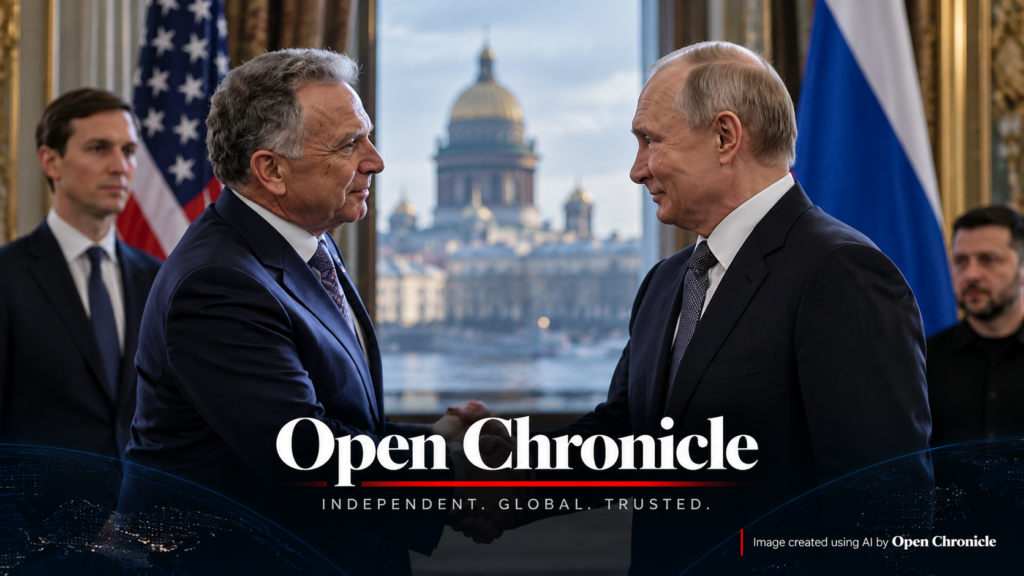
The White House is intensifying its diplomatic efforts to end the Russia–Ukraine war, with Steve Witkoff expected to present Moscow with an updated peace proposal following consultations with President Volodymyr Zelenskyy and European leaders in Oslo. Jared Kushner is reportedly set to participate virtually.
By Open Chronicle News Desk with Agencies
ST. PETERSBURG / WASHINGTON / OSLO — October 21, 2026
White House special envoy Steve Witkoff is expected to meet Russian President Vladimir Putin in St. Petersburg on Wednesday to present an updated American proposal aimed at ending the war in Ukraine, marking a potentially significant new stage in Washington’s diplomatic efforts to bring Moscow and Kyiv toward a negotiated settlement.
The planned meeting follows consultations in Oslo involving Ukrainian President Volodymyr Zelenskyy, Norwegian Prime Minister Jonas Gahr Støre and Finnish President Alexander Stubb, as the Trump administration seeks to narrow differences between the parties over the conditions for a possible ceasefire.
According to Axios, citing a US official, Witkoff will present ideas developed during the latest discussions with Ukrainian and European representatives. Jared Kushner, President Donald Trump’s son-in-law, is expected to join the meeting virtually.
The diplomatic initiative comes amid continuing Russian military operations in Ukraine, mounting financial and political pressures on Western governments, and renewed debate over the security guarantees that would be required to sustain any eventual peace agreement.
Although American and European officials have described the latest consultations as constructive, there has been no announcement of a breakthrough or an agreement between Moscow and Kyiv.
St. Petersburg Meeting: Washington Takes Its Proposal to Moscow
The anticipated meeting between Witkoff and Putin represents a direct attempt by the Trump administration to test whether the Russian leadership is prepared to engage with an updated framework for ending the conflict.
The proposal reportedly incorporates ideas discussed during consultations with Ukraine and European governments.
The precise contents of the document have not been made public.
It remains unclear whether the American initiative includes specific provisions concerning territorial arrangements, ceasefire monitoring, sanctions, security guarantees or the future of Ukraine’s relationship with Western defence institutions.
These questions have repeatedly complicated diplomatic attempts to bring the conflict to an end.
Moscow has maintained demands concerning Ukraine’s military and geopolitical position, while Kyiv has insisted that any settlement must protect Ukrainian sovereignty and provide credible guarantees against renewed Russian aggression.
Witkoff’s mission is therefore expected to focus not only on whether Moscow is willing to discuss a ceasefire, but also on whether the Russian and Ukrainian positions can be brought closer together.
The involvement of Kushner, who is reportedly expected to participate remotely, would add another senior figure associated with Trump’s diplomatic initiatives to the discussions.
However, the extent of Kushner’s role and the precise responsibilities assigned to him have not been publicly detailed in the information available.
Oslo Consultations Lay the Groundwork for Renewed Diplomacy
The planned meeting in Russia follows discussions in the Norwegian capital involving Witkoff, Zelenskyy and senior Nordic leaders.
Speaking at a news conference alongside Zelenskyy and Finnish President Alexander Stubb, Norwegian Prime Minister Jonas Gahr Støre confirmed that the American envoy would travel to Russia to present ideas developed during the Oslo consultations.
Støre described the discussions as good and constructive, emphasising the importance of maintaining cooperation between Ukraine, the United States and European partners.
The Norwegian leader also suggested that continued exchanges could eventually create the conditions for negotiations at the level of national leaders.
Such a development would represent a significant diplomatic step, although there is no indication that a summit has been formally agreed.
Norway’s participation reflects the continuing importance of European governments in efforts to shape a settlement that could affect the continent’s security for decades.
Finland’s involvement is also notable.
As a NATO member sharing a long border with Russia, Finland has a direct strategic interest in the outcome of the war and the future security arrangements between Moscow and its European neighbours.
The Oslo consultations underline Washington’s attempt to combine direct engagement with Moscow with continued discussions involving Kyiv and European governments.
Zelenskyy Seeks Guarantees That Ukraine’s Interests Will Be Protected
For Ukraine, the latest diplomatic initiative presents both an opportunity and a considerable challenge.
Zelenskyy’s government has repeatedly expressed willingness to explore negotiations that could bring the war to an end.
At the same time, Ukrainian officials have warned against arrangements that would leave the country vulnerable to renewed Russian military action.
The central concern is that a ceasefire without credible security guarantees could freeze the conflict without resolving the underlying causes of the war.
Kyiv has therefore sought assurances that any settlement would preserve Ukraine’s sovereignty and provide mechanisms capable of deterring future attacks.
These concerns are particularly important because Russia continues to occupy Ukrainian territory and military operations remain active.
Ukraine also faces the difficult task of maintaining military resistance while participating in negotiations whose outcome remains uncertain.
A diplomatic framework acceptable to Washington and Moscow would not necessarily be acceptable to Kyiv.
That distinction makes Ukrainian participation essential to any lasting settlement.
The latest Oslo discussions suggest that American officials are attempting to incorporate Ukrainian and European concerns into their approach before presenting proposals to the Kremlin.
Whether Moscow is prepared to accept those principles remains unresolved.
Trump Says Russia Wants a Deal
President Donald Trump offered a cautiously optimistic assessment of the diplomatic process on Tuesday, while continuing to press Zelenskyy to reach an agreement.
Asked whether negotiations were returning to a productive course following the Oslo consultations, Trump suggested that Moscow was interested in reaching a settlement.
“I think what’s happening is that Russia would like to get it done,” the president said, according to the supplied account.
Trump also emphasised Russia’s capacity to sustain prolonged military operations.
“Russia is a big machine. They just keep grinding forward,” he said.
“They have an unlimited supply of people.”
The president’s remarks reflect his longstanding argument that the war should be brought to an end through negotiations rather than prolonged military confrontation.
However, Russia’s willingness to participate in discussions does not necessarily mean that Moscow is prepared to accept terms considered acceptable by Ukraine or its European partners.
The critical question is whether the Kremlin’s objectives can be reconciled with Ukraine’s demands for sovereignty, security and a durable peace.
Washington Highlights Europe’s Financial Burden
Trump also renewed criticism of the financial demands placed on European governments by the war.
The president said the European Union was becoming tired of spending money on Ukraine, suggesting that the prolonged conflict was creating growing political and economic pressures.
European governments have provided substantial military, financial and humanitarian assistance to Ukraine since Russia’s full-scale invasion in February 2022.
That support has included weapons, ammunition, air-defence systems, budgetary assistance, refugee support and measures intended to sustain Ukraine’s economy.
However, European governments do not share identical views on the appropriate balance between military assistance and diplomatic engagement.
Some leaders argue that continued support is necessary to strengthen Ukraine’s negotiating position.
Others face domestic pressure over defence spending, economic conditions and the long-term costs of the conflict.
Trump’s comments suggest that the administration regards these pressures as an additional reason to accelerate diplomatic efforts.
Nevertheless, European governments have repeatedly emphasised that decisions affecting Ukraine’s security must involve Kyiv and that any agreement must be capable of preventing renewed hostilities.
The Difficult Questions Behind a Possible Ceasefire
Despite renewed diplomatic activity, several fundamental obstacles continue to complicate negotiations.
The most difficult concerns the status of Ukrainian territory currently occupied by Russian forces.
Kyiv has consistently rejected the legitimacy of Russia’s territorial claims.
Moscow, meanwhile, has sought arrangements that would consolidate its strategic position.
Another major issue concerns security guarantees.
Ukraine wants assurances that a ceasefire would not simply allow Russia to rebuild its military capabilities before launching another offensive.
Potential guarantees could involve continued military assistance, international monitoring arrangements or commitments from Western governments.
However, the supplied reporting does not establish that any of these measures forms part of Witkoff’s updated proposal.
Sanctions are another possible area of negotiation.
Western economic restrictions have been a major component of the international response to Russia’s invasion, and Moscow has repeatedly criticised them.
Whether sanctions relief could become part of a broader settlement remains an open question.
Finally, there is the challenge of implementation.
Even if negotiators were to agree on ceasefire terms, mechanisms would be required to monitor compliance, investigate violations and respond to renewed hostilities.
Without effective implementation arrangements, a formal agreement might prove difficult to sustain.
European Governments Seek a Role in the Peace Process
The involvement of Norwegian and Finnish leaders in the Oslo discussions illustrates the importance European governments attach to the negotiations.
The consequences of the Russia–Ukraine war extend far beyond Ukraine itself.
The conflict has transformed European defence planning, increased military spending and renewed concerns about the continent’s long-term security architecture.
A negotiated settlement could influence NATO’s future posture, relations between Russia and the European Union, and the defence priorities of individual European states.
For that reason, European leaders are seeking to ensure that their interests are represented in any diplomatic framework.
They also face the challenge of coordinating their positions with an American administration that has placed greater emphasis on reaching a negotiated outcome.
The balance between supporting Ukraine militarily and pursuing diplomatic engagement remains a central issue in transatlantic relations.
The Oslo meeting suggests that Washington continues to recognise the importance of European consultation, even as it pursues direct talks with Moscow.
Can Direct Talks With Putin Produce a Breakthrough?
Witkoff’s meeting with Putin could help clarify whether Russia is prepared to negotiate on the basis of the updated American proposals.
The immediate outcome may be measured less by the announcement of an agreement than by Moscow’s willingness to continue substantive discussions.
A constructive Russian response could lead to further consultations involving Ukraine and European governments.
It could also increase the possibility of negotiations involving senior political leaders.
However, a diplomatic breakthrough would require movement on issues that have remained unresolved throughout the conflict.
The Kremlin’s position on territory, Ukraine’s future security arrangements and the broader relationship between Russia and the West will be central to any meaningful progress.
There is also the possibility that the discussions will reveal continued differences rather than narrow them.
The existence of diplomatic contacts should therefore not be confused with evidence that a settlement is imminent.
The Big Picture: A New Diplomatic Opening, but No Agreement Yet
The planned St. Petersburg meeting marks another attempt by the Trump administration to turn diplomatic engagement into a concrete framework for ending the Russia–Ukraine war.
By moving from consultations with Zelenskyy and European leaders to direct discussions with Putin, Washington is attempting to establish whether the principal parties can identify sufficient common ground to advance negotiations.
The participation of Nordic leaders demonstrates that European security concerns remain an important part of the process.
Trump’s public statements, meanwhile, indicate that the White House continues to view a negotiated settlement as an urgent priority.
Yet the underlying difficulties remain substantial.
Ukraine seeks sovereignty, territorial security and guarantees against future aggression. Russia continues to pursue strategic objectives that have repeatedly conflicted with those demands.
European governments want a settlement that protects the continent’s security, while Washington is seeking a diplomatic outcome that could bring an end to a costly and prolonged war.
The success of Witkoff’s mission will depend not simply on whether Moscow agrees to continue talking, but on whether those discussions produce proposals that Ukraine can accept and that all parties are prepared to implement.
For now, the diplomatic process has gained momentum, but the distance between renewed negotiations and a lasting peace remains considerable.
Sources and Further Reading
The following sources provide the principal reporting and institutional background relevant to the diplomatic developments described in this article.
1. Axios — US Diplomatic Efforts and Ukraine Peace Negotiations
Reporting attributed to a US official concerning Witkoff’s planned meeting with Putin and Kushner’s expected virtual participation.
2. Reuters — International Reporting on Russia–Ukraine Diplomacy
Coverage of diplomatic discussions involving the United States, Ukraine, Russia and European governments.
3. Government of Norway — Office of the Prime Minister
Official information concerning Norwegian government diplomacy, including international security and cooperation with Ukraine.
4. President of Ukraine — Official Website
Statements, diplomatic updates and official communications from the Ukrainian presidency.
5. European Council — EU Response to Russia’s War Against Ukraine
Institutional background concerning European assistance to Ukraine, sanctions and diplomatic policy.
Editorial Note
This article is an original Open Chronicle news synthesis based on the supplied reporting concerning planned diplomatic discussions in St. Petersburg on October 21, 2026.
The information about Steve Witkoff’s expected meeting with Vladimir Putin, Jared Kushner’s reported virtual participation and the updated American peace proposal is attributed to reporting cited in the source material. The meeting’s completion, precise agenda and any resulting agreements have not been independently verified by Open Chronicle.
Statements attributed to President Donald Trump and Norwegian Prime Minister Jonas Gahr Støre are reproduced from the supplied account. The analysis of territorial disputes, security guarantees, sanctions and ceasefire implementation provides broader context and does not establish the contents of the reported American proposal.
The institutional links above provide background and official reference material. They should not be interpreted as direct confirmation of every reported detail concerning the planned meeting.
Open Chronicle | Independent. Global. Trusted.