
By Open Chronicle Cybersecurity
23 October 2026 | Cybersecurity News
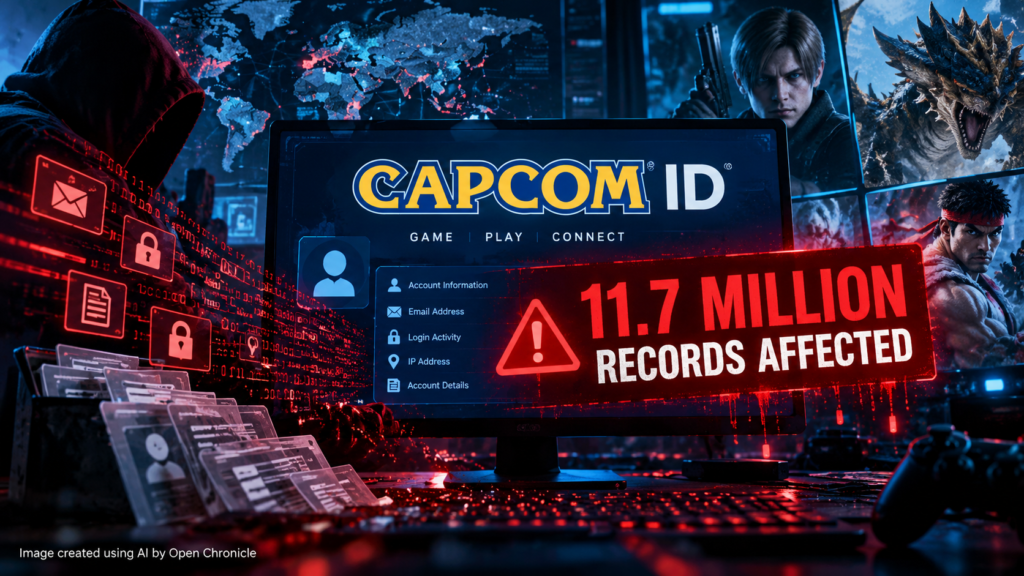
Japan’s Capcom has confirmed a major security breach involving its CAPCOM ID membership platform, with more than 11.7 million account records affected worldwide. While the company says customer-selected passwords and credit card information were not confirmed compromised, the incident has raised concerns about phishing, account security and the growing risks surrounding interconnected gaming services.
A Major Security Incident in the Gaming Industry
Japanese video game publisher Capcom has disclosed unauthorized access to its CAPCOM ID online membership system, affecting 11,774,247 records worldwide.
The company, internationally known for franchises including Resident Evil, Monster Hunter and Street Fighter, confirmed the incident in an official announcement on 22 October 2026.
CAPCOM ID serves as a unified account system through which registered users can access certain online games and digital services. Its role in connecting gaming accounts and online functionality makes the platform an important component of Capcom’s wider digital ecosystem.
According to the company, unauthorized access was detected on 19 October. An investigation subsequently established that customer information associated with the platform had been accessed by a third party.
Capcom says emergency measures have been completed and that services using CAPCOM ID remain operational. The incident has not disrupted customers’ ability to access or play its games.
Nevertheless, the scale of the exposed records represents a significant data protection incident for one of the world’s best-known video game publishers.
What Information Was Exposed?
The company’s disclosure identifies several categories of affected information.
The largest group consists of 11,774,247 records containing email addresses and account-related technical information. This includes account creation timestamps, the date and time of the most recent login, login counts and the client IP address used during the last login.
Although these details do not necessarily provide direct access to an account, they can reveal useful information about account activity and potentially support targeted social engineering.
Capcom also confirmed that additional personal information was exposed in a smaller subset of 43 records. Those details included dates of birth, gender, country or region and account nicknames.
Separately, the company identified unauthorized changes to the login passwords of 196 accounts.
Capcom says the passwords associated with those accounts have already been reset.
Importantly, the company has not confirmed that passwords originally selected by customers were compromised. It also states that credit card information was not included among the affected data.
These distinctions are essential when assessing the incident. The confirmed exposure of email addresses and account metadata should not be confused with evidence that the entire affected user population lost control of its login credentials.
How the Incident Unfolded
The publicly disclosed timeline begins on 19 October 2026, when Capcom detected suspicious activity involving CAPCOM ID.
The company immediately began blocking the unauthorized access and investigating its origin and potential impact.
On the same day, investigators confirmed that unauthorized access had occurred.
On 20 October, Capcom established an internal incident response headquarters to coordinate the investigation, contain the incident and assess the affected information.
During that process, the company determined that customer information had been accessed and that unauthorized password changes had occurred on a limited number of accounts.
Capcom also informed its external Information Technology Security Oversight Committee.
On 21 October, the company reported the incident to the Osaka Prefectural Police and Japan’s Personal Information Protection Commission.
Its public disclosure followed on 22 October.
Capcom says it has identified and addressed the attack method involved, but its announcement does not provide technical details explaining how the attacker initially gained access.
The identity of the responsible party has also not been publicly established in the company’s disclosure.
Without further evidence, attributing the intrusion to a particular criminal organization, vulnerability or attack technique would be premature.
Why Exposed Account Data Matters
One of the most important lessons from the Capcom incident is that a data breach can create meaningful security risks even when customer passwords are not confirmed stolen.
Email addresses are widely used as account identifiers across gaming platforms, online stores and digital services.
When attackers obtain a large collection of valid addresses associated with a particular company, they may use that information to create more convincing fraudulent communications.
Account metadata can increase the credibility of those messages.
For example, information about account activity could potentially help criminals craft communications that appear related to recent sign-ins, account verification or security maintenance.
The exposure of an IP address used during a previous login may also reveal limited network or geographic context, although it does not by itself identify a person’s precise physical location.
The resulting threat is therefore not limited to the immediate compromise of a gaming account.
It can extend to phishing campaigns, impersonation attempts and fraudulent requests designed to persuade users to disclose additional information.
Capcom has specifically warned customers about suspicious emails and other communications that may impersonate the company or related parties.
There is an important distinction between this foreseeable risk and a confirmed secondary attack. The company’s warning does not establish that a large-scale phishing campaign using the exposed records has already occurred.
The Risk of Account Takeover
The unauthorized password changes identified on 196 CAPCOM ID accounts introduce a separate security concern.
Changing an account password without the legitimate user’s permission can interfere with access and may indicate that an attacker obtained sufficient privileges to modify account credentials.
However, the public disclosure does not establish the exact mechanism through which those changes were made.
It would therefore be inaccurate to conclude that the original passwords were necessarily stolen, guessed or reused from another breach.
Capcom says the affected passwords have been reset and that it continues investigating the full impact of the incident.
For the wider user population, the immediate concern remains the possibility of fraudulent communications and attempts to obtain additional account credentials.
A Growing Challenge for Connected Gaming Platforms
The Capcom incident illustrates a broader cybersecurity challenge facing the gaming industry.
Modern video games increasingly rely on connected services that extend far beyond the software installed on a console or computer.
Unified accounts support online multiplayer, identity management, digital purchases, player communities and cross-platform functionality.
These systems provide convenience and continuity, but they also concentrate user information within services that can become attractive targets.
A compromise involving a central membership platform can consequently affect a much larger population than an incident involving a single game.
The issue is not unique to gaming.
Similar risks exist across streaming services, social networks, online marketplaces and other digital platforms that rely on centralized identity systems.
As digital ecosystems become more interconnected, protecting account infrastructure becomes a critical responsibility for service providers.
What CAPCOM ID Users Should Do
Capcom has indicated that it will contact affected customers and has established dedicated support channels for inquiries.
Users should remain attentive to official communications while treating unexpected messages with caution.
Several practical precautions can help reduce the risk of further compromise.
Verify account notifications independently. Rather than following a link in an unexpected email, users should navigate directly to the official Capcom website or account service.
Be suspicious of urgent security requests. Messages claiming that an account will be suspended unless the user immediately confirms personal information should be treated carefully.
Use unique passwords. A distinct password for each important account limits the potential impact if credentials are compromised elsewhere.
Review account activity. Users who notice unfamiliar changes, login problems or unexpected account notifications should contact official support.
Enable additional authentication protections where available. Multifactor authentication can provide an additional barrier against unauthorized access, although available options depend on the service.
Avoid opening unexpected attachments. Fraudulent messages may attempt to distribute malicious files or redirect users to imitation login pages.
Changing a CAPCOM ID password as a precaution may provide reassurance, particularly if it has been reused elsewhere. However, Capcom’s disclosure does not establish that all affected users’ original passwords were stolen.
The priority is to prevent attackers from exploiting exposed contact information to obtain further credentials.
Capcom’s Response and the Questions That Remain
Capcom says it has completed emergency containment measures and addressed the method used in the intrusion.
The company has also committed to continuing its investigation and strengthening its information security framework.
Several questions remain unresolved in the public record.
The company has not provided a detailed technical explanation of the initial access mechanism, identified the attacker or published a geographic breakdown of the affected records.
It also remains unclear whether subsequent investigations will identify additional affected information or further unauthorized account activity.
Future disclosures may help establish how the intrusion occurred and whether broader security changes are necessary.
For now, the confirmed facts support a serious assessment of the breach without justifying speculation about its origins.
The Wider Cybersecurity Implications
The exposure of more than 11.7 million CAPCOM ID records demonstrates how a major data protection incident can occur without a publicly confirmed compromise of payment card information or customer-selected passwords.
The central risk lies in the combination of scale, identifiable account information and the opportunities that exposed data can create for subsequent attacks.
For digital service providers, the incident reinforces the importance of monitoring account infrastructure, restricting access to customer data, detecting unusual account modifications and communicating clearly after security incidents.
For users, it highlights the need to distinguish legitimate account notifications from attempts at impersonation.
The investigation is continuing, and additional findings may change the understanding of the attack.
For the moment, the Capcom breach stands as a significant reminder that protecting digital identities requires more than safeguarding passwords alone.
Sources and Further Reading
The following official statements and specialist cybersecurity reports provide the factual foundation for this article. Sources are presented separately from the editorial analysis to support transparency and independent verification.
Capcom | Official Security Incident Disclosure
Primary corporate disclosure describing the CAPCOM ID security incident, the affected information, response measures, investigation timeline and guidance issued to customers.
BleepingComputer | Capcom Data Breach
Independent reporting examining the disclosed account records, unauthorized password changes and Capcom’s response to the security incident.
SecurityWeek | Capcom Security Incident
Specialist cybersecurity coverage addressing the scale of the incident, affected account information and the security implications of the disclosure.
Malwarebytes | Phishing Risks Following the Breach
Analysis of potential phishing risks and fraudulent communications following the exposure of customer account information.
Editorial Note:
This report reflects information publicly available as of 23 October 2026. Capcom’s investigation remains ongoing. Confirmed facts are distinguished from potential cybersecurity risks and analytical observations. No attribution to a specific threat actor or attack technique is made without supporting evidence.