
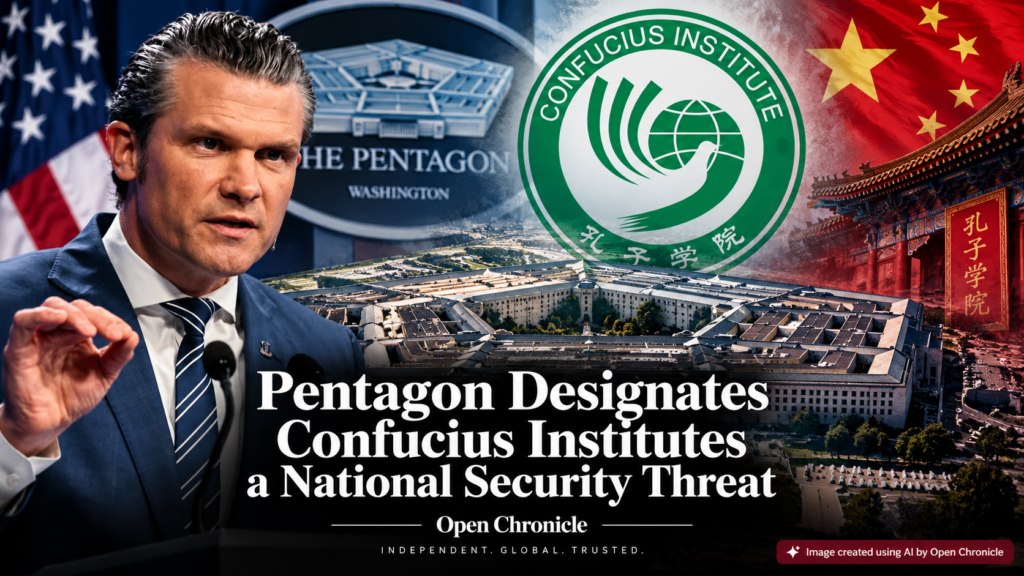
US Defense Secretary Pete Hegseth announces a new national security designation targeting China’s Confucius Institutes, adding another point of tension to relations between Washington and Beijing. The Chinese embassy has not immediately commented.
By Open Chronicle News Desk with Agencies
WASHINGTON — October 23, 2026
The United States Department of Defense has designated China’s Confucius Institutes as a threat to American national security, Defense Secretary Pete Hegseth announced on Friday, in a move that brings renewed attention to the role of Chinese-backed educational and cultural programmes in the United States.
The announcement was reported by Reuters on October 23, marking a new development in Washington’s scrutiny of institutions associated with the Chinese government.
Confucius Institutes, which have operated through partnerships with universities and other educational institutions around the world, have long been a subject of debate in the United States over academic independence, foreign influence and national security.
The Pentagon’s latest designation reflects those longstanding concerns, although the announcement did not immediately establish what specific measures would follow.
The Chinese embassy in Washington did not immediately respond to a Reuters request for comment.
Pentagon Announces National Security Designation
Defense Secretary Pete Hegseth confirmed on Friday that the Department of Defense had designated Confucius Institutes as a threat to US national security.
The announcement places the institutions within the broader debate over Chinese influence in American educational and research environments.
However, the brief Reuters report did not specify the legal authority underlying the designation, the evidence supporting the Pentagon’s assessment or the operational consequences for institutions that maintain relationships with Confucius Institutes.
It also did not establish whether the decision would result in new restrictions, funding conditions or additional oversight requirements.
Those questions will be important in determining the practical significance of the announcement.
What Are Confucius Institutes?
Confucius Institutes are Chinese-supported educational and cultural programmes established through partnerships with institutions outside China.
Their activities have traditionally included Mandarin-language teaching, cultural events and educational exchanges intended to promote knowledge of Chinese language and culture.
The programmes have operated in numerous countries and have often been associated with universities and educational organisations.
Supporters of such initiatives have emphasised their potential contribution to language education, cultural understanding and international academic cooperation.
Critics, particularly in the United States, have raised concerns about institutional independence, transparency and the possibility of political influence over educational activities.
The debate has focused not only on the programmes themselves but also on the conditions under which foreign-supported educational partnerships operate.
A Longstanding Debate Over Foreign Influence
Confucius Institutes have attracted scrutiny in Washington for years.
American policymakers have questioned whether educational programmes supported by foreign governments can create conflicts between cultural diplomacy and academic independence.
Concerns have included the transparency of institutional agreements, control over teaching materials and the possibility that sensitive political subjects could be restricted or discouraged.
Chinese authorities have historically defended Confucius Institutes as educational and cultural initiatives designed to promote international understanding.
The competing perspectives reflect a broader disagreement over the distinction between legitimate cultural diplomacy and activities that governments may regard as foreign influence.
The Pentagon’s new designation gives the issue an explicitly national security dimension.
Nevertheless, the Reuters dispatch supplied for this article does not provide details of any particular incident, investigation or finding that led to Friday’s decision.
Universities and Academic Partnerships Under Scrutiny
The announcement may attract attention from American universities and educational institutions that maintain, or have previously maintained, relationships with Chinese-supported language and cultural programmes.
International academic cooperation often involves arrangements covering funding, teaching personnel, course materials and institutional responsibilities.
For universities, questions of academic freedom and transparency are central to assessing such partnerships.
National security concerns can add further complexity, particularly where institutions also conduct sensitive research or receive federal funding.
However, the designation announced on Friday should not be interpreted as an automatic prohibition on all Chinese-language teaching, cultural exchanges or academic cooperation with China.
The available report does not establish such a restriction.
Any direct consequences for universities or educational organisations will depend on the scope of the Pentagon’s decision and any accompanying rules or guidance.
Another Source of Tension Between Washington and Beijing
The move comes against the backdrop of a broader strategic rivalry between the United States and China.
Relations between the two countries have been shaped by disagreements over trade, technology, military security, intelligence activities and international influence.
Educational and research cooperation has increasingly become part of that discussion.
Washington has expressed concerns about protecting sensitive technologies, research environments and institutions from foreign interference.
Beijing, meanwhile, has frequently criticised American restrictions involving Chinese organisations as discriminatory or politically motivated.
The Confucius Institutes designation could become another point of diplomatic disagreement, depending on how the decision is implemented and how Chinese authorities respond.
As of the Reuters report on Friday, the Chinese embassy in Washington had not issued an immediate response to the request for comment.
What Happens Next?
The Pentagon’s announcement raises several questions that remain unanswered.
The most immediate concerns are whether the designation will be accompanied by formal restrictions, whether it applies to specific institutions or the wider Confucius Institutes network, and whether additional federal agencies will take related action.
It also remains unclear whether the Defense Department intends to publish a detailed explanation of the security assessment.
For universities, policymakers and international education organisations, those details will determine the practical implications.
Until further guidance is available, the confirmed development is the Pentagon’s designation itself, rather than any particular enforcement measure.
The Big Picture: Education and National Security
The decision to classify Confucius Institutes as a national security threat highlights how educational and cultural programmes have become part of the wider competition between major powers.
Language education and international academic exchanges have traditionally been regarded as instruments of cooperation and cultural diplomacy.
Yet governments increasingly examine foreign-supported institutional relationships through the lens of national security, transparency and strategic influence.
The Pentagon’s announcement signals that Washington continues to regard certain forms of Chinese institutional engagement as a security concern.
Whether the designation leads to concrete restrictions, changes in university partnerships or a diplomatic response from Beijing remains to be seen.
For now, the announcement marks another development in US-China relations, illustrating how disputes over national security are extending beyond military and technological competition into the sphere of education and cultural exchange.
Sources and Further Reading
Reuters — Pentagon Designates Confucius Institutes a National Security Threat
Primary news report dated October 23, 2026, citing Defense Secretary Pete Hegseth’s announcement and the absence of an immediate response from the Chinese embassy in Washington.
US Department of Defense — Official Announcements
Institutional source for Pentagon statements, defence policy announcements and official guidance.
US Government Accountability Office — Federal Oversight and Accountability
Institutional background on federal oversight, public funding and government accountability, including matters relevant to foreign-supported institutional relationships.
US Department of State — US-China Relations
Official background on American foreign policy and diplomatic relations with China.
Editorial Note
This article is an original Open Chronicle news synthesis based on a Reuters dispatch dated October 23, 2026, reporting that the US Department of Defense had designated China’s Confucius Institutes as a national security threat.
The Pentagon’s announcement and the Chinese embassy’s lack of an immediate response are drawn from the supplied Reuters report. The discussion of Confucius Institutes, academic independence and US-China strategic competition provides broader contextual analysis.
The supplied report does not specify the legal basis, supporting evidence or immediate consequences of the designation. No additional enforcement measures have been presented as confirmed.