
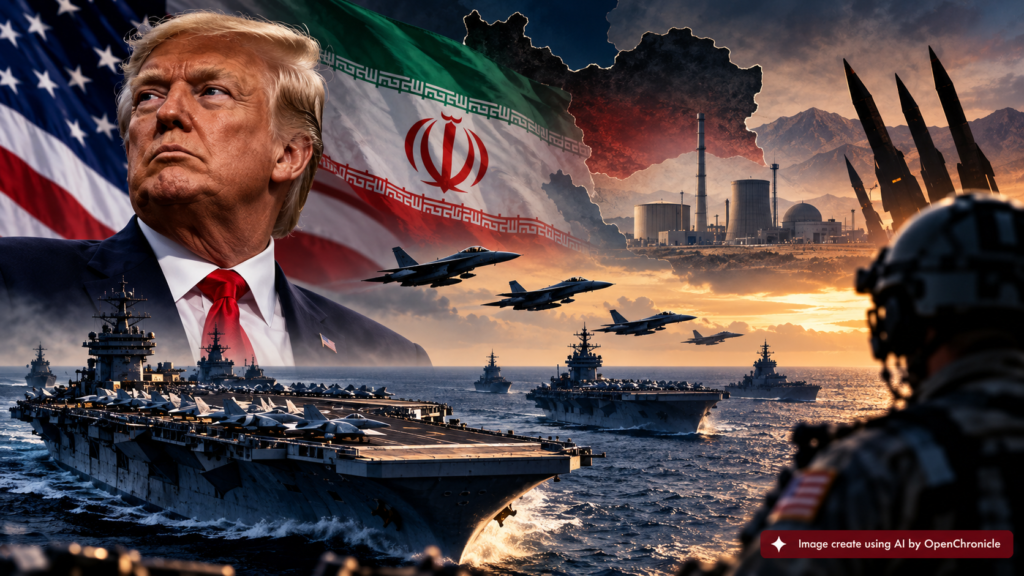
Reports of additional American aircraft carriers, thousands of military personnel and operational planning involving Israel are raising questions about whether Washington is preparing another military offensive against Iran. President Donald Trump has publicly kept the option of renewed strikes open, while the approaching US midterm elections add a political dimension to an increasingly tense regional security situation.
By Open Chronicle News Desk with Agencies
WASHINGTON / TEHRAN — October 24, 2026
The United States is reinforcing its military presence in the Middle East amid reports of preparations for possible new strikes against Iran, raising concerns that the confrontation between Washington and Tehran could enter another dangerous phase.
Recent reporting indicates that the Pentagon has been preparing additional military options, including the deployment of aircraft carriers, thousands of personnel and other capabilities that could support an extended regional operation.
American and Israeli military officials have also reportedly examined potential targets inside Iran, while President Donald Trump has publicly acknowledged the possibility of further military action.
The developments come as Washington approaches the November 3 midterm elections and as regional governments confront the possibility of Iranian retaliation against military installations, energy infrastructure and maritime traffic.
However, despite the accumulation of military preparations and increasingly direct political statements, there is no publicly confirmed evidence that Trump has issued a final order for a new offensive.
The distinction is essential: military preparations demonstrate that Washington is maintaining options for escalation, but they do not establish that an attack is inevitable.
US Reinforces Military Presence in the Middle East
One of the clearest indicators of heightened military readiness is the reported expansion of American forces across the region.
According to reporting published by The Washington Post on October 22, preparations could involve as many as three aircraft carriers and approximately 20,000 additional military personnel.
The report indicated that roughly 50,000 American service members were already stationed across the Middle East.
If fully implemented, the reported reinforcements would represent a substantial expansion of the American military presence.
Aircraft carrier strike groups provide capabilities extending well beyond conventional naval operations.
Their embarked aircraft can conduct surveillance, air defence, electronic warfare and strike missions, while accompanying vessels contribute missile defence and other operational support.
A larger American deployment could therefore serve several purposes simultaneously: protecting US personnel, reassuring regional partners, deterring Iranian military action and preparing for potential offensive operations.
The presence of additional forces does not necessarily mean that Washington intends to use them.
Nevertheless, such deployments increase the range of military options available to American commanders if political leaders decide to escalate the confrontation.
Pentagon Reportedly Orders Preparations for Major Combat Operations
Separate reporting has pointed to operational planning within the American military command structure.
A Reuters report published on October 8, citing information attributed to US officials in Axios reporting, indicated that the Pentagon had instructed US Central Command, known as CENTCOM, to complete preparations for possible large-scale combat operations against Iran.
CENTCOM is responsible for American military operations across much of the Middle East.
Its responsibilities include coordinating US forces, supporting regional partners and planning military responses to emerging security threats.
Preparations for major combat operations can involve logistical arrangements, force protection, operational coordination and assessments of the capabilities required for different contingencies.
Such planning is a routine component of military readiness, particularly during periods of confrontation.
However, the reported scale and timing of the preparations have attracted attention because they coincide with other signs of heightened regional tension.
The available reporting does not establish whether the Pentagon has selected a particular operational plan or whether the White House has authorised its execution.
Washington and Israel Examine Possible Military Options
The possibility of renewed American military action has also been linked to coordination with Israel.
Reports published on October 22 indicated that American and Israeli military officials had developed or reviewed options for potential strikes against Iranian facilities.
The reported planning involved possible military, nuclear-related and energy targets.
Those accounts suggest that Washington and Israel are considering different approaches to a possible escalation.
The extent of their coordination, however, remains unclear.
It has not been publicly established whether the two governments have agreed on a specific operation, timetable or set of objectives.
Israel has long regarded Iran’s nuclear and missile capabilities, as well as its regional military relationships, as major security concerns.
Iran, for its part, has repeatedly warned that attacks on its territory could provoke retaliation against the countries involved.
Any joint American-Israeli operation would therefore carry risks extending beyond the immediate targets.
Regional military installations, shipping routes and energy infrastructure could all become exposed to a wider confrontation.
Trump Keeps the Option of Renewed Strikes Open
President Donald Trump has added to speculation about a possible offensive by publicly discussing the prospect of additional military action.
On October 23, Trump indicated that the United States could conduct another operation against Iran, referring to the earlier American military campaign known as Operation Epic Fury.
His remarks signalled that the administration continues to regard military force as an available option.
However, the president did not announce a specific operation, identify an attack date or confirm that a final decision had been taken.
Presidential statements about military options can serve several purposes.
They may communicate warnings to an adversary, reinforce deterrence, support diplomatic pressure or prepare domestic audiences for possible developments.
They do not necessarily reveal the administration’s final intentions.
For that reason, Trump’s remarks must be considered alongside the military deployments and operational planning reported by news organisations.
Taken together, these developments indicate that the possibility of renewed confrontation is being actively considered.
They do not prove that a new war has already been authorised.
November Midterm Elections Become a Critical Political Factor
The approaching American midterm elections have emerged as another important element in the discussion.
The elections are scheduled for November 3, 2026, when voters will determine the composition of the House of Representatives and contest Senate seats across the country.
Reporting by The Washington Post indicated that the White House had signalled it would not launch a new offensive against Iran before the elections.
Other accounts suggested that Washington could reconsider military options after the vote.
These reports have encouraged speculation about whether the electoral calendar is influencing the administration’s decisions.
However, no confirmed military timetable has been established.
A reported preference to avoid an offensive before November 3 should not be interpreted as a guarantee that no military incident could occur during that period.
Similarly, the end of the elections would not automatically mean that an attack would follow.
The administration’s decisions could be influenced by diplomatic developments, Iranian actions, Israeli security assessments and the broader regional situation.
The political calendar is therefore relevant, but it is not sufficient to predict the timing of a possible operation.
Precautionary Measures Raise Concerns About Iranian Retaliation
Reports of precautionary measures involving American personnel have added to concerns about the regional security environment.
The Wall Street Journal and other publications have described the withdrawal or relocation of non-essential diplomatic personnel from areas considered vulnerable to possible retaliation.
Such measures are commonly adopted when governments believe that security conditions could deteriorate.
They can reduce the number of civilians exposed to danger and allow diplomatic missions to maintain essential operations with fewer personnel.
However, precautionary withdrawals are not conclusive evidence that an offensive is imminent.
They may also reflect intelligence assessments of possible attacks, heightened tensions or broader efforts to protect personnel.
In the current context, the measures are significant because Iranian officials have warned that another American or Israeli attack could trigger a regional response.
The potential consequences of retaliation would depend on the scale and nature of any initial military action.
Iran Warns of a Wider Regional Conflict
Iran has repeatedly warned that renewed attacks against its territory could lead to retaliation beyond its borders.
Recent reports have highlighted Iranian threats involving American military installations and strategic infrastructure across the Gulf region.
Such warnings reflect Tehran’s ability to impose costs on adversaries through a variety of military and regional capabilities.
Iran maintains missile and drone forces and has longstanding security relationships with armed groups operating in different parts of the Middle East.
A renewed confrontation could therefore extend beyond direct exchanges between the United States, Israel and Iran.
Regional governments hosting American military facilities could face increased security concerns, even if they were not directly involved in an initial offensive.
The risk of escalation would be particularly serious if attacks caused significant casualties or damaged critical infrastructure.
The available reporting does not establish that Iran has decided to launch any specific retaliatory operation in response to the current American deployments.
Nevertheless, its public warnings form part of the strategic environment in which Washington is assessing its options.
The Strait of Hormuz and Global Energy Security
The possibility of military escalation has also raised concerns about maritime security in the Persian Gulf.
The Strait of Hormuz is one of the world’s most strategically important maritime passages, connecting the Persian Gulf with the Gulf of Oman and the wider Indian Ocean.
A substantial volume of internationally traded oil and liquefied natural gas passes through the waterway.
Any serious disruption could affect global energy markets, shipping costs and commercial supply chains.
Recent reporting has included Iranian claims concerning attacks on vessels in the region.
The Associated Press reported on October 22 that Iranian authorities had claimed attacks involving seven tankers.
Those claims require independent verification, and the reported incidents should not be treated as confirmed solely on the basis of statements from a party to the conflict.
Even so, the allegations underline the importance of maritime security during periods of confrontation.
A wider conflict involving commercial shipping or energy installations could create economic consequences far beyond the Middle East.
For European and Asian economies that depend on imported energy, instability in the Gulf represents a significant strategic concern.
Military Preparations Do Not Necessarily Mean an Attack Is Imminent
Although the available reports contain several indicators of heightened military readiness, they must be interpreted carefully.
Governments frequently deploy additional forces during crises without subsequently launching major offensive operations.
Military reinforcements can be intended to deter an adversary, defend existing installations or strengthen diplomatic leverage.
Operational planning is also a normal responsibility of armed forces.
Commanders are expected to prepare for different contingencies, including scenarios that political leaders may ultimately decide not to pursue.
The current situation therefore requires a distinction between three separate developments.
The first is the expansion of American military capabilities in the region.
The second is the reported preparation of operational plans for possible strikes.
The third would be a political decision authorising a specific offensive.
The first two developments have been described in recent reporting.
The third has not been publicly confirmed.
This distinction is fundamental to assessing the risk without presenting speculation as established fact.
Diplomacy Remains an Alternative to Military Escalation
Despite the military preparations, diplomatic options have not necessarily been exhausted.
Periods of intense military pressure can coincide with indirect negotiations, diplomatic messages and efforts by regional governments to prevent a broader confrontation.
For Washington, the prospect of additional military action may form part of a strategy intended to influence Iranian decisions.
For Tehran, maintaining the ability to retaliate can serve as a deterrent against further attacks.
These competing calculations can create an unstable situation in which both sides seek to demonstrate resolve while avoiding an uncontrolled escalation.
The risk is that military incidents, intelligence miscalculations or unexpected attacks could undermine diplomatic efforts.
Regional governments would have strong reasons to seek restraint, particularly given the possible consequences for civilian populations, energy supplies and commercial transport.
Whether diplomacy can reduce tensions will depend on decisions taken in Washington, Tehran and other regional capitals.
What Developments Should Be Watched?
Several publicly observable developments will help clarify whether the confrontation is moving towards military action or remaining within a framework of deterrence and diplomatic pressure.
Further confirmed American force deployments would provide additional evidence of the scale of the military buildup.
Official announcements from the Pentagon or CENTCOM could clarify the stated purpose of those deployments.
Statements from the White House and Israeli government may indicate whether military options remain under consideration or whether diplomatic initiatives are gaining importance.
Changes to diplomatic security arrangements, maritime advisories and regional airspace restrictions could also reflect shifts in the broader security environment.
At the same time, any independently confirmed attacks against American personnel, Israeli territory or Gulf infrastructure could substantially alter the political calculations of the governments involved.
None of these indicators should be interpreted in isolation.
The significance of future developments will depend on their context and on whether they are corroborated by reliable sources.
The Big Picture: Washington Prepares Its Options as the Region Faces Another Dangerous Moment
The American military buildup in the Middle East represents a significant development in the confrontation with Iran.
Reports of additional aircraft carriers, thousands of military personnel, operational preparations by CENTCOM and military coordination with Israel indicate that Washington is maintaining the capability to conduct further operations.
President Trump’s public statements have reinforced the perception that another offensive remains possible.
The approaching November 3 midterm elections have introduced an additional political consideration, with some reporting suggesting that the administration may defer any new major operation until after the vote.
Meanwhile, Iranian warnings of retaliation and concerns about the security of the Strait of Hormuz underline the potential consequences of renewed hostilities.
The available information supports the conclusion that the United States is preparing for the possibility of military escalation.
It does not establish that an offensive has been definitively authorised or that a date has been selected.
The central question is no longer whether Washington possesses the military capability to strike Iran, but whether the administration will decide that the strategic and political objectives of another operation outweigh the risks of a wider regional conflict.
For now, the Middle East remains in a period of heightened military readiness, uncertain diplomacy and significant escalation risks.
Sources and Further Reading
The Washington Post — US Military Reinforcements and Possible Operations Against Iran
Reporting dated October 22, 2026, concerning additional aircraft carriers, military personnel and preparations for possible further operations.
Reuters / Axios — Pentagon and CENTCOM Operational Preparations
Reporting dated October 8, 2026, concerning alleged instructions to prepare for possible large-scale combat operations.
Reuters — Trump Discusses Possibility of Renewed Military Action
Reporting dated October 23, 2026, concerning the president’s public remarks about another potential operation against Iran.
Associated Press — US Military Deployments and Regional Security Developments
Reporting dated October 22, 2026, covering additional American military assets, Iranian statements and maritime security concerns.
The Wall Street Journal — Regional Security and Diplomatic Precautions
Reporting concerning the security of American personnel and possible Iranian retaliation.
US Central Command — Official Military Communications
Official institutional reference for public information on American military operations in the Middle East.
Editorial Note
This article is an original Open Chronicle editorial analysis based on international reporting available through October 23, 2026, concerning American military deployments, reported operational planning, statements by President Donald Trump and regional security developments involving Iran and Israel.
Reports about possible military operations, coordination between governments, troop deployments and potential targets are attributed to their respective news organisations and should not be interpreted as confirmation that a new offensive has been authorised.
The discussion of strategic objectives, deterrence, escalation risks and potential regional consequences constitutes editorial analysis. The available reporting does not establish a confirmed date or final political decision for renewed American military action against Iran.