
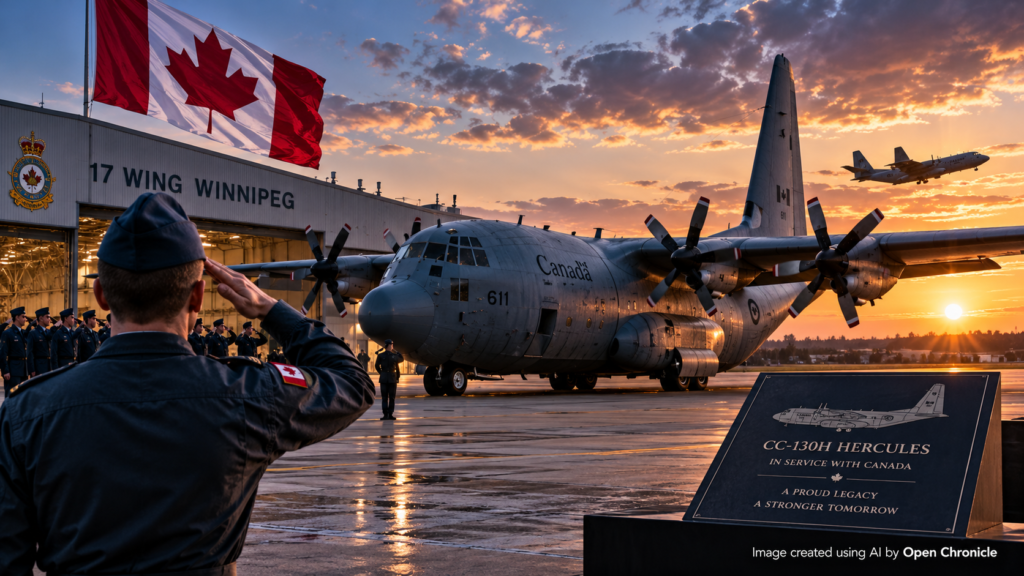
A retirement ceremony at 17 Wing Winnipeg marks the conclusion of the CC-130H Hercules’ military service, honouring an aircraft that became an enduring symbol of Canadian military transport, operational versatility and aviation heritage.
By Open Chronicle News Desk with Agencies
WINNIPEG, CANADA — October 24, 2026
The Canadian Armed Forces have marked the retirement of the CC-130H Hercules from military service with a ceremony at 17 Wing Winnipeg, bringing an important chapter in Canadian military aviation history to a close.
The event commemorated the aircraft’s withdrawal from service and recognised its place within Canada’s military aviation heritage.
The CC-130H Hercules belongs to the long-running Lockheed C-130 family, one of the world’s most recognisable military transport aircraft designs.
Developed to operate in demanding environments and support a wide variety of military missions, the Hercules became an important component of air transport operations for numerous armed forces around the world.
For Canada, the retirement of the CC-130H represents more than the withdrawal of an ageing aircraft. It reflects the continuing evolution of military aviation, changing operational requirements and the transition towards newer aircraft technologies.
A Retirement Ceremony at 17 Wing Winnipeg
The retirement ceremony took place at 17 Wing Winnipeg, a Royal Canadian Air Force installation in Manitoba.
The base plays an important role in Canada’s military aviation community, supporting a range of operational, training and administrative activities.
The event marked the formal recognition of the CC-130H Hercules’ departure from military service.
Military aircraft retirement ceremonies traditionally provide an opportunity to acknowledge the personnel who operated, maintained and supported an aircraft throughout its service life.
Pilots, navigators, loadmasters, technicians and ground crews all contribute to the operational effectiveness of military transport aircraft.
Although the information provided does not specify the participants, programme or individual aircraft involved in the ceremony, the occasion represents a significant milestone for the Royal Canadian Air Force.
The Hercules: A Defining Military Transport Aircraft
The Lockheed C-130 Hercules family has played a major role in military aviation since the 1950s.
Its design was developed around the need to transport personnel, equipment and supplies into locations that could be difficult to reach using conventional transport aircraft.
One of the Hercules’ defining characteristics is its ability to operate from relatively short or austere runways, depending on operating conditions and aircraft configuration.
This versatility made the aircraft particularly valuable for military forces required to operate across large geographical areas.
The C-130 family has been adapted for numerous missions, including tactical airlift, humanitarian assistance, medical evacuation and specialised military operations.
The CC-130H was part of this broader family of aircraft, combining the established Hercules design with equipment and configurations suited to Canadian requirements.
Its retirement marks the conclusion of the service of this particular Canadian variant, rather than the end of the Hercules aircraft family worldwide.
Supporting Military Operations Across Canada’s Vast Territory
Canada’s geography presents distinctive challenges for military aviation.
The country spans enormous distances, includes remote northern communities and experiences severe weather conditions that can complicate transportation.
Military transport aircraft are essential to maintaining operational mobility across this environment.
Aircraft such as the Hercules have historically provided the Canadian Armed Forces with the flexibility to move personnel and equipment between established military installations and more remote locations.
The ability to operate in difficult conditions is particularly important for a country whose defence responsibilities extend from densely populated southern regions to the Arctic.
Military airlift also supports emergency response and humanitarian operations when civilian transportation networks are limited or disrupted.
The broader Hercules family has therefore held an important place in Canada’s military aviation capabilities.
An Aircraft Associated With Versatility and Reliability
The Hercules became internationally recognised for its robust design and operational adaptability.
Unlike aircraft developed primarily for long-distance passenger transportation, the C-130 family was designed to accommodate military cargo and operate in challenging environments.
Its high-wing configuration, rear loading ramp and four-engine arrangement contributed to its distinctive appearance and operational capabilities.
The aircraft’s design allowed military operators to transport different types of cargo and support missions requiring flexible loading and unloading arrangements.
Over time, the Hercules family evolved through successive variants incorporating changes to engines, avionics, structures and onboard systems.
The CC-130H represented an earlier generation of this continuing aircraft family.
Its retirement reflects the natural progression of military aviation as operators assess aircraft age, maintenance requirements, operational performance and the availability of newer capabilities.
The People Behind the Aircraft
The history of a military aircraft cannot be separated from the personnel responsible for keeping it operational.
Transport aviation requires close cooperation between aircrews, maintenance teams, logistics personnel and mission planners.
Pilots and other aircrew members must manage complex operational requirements, particularly when flying into remote locations or operating under difficult weather conditions.
Aircraft technicians are responsible for maintaining airworthiness and ensuring that essential systems remain reliable.
Loadmasters and ground personnel support cargo handling, aircraft preparation and the safe movement of equipment and passengers.
For those who worked with the CC-130H Hercules, its retirement also represents the conclusion of a professional chapter.
The aircraft’s legacy is therefore measured not only through its technical characteristics but also through the experience and dedication of the personnel who supported its operations.
Modernising Canada’s Military Airlift Capabilities
The retirement of older aircraft is part of the broader challenge of maintaining modern military aviation capabilities.
Air forces must balance operational readiness, maintenance costs, fleet availability and the need to incorporate technological improvements.
Newer transport aircraft can offer advantages in areas such as avionics, reliability, fuel efficiency and operational support, although the precise benefits depend on the aircraft type and mission.
Canada operates newer Hercules variants, including the CC-130J, which incorporates significant technological developments compared with earlier generations.
The Royal Canadian Air Force also uses other transport aircraft to support different operational requirements.
The retirement of the CC-130H should therefore be understood within the wider context of fleet evolution.
The supplied announcement does not identify a specific replacement aircraft or provide details of how individual CC-130H responsibilities will be reassigned.
Those operational arrangements would require confirmation from the Canadian Armed Forces.
Preserving Canada’s Military Aviation Heritage
The withdrawal of a historic aircraft type often raises questions about how its service will be remembered.
Military aviation heritage is preserved through official records, museums, historical collections and the experiences of former service personnel.
Aircraft such as the Hercules occupy an important place in that history because they illustrate how transport aviation developed alongside changing military requirements.
Their service also reflects the less visible but essential logistical foundations of military operations.
While fighter aircraft frequently attract public attention, transport aircraft enable armed forces to move personnel, equipment and supplies.
The Hercules became an enduring symbol of that role.
The information provided does not indicate whether any retired CC-130H aircraft will be preserved for museum display or other heritage purposes.
Nevertheless, the retirement ceremony at Winnipeg serves as an opportunity to recognise the aircraft’s contribution to Canadian military aviation.
The Big Picture: The End of One Chapter in Canadian Military Aviation
The retirement of the CC-130H Hercules marks a notable moment in the evolution of the Royal Canadian Air Force.
For generations, the wider Hercules aircraft family has represented versatility, endurance and the ability to support operations across difficult environments.
The CC-130H formed part of that aviation tradition.
Its departure from military service reflects the continuing process of modernisation as armed forces adapt their fleets to changing operational requirements.
At the same time, retirement ceremonies recognise that an aircraft’s importance extends beyond its technical specifications.
Its legacy also belongs to the personnel who flew it, maintained it and relied upon its capabilities.
The ceremony at 17 Wing Winnipeg closes the CC-130H chapter in Canadian military service while preserving the Hercules’ place in the history of military transport aviation.
Sources and Further Reading
Royal Canadian Air Force
Official institutional reference for the Royal Canadian Air Force, its aircraft fleet, operational responsibilities and military aviation heritage.
Canadian Armed Forces
Official information concerning Canada’s armed forces, military transport capabilities, operational missions and the role of aviation in national defence.
Government of Canada — National Defence
Official government information on Canadian defence policy, military aviation, fleet management and modernisation of the country’s defence capabilities.
Lockheed Martin — C-130 Hercules Aircraft History
Manufacturer information concerning the development, technical evolution and worldwide service of the C-130 Hercules military transport aircraft family.
Editorial Note
This article is an original Open Chronicle news feature based on the supplied announcement that a retirement ceremony for the CC-130H Hercules took place at 17 Wing Winnipeg. Historical and technical background concerning the Hercules aircraft family is provided for context.
The original information does not specify the ceremony’s exact date, participating officials, number of aircraft retired or the final operational flight. Those details have therefore not been presented as confirmed facts.