
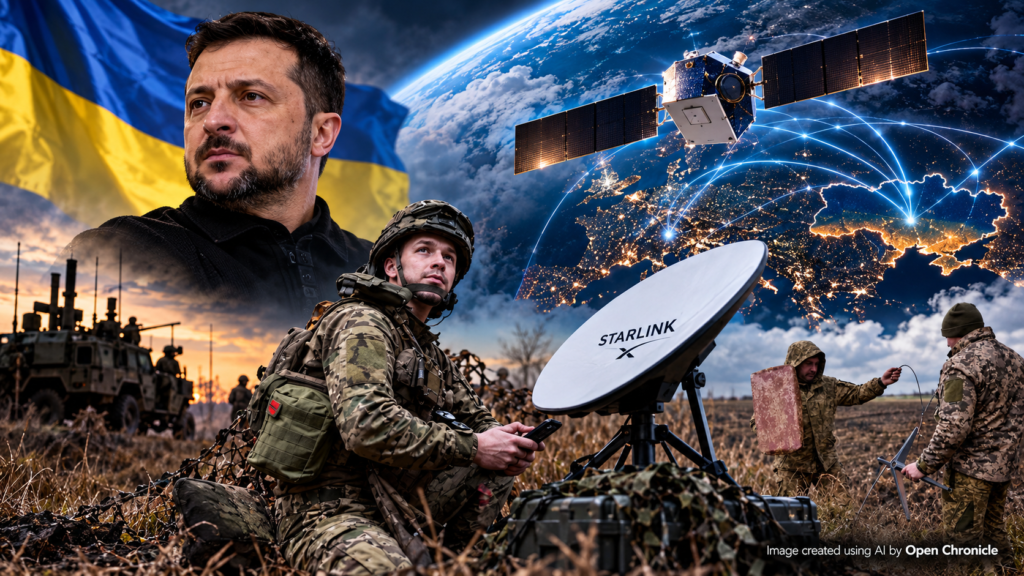
Kyiv says satellite communications are stable again after more than a week of restrictions that Ukrainian officials say hampered military operations. The restoration follows diplomatic discussions with Washington, conflicting accounts over responsibility for the slowdown and demands from US senators for a Pentagon investigation.
By Open Chronicle News Desk with Agencies
KYIV / WASHINGTON — October 24, 2026
Ukraine announced on Saturday that access to the Starlink and Starshield satellite systems had been fully restored following more than a week of disruptions and speed restrictions that Ukrainian officials said interfered with the country’s military operations.
The Ukrainian Defence Ministry said its monitoring systems had confirmed that satellite performance had returned to normal, with connections remaining stable even when equipment was moving at speeds exceeding 400 kilometres per hour.
The announcement marks a significant development for Ukraine’s armed forces, which rely heavily on satellite connectivity for battlefield communications, drone operations, logistics and coordination between military units.
The restoration follows direct discussions between Ukrainian President Volodymyr Zelenskyy and American officials, including appeals to President Donald Trump’s administration to help resolve the disruption.
However, the episode has raised broader questions about the control of satellite infrastructure used in wartime, the relationship between commercial technology providers and the US government, and the vulnerability of military operations that depend on privately developed communications networks.
Ukrainian Defence Ministry Confirms Restoration
Ukraine’s Defence Ministry said Saturday that its monitoring systems had officially recorded the recovery of Starlink and Starshield performance.
According to the ministry, satellite connections were once again stable at movement speeds above 400 km/h, an important technical threshold for military platforms operating at high speed.
Ukrainian Defence Minister Yevhen Khmara welcomed the development, presenting the restoration as the result of diplomatic engagement at the highest political level.
“This is another example of how direct dialogue and the firm position of the President of Ukraine at the highest level can deliver results,” Khmara said in a statement.
He emphasised the importance of the restored service for Ukrainian military operations.
“And this result is especially important for the front line, for our troops, drone operations, logistics and communications,” the minister added.
The statement suggests that the restrictions had affected more than routine communications, potentially limiting the performance of military systems requiring continuous connectivity during movement.
Ukrainian officials have not provided a comprehensive public assessment of the operational consequences of the disruption.
A Week of Restrictions and Military Concerns
The disruption began more than a week before Saturday’s announcement, when Ukrainian officials reported slowdowns and restrictions affecting Starlink and Starshield-supported networks.
Kyiv warned that the limitations were interfering with military capabilities, including operations in Russian-controlled Ukrainian territory.
Zelenskyy said the speed restrictions endangered Ukrainian personnel by limiting the effectiveness of offensive and defensive military systems.
Satellite communications have become a critical element of Ukraine’s military infrastructure since Russia launched its full-scale invasion in February 2022.
The systems support communications between frontline units, coordination of operations, intelligence transmission and the functioning of certain unmanned platforms.
Restrictions affecting connectivity during high-speed movement can therefore have consequences beyond slower internet access.
They may interfere with the ability of connected equipment to exchange information reliably while operating in demanding battlefield conditions.
The precise extent to which the latest disruption affected individual Ukrainian operations remains unclear.
Nevertheless, the concerns expressed by Kyiv demonstrate how deeply satellite communications have become integrated into the country’s military capabilities.
Zelenskyy Appeals to Washington
As the restrictions continued, Zelenskyy appealed to President Trump and other senior American officials to help restore the affected systems.
Following discussions with US representatives, the Ukrainian president announced on Tuesday that the early-warning system had resumed functioning.
However, the restoration was not immediately complete.
According to Ukrainian officials, additional time was required before the networks recovered their previous operating speeds.
Saturday’s announcement therefore represents the final stage of a recovery process that began earlier in the week.
Kyiv has portrayed the outcome as evidence that direct diplomatic engagement with Washington can produce practical results even amid disagreements between the two governments.
The episode also demonstrates the importance of US cooperation to Ukraine’s ability to maintain essential military infrastructure.
Trump Administration Denies Ordering Slowdown
The restrictions prompted questions about whether the US government had directed changes to the satellite systems.
The Trump administration denied ordering the slowdown.
Administration officials instead pointed towards Elon Musk’s SpaceX, the company operating the commercial Starlink network.
Speaking to reporters on October 16, Trump rejected suggestions that his administration had ordered the restrictions.
“I didn’t do that. No, we didn’t do that at all,” the president said.
He added that the infrastructure was “probably functional.”
On Friday, Trump said he had not spoken to Musk about the situation but was prepared to do so if the disruption continued.
“I’ve heard it was fixed, but if it’s not, I’ll speak to him,” Trump told reporters.
The president’s comments reflected uncertainty surrounding the technical and administrative decisions that had affected the networks.
Although Ukraine now says connectivity has been restored, the publicly reported statements do not establish who initiated the restrictions or why they were introduced.
Elon Musk Distinguishes Starlink From Starshield
The controversy has also highlighted an important distinction between SpaceX’s commercial Starlink service and Starshield systems used by the US government.
In a post on X last week, Musk said Starshield was controlled by the American government.
“Starshield systems are owned and controlled by the US government. Any limits on speed or usage are decided by the US military and ultimately POTUS,” he wrote.
Musk drew a distinction between those government-controlled systems and Starlink, which he described as a commercial service operated by SpaceX.
“Starlink is a commercial service owned and controlled by SpaceX,” he stated.
He added that Starlink usage was limited to civilian or defensive activities and should not be used for offensive military action.
The statements introduced competing explanations about responsibility for the restrictions.
The Trump administration denied ordering the slowdown, while Musk said that limitations involving Starshield were ultimately determined by US military authorities.
The distinction matters because the two services operate under different arrangements, with potentially different rules governing their use.
The available statements do not establish whether the disruptions resulted from one decision, multiple restrictions affecting separate services, or technical changes implemented through different administrative channels.
US Senators Demand Pentagon Investigation
The controversy has also attracted attention in Congress.
A bipartisan group of US senators requested that the Pentagon’s independent inspector general launch an official investigation into the Starlink disruptions.
The request reflects concerns about the potential consequences of limiting communications systems relied upon by Ukrainian forces.
An investigation could examine the circumstances surrounding the restrictions, the authorities responsible for implementing them and their potential effect on American support for Ukraine.
The senators’ intervention also highlights a broader issue: the extent to which private companies and government agencies can influence the operational capabilities of a foreign military that depends on American-developed technology.
The information provided does not establish whether the inspector general has formally opened an investigation.
Restoration Comes Amid Continued Russian Attacks
The satellite communications dispute unfolded against the backdrop of continuing Russian attacks on Ukrainian territory.
Over the past two weeks, Russia has carried out several strikes, including a deadly attack on an apartment building in Zaporizhzhia.
According to Ukrainian officials, that attack killed 20 people, including three children.
The reported casualties underscore the continuing danger faced by civilians as the war enters another period of intense military and diplomatic uncertainty.
For Ukraine, reliable communications are essential not only for battlefield coordination but also for maintaining situational awareness and supporting defensive operations.
The restoration of satellite access comes at a time when Ukrainian authorities are seeking to preserve military capabilities while responding to sustained Russian attacks.
Why Satellite Communications Matter to Modern Warfare
The dispute has drawn renewed attention to the role of satellite infrastructure in contemporary armed conflict.
Unlike traditional communications networks, satellite systems can provide connectivity in areas where terrestrial infrastructure has been destroyed, disrupted or made inaccessible.
This makes them particularly valuable in Ukraine, where Russian attacks have repeatedly damaged communications and energy infrastructure.
Satellite connectivity can support several critical functions, including coordination between military units, transmission of reconnaissance information, logistics management and the operation of certain unmanned systems.
The ability to maintain stable connections while equipment moves at high speed is especially important for military applications that depend on uninterrupted data exchange.
Ukraine’s announcement that connectivity remains stable above 400 km/h therefore carries operational significance.
However, the ministry’s statement should not be interpreted as proof that every military communications system has recovered or that all consequences of the disruption have been resolved.
The broader issue is one of technological dependence.
Modern armed forces increasingly rely on systems developed, owned or operated by commercial companies.
When those systems become essential to military operations, decisions about access, technical limitations and permitted uses can acquire strategic and political importance.
Washington, Kyiv and the Politics of Technological Dependence
The Starlink controversy comes amid a complicated relationship between Washington and Kyiv.
Ukraine continues to depend on American military assistance and technological support, while the Trump administration has pursued its own diplomatic approach to the war.
The dispute over satellite restrictions has introduced another source of uncertainty into that relationship.
For Kyiv, the immediate priority was restoring communications capabilities needed by its armed forces.
For Washington, the controversy has raised questions about responsibility, oversight and the distinction between government-controlled military systems and commercial infrastructure.
For SpaceX, the episode has renewed scrutiny of the company’s role in providing technology that can become indispensable during armed conflict.
These competing interests illustrate the difficulty of separating commercial technology policy from national security when private infrastructure is integrated into military operations.
The restoration of service resolves the immediate connectivity problem reported by Ukrainian officials, but it does not settle the underlying questions about control and accountability.
The Big Picture: A Communications Crisis With Strategic Implications
Ukraine’s announcement that Starlink and Starshield performance has returned to normal represents an important operational development after more than a week of uncertainty.
The restoration is particularly significant for frontline communications, drone operations and military logistics, according to Ukrainian authorities.
Yet the episode has exposed vulnerabilities that extend beyond the immediate technical disruption.
The competing explanations from the Trump administration and Elon Musk have raised questions about who controls different elements of the satellite infrastructure and under what circumstances restrictions can be imposed.
The bipartisan request for a Pentagon investigation demonstrates that those questions have also become matters of congressional concern.
For Ukraine, the incident reinforces the importance of reliable communications and the risks associated with depending on systems whose operation may be influenced by decisions taken outside the country.
For the United States, it raises questions about oversight and responsibility when commercial and government-controlled technologies are used by foreign military partners.
The immediate crisis may have ended with the restoration of satellite access, but the larger debate over who controls essential military communications infrastructure remains unresolved.
As the war continues, that question is likely to become increasingly important for Ukraine and for other countries whose security depends on advanced satellite networks.
Sources and Further Reading
ABC News — Ukraine Faces Loss of Key US-Affiliated Satellite Support
Reporting on disruptions and speed restrictions affecting Starlink and Starshield satellite services, including their implications for Ukrainian military communications, drone operations and battlefield coordination.
ABC News — US Senators Seek Answers Over Starlink Disruptions
Reporting on a bipartisan request by US senators for a Pentagon inspector general investigation into the satellite restrictions and their possible effects on American support for Ukraine.
Ukraine’s Ministry of Defence — Official Communications
Official institutional reference for statements concerning the reported restoration of Starlink and Starshield performance, satellite connection stability and the importance of communications for Ukrainian defence operations.
Statements by President Donald Trump and Elon Musk
Public statements attributed to President Donald Trump and SpaceX chief executive Elon Musk concerning responsibility for satellite restrictions, the distinction between commercial Starlink and government-controlled Starshield systems, and the reported restoration of service.
Editorial Note
Article based on the supplied October 24, 2026 report, including statements attributed to Ukrainian officials, President Donald Trump and Elon Musk. The reported restoration of service is attributed to Ukraine’s Defence Ministry. Responsibility for the original restrictions remains disputed.