
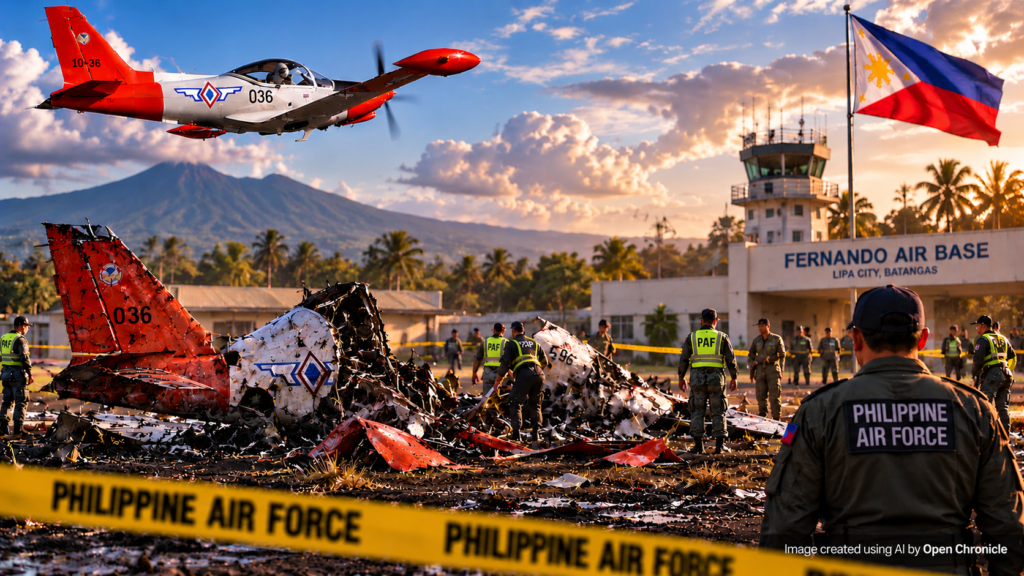
Two military training aircraft collided during a formation flight exercise at Fernando Air Base in the Philippines. All four pilots were killed, prompting an official investigation and the temporary grounding of the Philippine Air Force’s SF-260 fleet.
By Open Chronicle News Desk with Agencies
LIPA CITY, PHILIPPINES — October 24, 2026
Four Philippine Air Force pilots were killed after two SF-260 military training aircraft collided during a flight exercise at Fernando Air Base in Lipa City, Batangas Province, on Friday, October 23.
The accident occurred at approximately 3:51 p.m. local time, according to information released by the Philippine Air Force.
Both aircraft crashed within the perimeter of the military installation. Authorities reported no additional casualties on the ground.
The Philippine Air Force has launched an investigation into the circumstances of the collision and temporarily suspended flight operations involving its entire SF-260 fleet as a precautionary measure.
The identities of the four deceased pilots have not been publicly released at the request of their families.
Collision During a Formation Training Exercise
According to local media reports, the two aircraft were participating in a formation flight exercise when they collided.
The aircraft involved were identified by their numbers, 032 and 037.
Formation flying is a component of military aviation training, requiring pilots to maintain carefully controlled distances and positions relative to other aircraft.
Such exercises help develop coordination, situational awareness and precision flying skills.
However, the close proximity of aircraft during formation manoeuvres also requires strict adherence to established flight procedures.
The precise sequence of events leading to Friday’s collision has not yet been determined.
Investigators will need to establish the aircrafts’ positions, flight conditions and operational circumstances before drawing conclusions about the cause.
The available information does not indicate whether weather conditions, mechanical problems, human factors or other circumstances contributed to the accident.
Four Pilots Confirmed Dead
The Philippine Air Force confirmed that four pilots died in the crash.
Colonel Elvin Kapingwian, spokesperson for the Philippine Air Force, said both aircraft came down inside Fernando Air Base.
“Both aircraft crashed within the base perimeter; no other casualties were reported,” Kapingwian said in a statement.
The absence of additional casualties indicates that the accident did not result in reported injuries among personnel or civilians outside the two aircraft.
The names of the deceased service members have been withheld at the request of their families.
No further details concerning the pilots’ ranks, service histories or individual assignments were provided in the initial reports.
The accident represents a significant loss for the Philippine military aviation community, particularly its pilot-training operations.
Philippine Air Force Grounds Entire SF-260 Fleet
Following the collision, Philippine Air Force authorities ordered the temporary suspension of flight operations involving the SF-260 aircraft fleet.
The decision was taken while investigators examine the circumstances surrounding the accident.
Grounding an aircraft type after a fatal incident is a precautionary measure that allows military authorities to review operational procedures and determine whether any wider safety concerns require attention.
The suspension does not, by itself, establish that the aircraft suffered from a technical defect.
Investigators may examine several aspects of the accident, including flight planning, communications, aircraft maintenance records and the procedures followed during the formation exercise.
The Philippine Air Force has not announced when SF-260 operations will resume.
Any decision to return the aircraft to service is expected to depend on the findings of the investigation and the completion of any necessary safety assessments.
What Is the SF-260 Military Training Aircraft?
The SF-260 is a two-seat, single-engine aircraft developed by the Italian manufacturer SIAI-Marchetti.
Designed as a light training aircraft, it has been used by military aviation organisations for pilot instruction and other specialised missions.
The aircraft’s compact design and flight characteristics make it suitable for developing fundamental flying skills and preparing pilots for more advanced military aviation training.
The SF-260 family has also been produced in armed configurations capable of performing light attack missions.
In the Philippines, the aircraft has served in pilot-training roles, while armed variants have also been used for operations against ground targets.
Its dual-use history reflects the versatility of light military aircraft that can support both instructional and operational requirements.
The aircraft involved in Friday’s accident were identified as military training aircraft.
The available information does not establish whether they were equipped with any weapons during the exercise.
Fernando Air Base and Philippine Military Aviation
Fernando Air Base is located in Lipa City, in Batangas Province, south of Manila.
The installation has an established role in Philippine military aviation and pilot training.
Military flight-training facilities provide an environment in which pilots develop technical skills, operational discipline and the ability to perform increasingly complex manoeuvres.
Training exercises can involve individual flights, coordinated formations and other activities designed to prepare personnel for operational assignments.
The loss of two aircraft during a formation exercise highlights the risks that remain inherent in military aviation training.
Even routine training activities require precise coordination between pilots, instructors, air traffic personnel and ground support teams.
The investigation into Friday’s accident will be important in determining whether changes to training procedures or other safety measures are necessary.
Investigation to Establish Cause of Collision
The Philippine Air Force has initiated an official investigation into the accident.
The inquiry is expected to focus on reconstructing the events leading to the collision and identifying any contributing factors.
Investigators may consider the flight paths of both aircraft, the timing of manoeuvres, communications between pilots and the prevailing operating conditions.
Aircraft maintenance and inspection records may also form part of the review.
However, no specific investigative findings have been publicly established in the information currently available.
Authorities have not announced a timetable for the completion of the investigation.
Until its findings are released, the cause of the collision remains undetermined.
The Importance of Military Flight-Training Safety
Military aviation training is essential to maintaining a capable air force.
Before pilots can operate more advanced aircraft, they must develop proficiency in aircraft handling, navigation, communications and emergency procedures.
Formation flying introduces additional demands because pilots must maintain spatial awareness while coordinating movements with other aircraft.
The accident in Batangas illustrates the importance of continuous safety oversight during these operations.
Military aviation authorities routinely review incidents to identify lessons that may help reduce the risk of future accidents.
Such investigations can result in changes to training practices, operational procedures, maintenance requirements or other aspects of flight safety.
In the Philippines, the temporary grounding of the SF-260 fleet represents an immediate precaution while those questions are examined.
The Big Picture: A Fatal Loss for Philippine Military Aviation
The deaths of four Philippine Air Force pilots in the collision at Fernando Air Base mark a serious tragedy for the country’s military aviation community.
The accident involved two SF-260 training aircraft during what local reports described as a formation flight exercise.
Both aircraft crashed within the air base, and no additional casualties were reported.
The Philippine Air Force has responded by opening an investigation and temporarily grounding the SF-260 fleet.
For the families of the deceased pilots and their fellow service members, the immediate consequences are personal and profound.
For the military institution, the priority is to establish what happened and determine whether additional measures are needed to protect aircrews.
The cause of the collision remains under investigation, and the findings will be central to decisions about the future operation of the Philippine Air Force’s SF-260 training fleet.
Sources and Further Reading
Philippine Air Force — Official Statement
Official Philippine Air Force communication concerning the collision involving two SF-260 military training aircraft at Fernando Air Base in Lipa City, Batangas, on October 23, 2026, including the reported fatalities and the military response to the accident.
DZRH News — Four PAF Pilots Killed in Batangas Aircraft Crash
Local reporting on the fatal collision during a military formation training exercise, the identification of the aircraft involved, the investigation launched by Philippine Air Force authorities and the temporary suspension of SF-260 flight operations.
Editorial Note
This article is an original Open Chronicle news report based on the Philippine Air Force statement and the supplied local media account. The collision, reported casualties and temporary grounding are attributed to those sources. The cause of the accident remains under investigation, and no conclusions about responsibility or contributing factors have been established.